
On August 1, a popular AI coding tool quietly changed a setting—leaving users unable to see how much money they were spending.
The tool, Cursor, is one of the most popular “AI coding assistants” of the past two years: users describe requirements in plain language, and it edits code accordingly. Subscriptions cost $20 per month with an included usage allowance, charging pay-as-you-go fees for any overage. Previously, the usage page displayed two metrics side-by-side: how many “words” (tokens) were consumed that month, and the corresponding dollar amount. On August 1, users noticed that the dollar column had vanished, leaving only raw token counts; exported CSV billing statements were also missing dollar amounts.
“I rely on this page daily to monitor expenditure, and today dollar amounts suddenly turned into token counts,” a user wrote on the official Cursor forum. The post was quickly reshared to developer community Hacker News, accumulating 291 points and 125 comments within 24 hours. A few hundred upvotes is modest for Hacker News, but it hit a widely felt nerve: almost nobody can explain how their AI bills are calculated. An account claiming to be a Cursor employee responded, explaining that overall spending is still visible on the main account page; the missing CSV dollar values were “accidentally broken while cleaning up old features and fixed”; as for the spending chart, “some users misinterpreted included tier usage values as actual charges, so we removed it.”
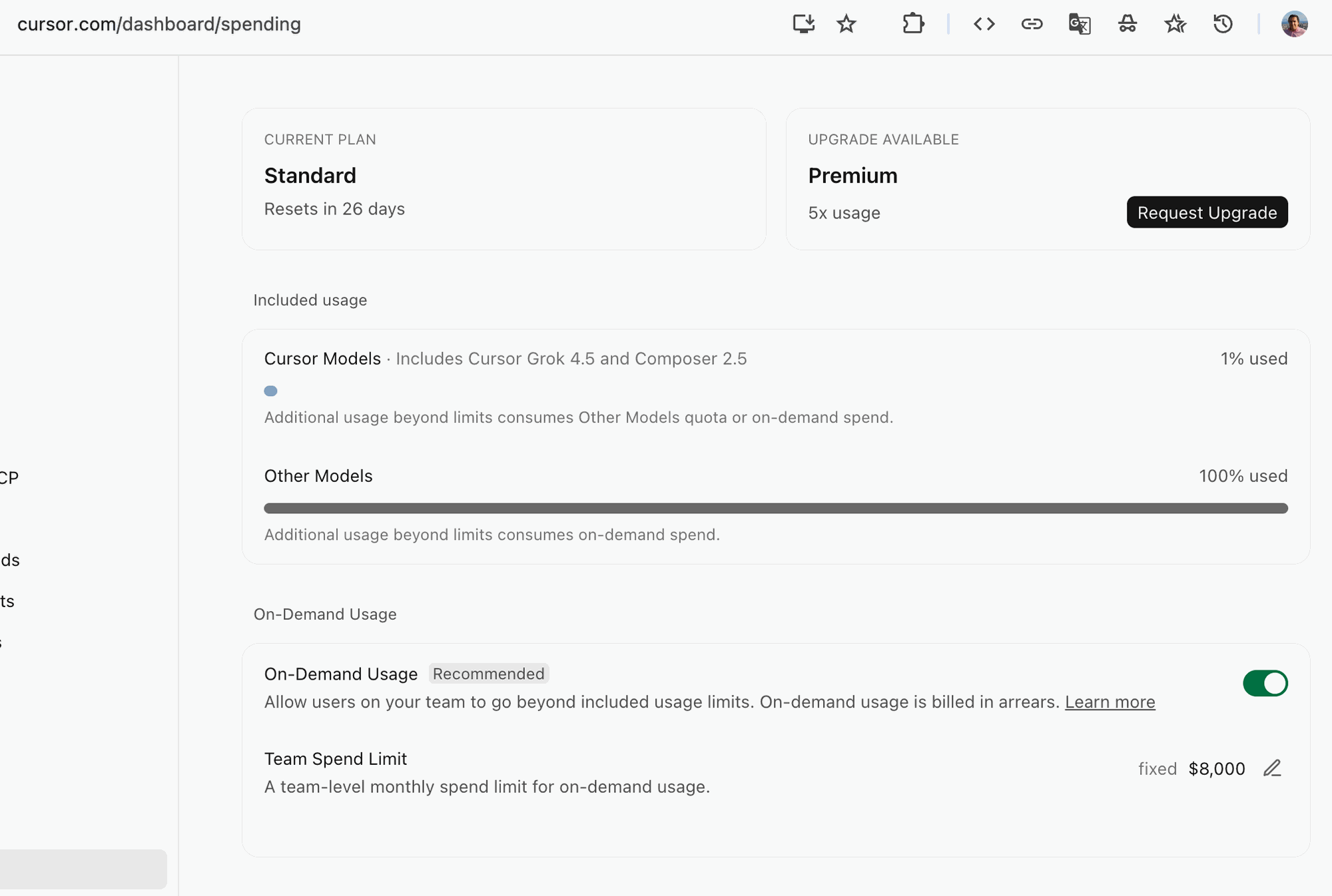 Figure: Screenshot posted by a user in the discussion—showing only token count metrics with no corresponding dollar amounts. Source: pasteboard.co
The response failed to fully settle doubts. Users pointed out that the circular cost indicator next to context usage was also removed: “Now if you accidentally run an expensive model, you won’t notice until your monthly allowance is burned through.” The two moves point in the same direction: users can still track “token usage,” but calculating how usage translates to actual dollars has become far more difficult.
On the same day, an even more striking benchmark surfaced in the comment section. A developer named tosh ran 10 identical tasks (calculating file checksums, merging spreadsheets, fixing a build pipeline) using the same LLM model on the same virtual machine across 6 different AI coding tools. The result: the most efficient tool consumed just 173k tokens, while the most wasteful consumed 5,070k (5.07M) tokens—a 29x difference. All tools completed the tasks successfully with identical outcomes; the only difference was cost.
 Figure: Real-world token consumption across 6 tools using the same model and tasks—ranging from 173k to 5.07M tokens. Source: news.ycombinator.com
To understand why, two terms need clarification. A token is the fundamental unit of AI billing, roughly equivalent to a word or word fragment. Before every response, an AI must read your query, system instructions, tool definitions, and previous conversation history in full—charging for every token ingested. Meanwhile, “tool” here refers to the wrapper around the AI model—system prompts, tool manifests, memory files, project instructions, and intermediate artifacts injected into the prompt context.
This vast gap proves that the model itself isn’t expensive; what’s expensive is how tools utilize the model. Looking closely at the data, output tokens generated across all 6 tools were roughly comparable (30k to 50k tokens). Almost the entire discrepancy stemmed from input tokens. The leanest tool provided no system prompt at all, giving the model a bare terminal interface; the most bloated tool packed an elaborate “memory system” exceeding 10,000 tokens, sending it verbatim with every conversation turn. One commenter estimated that such preamble overhead can double single-task costs.
Bloated prompts don’t just cost more money; they degrade performance. An LLM’s working desk—formally known as the context window—has fixed limits, typically between hundreds of thousands to one million tokens. Once full, tools must either compress earlier turns into summaries (risking lost details and hallucinations) or reset context entirely. More subtly, one commenter noted that seemingly helpful background context can derail models, causing extra reasoning steps, circular logic, and slower execution.
Granted, a 29x variance represents an extreme edge case, not every developer’s daily bill. Skeptics noted that much of the input volume in heavy tools hits prompt caching, where cached tokens cost up to 90% less. Minimalist tools often complete tasks before reaching the minimum caching threshold (under 1,024 tokens), missing out on discounts. The benchmark author also acknowledged that minimalist setups lack orchestration for complex multi-file tasks. These nuances are valid, but the structural takeaway remains: token consumption for identical work depends primarily on vendor architecture choices, not user requirements.
For non-developers, the broader implication is clear: in the AI era, billing units are shifting from visible dollars to invisible token counts. Subscription quotas are essentially pools of token volume. When vendors hide dollar figures and display only token counts, users lose the ability to compare costs—a task might take tens of thousands of tokens in one tool and millions in another, with users unable to assess where they fall. One user calculated that at raw API pricing, his $100/month subscription consumed nearly $5,000 worth of underlying API tokens. Because subscription pricing disconnects revenue from underlying API costs, vendors have little financial incentive to optimize prompt bloat.
Cursor states that CSV exports are fixed, but the dollar usage chart won’t be returning. As discussions continue, developers are building minimalist tools of their own. For observers, the takeaway is simple: when bills become opaque, the extra cost is usually hidden right inside the opacity.
Reference Links:
- Cursor Official Forum: Usage page to token amount
- HN Discussion (item?id=49135257)
- Benchmark author tosh’s X post (original test data)