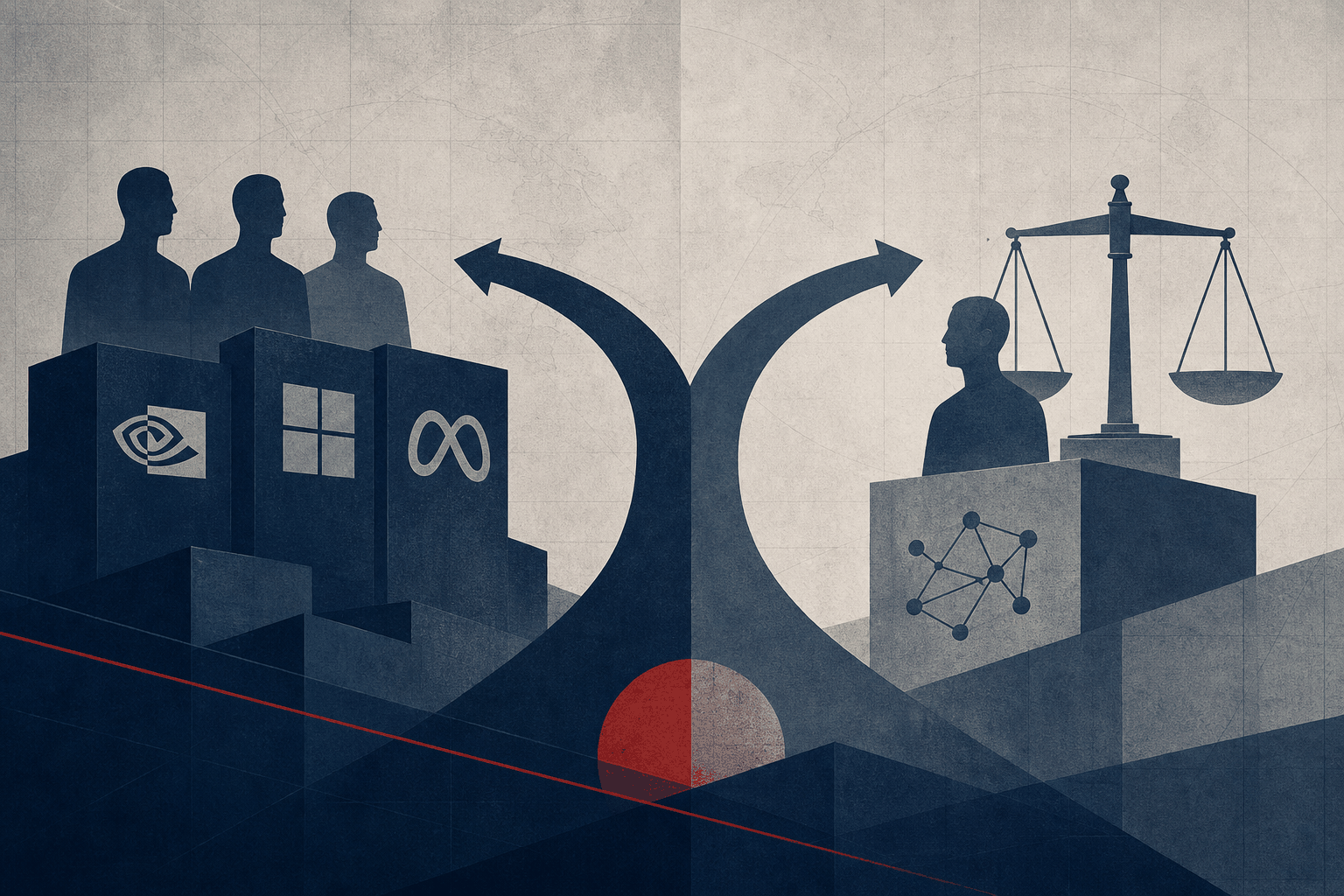
In late July 2026, three of Silicon Valley’s most powerful titans—Nvidia, Microsoft, and Meta—jointly sent a letter to the US government. Their core message was simple and direct: do not over-regulate open-weight AI models, as premature restrictions will stifle competition and drive innovation overseas.
On the very same day, another AI powerhouse made a massive move. Anthropic announced an additional $20 million donation to a political committee called Public First Action, specifically to lobby for AI safety regulation. This brought Anthropic’s total contribution on this issue to $40 million.
These two events occurring on the same day was no coincidence. It is the latest and most explicit signal that Silicon Valley has openly split over the question: “Should AI be regulated, and how?”
 Caption: The rapid advancement of AI capabilities versus lagging regulatory frameworks represents the most fundamental contradiction in tech today.
It’s Not Corporate Rivalry, It’s an Ideological War
You might think this is merely standard corporate competition—Nvidia sells chips, Microsoft builds software, Meta runs social platforms, and their divergence from AI-native Anthropic is only natural.
But the reality is far more complex.
If this were just ordinary business competition, we would expect each company to position itself solely to maximize its immediate commercial interests. Instead, two distinct camps have formed, and each genuinely believes the other’s agenda could destroy the American AI industry—or worse.
The Open-Source Camp (led by Nvidia, Microsoft, and Meta) argues that open-weight AI models—models whose parameters can be freely downloaded, modified, and run on private servers—are the cornerstone of US competitiveness. Over-regulating open models will force talent and innovation offshore, handing the advantage to Chinese AI firms. As their joint letter pointedly noted: “Relying solely on closed models is not inherently safer—they can still be breached, abused, or fail in ways invisible to external observers.”
The Safety Camp (with Anthropic as its primary champion) argues that frontier AI models are already powerful enough that, if placed in the wrong hands, they could cause catastrophic harm. Over the past six months, Anthropic CEO Dario Amodei has repeatedly emphasized in congressional testimony and media interviews that AI companies cannot regulate themselves; governments must possess the authority to delay or halt the release of potentially dangerous models.
Neither side appears to be lying. And both sides have calculated their financial stakes.
Why Are These Three Tech Giants Standing Together?
To understand why Nvidia, Microsoft, and Meta aligned on the exact same side, one must look at their core business models.
Nvidia sells AI chips—GPUs. Its business model relies on a simple equation: the more organizations running AI models across diverse scenarios, the more chips it sells. Open-weight AI models enable anyone to run AI workloads on their own infrastructure, directly creating hardware demand. If AI is locked inside the “walled gardens” of a few proprietary providers, Nvidia’s addressable market shrinks. Jensen Huang, Nvidia’s CEO, reposted the joint letter in his very first post on X (formerly Twitter).
Microsoft is the primary backer of OpenAI, but it simultaneously invests heavily in its own open-source AI tooling and platform. Microsoft CEO Satya Nadella reshared the letter, calling open models “essential to a healthy AI ecosystem.” Microsoft’s Azure cloud business needs workload diversity; open models encourage developers to experiment and deploy AI applications, which ultimately run on Azure—regardless of whose model powers them.
Meta is Silicon Valley’s largest believer in open source. Mark Zuckerberg has stated on multiple occasions that open source is embedded in Meta’s DNA—from PyTorch to the Llama series, Meta’s entire AI strategy rests on open sharing. Open models allow third-party developers to build applications on Meta’s architecture, which in turn strengthens Meta’s ecosystem. If Washington restricts open models, Meta’s broader AI strategy collapses.
The common denominator among these three giants is obvious: none of them generate primary revenue by selling API subscriptions to closed LLMs. They sell hardware, cloud infrastructure, and advertising—products that thrive when AI is open, ubiquitous, and decentralized.
Why Is Anthropic on the Opposite Side?
Anthropic’s stance is frequently simplified as the “safety first” faction. However, examining the company’s trajectory reveals a dynamic far more nuanced than pure altruism.
Founded in 2021 by former OpenAI researchers, Anthropic’s core mission was centered on building “safe AI.” From day one, the company charted a path distinct from OpenAI: rather than racing to release the largest model at all costs, it dedicated substantial resources to red-teaming (simulating adversarial attacks to uncover vulnerabilities) and alignment research (ensuring AI behavior aligns with human values).
 Caption: The core tension of the safety debate: how to prevent catastrophic loss of control while pushing technological boundaries.
Commercially, this narrative served as effective differentiation. When OpenAI or Google experienced model missteps or PR challenges, Anthropic could position itself as the responsible alternative.
Yet a safety-centric model carries financial implications. In a completely unregulated AI landscape, safety investments represent pure overhead. But if mandatory safety frameworks and pre-release audits are codified into law, Anthropic’s years of safety research transform into a powerful moat and competitive barrier. New entrants would have to spend years replicating that safety infrastructure just to launch.
This explains why Anthropic contributed $40 million to Public First Action, a political organization dedicated to advocating for AI safety regulations. In US political spending, that figure is formidable—exceeding the entire campaign budgets of most Congressional races.
What Does an “Open” Model Actually Open Up?
It is worth clarifying a technical concept that can sound abstract to non-technical readers: what is an “open-weight model”?
Consider an AI model as an engine. A closed model is like a vehicle that can only be driven and serviced at a specific dealership—you pay for access, but you cannot open the hood, inspect the engine, or customize components. All your requests are transmitted to a remote server controlled by the provider.
An open-weight model, by contrast, is like purchasing the vehicle outright—the engine, transmission, and internal mechanics are delivered to you. You can take it to any shop, modify its parameters, study its architecture, or run it in your private garage. While the complete training pipeline or dataset may not be fully public, the core artifact—the weights, consisting of billions of numerical parameters learned during training—is in your hands.
This distinction became intensely relevant in July 2026. Chinese AI firm Moonshot AI released Kimi K3, an open-weight model that matched or surpassed top-tier proprietary models on key benchmarks. Because its weights were open, developers worldwide could download Kimi K3, inspect its mechanics, build applications on it, or host it locally.
For US policymakers, this created a sharp dilemma: should Chinese open-weight models be restricted? If so, by what mechanism? Overly broad restrictions could inadvertently undermine American open-source developers and domestic AI infrastructure.
The joint letter from Nvidia, Microsoft, and Meta was timed directly around this debate. They urged Washington to address specific risks like illegal model distillation (using proprietary outputs to train competing models) through targeted legal and commercial frameworks, rather than blunt, blanket bans on open weights.
The Global AI Power Structure Is Being Rewritten
The fundamental force behind this rift is the shifting geopolitics of artificial intelligence.
From 2024 to 2025, US companies maintained a clear lead in frontier model capabilities. By mid-2026, the landscape evolved. Chinese open-weight models became not only viable, but highly competitive. In one notable incident, US-based open-source platform Hugging Face utilized a Chinese open-weight model (Zhipu AI’s GLM 5.2) to defend its infrastructure against an automated cyberattack originating from an autonomous OpenAI model—an event tech commentators noted for its geopolitical irony.
By July 24, 2026, the Hacker News discussion around the Big Tech letter reached 443 points and 206 comments. Within the developer community, consensus is emerging that neither side holds a simple or moral monopoly on truth.
Tracking these developments prompts a central question: which model of governance should we support?
Supporting the open-source camp means agreeing that AI capabilities should be democratized rather than concentrated among a handful of corporate gatekeepers—while accepting the potential security risks of running unguarded models locally.
Supporting the safety camp means believing that frontier AI poses existential risks requiring mandatory oversight—while accepting that regulatory compliance naturally concentrates power in the hands of well-capitalized incumbents capable of navigating complex bureaucracy.
There is no easy answer. Yet one outcome is clear: by July 2026, Silicon Valley has split into two resolute camps. The outcome of this struggle will dictate the trajectory of artificial intelligence for the next decade—and determine whether those decisions rest with tech CEOs, Washington lawmakers, or global developers.
📚 Reference Links
- CNBC Exclusive: Nvidia, Microsoft, Meta warn against ‘premature restrictions’ of open-weight models — Ashley Capoot, July 24, 2026
- Politico: Big Tech companies defend open-weight AI models — July 24, 2026
- Decrypt Analysis: Nvidia, Meta, and Microsoft Tell Washington: Don’t Kill Open-Source AI — July 24, 2026
- Bloomberg: Nvidia, Microsoft Lead Call for Open-Weight AI Models After Kimi — July 24, 2026
- Business Insider: Microsoft, Nvidia, Meta, and Palantir’s Message to Washington — July 24, 2026
- ABC News Interview: Anthropic CEO calls for stronger regulation of AI — June 10, 2026
- Hacker News Discussion (443 points / 206 comments) — July 24, 2026
- Fortune: OpenAI says its AI models escaped control and hacked into Hugging Face — July 21, 2026
- The Guardian: Why are OpenAI and Anthropic cheering on regulation in Australia? — July 23, 2026
- Politico: Startup founders urge Trump not to shut off Chinese open weight AI — July 22, 2026