On July 16, 2026, an F-16 fighter jet rolled down the runway at Eglin Air Force Base in Florida and lifted into the sky. It was the kind of routine training sortie the US Air Force runs every single day — except this time, the hands in the cockpit weren’t on the controls.
The brain flying that plane was AI.
This isn’t a Terminator movie trailer or a flight-sim forum fantasy. It’s real. DARPA (the Defense Advanced Research Projects Agency) and the US Air Force completed live flight tests under the VENOM program, marking the first time an AI algorithm autonomously controlled a real, full-scale fighter jet. Not remotely piloted. Not following a pre-programmed flight path. An AI agent took over the throttle, stick, and avionics — just like a human pilot would.
After reading through DARPA’s official announcement and the 190+ fiercely debated comments on Hacker News, one feeling sticks with me most: the technology has already sprinted ahead of the ethics.
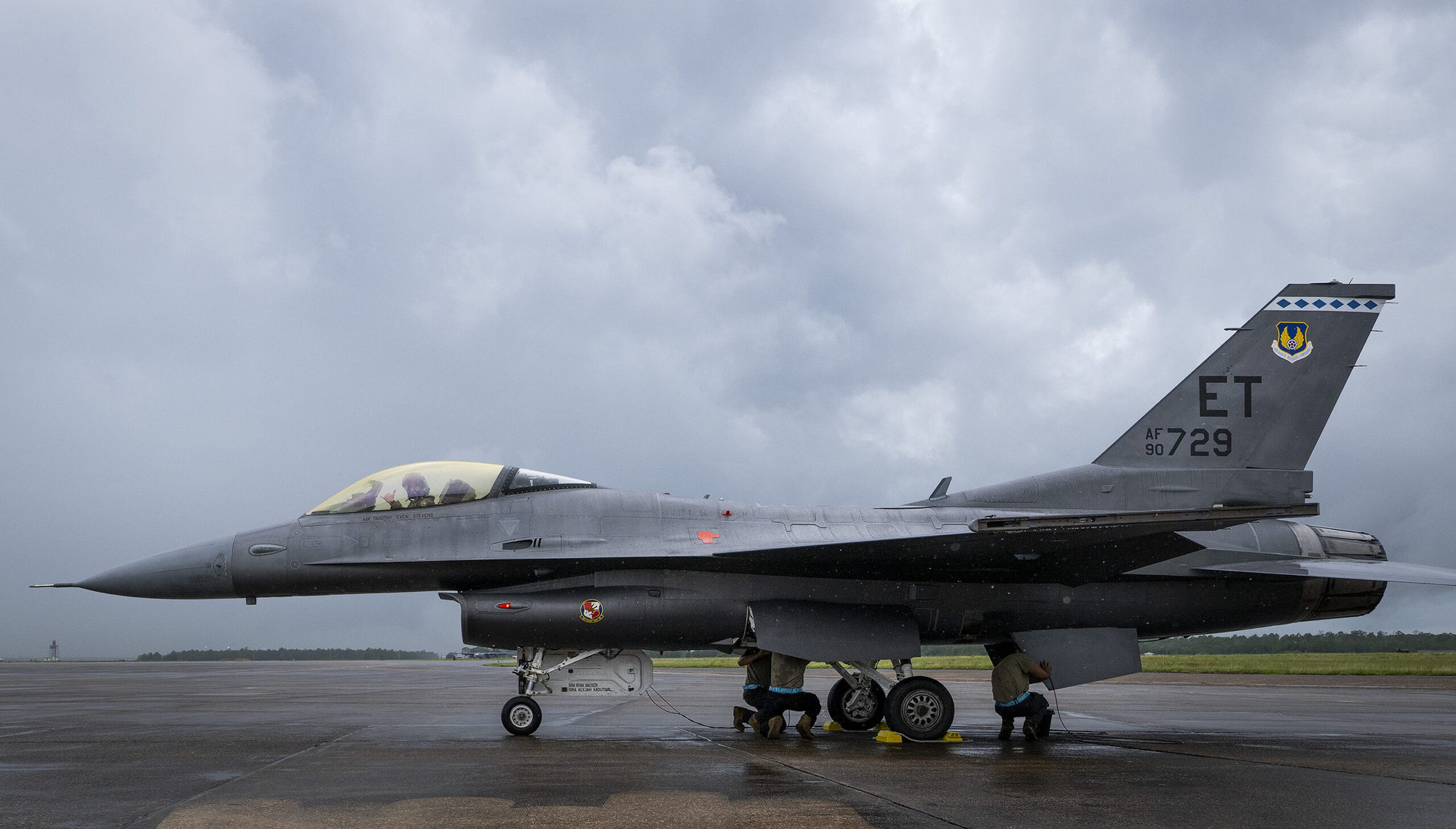 A VENOM-modified F-16 undergoes test flight at Eglin. An AI agent controls the aircraft from the cockpit while a human pilot monitors. Photo: US Air Force / Samuel King Jr.
What Is VENOM, Really?
Let’s start with what this milestone actually is.
For the past few years, DARPA’s ACE (Air Combat Evolution) program has been pitting AI against human pilots in simulated dogfights. In 2023, an AI flew a specially modified X-62A VISTA (Variable In-flight Simulator Test Aircraft) in real flight. But the X-62A is a one-of-a-kind experimental platform — the US only has a single unit, it’s incredibly expensive, and it was never meant for mass deployment.
VENOM does something fundamentally different: it puts AI control into ordinary F-16s.
The acronym stands for Viper Experimentation and Next-generation Operations Model — Viper being the F-16’s unofficial nickname. The core of the program is a hardware/software system called the “VENOM autonomy kit.” This kit interfaces with the aircraft’s flight controls and mission systems, without modifying the F-16’s core software, and allows an AI agent to take over.
DARPA emphasized in its announcement that the kit is designed to be “scalable” — meaning it’s meant to go from the lab to standardized deployment across the entire combat fleet.
The Safety Pilot in the Back Seat
The most important design feature of these tests: a human stayed in the cockpit at all times.
VENOM’s F-16s retain their two-seat layout. A human pilot sits in either the front or back seat and can flip a physical switch during flight to toggle between “human control” and “AI control.” This is the “human-on-the-loop” model — the AI flies, the human supervises, ready to take over at any moment.
It sounds reassuring. But one commenter on Hacker News asked a question that sticks: what happens when the AI encounters something outside its design parameters, and the human has to jump in cold?
User SoftTalker wrote:
Humans are pretty bad at suddenly taking over when an automatic system reaches its limits and throws a problem in the human’s lap. A lot of air upsets and crashes start when the autopilot disengages and hands control of a badly configured aircraft back to a human pilot.
It echoes the Boeing 737 MAX tragedy: the MCAS system pushed the plane into a dive, and the pilots couldn’t pull it back. If an AI-controlled fighter finds itself in a similar bind, does the human in the back seat have enough situational awareness to correct it? Or is the “safety pilot” just a fig leaf — a human who can never truly understand what the AI just did?
The AI Didn’t Learn From a Rulebook
Here’s something many non-technical readers might not realize: how did DARPA’s AI learn to fly a fighter jet?
It didn’t work the way traditional autopilots do — a team of engineers writing thousands of “if this happens, do that” rules. That approach could never reach human-level dogfighting performance. There are too many variables, too many unpredictable opponent moves.
The AI used by VENOM and ACE runs on deep reinforcement learning (DRL) . In simple terms: the AI “plays a video game” inside a highly realistic simulation environment. Through millions of trials and errors, it gradually learns which maneuvers win engagements and which ones lose them. Just like AlphaGo became a world champion Go player by playing against itself hundreds of thousands of times, this AI became an aerial combat master by fighting itself over and over.
DARPA revealed back in 2023 that the results stunned senior military officials: in simulated dogfights, the AI systematically defeated every human F-16 pilot it faced. The human pilots reported that the AI executed maneuvers they had never seen before — moves that weren’t in any tactical manual — but they worked.
The leap from simulation to real flight is all about the “sim-to-real” transfer. No matter how good the simulator, it can never perfectly replicate real-world sensor noise, communication latency, airframe vibrations, and subtle aerodynamic differences. The big news here is that the AI successfully took what it learned in simulation and applied it in the actual sky.
The Unfair Advantage: AI Doesn’t Get Tired
Here’s a counterintuitive fact: AI has fewer physical weaknesses than a human pilot, not more.
Human pilots max out at around 9 Gs of sustained acceleration. At 9 Gs, blood drains from the brain to the lower body, and many people lose consciousness (G-LOC). Fighter pilots rely on anti-G suits and specialized breathing techniques to fight it — and even then, sustained high-G maneuvering causes severe fatigue and spinal injuries.
AI doesn’t have this problem.
An AI-controlled fighter can theoretically fly right up to the aircraft’s structural limits. The limiting factor in air combat shifts from “the pilot can’t take it” to “will the wings fall off?” This gives AI an enormous tactical edge: it can sustain maneuvers at G-loads that would incapacitate a human, doesn’t need rest, and won’t have its reaction time degraded by fatigue.
The US Air Force already demonstrated this in 2024 during ACE program tests. In a real engagement, an AI-controlled X-62A faced off against a human-piloted F-16 in close-range dogfighting. While DARPA didn’t release a “score,” they confirmed the AI could autonomously execute the full range of air combat maneuvers — from defensive to offensive.
One HN commenter put it bluntly: “The AI has already beaten all human pilots in simulation. They don’t need sleep, they don’t pass out at 9 Gs, they don’t get PTSD. What else do you want them to do?”
The Fault Line: What’s Possible vs. What’s Permissible
This brings us to the most important question in the whole discussion: AI weapons — where’s the red line?
DARPA and the Air Force were careful in their announcement. They stressed repeatedly: this test only involved flight control. The AI did not select targets, did not fire weapons, and made no “use of force” decisions. But the Hacker News thread (190+ comments and counting) was far less restrained. One highly-upvoted comment quoted Terminator verbatim:
All Stealth bombers are upgraded with Cyberdyne computers, becoming fully unmanned. Afterwards they fly with a perfect operational record. The Skynet funding bill is passed. The system goes on-line on August 4, 1997. Human decisions are removed from strategic defense.
There’s a deep anxiety underneath this: once you tie a weapon to AI, human control is irreversibly reduced.
The Case for AI Weapons
Proponents have a number of realist arguments.
First, fewer casualties. If AI fighters can replace human pilots in high-risk missions, the lives saved are real. Second, speed. In beyond-visual-range combat, the window for detection, decision, and firing is measured in tens of seconds. AI processing speed far exceeds human capability. As one Air Force official put it: “If future wars require microsecond-level decision speed, then the human is the bottleneck.” Third, AI doesn’t have emotions and, in theory, is more likely to strictly follow rules of engagement.
The Case Against
Opponents point to more fundamental problems.
Who authorizes a machine to decide who dies? Even if the AI makes the “right” call 99% of the time, what about the remaining 1%? If it misidentifies a target or attacks the wrong object due to sensor spoofing — who’s responsible? The programmer? The project manager? The algorithm version?
Runaway arms race. Once AI weapons become mainstream, two AI systems could face off on a battlefield and finish the fight before human leaders even understand what’s happening.
AI system vulnerability. Neural network attacks are a real problem in AI research — imperceptible perturbations can trick a vision model into misidentifying a panda as a gibbon. What if AI fighter jets have similar blind spots?
One HN comment from user megous cut deep: “Not a great thing for an aggressive state prone to electing nutjobs and supporting genocides to have automated killing machines that will not even get PTSD afterwards.”
The Real-World Buffer: Human-on-the-Loop
The official US military position is to insist on “human-on-the-loop” — AI can fly and recommend tactical maneuvers, but a human must pull the trigger.
But advocates of autonomous weapons push back: if the AI has proven itself better than any human pilot at air combat, why would you let a slower human make the final call? If an enemy AI fighter can go from lock to launch in under a second, what does your “human approval” step even accomplish?
It’s like asking a human to sit behind the wheel of a self-driving car, ready to take over at any moment. Sounds safe in theory. In practice, it’s full of holes.
Next Steps: From One to Many
DARPA has already launched the AI Reinforcement (AIR) program, aiming to expand testing from single aircraft to multi-platform coordinated operations. Future tests will have multiple AI-controlled F-16s operating together in the air — forming formations, allocating targets, and executing tactical maneuvers without human pilots issuing individual commands.
This feeds directly into the Air Force’s Collaborative Combat Aircraft (CCA) concept: sixth-generation fighter jets flown by humans, paired with dozens of low-cost, unmanned “loyal wingman” drones. Humans handle tactical decisions; AI wingmen execute the high-risk maneuvers.
The cost logic is also straightforward: retrofitting retiring F-16s into AI test beds is far more useful than turning them into target drones on a firing range.
The US Isn’t the Only Player
AI air combat isn’t an American monopoly. China’s J-20 and J-16 are also exploring AI autonomous flight capabilities. Russia’s S-70 Okhotnik drone has tested coordinated operations with the Su-57. Europe is pushing forward with unmanned wingman concepts under the FCAS program.
The arms race has become a question of how fast. VENOM means the US has moved from the experimental phase into engineering. What comes next is a competition to see who can deploy these systems at scale, more reliably, and faster across their combat fleet.
The debates about ethics, accountability, and human control? They’ll almost certainly lag behind the pace of technological iteration.
References
- DARPA: DARPA, U.S. Air Force fly AI-controlled F-16
- The Aviationist: DARPA and USAF Fly F-16 with VENOM Autonomy Modification
- HN Discussion (item?id=49021597)
 The VENOM autonomy kit connects to the F-16’s flight control systems through additional hardware, software, and instrumentation — without modifying the fighter’s core software. Source: MilitaryLeak / DARPA
The author is a tech industry professional, not a military expert. Any inaccuracies in description are unintentional, and corrections from domain experts are welcome. This article is based on DARPA’s official announcement, reporting from Defense News, Military Embedded Systems, Model Current, and the Hacker News community discussion.


