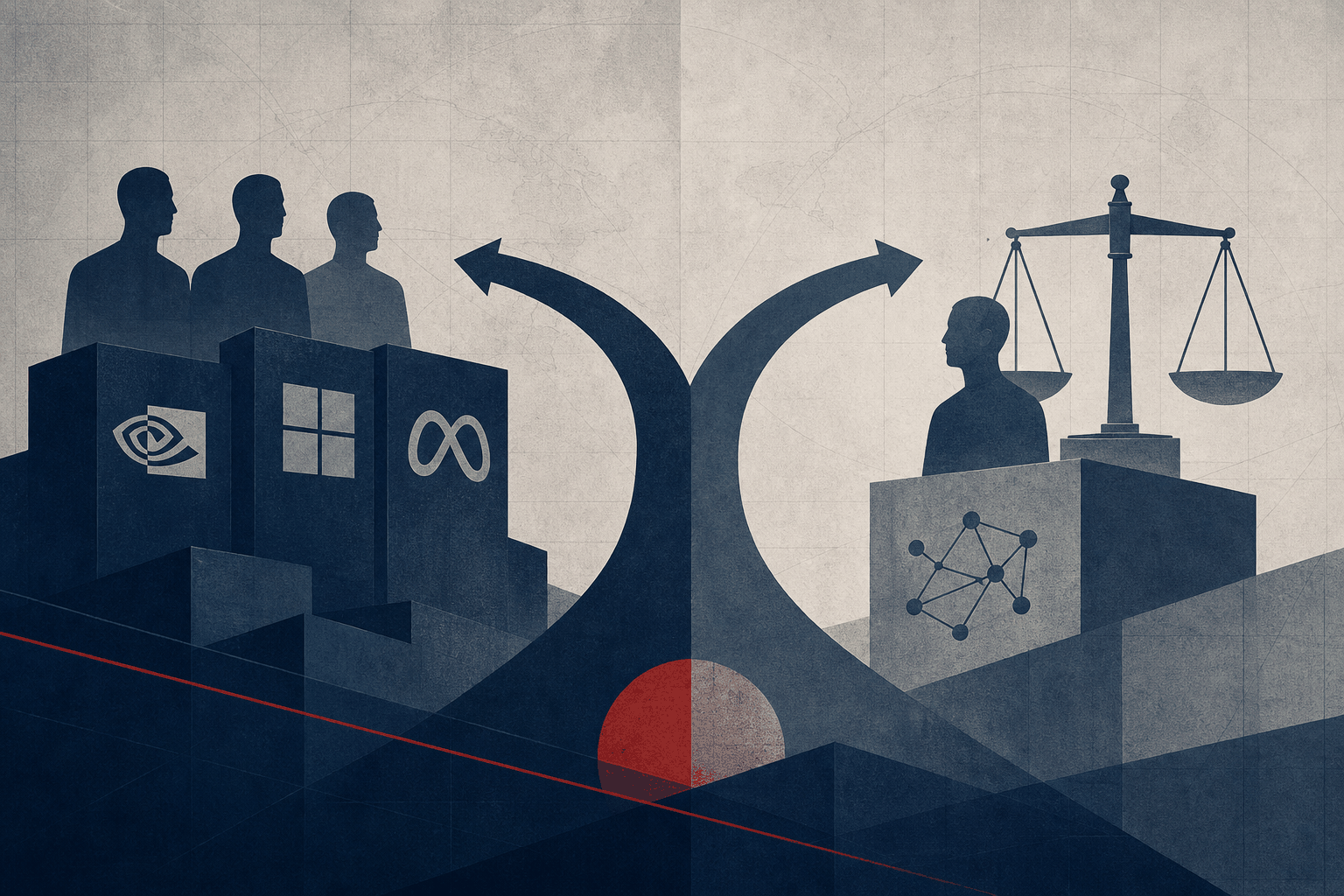
On July 22, 2026, Politico revealed an unusual open letter. Nearly 200 Silicon Valley startups, banded together as the “Little Tech Association,” wrote to President Trump and Commerce Secretary Lutnick: please don’t cut off American access to Chinese open-source AI models.
The signatories include Y Combinator, Proton (the encrypted email service), and nearly 200 VC-backed tech companies. Their warning: if the government really blocks Chinese open-source AI, the ones that will get hurt most are America’s own next-generation startups.
What’s the context here? Why are American startups rushing to “protect” Chinese AI? Would a ban even work? Let me try to unpack the calculus on each side.
The Trigger: A 2.8-Trillion-Parameter Chinese Model
It all started with an AI model.
In July 2026, Chinese AI company Moonshot AI released Kimi K3 — an open-source large language model with 2.8 trillion parameters. It’s one of the largest AI systems ever released by Chinese developers.
K3’s release sent ripples through the industry. Its benchmark performance was the real headline: it approached or matched America’s best closed-source models on several key tests.
Shortly after, White House tech advisor Michael Kratsios posted on X, claiming the US government had evidence that Moonshot used “distillation” to extract capabilities from Anthropic’s Fable model in developing K3.
Treasury Secretary Scott Bessent was even blunter: sanctions are “on the table.” He told Bloomberg that the US would scrutinize Chinese open-source AI models for intellectual property theft.
Suddenly, “ban Chinese open-source AI” became a live debate in Washington.
A Ban That Started Six Months Ago
This isn’t the US government’s first move on AI restrictions.
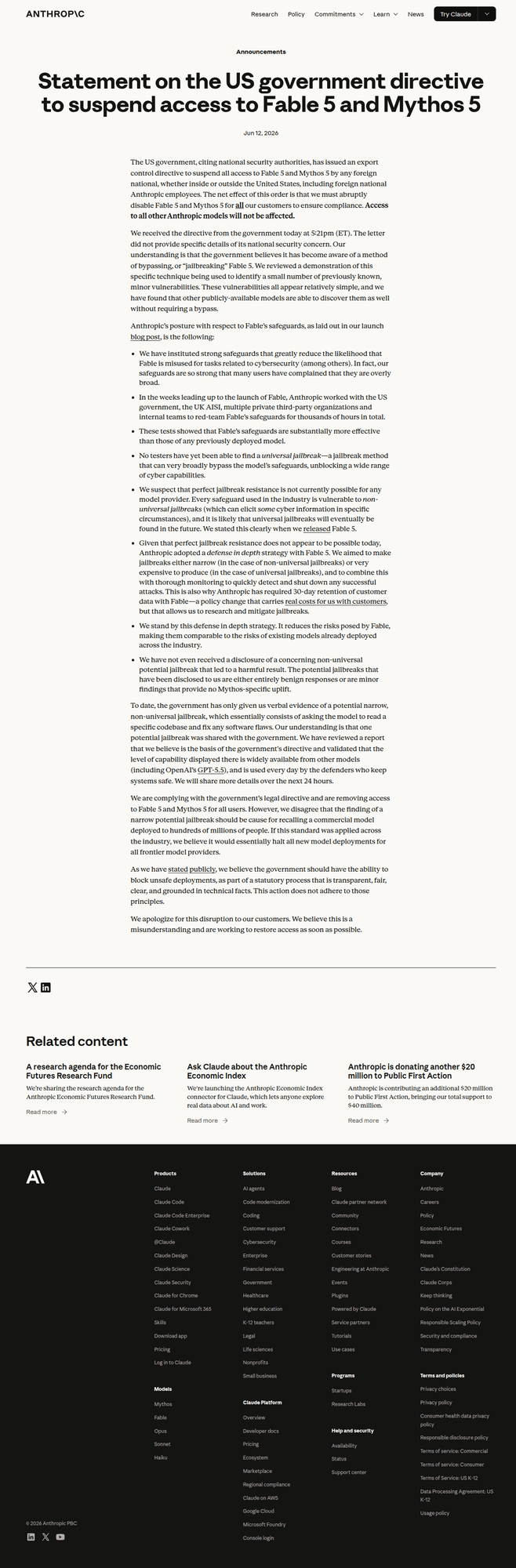
On June 12, 2026, the US government issued an export control directive to Anthropic under national security authority, ordering the company to immediately suspend all foreign national access to Fable 5 and Mythos 5 — regardless of whether those individuals were inside or outside the US, including Anthropic’s own non-US employees.
Anthropic’s statement noted that the government issued the order at 5:21 PM ET without providing specific details about the national security concerns. The company said the government claimed to have found a way to bypass Fable 5’s safety mechanisms, but Anthropic’s own assessment was that the vulnerabilities were “relatively simple” and achievable with other publicly available models as well.
 Anthropic’s June 12, 2026 statement disclosing the US government’s order to suspend Fable 5 and Mythos 5 access for all foreign nationals.
The effect was immediate: Anthropic had to shut off its two most powerful models to users worldwide.
But this raised a crucial question: you can block closed-source models. What about open-source?
The Open-Source AI Dilemma
To understand this complex standoff, you first need to grasp why “open-source AI” gives regulators such a headache.
Traditional export controls target physical goods — chips, equipment, technical documents. You can seize shipments, ban sales, and restrict transfers. But AI models — especially “open-weight” models — are an entirely different beast.
Open-weight means, in plain English: the model’s “brain” — the trained parameter files — has been publicly posted online. Anyone can download it and run it on their own computer. No API call needed. No permissions required. Just like downloading open-source software.
What does that mean in practice?
Even if the US government orders a “ban on access,” the model files are still on GitHub and Hugging Face for anyone in the world to download. Hackers don’t care about bans. Foreign powers don’t comply with them. And people who already downloaded the files aren’t going to delete them.
HN user capevace had a sharp take on this, and I’ll quote it directly:
I’m not even sure what the argument for banning Chinese models/open weights even is supposed to be?
if it’s to stop hackers doing hacking things with “uncontrollable models” then, well… they’re already doing something illegal to begin with, why would they care about breaking another law running these models?
if it’s to stop foreign actors, then that ban would not apply to them anyway
it’s not stopping distillation either, Chinese labs are already banned from using US frontier models and look at how good that is working
I don’t get it. Am I missing something? The only thing a ban would do is protect the American market from further downward price pressure on inference, protecting VC investors in the short term. But that’s also an admission that the American labs can’t compete on merit anymore.
This perspective has been widely echoed across the community.
Silicon Valley Splits: Who’s For and Against?
The central conflict line here is really a split within Silicon Valley itself.
On one side is the Little Tech Association — nearly 200 startups that depend on cheap open-source AI models to build their products. They don’t have the funding to pay per-token API fees to OpenAI or Anthropic.
On the other side are the large AI companies — Anthropic, OpenAI, and others — who have invested billions training closed-source models and naturally want to protect their market moats.
One founder who signed the letter told the press: “Our members aren’t asking for special treatment. They just want free markets, open systems, and real consumer choice.” In other words: “Don’t use national security as a cover to eliminate competition for big companies.”
To put it bluntly: if the US bans Chinese open-source AI, startups lose their cheapest source of AI inference. They’d either be forced onto higher-priced American closed-source models, or they’d simply go out of business.
Politico’s reporting captured the stakes in one line: “‘Hundreds of companies’ could die.”
Does the Distillation Accusation Hold Water?
Let’s come back to the distillation accusation.
The White House claims Moonshot used distillation to steal capabilities from Anthropic’s model. Distillation is real — it’s a technique where a weaker “student” model learns from a stronger “teacher” model’s outputs, dramatically reducing development cost.
But here’s the problem: proving distillation is nearly impossible.
TechCrunch put it bluntly: “Distillation is nearly impossible to prove and the timeline is thin, but that won’t matter.”
Why doesn’t it matter? Because in political battles, the accusation itself is a weapon. Even without hard evidence, a public accusation can be enough to justify policy action.
But cooler heads in the community note something important: Chinese AI labs have been training without access to US frontier models for a while now. The rise of DeepSeek, Qwen, GLM, and other high-quality open-source models shows that Chinese AI capabilities are no longer dependent on “distillation.” Banning open-source models isn’t really about preventing “theft” — it’s about stopping Chinese models from expanding their global influence through open channels.
The Paradox of Prohibition
After mapping out the various positions, I keep coming back to a structural paradox:
If Chinese open-source AI is weak enough to be worth banning, it’s not a threat. If it’s strong enough to be a threat, you can’t ban it anyway.
This is the “Stockholm open-source dilemma” — once an open-weight model is released, it lives somewhere on the internet forever. You can take down a GitHub repo, but the code and weight files have already spread through BitTorrent, cloud storage, and USB drives across the globe.
As one HN commenter put it: “Anyone who says ‘we can technically stop Chinese open-source models’ doesn’t understand how the internet works.”
In fact, companies and developers are already batch-downloading these models for archiving. If the US government actually issues a ban, the only real effect would be: compliant American startups lose access, while developers and hackers in China, Europe, and Southeast Asia continue using them without interruption.
It’s a textbook “shoot yourself in the foot” sanction.
The Case for Restriction
I shouldn’t only present one side. There are legitimate arguments for limits.
The national security concern is real: if Chinese AI models are used to generate malicious code, build biological weapons, or launch cyberattacks, the US should have some ability to manage that risk. The White House Office of Science and Technology Policy argues that open-weight models are a double-edged sword — good actors use them, and bad actors do too.
There’s also an economic logic: protecting the US AI industry’s advantage. If Chinese companies are outputting high-quality open-source models at low cost (partly through distillation of American technology), US AI companies — especially Anthropic and OpenAI — may be unable to recoup their multi-billion-dollar investments. Over time, this could erode US AI innovation capacity.
And there’s a geopolitical dimension: AI is widely considered the “general-purpose technology” that will define future military and economic power. Whoever controls AI controls decades of global competitiveness. In this frame, protecting the domestic AI industry isn’t just a business issue — it’s national security.
Where Is This Headed?
As of this writing, the Trump administration hasn’t formally responded to the open letter. But several signals are worth watching:
- Treasury Secretary Bessent has explicitly said “sanctions are on the table”
- The White House tech advisor directly accused Moonshot by name
- The Little Tech Association was just formed and is still building influence
- Members of Congress have also proposed bills to restrict Chinese AI models in the US
Meanwhile, Europe and Southeast Asia are becoming major recipients of Chinese open-source AI. A UBS report found that Indian companies are “massively switching to Chinese LLMs due to unsustainable US token bills.” This means that even if the US completely blocks Chinese AI, its global influence is still growing.
The Hacker News thread on this topic has surpassed 700 upvotes and 630 comments and is still climbing. A related discussion — “The arguments against open source AI are bad” — has also gained significant traction, with more people publicly questioning the logic of banning open-source models in the name of safety.
 The HN thread on this story. At time of writing, the post had 702 points and 633 comments — one of the most discussed topics of the day.
One Final Observation
Stepping back, I think this debate reveals a deeper contradiction:
The US wants to maintain technological dominance in AI — but “open source” and “dominance” are fundamentally incompatible.
The logic of open source is: shared knowledge, collective progress, survival of the fittest. The logic of dominance is: I’m ahead, so I set the rules and prevent others from catching up. When Chinese models close the gap through open-source distribution, the US government faces a hard choice — either accept that “open source means no monopoly,” or risk harming its own industry by trying to block access.
Caught in the middle are the startup founders who don’t have billions to train their own models, don’t want to pay per-token to the big AI companies, and just want to build great products with AI.
What they’re asking for is simple: don’t close the door. At least, not while we’re still inside.
References:
- Politico: Startup founders urge Trump not to shut off Chinese open weight AI
- HN Discussion (item?id=49023016)
- Anthropic: Fable/Mythos access suspension statement
- HN Discussion: The arguments against open source AI are bad (item?id=49024643)
- TechCrunch: Treasury threatens sanctions after White House claims Moonshot distilled Anthropic’s Fable
- Business Insider: Startup founders urge Trump not to shut off Chinese open weight AI