
On July 1, 2026, Google published its latest environmental report. My first reaction after reading it: is this number a mistake? A tech giant built on the creed of “don’t be evil,” committed to 24/7 carbon-free operations by 2030, saw its annual electricity consumption jump from 31 terawatt-hours (TWh) to 43 TWh — an increase of 12 TWh in a single year.
What is 12 TWh? It’s roughly the annual electricity consumption of the entire country of Portugal.
And the driving force behind this has something to do with everyone who opens a browser and types a keyword into a search box. Because the results page in front of you is no longer the lightweight, sub-50 KB text list of 2010 — it has become a data behemoth exceeding 5 MB.
One Hundred Times: How a Search Page Got Fat
In 2010, searching for something on Google from your phone returned ten blue links, a search box, and maybe one or two simple ads. The entire page was clean and sparse, around 50 KB — roughly the size of a short Word document.
In 2026, what happens when you perform the same action?
You search “weekend getaway ideas.” Before the page even finishes loading, it’s already marshaling its forces: the AI-generated “Overview” module needs to call a large language model, generating a multi-hundred-word response based on your location, search history, and the current time; then come six ads, real-time-bid based on your recent browsing patterns, each backed by a user profiling and tracking system; on the right, a map card; on the left, a “People also ask” accordion list rolls out (each question you expand triggers another server request); at the bottom of the page, at least fifteen third-party tracking scripts sit buried, telling advertisers who you are, where you came from, and where you’re headed; plus high-resolution hotel thumbnails, star ratings, price comparison tables, video carousels…
By the time the entire page loads, the transferred data easily exceeds 5 MB — 100 times the 2010 page.
This isn’t my estimate. According to HTTP Archive, a public database that continuously tracks global web page sizes, the median mobile web page hit 2.3 MB in 2025, and desktop pages are even larger. Google’s search results page, layered with AI-generated content, personalized ads, and rich media cards, far exceeds the average.
The problem: this 100× growth isn’t because search results got 100× better. Most of the extra “weight” is stuff you didn’t ask for and probably don’t need.
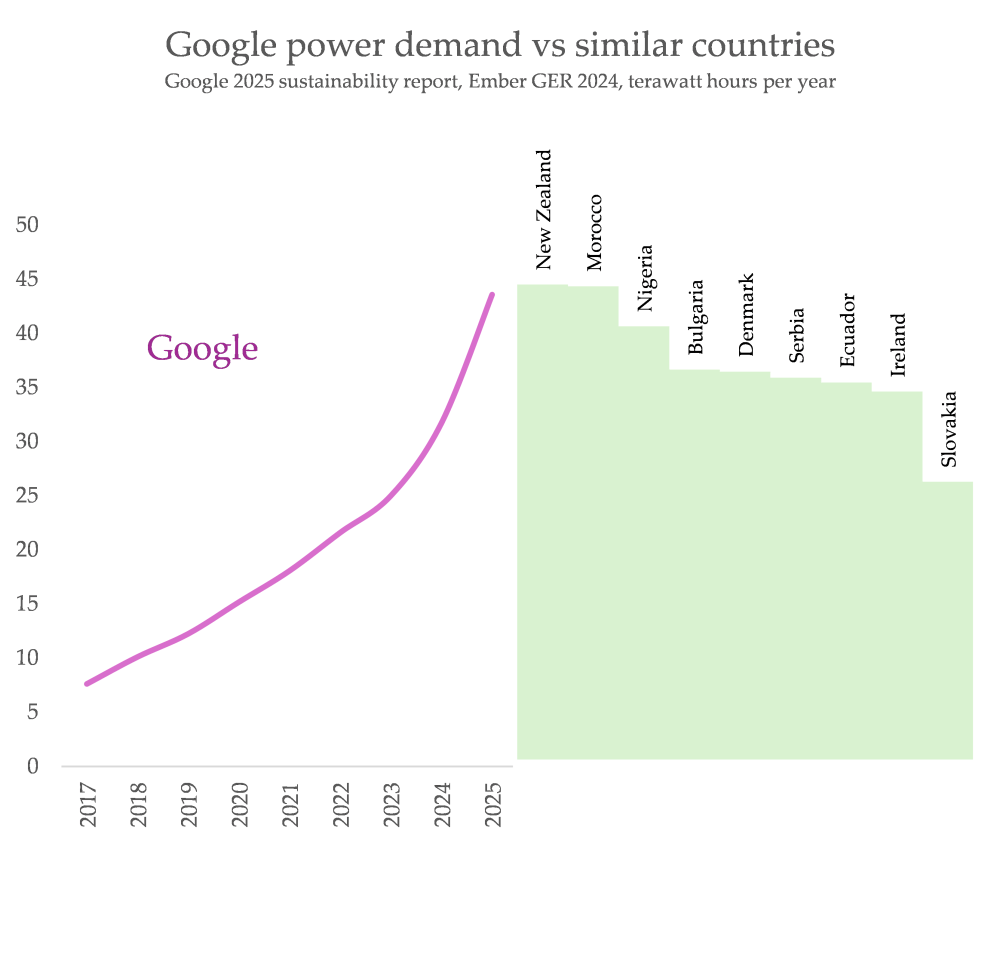 ▲ Google’s electricity consumption compared to multiple national power grids — it’s no longer operating at a “company” scale (source: ketanjoshi.co)
Every Kilobyte of Data Burns Carbon
Many readers might think: so the page got bigger — isn’t that just “a bit more data transferred”?
It’s not that simple.
When you perform a search, data doesn’t materialize out of thin air. Its travel route looks roughly like this: your phone or computer sends the request to a nearby cell tower or router → forwarded through layers of network equipment → arrives at one of Google’s data centers → tens of thousands of servers collaborate to complete search matching, AI generation, and ad bidding → the result gets packaged and transmitted back → your browser “unpacks” the received data and renders it into a page.
Every link in this chain consumes electricity. Server CPUs and GPUs need power. Data centers need air conditioning to dissipate heat (servers generate enormous amounts when running). Network transmission equipment needs power too. What we call “cloud computing” is, at bottom, shifting computational demand onto a physical machine in a giant warehouse somewhere on Earth — a machine that runs on real electricity and produces real carbon emissions.
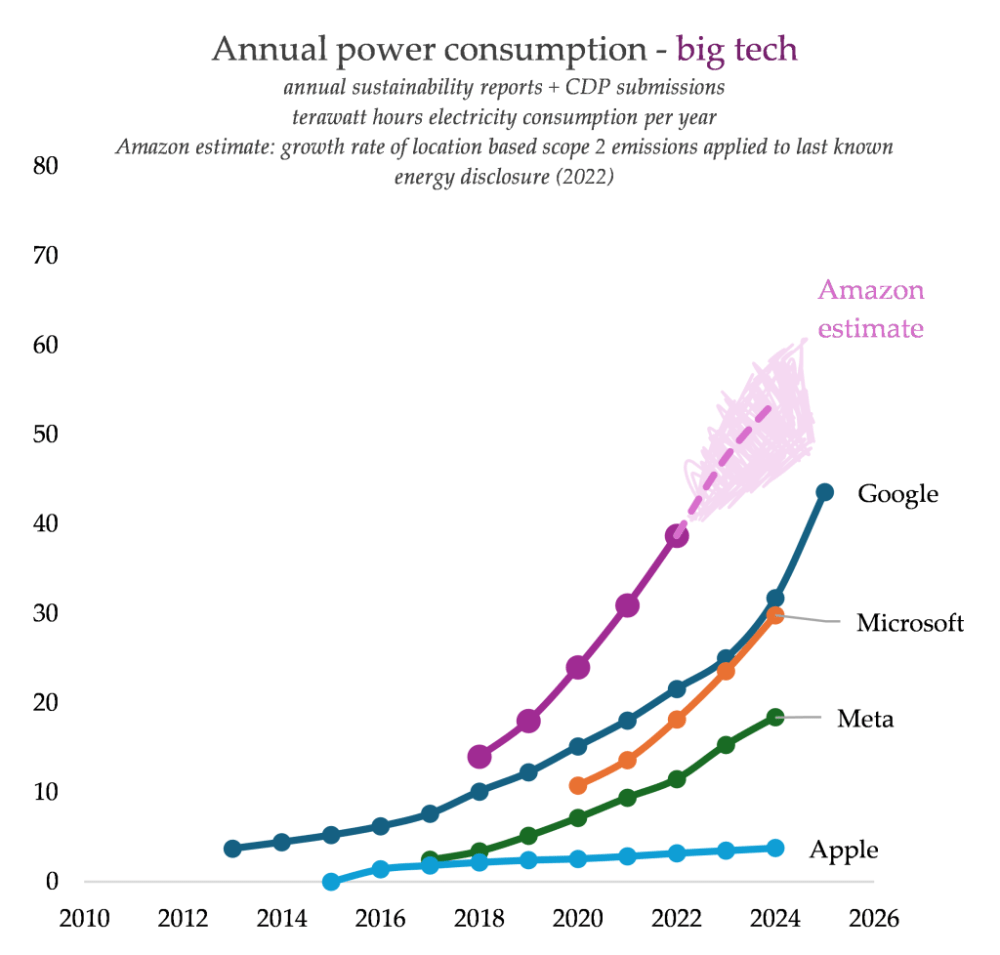 ▲ Electricity consumption growth trends for Google, Microsoft, and other tech giants. Google’s increase leads by a wide margin (source: ketanjoshi.co)
So, how much carbon does transferring 5 MB of data actually produce?
According to mainstream estimation models from the IEA and academic research, transferring 1 GB of data (about 1,000 MB) consumes roughly 3 to 7 kilowatt-hours of electricity — depending on data center efficiency, energy mix, and transmission distance. If that electricity comes from a fossil-fuel-heavy grid, 1 GB of data transfer corresponds to roughly 0.5 to 1.5 kg of carbon emissions.
Let’s do the math: a 5 MB search results page, if 4.95 MB of that is “extra burden,” each page emits roughly 2 to 5 extra grams of CO₂. Doesn’t sound like much. But Google processes roughly 8.5 billion searches per day.
Per day: the extra carbon emissions land somewhere between 200 and 400 tonnes. Over a year: 70,000 to 140,000 tonnes — equivalent to the annual emissions of 30,000 to 60,000 gasoline cars.
And that’s just the added weight of search result pages. Add in AI queries, email, video, cloud storage… the total is far, far larger.
Green Commitments vs. Ad Engine: Google’s “Split Personality”
This is the most bewildering part of the whole story.
If you open Google’s sustainability website, you’ll see an entirely different picture: 24/7 carbon-free operations by 2030, over 12 GW of clean energy projects contracted, world-leading data center efficiency, every server using 90% less power than a decade ago. These numbers aren’t fabricated — Google’s investment and achievements in renewable energy procurement genuinely lead the tech industry.
But the same Google has another side: its electricity consumption surged from 31 TWh in 2024 to 43 TWh in 2025, the largest single-year increase in its history. Its total carbon emissions are 51% higher than its 2019 baseline. It admits in its environmental report that “AI infrastructure buildout is accelerating faster than grid decarbonization.” In 2025 alone, data centers in Ireland consumed 23% of that country’s entire electricity supply.
 ▲ Google’s actual emissions (Raw) and “claimed” emissions (Claimed) are both drifting away from its climate targets (source: ketanjoshi.co)
The issue is that Google’s way of making money and its way of saving electricity operate on two mutually incompatible logics.
Google is an advertising company. In 2025, ad revenue accounted for roughly 75% of its total revenue. What does the ad business run on? More user data, more precise tracking, richer ad formats, longer user dwell times. And these things, at the code level, all mean — more JavaScript, more tracking pixels, more rich media content, larger page sizes. Google’s business model inherently demands that search results pages “must get fatter.”
And the arrival of AI has made this problem an order of magnitude worse. AI-generated search overviews (AI Overview) require invoking large language models, and a single AI inference consumes roughly 10 to 30 times the energy of a regular search. What’s worse, Google made AI Overviews opt-out by default — users don’t need to click anything; it fires automatically. You just wanted to look up a recipe, and the server has already “reasoned” through 200 words on your behalf.
As Ketan Joshi wrote in the analysis that sparked this whole discussion: “Don’t get Google’s talking points mixed up — it’s buying clean energy on one side while powering AI infrastructure with fossil fuels on the other. The former can’t keep pace with the latter’s appetite.”
It’s Not Just Google’s Problem
If this were just one company’s problem, it would be, at most, “an ad company not walking its talk.” But the scale has grown large enough to concern public infrastructure.
In Ireland, data centers already consume 23% of the nation’s electricity. Ireland’s grid operator EirGrid was forced to urgently halt a batch of data center connection applications in 2026. In Northern Virginia — one of the densest data center regions in the world — the local grid is approaching its limits, and approvals for new natural gas power plants are accelerating. As one Lobsters commenter put it with devastating concision: “We’re burning our future as fuel for ‘convenience.’”
This isn’t alarmism. In early July 2026, global ocean surface temperatures once again reached record highs for the same period. The climate doesn’t care whether you opened an incognito window.
But I’m not about to suggest “stop using Google” — for the vast majority of people, that’s neither realistic nor necessary. The question worth thinking about is: do we have the right to demand that a company, while providing convenience, at least lives up to the green commitments it wrote down itself?
When we habitually open a browser, type a keyword, and get an answer in less than a second — maybe we can spare two more seconds to think: how much was burned behind the scenes that shouldn’t have been?
Reference links: