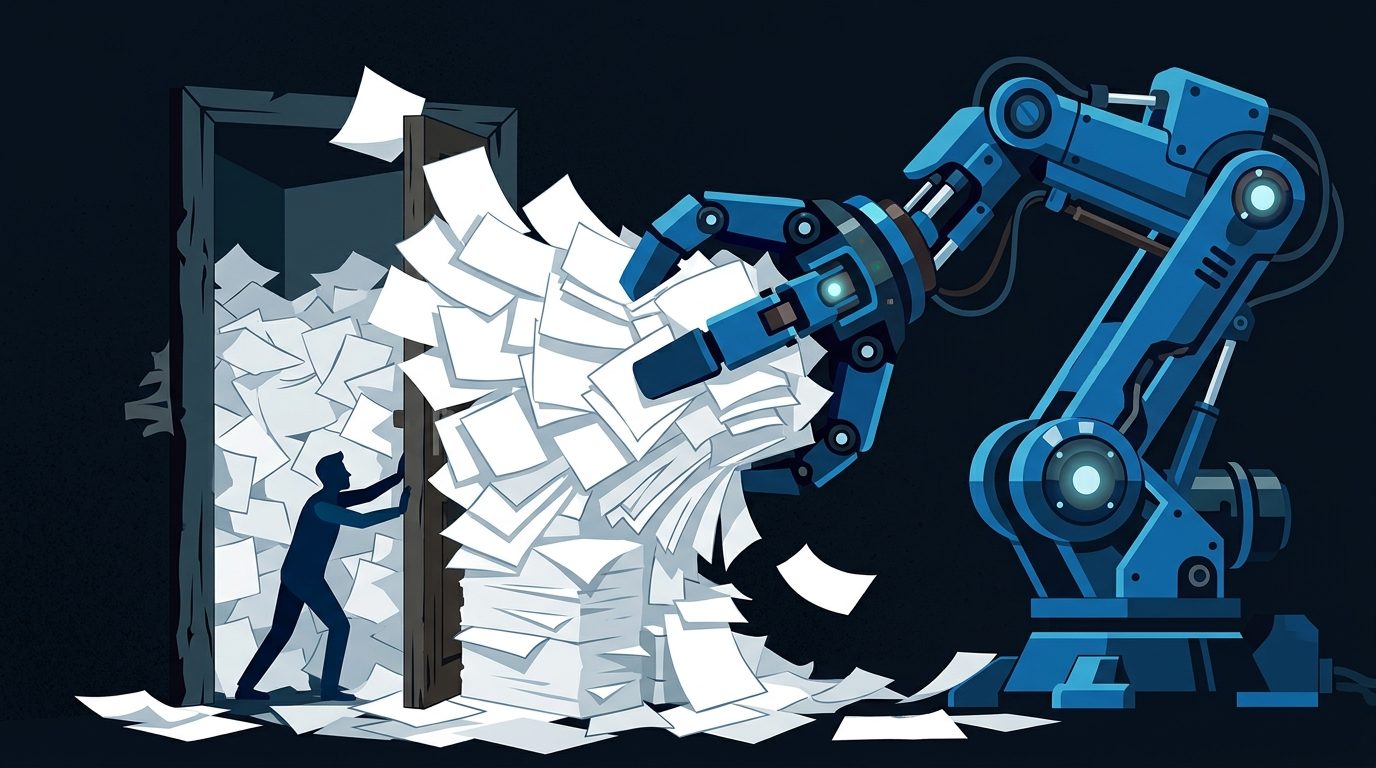
In 2025, fewer than 2% of new computer science papers on arXiv were suspected to be AI-written. By 2026, that number hit 15%. Not a gradual climb — a surge.
That’s the finding from a large-scale scan recently published by the Unslop team. They analyzed the full text of 12,750 papers on arXiv, calibrating their detection threshold so that only 0.4% of pre-ChatGPT human papers would be falsely flagged as AI-written. At that baseline, AI-written content in computer science went from virtually zero to 15%. Expand to the most recent full quarter, and the figure hits 32%, with a peak near 39% in early 2026.
This is actually happening in 2026.
How Deep Has AI Infiltrated Academia?
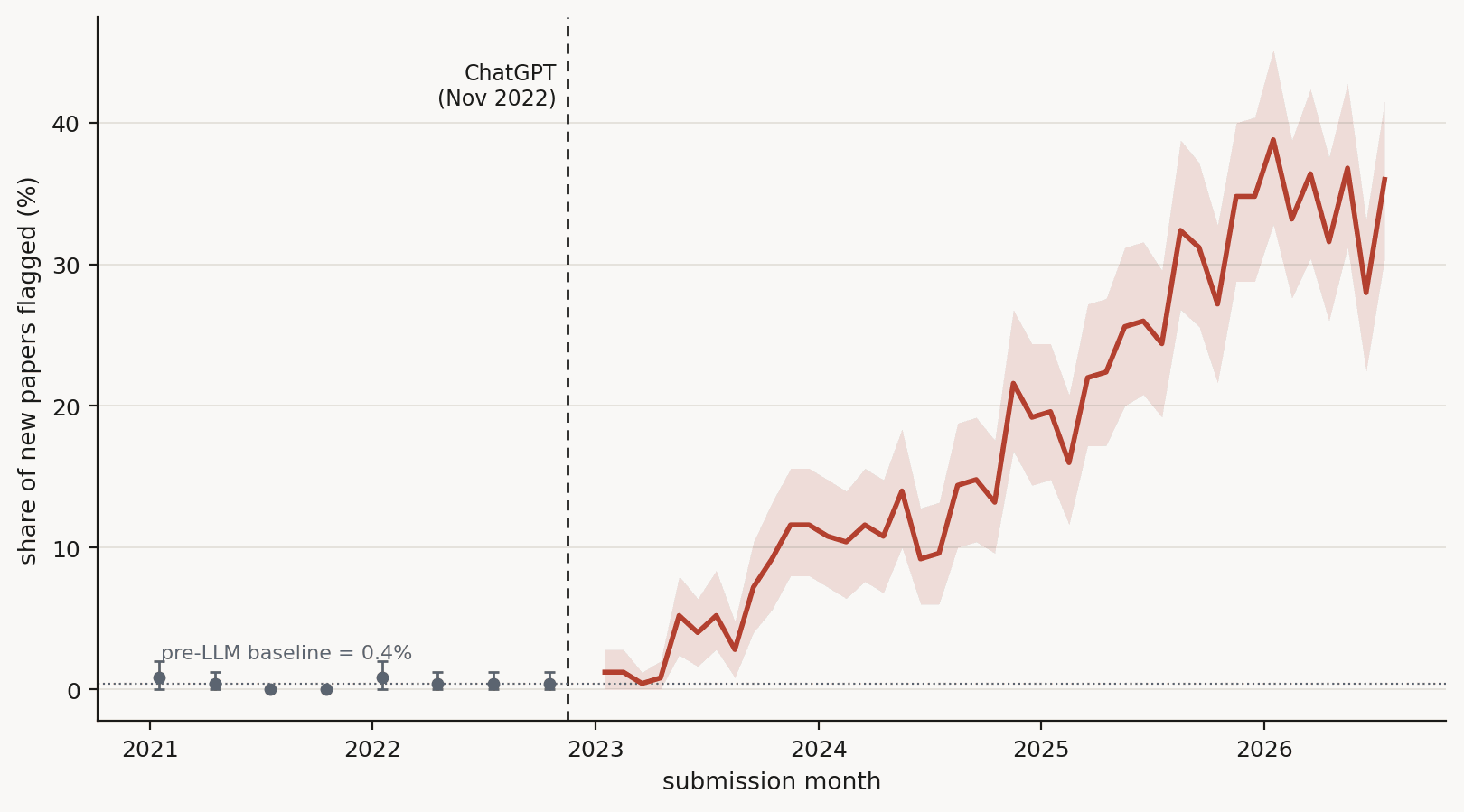
The Unslop scan covered ten disciplines. Here’s the breakdown (last 12 months, through July 2026):
- Computer Science: 65% of new papers flagged as likely AI-written
- Quantitative Biology: 56.3%
- Electrical Engineering & Systems: 51.3%
- Economics & Finance: 47%
- Applied Physics: 34%
- Statistics: 31.3%
- Condensed Matter Physics: 24%
- High Energy Physics: 14%
- Astrophysics: 10.7%
- Mathematics: 0.7%
What these numbers share: before ChatGPT (2021-2022), the baseline false-positive rate across all these fields was between 0% and 3.5%. The curves only started rising in early 2023.
In other words, text that “reads like AI wrote it” has gone from a negligible noise signal to the mainstream in many disciplines.
Image 1: arXiv papers flagged as AI-written over time (2021–2026)
Image 2: AI-writing flag rate by discipline
Why Can’t Detectors Catch AI-Written Papers?
You might think: isn’t AI writing easy to spot? Doesn’t it have that telltale “AI voice”?
Reality says otherwise.
First, AI writing quality has evolved far faster than detection tools. Early GPT-3 output had obvious patterns — repetitive sentence structures, overuse of “moreover” and “furthermore,” hollow conclusions. But by GPT-4, Claude, and newer models, combined with user editing, the boundary between AI and human text is extremely blurred.
Second, so-called “AI detectors” are just statistical classifiers. They work by learning distributional differences in word choice and sentence structure between human and AI writing. But every statistical model has two Achilles’ heels: false positives (flagging well-structured human writing as AI) and false negatives (AI text that’s been lightly edited loses its statistical fingerprints).
Here’s the really uncomfortable part: detection accuracy crashes against deliberately disguised AI text. If someone spends even a little time rewriting an AI draft — swapping synonyms, reordering paragraphs, adding a sentence of their own judgment — detectors become essentially useless.
HN user pbui ran an experiment: he fed his own 2011 paper into a detector — 27% machine-written. His 2012 PhD thesis? 40% machine. A 2015 IEEE paper? 74% machine. A real human paper, written before AI existed, flagged as mostly machine-written. What does that tell us? These detectors can’t even reliably identify human writing, let alone distinguish it from AI.
Cat and Mouse: The Detection Arms Race
This is fundamentally an asymmetric arms race:
Defense (detection tools): must identify every possible AI generation strategy. But AI models update daily, prompt engineering evolves constantly — detectors are always playing catch-up.
Offense (AI users): only needs to make text “look human.” Draft with GPT-4 and edit twice today, use a different Claude style tomorrow, run AI output through a paraphraser the next day — the detector’s training data is always one step behind.
The Unslop team is upfront about this: their detector has varying sensitivity across different language models, and they have no way to know which model or prompt the user actually employed. That means their reported numbers are a floor — the real proportion is higher, not lower.
To make matters worse, even a 99% accurate detector produces massive false positives when applied to thousands of papers. HN user NitpickLawyer pointed out that early AI detectors once flagged the Declaration of Independence as 100% AI-written. False positives have real consequences — students have already been wrongly accused of using AI on their assignments.
Why Are Researchers Using AI to Write Papers?
Two opposing forces are at play:
On one side: academic integrity. Papers should represent a researcher’s own thinking and effort. If even the writing is outsourced to AI, what is research actually studying?
On the other side: efficiency — or survival. Academia has an iron law: publish or perish. Junior researchers need publication counts, professors chase metrics, PhD students need papers to graduate. Under this pressure, using AI to quickly turn ideas into a polished paper looks like a rational choice.
Some are pushed into it — tight lab budgets, peers producing at astonishing speed, ever-lengthening review cycles. Without AI, keeping up is nearly impossible. Others are opportunistic — lightly edit AI-generated content, slap their name on it, churn out papers to pad their metrics.
In practice, these two motivations blur. A researcher might start with “I’ll just use AI to polish the language,” then find it’s surprisingly handy, and end up with “the AI draft is good enough, I’ll tweak a few spots.” There’s no clear red line, but the shift is real, and it’s reshaping the ecology of academic writing.
What Does This Mean for Academic Integrity?
Most major journals and conferences are still feeling their way around AI writing policy. Some explicitly ban it, some require disclosure, some look the other way.
But the real issue isn’t policy — it’s enforceability. If detection tools are unreliable, declarations of AI use depend entirely on author honesty. And someone willing to use AI to write a paper without declaring it probably isn’t going to suddenly become honest.
The deeper crisis: when the proportion of AI writing gets high enough, the signal value of academic literature itself degrades. If you spend significant time reading a paper only to discover it’s an AI-generated template with a few formulas tacked on, the entire foundation of scholarly communication is shaken.
Of course, there’s another perspective: tools themselves aren’t good or evil. If AI helps researchers express ideas faster and structure arguments more clearly, it’s just an aid to writing. The key is how it’s used and where the boundaries lie — using AI to augment thinking versus using it to replace thinking.
Unslop’s research leaves us with one clear conclusion: AI’s penetration into academic writing is irreversible. Detection can’t catch up, regulation can’t plug the gap, and honesty is a matter of conscience. What happens next depends on whether academia can find a defensible balance between “embracing efficiency” and “holding the line.”
The real challenge facing academia: how to use AI without destroying scholarship itself.
References:
- How we measured AI writing across arXiv, and where the measurement breaks — Unslop blog
- Hacker News discussion: 187 points, 137 comments
- Unslop Detector technical documentation — principles and calibration methodology