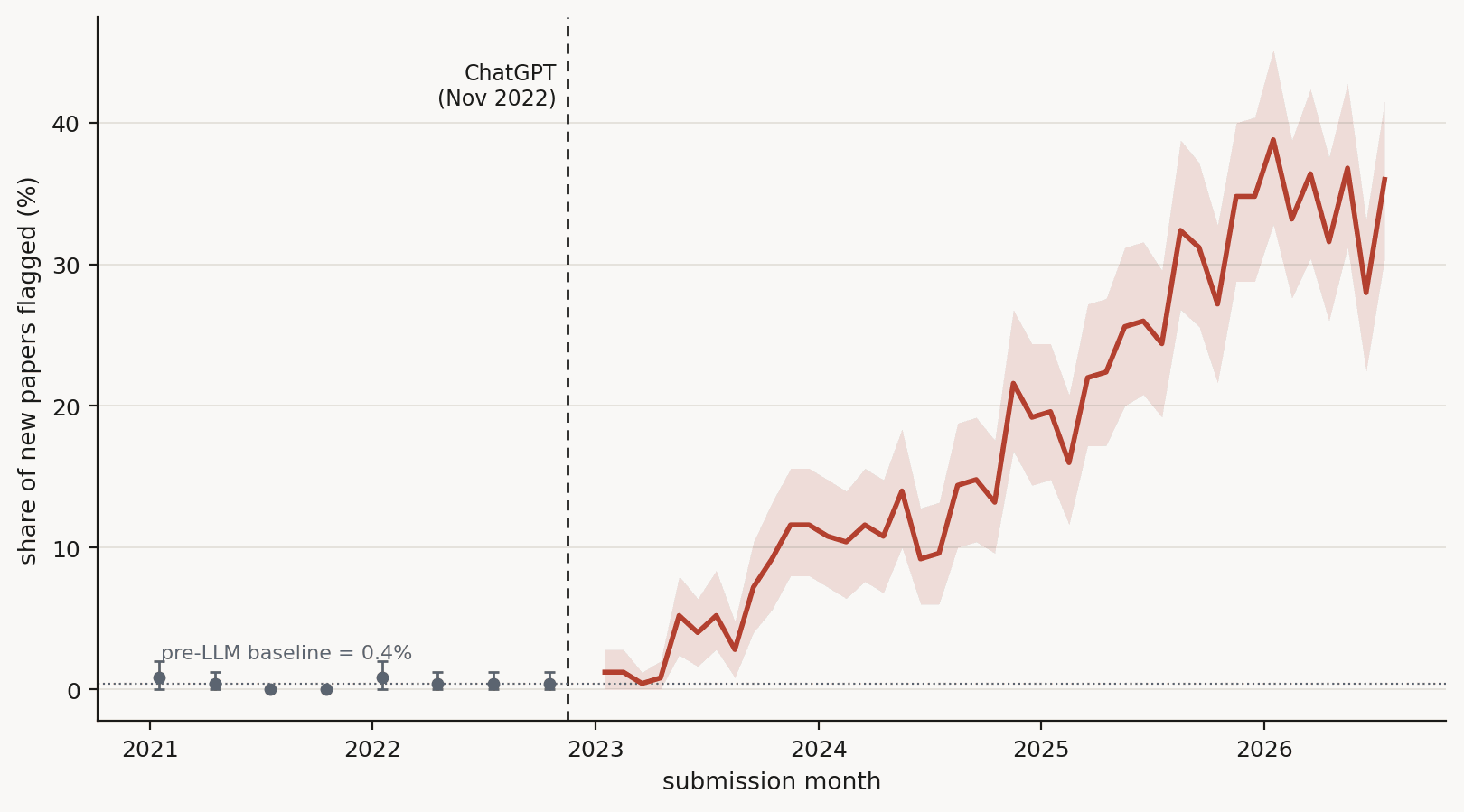
In September 2026, arXiv received 40,363 paper submissions in a single month—a record high in its 35-year history. This unprecedented flood generated nearly 9,000 support tickets, pushing the preprint platform’s moderation system to the brink of collapse.
Forty Thousand Submissions Overwhelm Volunteer Moderators
In September 2016, arXiv’s monthly intake stood at fewer than 10,000 papers; a decade later, that figure has quadrupled. Submissions in cs.AI (Artificial Intelligence) alone skyrocketed more than sixfold in just two years. Behind this exponential growth lies a deluge of fragmented “salami-sliced” papers and heavily AI-generated text swamping the platform.
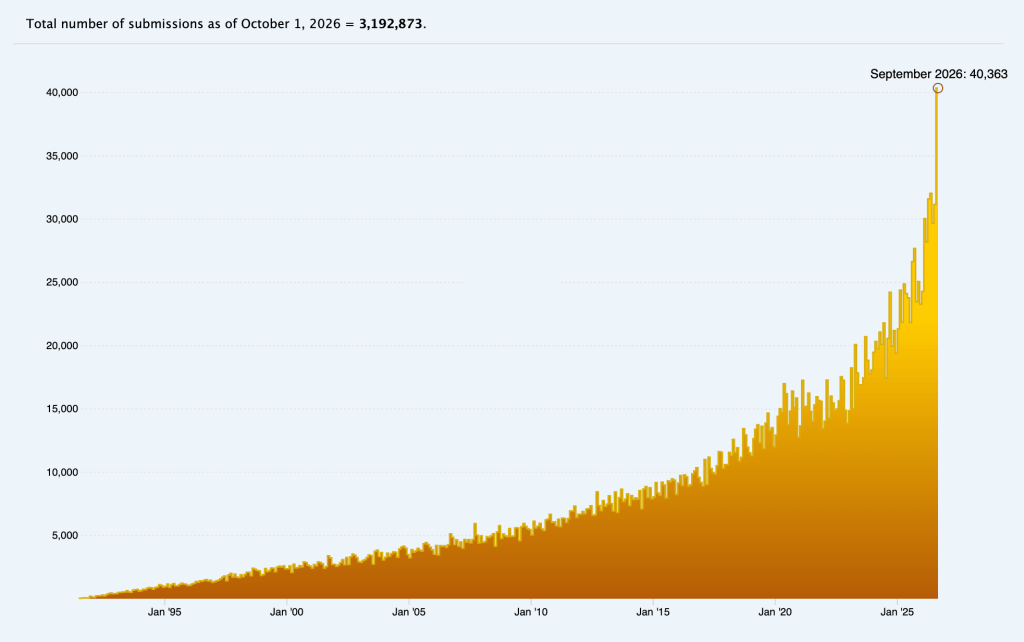 Figure: Monthly arXiv submissions from 1991 to 2026, reaching a historic record of 40,363 in September 2026. Source: arXiv Official Blog
Machines never need to sleep, but volunteer moderators only have 24 hours in a day. With massive volumes of low-quality, stitched-together text packaged as academic preprints, traditional peer screening and volunteer moderation mechanisms simply cannot cope with traffic spikes of this magnitude.
Rejected Submissions Still Consume Quota
Effective October 1, 2026, arXiv implemented a blanket rate limit across all categories: each submitter is capped at a maximum of 2 submissions per calendar month, with no more than 3 submissions active at any given moment. Interdisciplinary submissions receive no exemption. This blunt, hard-line policy directly shuts down the exploit of mass scattershot submissions across multiple domains.
Crucially, rejected submissions still deduct from the monthly quota. The official count locks in at the moment of submission. Once an author clicks “Submit” on a valueless paper, real moderator attention has already been expended. By imposing this direct operational cost, the rules effectively choke off pipeline-style paper mills.
Casualties of a Zero-Sum Game
Thomas Dietterich, member of the arXiv Editorial Advisory Council, acknowledged that a small minority of authors submitting large volumes of low-quality papers disproportionately drains volunteer moderators’ time. Legitimate researchers who consistently produce high-quality work pay the price, watching their manuscripts delayed by days or even weeks due to platform-wide backlogs.
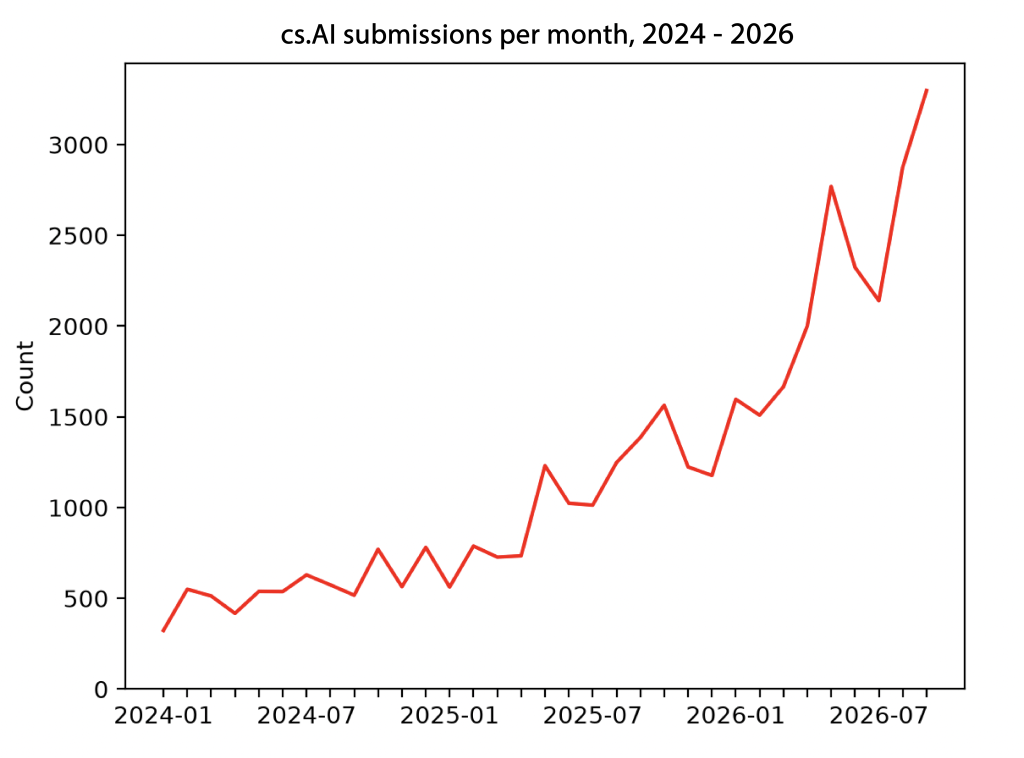 Figure: Submissions to the cs.AI category from 2024 to 2026, growing more than 6x in two years. Source: arXiv Official Blog
While arXiv allows authors to use AI as an assistive research tool—provided such usage is disclosed and the underlying scholarship meets rigorous academic standards—the latest deluge bypasses these requirements, turning serious preprint publishing into a low-cost numbers game.
Academic Infrastructure Draws the Line
arXiv framed the submission cap as a temporary stopgap, buying operational breathing room to overhaul its moderation tooling and workflows. In an era where the marginal cost of producing academic prose approaches zero, human reviewer attention has become the only truly scarce resource.
The monthly quota effectively prices the hard physical limits of human verification bandwidth. arXiv’s rate-limiting policy exposes an uncomfortable truth: academic infrastructure has been forced to concede that machine generation has outpaced human reading comprehension. When machines can churn out lengthy dissertations with a single prompt, enforced quotas remain the last line of defense against the flood.
References:
- arXiv Official Blog: Fair Moderation, Equitable Access, and AI
- HN Discussion (item?id=49926512)