On July 21, 2026, Hacker News’s front page was dominated by China AI topics. Three in-depth analysis posts collectively scored over 1,200 points with nearly 1,500 comments. And no, this wasn’t Chinese users gaming the system — the authors were veteran US tech writer Ben Werdmuller, Stratechery analyst Ben Thompson, and frontier economics research firm Emerging Trajectories. The US developer community is collectively asking the same question: is China’s open-weight AI actually winning?
The answer, as it turns out, upends conventional wisdom more than you might think.
A Watershed Moment
Let’s start with something that’s happening right now.
Over the past two weeks, two Chinese companies released new AI models: Moonshot Labs’ Kimi K3 and Alibaba’s Qwen 3.8. If this were just “another model release,” it would be a routine day on the tech news cycle.
But this time is different.
Both models are approaching the performance of Anthropic’s Fable 5 — widely considered the strongest AI model in the world. More crucially: the weights (think of them as the model’s “source code” and core parameters) for both Kimi K3 and Qwen 3.8 will be publicly released. Anyone, any company, any country can freely download, deploy, modify, and commercially use them.
This is the open-weight approach.
And it stands in stark contrast to America’s paid-API model. One is like publishing a recipe so anyone can open a restaurant; the other is like having a single monopoly eatery where you have to pay every time you eat.
The Villain: America’s Closed AI Dead End
To understand why China’s approach is winning — and why it’s not an accident — you need to see the path US AI companies are on.
Anthropic (maker of Claude) and OpenAI (maker of ChatGPT) share a remarkably similar business model: build closed APIs and charge per use. You can’t download their models, can’t run them on your own servers, can’t see how they work internally. Want access? Pay up, every single time.
This model has several fatal flaws.
First, AI models have almost no moat. As Werdmuller notes, switching between models costs users almost nothing — swapping ChatGPT for Claude is, for most developers, a one-line code change. Real moats live in surrounding services (enterprise contracts, system integration, data security), not in the model itself.
Second, the closed-API cost structure is unsustainable. Emerging Trajectories’ analysis shows that Anthropic Fable 5 costs nearly 3x more per task than open-source alternatives. And because Anthropic doesn’t own its own data centers and power generation, its costs scale linearly with usage — more users means faster cash burn, with margins that never improve.
Third, US export controls have backfired. Restricting chip exports to China has only accelerated Chinese self-reliance while making global developers (especially those in countries that can’t buy high-end chips) gravitate toward Chinese open-source models — at least they aren’t subject to US export restrictions.
Behind the data is an engineering judgment: closed models’ profits come from scarcity, and AI model scarcity is evaporating fast. It’s a math problem.
The Chinese Strategy: Why Open Weights Are Winning
Chinese companies are playing an ecosystem game.
Release model weights publicly so anyone can freely use, modify, and deploy them. This means:
-
Developers win. They can run models on their own servers without depending on any company’s API. Data stays private. Emerging Trajectories cites one telling data point: 80% of US startups now use Chinese models — primarily because they’re good, cheap, and free.
-
Cloud providers win. AWS, Alibaba Cloud, and Google Cloud can all host these open-source models, charging for compute rather than per-call licensing. Cloud providers have become some of the biggest beneficiaries of the open ecosystem.
-
Chip makers win. NVIDIA’s GPUs run Chinese open models just fine — demand has actually increased thanks to openness. A more open software layer drives a larger hardware market.
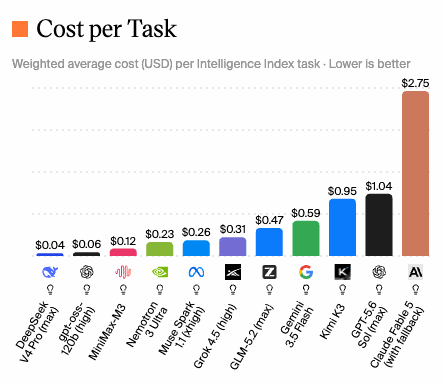 Per-task cost comparison across models (source: Emerging Trajectories). Anthropic Fable 5 costs nearly 3x comparable alternatives.
This is the network effect of open weights: more users → more community improvements → more hardware support → better performance → even more users.
America’s closed APIs break this virtuous cycle. They’re collecting tolls on each transaction rather than capturing the long-term value of ecosystem growth.
Three-Way Chess: Kimi K3 · Qwen 3.8 · Anthropic
Three players, each in a fundamentally different position.
Anthropic: The Ceiling on Safety Premiums
Anthropic is the most technically capable company — and the most vulnerable. Its strategy rests on two pillars:
- Safety narrative — its models are rigorously aligned, more “safe,” more “ethical,” less prone to hallucination. This commands a safety premium.
- Regulatory lobbying — push for government AI regulation to raise the barrier to entry and keep competitors out.
Both pillars are weakening. Kimi K3 and Qwen 3.8 matching Fable 5’s performance means the biggest differentiator — performance — is evaporating. When two models run at the same speed, why pay 3x for “safety”?
Kimi K3 (Moonshot Labs): The Attacker’s Advantage
Moonshot Labs is an interesting case. It doesn’t invest in data centers, doesn’t pursue vertical integration, and keeps its strategy simple: build the best model, then open it. Win developer goodwill and ecosystem support through open weights, then monetize through enterprise services. This “API-free, enterprise-service-paid” model is rapidly eating into Anthropic’s high-end market share.
Qwen 3.8 (Alibaba): The Giant’s Compute Dividend
Alibaba owns its own data centers and cloud business. Its open-source strategy has a hint of cunning: Qwen 3.8 approaches Fable 5’s performance, and Alibaba Cloud can directly integrate it. Customers running Qwen on Alibaba Cloud pay far less than calling the Anthropic API. Alibaba makes money on compute, treating the model itself as a loss leader.
What This Means for Ordinary People
You might not write code, but this battle will affect you directly.
First, prices for AI services will drop significantly. When high-quality open-source models exist for free, any company trying to charge premium prices faces competition. The open-source releases of Kimi K3 and Qwen 3.8 effectively set a price ceiling on global AI services — your API pricing can’t exceed the cost of running an open model.
Second, AI “black boxes” will shrink. Openness means outside auditors can examine model behavior, discover biases, and fix vulnerabilities. This is good for everyone who uses AI products — you have a right to know how the tools you depend on actually work.
Third, Chinese AI products will get closer to your needs. As Chinese models build reputation in the global developer community, improvements will flow back into consumer products. The AI translation, image generation, and smart assistants on your phone may well be powered by Chinese teams.
To Be Fair: America Has a Point
This article doesn’t want to create a “China good, US bad” binary. In my view, American concerns are real.
Anthropic’s safety alignment work is genuinely ahead. Its models perform better against adversarial prompts and harmful content. Open-source models do carry higher risk of malicious use (generating disinformation, cyberattack code). Werdmuller himself acknowledges: “try asking these models about Tiananmen Square” — Chinese models’ content filtering on sensitive topics is a real obstacle for global developers unaccustomed to such restrictions.
But technical competition isn’t just about who’s “safer” — it’s about whose model is more sustainable. The moment open-source models match closed-source performance, the clock starts ticking on the safety premium.
Final Thoughts
July 2026 may be remembered as a turning point for the AI industry.
Not a technological turning point — model capabilities are still improving steadily, no singularity in sight. But an industrial logic turning point: the value of AI is shifting from “owning the best model” to “building the most vibrant ecosystem.” In this new logic, China’s open-weight approach is structurally more advantaged than America’s closed-API model.
It’s like the 1990s Microsoft vs. Linux story all over again: closed proprietary software once ruled the world, but the eventual winner was the system that the most people used — even if it “wasn’t perfect.”
Global developers have already voted with their feet. Those 1,200+ points on Hacker News speak for themselves.
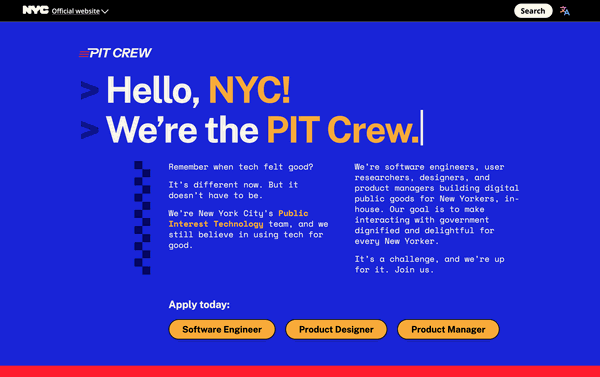 Ben Werdmuller’s article. The headline says it all: “American AI is locked down and proprietary. It’s losing.”
References:
- Werd: American AI is locked down and proprietary — it’s losing
- Emerging Trajectories: Kimi K3, Qwen 3.8, and Anthropic’s (Potential) Unravelling
- Stratechery: Who’s Afraid of Chinese Models?
- Hacker News discussion (item?id=48979269)