
At the outer perimeter of more than 225 million websites worldwide stands a doorkeeper widely trusted to almost never make a mistake. Enterprises spend fortunes fortifying internal perimeters, and developers adhere to rigorous standards for application code. Yet if this front-line sentry falters while inspecting inbound traffic, the master keys to the entire infrastructure fall into adversary hands. Two critical vulnerabilities, each scoring a 9.2 on the CVSS scale, have abruptly shattered that long-standing quiet.
On November 18, 2026, network infrastructure giant F5 shipped an emergency security patch for the open-source web server nginx. Without needing credentials or prior access, attackers can execute arbitrary code simply by delivering a crafted network request across the internet. A fundamental logic flaw lingering unnoticed in the codebase for over a decade—eluding scrutiny from elite security researchers worldwide—was just rooted out by AI. Confronted with an exploit chain that cuts directly through server perimeters, system administrators find their patch window compressed from weeks to mere days.
Guarding 220M Websites: The Gatekeeper Collapse Renders Internal Defenses Irrelevant
Across modern Internet infrastructure, nginx remains the dominant web server software, posted like a front-desk guardhouse at the edge of corporate networks. Its primary duty is taking in raw web requests and routing them cleanly to downstream backend services. The newly disclosed unauthenticated remote code execution (RCE) flaws permit external actors to send specially malformed packets to publicly exposed ports, forcing the engine to execute malicious instructions.
Many engineering teams invest heavily in guarding against SQL injection and credential theft, operating under the assumption that their front door is rock-solid. In reality, these twin vulnerabilities reside directly within nginx’s own protocol-parsing engine. Pristine business logic cannot save an application once its entry gateway collapses. Even if a host merely serves static assets without running any dynamic backend code, attackers can still gain full control over the system.
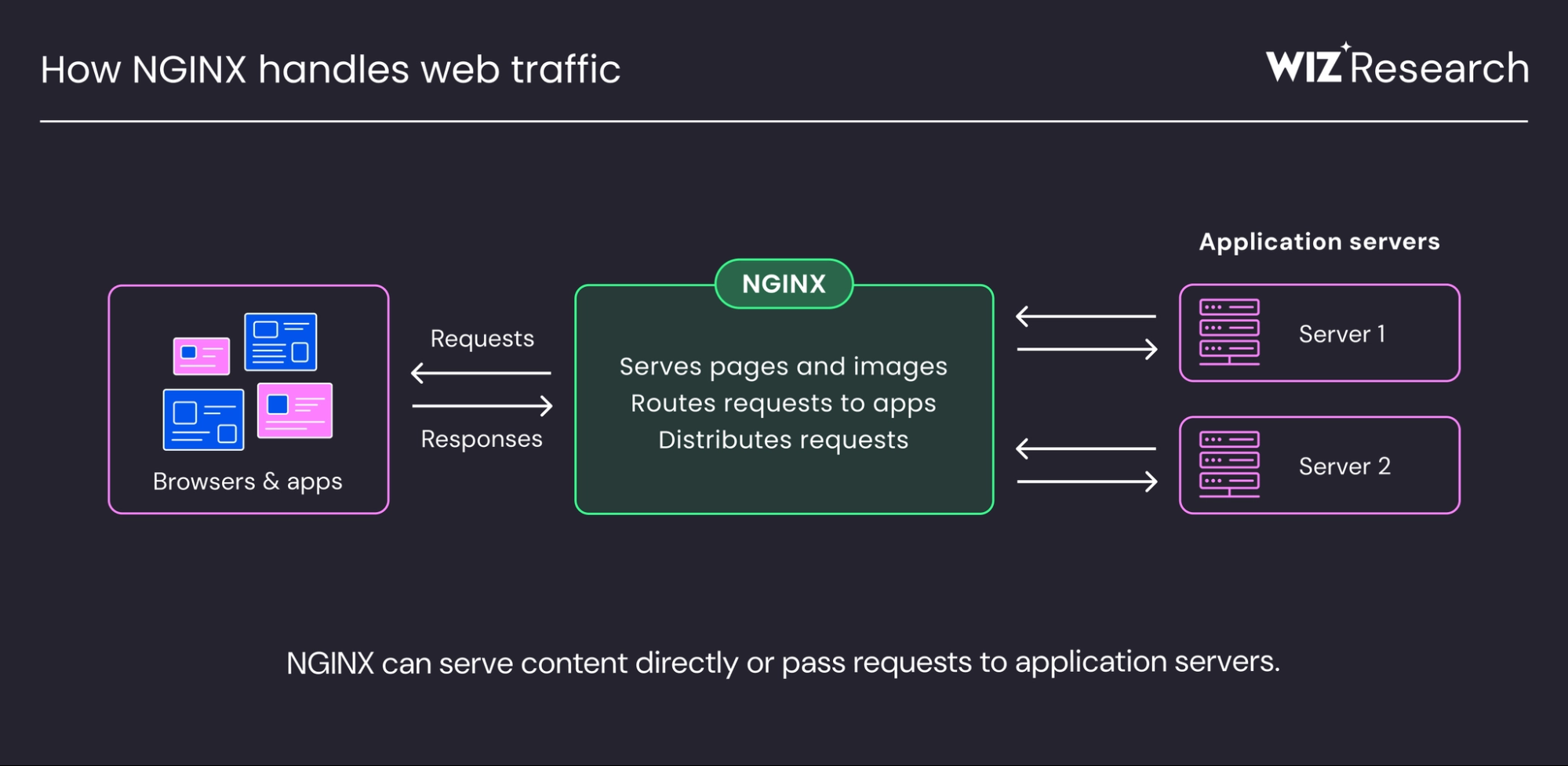 Figure: Architectural overview showing nginx handling inbound traffic and forwarding upstream requests to backend applications. Source: Wiz Research Blog
The sheer footprint of affected endpoints caught many operators off guard. On November 10, 2026, cyberspace scanner Shodan indexed over 56.7 million public hosts displaying nginx identifiers. Among the 11.94 million hosts whose precise version could be determined, an astonishing 98.9% fell within the vulnerable version range. When core infrastructure components break down, every downstream layer of defense is stripped bare.
A Decade-Old Arithmetic Flaw: Invisible to Human Eyes, Mass-Harvested by AI
Tracked as CVE-2026-123007, the most impactful vulnerability stems from an elementary arithmetic error: an integer underflow. Within the HTTP/2 flow-control window calculations, a value that drops below zero is treated by the system as an enormous positive unsigned integer. This tricks the runtime into assuming an essentially limitless send window, triggering an out-of-bounds memory copy.
The lifespan of this bug is staggering. Spanning every official release from version 1.9.5 in 2015 all the way to 1.31.8 in 2026, over ten years of stable code was vulnerable. Even the main development branch as of November 10, 2026, harbored the flaw. Disclosed concurrently, CVE-2026-123633 represents a use-after-free defect occurring during the teardown of HTTP/2 connections.
Low-level C codebases are notorious for sprawling control flow, placing an immense cognitive load on humans inspecting hundreds of thousands of lines. Human fatigue and finite attention have historically acted as natural barriers keeping vulnerabilities hidden. Security firm Wiz Research deployed Atlas, its proprietary static analysis tool, to pinpoint both subtle execution paths. Leveraging commercial frontier LLMs, they successfully confirmed and demonstrated exploitability.
Security firm Xint pushed automation even further. After manually discovering one weakness, researchers initiated an autonomous AI-driven audit pipeline that discovered four additional critical vulnerabilities without human intervention. The coordinated patch release addressed multiple 9.2-rated vulnerabilities spanning HTTP/3 reverse proxies and DNS resolution modules. As the Wiz team observed, structural complexity once served as an accidental defense barrier; today, AI is dissolving that barrier, leaving no vast codebase safe from automated inspection.
Chaining Six Exploits: From Public Web Packet to Host-Level Root
Faced with isolated flaws, engineering teams often lean on defense-in-depth, presuming that hosting an application within a Docker container insulates the underlying physical host. The nginx2root exploit chain published by Xint demolished that assumption by stringing together five nginx parsing bugs with a local Linux kernel privilege escalation flaw.
In a live network scenario, an attacker transmits crafted traffic to a public IP. The exploit first leverages CVE-2026-123007 to breach nginx at the perimeter, achieving arbitrary code execution under unprivileged worker process permissions inside the container. Next, the payload exercises a kernel protocol flaw from within the containerized namespace, tearing right through sandbox isolation boundaries. The attacker emerges on the physical host with full root privileges.
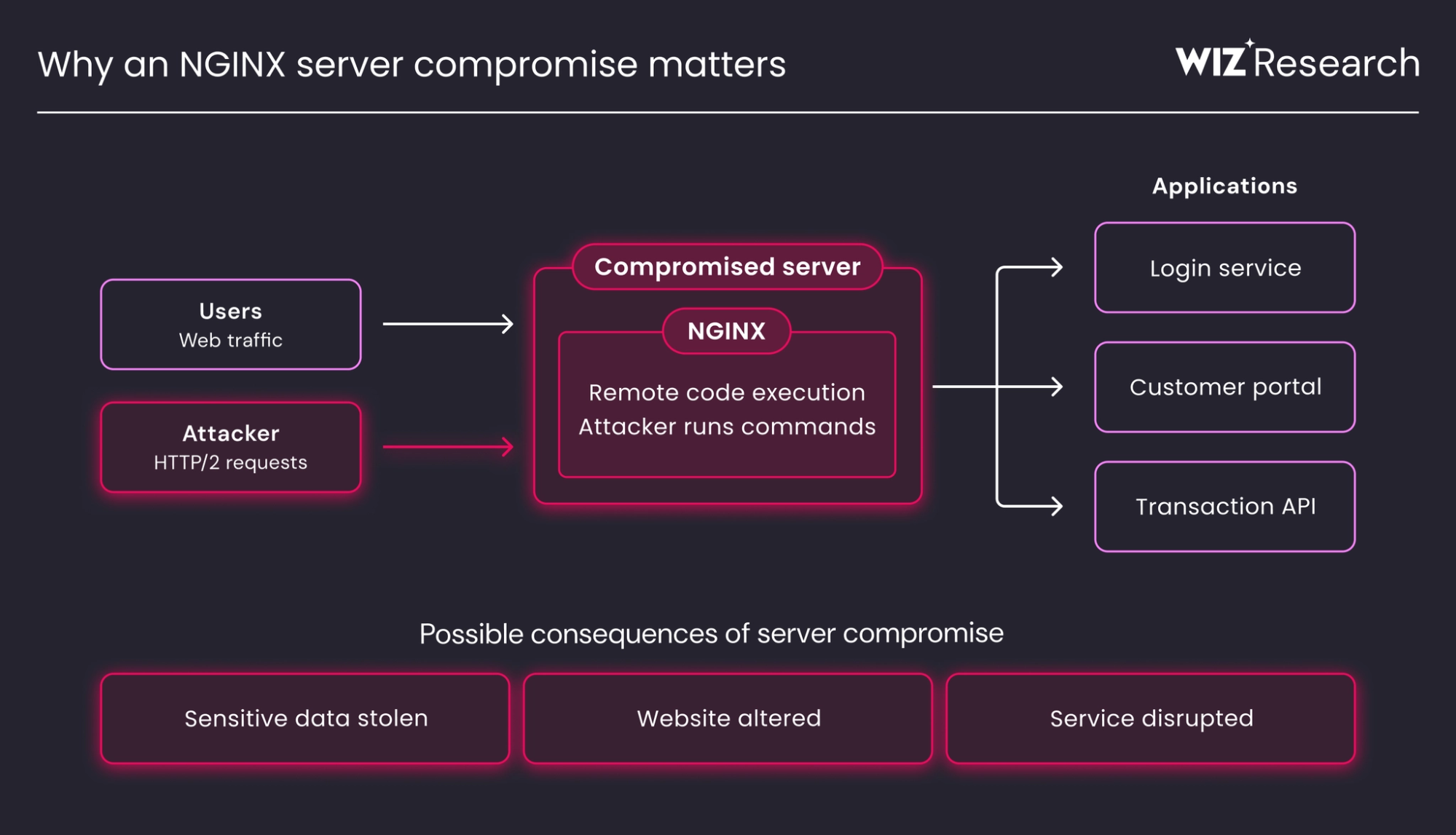 Figure: Conceptual diagram illustrating how an attacker executing code via nginx compromises all behind-the-scenes applications and underlying data. Source: Wiz Research Blog
Modern operating systems employ Address Space Layout Randomization (ASLR) to shuffle memory locations and disrupt predictable targeting. In this chain, however, attackers utilized out-of-bounds memory leaks to read raw internal buffers, mathematically reverse-engineering the running memory layout. Standard mitigations were neutralized in seconds. The transition from an isolated edge breach to total host compromise took seconds, exposing severe cracks in layered defenses.
Disabling HTTP/2 Is Not Enough: Distro Backports Create False Security
Upgrading directly to the official nginx 1.31.9 release provides the cleanest remediation, yet taking production clusters offline for emergency updates is fraught with operational risk. Some engineers contemplated simply disabling HTTP/2 in their configuration files as a temporary stopgap. While this workaround mitigates the primary HTTP/2 flaws, it does nothing to address the companion DNS parsing and mail proxy vulnerabilities patched in the same advisory.
Enterprise dependencies further restrict operational maneuvering. In modern microservice meshes, internal RPC architectures rely heavily on gRPC, which fundamentally mandates HTTP/2 transport. The protocol offers no graceful fallback mechanism. Disabling HTTP/2 instantly severs vital internal communication channels.
Even when sysadmins audit their fleet, standard distribution backporting practices introduce widespread confusion. Major Linux distributions routinely backport security fixes into older package versions without incrementing upstream version numbers. On Ubuntu 22.04 LTS, for instance, a thoroughly patched nginx package will still report its version string as 1.18.0.
This discrepancy fuels dangerous ambiguity during incident response. Operators relying on surface-level version checks can easily misidentify fully patched systems as vulnerable, or vice versa. Verifying an endpoint requires checking distribution-specific package build strings rather than upstream tags. Protocol locks prevent immediate mitigation, and misleading version banners complicate triage, pushing operational friction to unprecedented heights.
Public Commits Before Advisories: The Defender Window Collapses to Days
Beyond raw technical severity, this disclosure highlights a tectonic shift in incident timelines. A review of the timeline shows initial reports landing on October 21. Fix commits were integrated into the public repository an entire week prior to the coordinated advisory, with commit messages explicitly naming the reporting security researchers.
In the open-source world, transparency is paramount. But in an era where AI agents actively track public commits, automated systems monitor repository changes by the minute, feeding diffs into large language models for rapid reverse engineering. AI can parse the patched logic, identify the underlying bug, and generate functional weaponized exploit scripts in record time.
Historically, defenders enjoyed a comfortable breathing room. It often took months after a CVE advisory for reliable weaponized exploits to circulate in the wild. Today, that buffer has collapsed. The clock starts ticking the very second a patch commit hits a public git tree.
Attackers empowered by AI can construct operational exploits in days, while defenders remain bottlenecked by enterprise testing and deployment cycles. The simultaneous emergence of decade-old bugs makes one reality undeniable: security through obscurity and human oversight blind spots is officially dead. AI has democratized vulnerability discovery, transforming public patch releases into immediate exploit roadmaps. Whether defenders can compress their patching cycle from weeks to days will decide the security of millions of digital gateways worldwide.
Reference Links:
- Wiz Research Blog
- Xint Blog
- Netcraft September 2026 Web Server Survey
- Hacker News Discussion