Output Prices Cut by 9x, Cost per Task Cut by 20x
On November 16, 2026, Tencent Hunyuan unveiled Hy4 flash. On the official API rate card, output pricing sits at $0.281 per million tokens—down from $2.501 on the preceding Hy4, an 8.9x drop. The cached input price gap stretches even further to 14x, at $0.003 versus $0.042. Yet the most striking number is buried inside Tencent’s internal benchmark, WorkIndex: doing the exact same work, Hy4 flash averages 1/20 the cost per task compared to Hy4.
 Figure: Hy4 flash launch hero banner. Source: Tencent Hunyuan
The past two years have seen countless LLM price-slashing events, but reducing actual “cost per task” to one-twentieth is a first. A token is the smallest billing unit in model pricing, roughly equivalent to a word or half a word, and a real-world task routinely consumes hundreds of thousands of tokens. If unit prices drop but models become chatty and verbose, the monthly bill climbs anyway. Tencent essentially swapped the ruler from token price to completed tasks—and when the ruler changes, the leaderboard reshuffles with it.
Reaching this depth of savings cannot be sustained through marketing promotions alone; it requires squeezing efficiencies layer by layer across the model and inference stack. Hy4 flash accomplishes this across three distinct layers: architecture, inference engineering, and post-training. Below is a breakdown of how each part works.
Priced by Token, Paid by Task
WorkIndex is an internal benchmark suite developed by Tencent, featuring eight practical tasks that directly mirror real-world billable work: creating PPT presentations, revising slides, human-AI collaborative slide decks, co-writing Markdown documents, document editing, spreadsheet formulas and fixes, audio/video editing, and visual comprehension. According to official data, Hy4 flash matches or slightly exceeds Hy4 preview in overall task completion quality, while its average cost per task drops to 1/13 of Hy4 preview, 1/20 of Hy4, and 1/8 of DeepSeek-V4.1-Flash-1017 (evaluated under Max tier, peak-hour pricing).
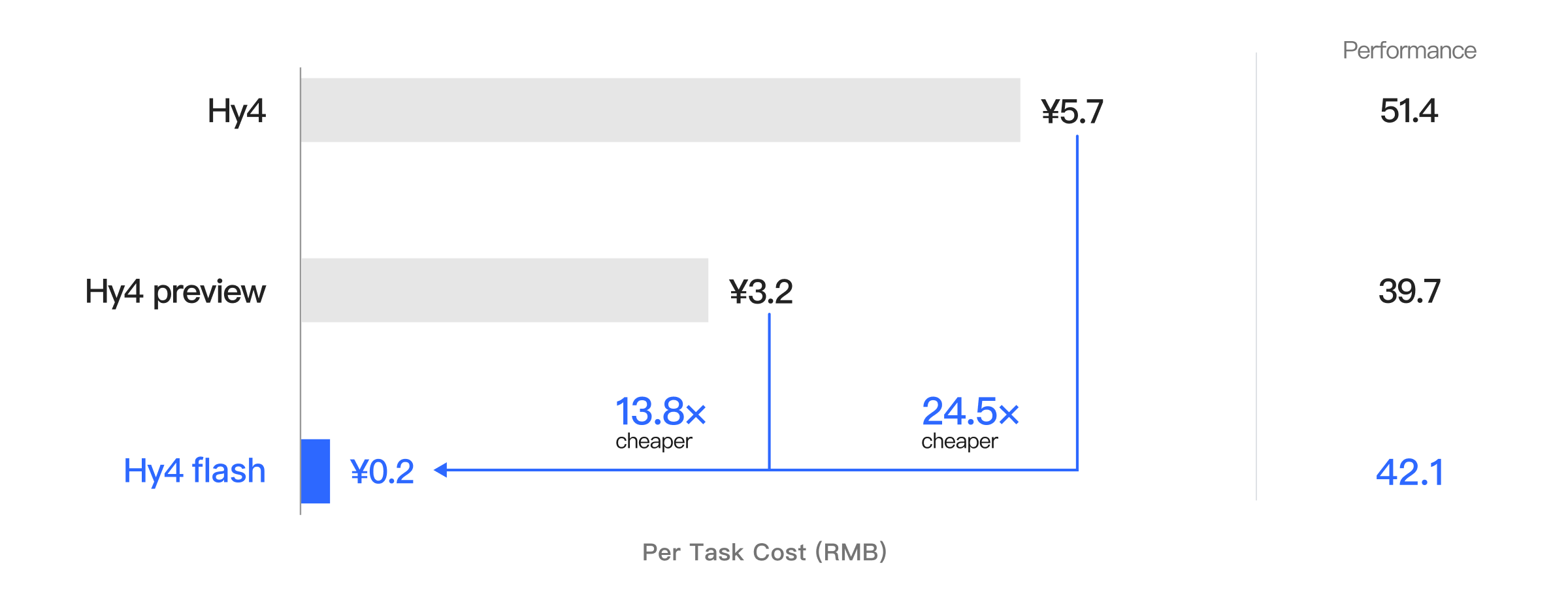 Figure: Official Figure 1: Performance-cost distribution across 8 internal WorkIndex evaluations and 7 public agent benchmarks. Note that the horizontal axis measures cost, not score. Source: Tencent Hunyuan
The takeaway of this chart is spelled out in its caption: capability scores remain virtually flat, while costs collapse between 1/8 and 1/20. Tencent positioned cost as the primary axis, making an unmistakable statement: before asking how capable a model is, first ask what it costs to run. As leaderboard scores tighten among frontier labs, the variable that creates real separation is shifting directly to the bottom line.
The First Cut: KV Cache Slashed to 1/24
To understand where the savings originate, consider what the KV cache (Key-Value cache) does. Every time a language model processes a long document, it maintains a running set of notes—the attention relationships between each incoming token and all preceding context. The larger the document, the larger the memory footprint of this notebook, requiring more pages to scan during every decoding step and driving up operational costs. In long-context workloads, memory consumption from the KV cache accounts for the lion’s share of infrastructure expenses.
Hy4 flash combines three architectural pillars: hybrid attention (applying different tiers of attention to different spans to avoid over-computing easy passes), LatentMoE (a mixture-of-experts design where the vast majority of parameters remain idle until triggered), and Engram. Official metrics indicate that the KV cache footprint has shrunk to 1/24 of Hy3 and 1/6 of Hy4. When memory overhead drops to a fraction of its former self, a 1M-token context window becomes economically viable. Shoveling massive documents into the model no longer causes GPU memory blowouts, allowing prices to crater. The $0.003 cached input rate is simply the other side of this architectural coin: identical prompt context requires no recomputation, stored notes take up a tiny fraction of memory, and hosting expenses plummet accordingly.
The MoE design tackles compute efficiency: across 224B total parameters (including 64B within the Engram module), each token activates only 12B. Imagine a facility staffed with 224 workers, but each incoming word only calls 12 people to action while the rest sit idle and off the clock. Activating compute strictly on demand without drawing power across idle parameters serves as the engineering bedrock for bottom-dollar pricing.
Faster Execution, Tighter Phrasing
While architecture trims memory overhead, inference engineering saves raw machine time. The Hy4 flash inference stack relies on three core components: megakernels (condensing the entire decoding loop into a fused GPU program to eliminate data shuffling between distinct operators), 4-bit quantization (compressing model weights from full floating-point representations into 4-bit formats to save memory bandwidth), and DFly scheduling. Tencent reports sustained decoding speeds exceeding 150 tokens per second. Low cost requires high speed: the more tokens a single GPU outputs each second, the lower the amortized hardware runtime per token, keeping low pricing sustainable without losing money.
Post-training tackles the volume of tokens generated. Hy4 flash first undergoes self-distillation from the larger Hy4 foundation—using the flagship model as an instructor to transfer general problem-solving capabilities—followed by reinforcement learning that trains the model to answer concisely without unnecessary chatter. According to official figures, average end-to-end output tokens dropped by 50%. Since output generation is the most expensive billing tier ($0.281 versus $0.070 for standard input), cutting output length in half cuts half the bill right away. Among the three optimizations, this delivers the most immediate return.
Only when these three layers multiply together does the 1/20 ratio emerge: architecture brings memory overhead down to near zero, inference engineering amortizes hardware time, and post-training halves the costliest output tokens. No individual trick could achieve an order-of-magnitude reduction on its own. True affordability is engineered; discount rates are merely printed on marketing slides—the former lives inside model weights and inference kernels, while the latter only lasts until promotions expire.
The Numbers Come from Tencent: How to Interpret Them
It is important to be clear about provenance: all data cited above originates from Tencent’s official disclosures. WorkIndex is a proprietary benchmark; the test scenarios were selected in-house, the baseline competitors chosen internally, and independent third-party replication is not yet available. Self-reported benchmarks naturally skew in favor of the publisher and must be viewed with measured skepticism.
Nonetheless, multiple cross-cutting internal data points show consistent gains. In a double-blind trial involving 85 internal WorkBuddy users across 259 tasks and 27 categories, Hy4 flash earned user satisfaction ratings comparable to Claude Haiku 5.5, while achieving the shortest end-to-end completion time and substantially lower costs than competing baselines. Independent product lines tell a similar story: within the WorkBuddy productivity assistant, average task latency fell 70% with costs running at roughly 1/15 of Hy4; on WeCom (Enterprise WeChat), the “DaYuan” assistant generated output 88% faster with approximately 60% fewer thinking-mode tokens; in QQ, “Xiao Q” recorded satisfaction gains of 6.16, 2.84, 0.92, and 2.22 percentage points across music recommendations, channel interactions, Qzone feeds, and long-form astrology queries; and Yuanbao reported a 13.6% uplift in autonomous agent benchmarks over Hy3.
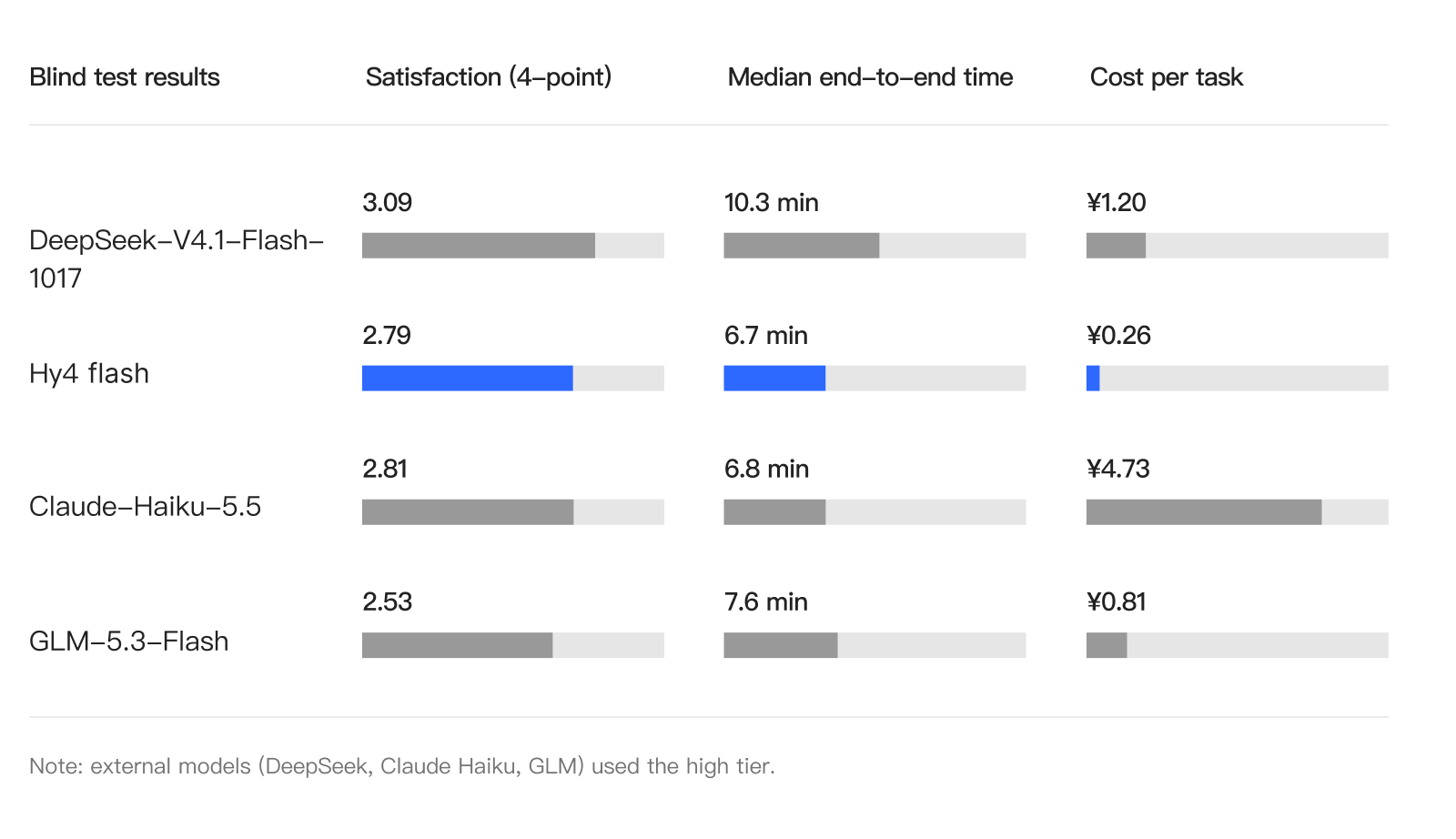 Figure: Double-blind test results from 85 WorkBuddy users across 259 tasks and 27 categories. User satisfaction rivaled Haiku 5.5 alongside the shortest completion time. Source: Tencent Hunyuan
An internal benchmark can be tailored, but multiple unrelated business teams reporting simultaneous efficiency gains is harder to stage. Productivity tools, social bots, and autonomous agents all point in the same direction, suggesting that the cost-reduction architecture translates cleanly to production environments. While independent verification will validate exact margins, the overarching trend appears genuine.
Frontier AI Gets a New Scorecard
Tencent outlines clear deployment boundaries in its announcement: for day-to-day productivity tasks—deep search, document processing, slide generation, quick frontend prototyping, and computer use (agents operating OS user interfaces)—Hy4 flash is the recommended default. For long-horizon software engineering, Tencent continues to recommend Hy4, citing its higher intelligence ceiling. The two models coexist: flash wins on operating economics, while flagship Hy4 wins on peak reasoning capacity.
Distribution channels are already online: Tencent Cloud TokenHub, WorkBuddy, Yuanbao, WeCom, QQ, ima, and Marvis, with an OpenRouter rollout forthcoming. WorkBuddy is free through November 30, alongside a 50% API discount on TokenHub. Tencent also plans to release open-weight checkpoints. Once open-sourced, the true test of this “1/24 KV cache + megakernel + 50% token reduction” blueprint will depend on how many community developers and enterprise teams choose to adopt it.
Returning to the opening metric: as baseline reasoning scores converge across frontier models, cost per task remains one of the few levers capable of opening up order-of-magnitude advantages. Hy4 flash achieves aggressive pricing through architecture, inference pipelines, and post-training without degrading general capabilities. That kind of efficiency is baked into the model architecture and runtime stack, ready to be studied and replicated. Frontier AI competition now tracks two columns: one for reasoning benchmarks, and one for operational costs. Once capability scores reach parity, the race to run cheapest has only just begun.
Reference Links:
- Tencent Hunyuan Hy4 flash Official Release Page