Voice conversational demos have looked dazzling for two years, yet they have rarely made their way into enterprise phone systems. Companies have run into two stubborn bottlenecks: unpredictable call costs, where mainstream cloud APIs can easily rack up several dollars per hour, and excessive latency, where callers are stranded in pauses lasting over a second.
On October 21, 2026, Mistral introduced the Voxtral 3 speech model family, restructuring its pricing around telecom billing logic: transcription costs $0.0035 per minute, while speech synthesis is billed per character. With transparent pricing tables published, voice agents have shifted overnight from an exploratory “can we build it” puzzle to an operational procurement decision: “how much does it cost per minute?”
Smooth Demos, Impossible Cost Forecasts
Until now, conversational voice agents were largely cobbled together across fragmented pipelines: first converting incoming audio into text, passing that text into a large language model to generate a reply, and finally streaming the output into a text-to-speech engine. Each leg came with its own billing metric—transcription per minute of audio, reasoning per token, and synthesis per character. A single customer support call crossed three pricing structures at once, making it nearly impossible for finance teams to establish budget ceilings.
Voxtral 3 collapses these disparate stages into a unified pipeline: Voxtral Small Transcribe 3 handles multilingual transcription with speaker diarization and context biasing; Mini Transcribe 3 offers a lightweight 4B parameter footprint designed for low-cost deployments; Realtime Transcribe 3 delivers streaming transcription with end-to-end latency below 500 milliseconds; and Mini TTS 3 handles emotional speech output at $13 per million characters. Alongside these models, Mistral launched a dedicated Voice Agent SDK supporting multi-turn dialogue and native tool calling.
At $0.0035 per minute, an entire hour of transcription with the 4B Mini Transcribe 3 model costs just $0.21. On its launch page, Mistral positioned this price point directly against OpenAI TTS-1, Deepgram, ElevenLabs Flash, and Gemini Flash.
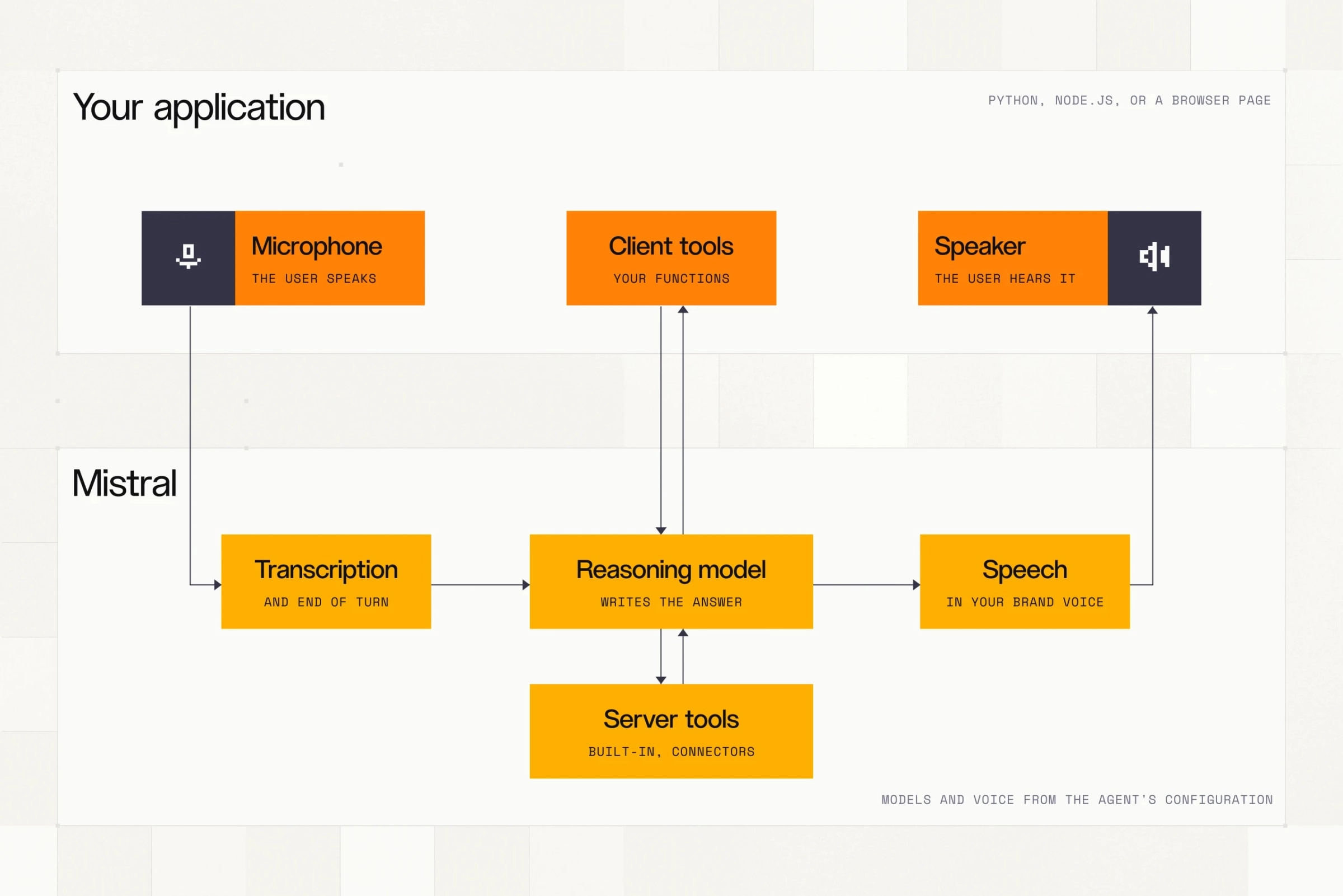 Figure: The Voxtral 3 Voice Agent architecture, integrating user audio, model inference, external tool calling, and speech synthesis into a real-time conversational loop. Source: Mistral AI official release.
Latency and Interruption Are the Real Hurdles
The latency threshold for human-computer conversation is unforgiving. Natural pauses in face-to-face human conversation sit in the range of a few hundred milliseconds; once a machine pause exceeds 800 milliseconds, callers instinctively suspect the line has dropped. In traditional cloud architectures, latency piles up across several hops: audio upload, model queueing to generate the first token, and downstream synthesis streaming, frequently accumulating past a full second.
Realtime Transcribe 3 compresses streaming transcription latency below 500 milliseconds, leaving ample headroom for subsequent tool execution and LLM inference. For customer service workflows, this headroom is indispensable: the model can query backend databases while the customer is still speaking, delivering an immediate answer the instant they finish their turn.
Another persistent obstacle is turn-taking and accidental interruption. Early systems relied strictly on volume thresholds for voice activity detection. A heavy breath or a slight pause mid-sentence would trigger the bot to cut the user off. Voxtral 3 combines acoustic features with joint semantic modeling to detect genuine end-of-turn signals, ensuring callers can pause and deliberate mid-sentence without being interrupted.
Error Rates Across 45 Languages Drop to 4%
In terms of core transcription capabilities, Voxtral Small Transcribe 3 achieved a 4.0% word error rate (WER) across 45 languages on the FLEURS benchmark, while the 4B Mini variant posted 4.1%. By comparison, Whisper large-v3 registered 16.0% and 14.9% on the same benchmark, competing alongside Microsoft MAI-Transcribe-2, Gemini 3.5 Transcribe, Scribe v2, and GPT-Transcribe.
In multilingual evaluations by Artificial Analysis, Voxtral Small Transcribe 3 ranked first across European languages including French, Spanish, Italian, Portuguese, and Dutch.
Enterprise deployments, however, care far more about messy multi-speaker environments. On conversational tests with speaker diarization, Voxtral Small recorded a concatenated permutation WER (cpWER) of 18.4%, compared to 38.4% for Gemini 3.5 Transcribe—a gap that determines whether meeting transcripts can be consumed directly or require extensive manual cleanup.
Domain-specific vocabulary is another major friction point. Context biasing allows developers to inject custom vocabulary lists prior to transcription, boosting keyword recall from a generic baseline of 81.4% up to 94.6%. Pharmaceutical names, medical jargon, and product SKU codes no longer depend on tedious post-hoc correction.
 Figure: Voice AI commercialization focuses on high-volume enterprise telephone networks and customer contact centers. Source: Mistral AI official release.
Data Sovereignty Decides Enterprise Contracts
Technical metrics are merely the table stakes. In enterprise procurement across banking, healthcare, and the public sector, vendors must satisfy stringent compliance standards: raw voice recordings contain biometric voiceprints, and under EU GDPR as well as regional privacy frameworks, cross-border transmission of biometric data faces heavy restrictions.
Most North American cloud providers operate solely as managed services, requiring customer voice streams to flow through designated public cloud infrastructure. Mistral offers two paths instead: calling endpoints hosted entirely within European Union borders, or downloading the open model weights to deploy inside the enterprise’s private datacenter, giving customers total control over data retention. For European financial institutions and government agencies, this option eliminates a major legal hurdle at the negotiation table.
The battleground for voice AI has shifted toward operational engineering costs and jurisdictional data control. Now that transcription accuracy has crossed the practical usability threshold, the vendors winning enterprise contracts are those that can solve two questions: how much does it cost per minute, and whose jurisdiction hosts the servers?
References:
- Mistral AI Official Announcement
- Hacker News Community Discussion
- Artificial Analysis Speech Models Evaluation Report
- BeSimple AI Voice Code Bench Benchmark