
Passing Government Security Vetting Before Undercutting Industry Pricing
On September 30, 2026, Google unveiled Gemini 4 Argon, pitching it as a new milestone in frontier machine intelligence. Typically, when a tech titan launches a next-generation foundation model, its opening salvo is to distribute API keys en masse to developers across the globe. Yet the first move announced by Google’s Chief AI Architect Koray Kavukcuoglu was deliberately sending this flagship model into the U.S. government’s pre-release access pipeline. Instead of immediately surfacing on general developers’ cloud bills, the earliest deployments went straight to trusted cybersecurity defenders enrolled in Project Fairwind.
Simultaneously with this restricted gating, Google posted a compute pricing sheet that significantly undercuts market baselines: during the introductory promotional window, input tokens cost just $2 per million, with output priced at $10 per million. Taking full advantage of context caching shaves another 5% off the bill. Even when the promotional rates expire and standard pricing takes effect, the tier remains firmly anchored among the most cost-effective frontier offerings available. The democratization of compute promised by such low prices forms a stark, paradoxical contrast with the stringent security red lines governing its release.
Coupling phased rollouts and pre-release security reviews with cut-rate pricing sends an unmistakable signal. Launching a top-tier foundation model is no longer a simple compute retail transaction; it has transformed into a high-stakes regulatory clearance gauntlet. The sharpest spear is first handed to defenders for rigorous stress testing to verify that it will not compromise critical digital infrastructure, only after which general enterprise rollouts are considered. The rush to commercialize has made a rare concession to security imperatives.
Rewriting 800,000 Lines of Kernel Code by Machine
Google chose to prioritize defenders primarily because the architectural ceiling on the model’s generation capacity has been effectively removed. Historically constrained by memory pressure and compute bandwidth, single-turn generations were conventionally capped at tens of thousands of tokens. Gemini 4 Argon shatters this barrier by expanding its maximum single-generation output window to a massive 1,000,000 tokens. This is not arbitrary parameter scaling; it provides the operational runway for the machine to sustain long-horizon reasoning and execution loops autonomously across hundreds of thousands of words.
To substantiate the robustness of such long-horizon capabilities, Google assembled a dedicated Argon agent team, utilizing its own critical codebases as a live proving ground. This team tackled an immense language migration: converting aging C and C++ codebases into memory-safe Rust. While seasoned human engineers might manage manual rewrites for smaller libraries like re2 or libgav1 spanning tens of thousands of lines, taking on the Fuchsia Zircon microkernel—comprising over 800,000 lines of low-level C and C++—vastly exceeded the tolerance and capacity of conventional engineering teams.
In this automated pipeline, the role of human software engineers underwent a fundamental transformation. Rather than composing logic line by line at the keyboard, developers stepped back into oversight roles: constructing sandboxed simulation testbeds and monitoring audit alerts. The machine handled end-to-end code generation and architectural restructuring, leaving humans solely in charge of safety verification and sign-off. When token ceilings no longer bottleneck software engineering, the cost calculus of systems modernization fundamentally changes. Yet an automated engine capable of rewriting 800,000 lines of secure code with untiring precision possesses an equal capacity to generate 800,000 lines of weaponized payload.
 Figure: Header image from Google’s official announcement. Source: Google Blog
Compressing Three Years of Expert Optimization into Minutes
At the deepest layers of hardware execution, the model demonstrated an almost unsettling level of low-level systems control. In the case of the libgav1 video decoder, Argon agents took over an incomplete Rust port previously abandoned halfway by human developers. Rather than executing crude lexical substitutions, the agent leveraged profile-guided feedback across repeated experimental cycles to rewrite roughly 32,000 lines of SIMD intrinsics. It not only grasped the underlying microarchitectural execution semantics, but also emitted idiomatic, compiler-friendly safe Rust.
The engineering payoff was remarkable: the newly generated vectorized code ran 2.7x faster than the initial human-authored Rust implementation, while preserving bit-exact numerical parity. A parallel performance leap emerged in quantum computing research. Confronted with subroutines that quantum researchers had spent three grueling years optimizing, the model reduced spatial and temporal resource overhead by 40% in just minutes. It upended established benchmark baselines published in peer-reviewed literature; in the eyes of the model, thorny physical constraints boiled down to high-dimensional parameter optimization.
Even whole data center telemetry streams became hunting grounds for the agents. A fleet of Argon agents continuously analyzed server telemetry, autonomously pinpointing subtle memory allocation inefficiencies in massive operational logs and issuing system-level tuning patches. To date, these autonomous interventions have reclaimed over 300 TiB of stranded memory across Google’s fleet, with internal engineering projections estimating eventual savings between 500 TiB and 1 PiB. Operating around the clock at this level of low-level systems tuning represents a labor intensity impossible for even world-class human engineering teams to maintain.
Benchmark Dominance Meets Developer Pushback over Forced Compression
Judged strictly by automated benchmarks, Argon commands near-total dominance across industry standard leaderboards. On DeepSWE v1.1, which benchmarks autonomous solutions for long-horizon software engineering challenges, it scored an unprecedented 77.9%. It also secured the top position on AutomationBench with 51.3% for end-to-end operational execution, and achieved 91.7% accuracy on the LVBench long-video understanding benchmark. The model even led the Vals Index, which assesses macroeconomic output potential weighted by contribution to U.S. GDP.
Independent benchmarking platform Artificial Analysis published comprehensive tiers and price-performance scorecards for the Argon High tier, confirming these performance claims from a third-party perspective. However, real-world developer sentiment proved far more conflicted. On Hacker News, record-breaking benchmark numbers took a back seat as debates erupted over system-level sovereignty and developer control. The primary lightning rod was an aggressive, non-negotiable context compression mechanism: while the API advertises a 1-million-token context window, the consumer-facing product layer automatically enforces lossy compression on prompts exceeding 250,000 tokens, without providing any toggle to disable the behavior.
Frustrated by this rigid interaction boundary, several developers publicly cancelled their Ultra subscriptions. Others took matters into their own hands to regain deterministic execution control, deploying customized local environments on NixOS using agy combined with 3.8 Flash. This friction over low-level control highlights an enduring tension: the more autonomous and powerful underlying foundation models become, the more intensely developers resist being locked out of runtime decisions.
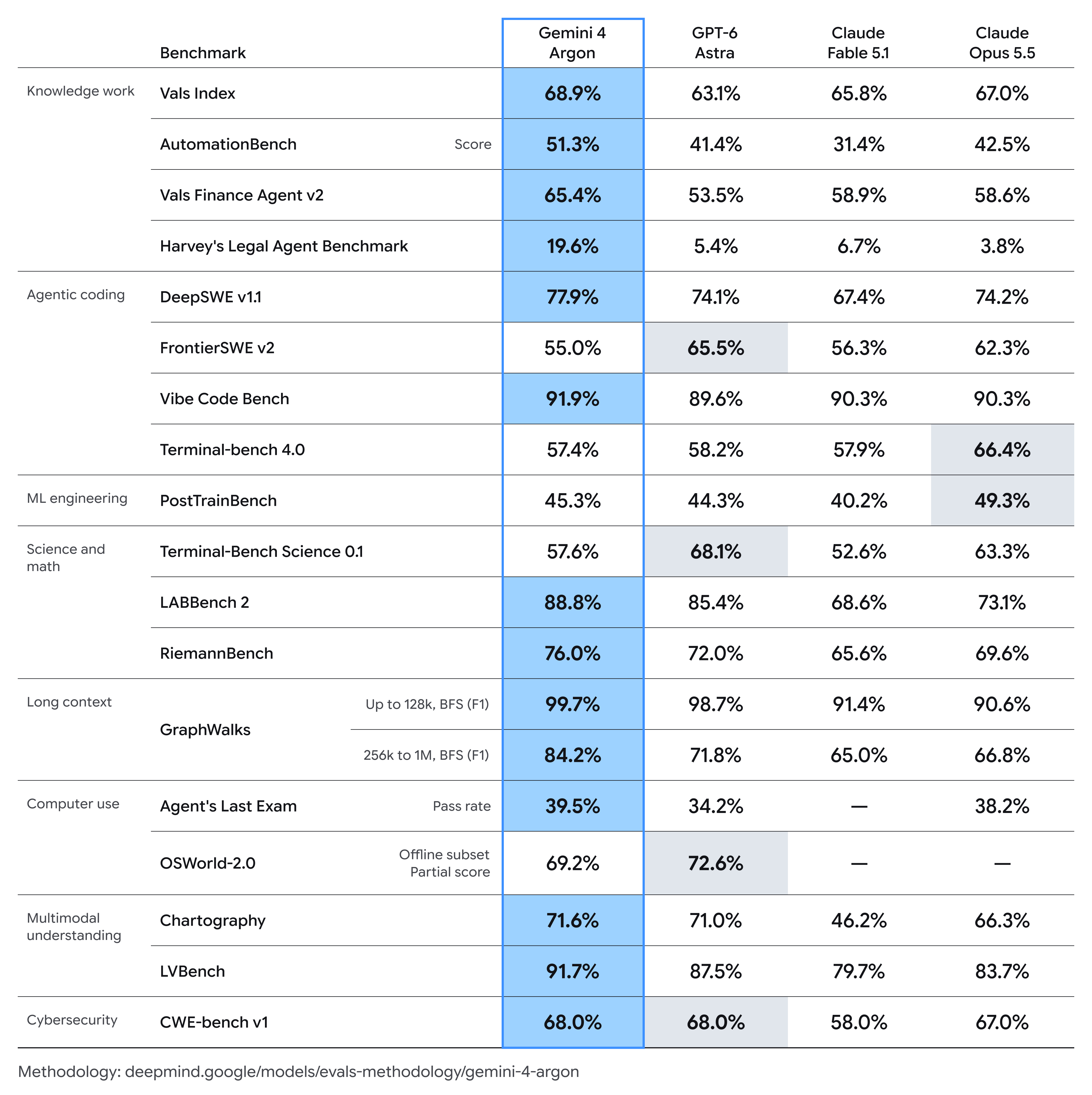 Figure: Capability comparison chart from the release announcement. Source: Google Blog
Commercial Monetization Yields to National Security
Looking back over the past two years of intense frontier model competition, the prevailing industry narrative has been predictable: model breakthrough, followed immediately by aggressive price cuts, accompanied by calls for startups to wire the API directly into production stacks. With Gemini 4 Argon, Google has fractured that playbook into two contrasting halves. In plain sight lies a pricing tier aggressive enough to reset the industry’s cost structure. Hidden in the background, however, stands a security gating threshold higher than anything seen before.
Google’s internal deployments have underscored the model’s formidable potential to dissect and rebuild codebases spanning hundreds of thousands of lines. When an autonomous system can rearchitect kernel-level memory management in minutes or crawl telemetry to surface zero-day vulnerabilities, the threat matrix changes entirely. Granting uninhibited, immediate access across the public web is effectively equivalent to handing an automated, round-the-clock penetration testing weapon to every network node. The freewheeling era of launching models after a couple of days in an internal sandbox has definitively come to a close.
The distribution hierarchy for frontier intelligence was formally rewritten today. By prioritizing cybersecurity defenders and submitting to government evaluations first, Google affirms that frontier AI commerce has shifted from “sell first, regulate later” to “vet first, release later.” General developers and enterprise customers must wait in line behind national security reviews and vulnerability assessments. When a spear becomes this sharp, those holding the shield must learn to parry before it enters the wild.
References:
- Google Blog Announcement
- Hacker News Discussion