
TRADE SECRET INFORMATION REDACTED PURSUANT TO NEB. REV. STAT. §§ 81-1527; 84-712.05 AND NAC TITLE 115, CH. 2
The filing documents are stamped with strict trade secret laws. But beneath the redaction layer lay the truth: 13 million gallons of water consumed annually and a peak power load of 52.65 megawatts.
Nebraska requires data centers operating in the state to submit infrastructure impact reports. Google submitted its PDF files with specific numbers blacked out. They put up a good front, but forgot to remove the underlying text characters from the document. Anyone could simply select the blacked-out layer with a mouse, copy it, and paste it into a blank document. The defense line, carefully wrapped in Nebraska state law, was instantly undone on the clipboard.
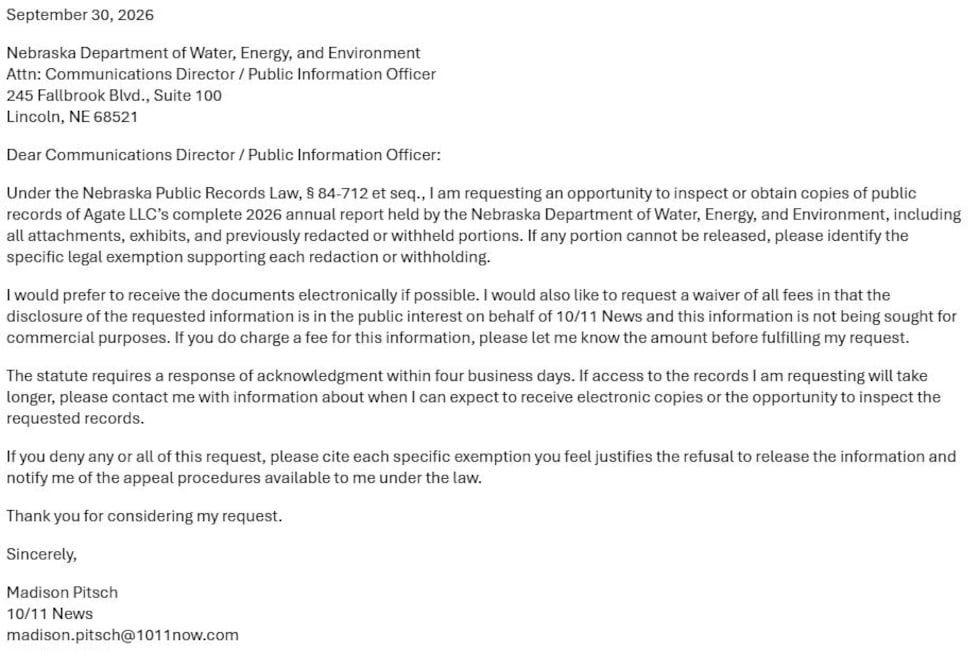 Image: 10/11 NOW submitted a public records request to the state Department of Environment and Energy (NDEE) to view the redacted information. Source: 10/11 NOW (Photo by Madison Pitsch)
Three Facilities Split Across Three LLCs
Rewind to July 20, 2026. Nebraska Governor Jim Pillen signed a specific executive order mandating that data centers operating in the state self-report to the Nebraska Department of Environment and Energy (NDEE). The core of the report was the specific impact of the facility’s operations on water resources, the power grid, and local infrastructure. The deadline for submitting these reports was set for September 30.
Google submitted its filing materials with its Lincoln, Omaha, and Papillion facilities each listed under an independent Limited Liability Company (LLC). The data center located at 5475 Cloud Court in Lincoln was listed under Agate LLC, with a total facility area of 288,530 square feet—roughly the size of five standard football fields.
The exposed underlying text revealed that this facility’s peak electricity demand in 2025 reached 52.65 megawatts. The annual water consumption was reported at 13.299 mega-gallons, or about 13 million gallons. To put that in perspective, this amount of water is enough to fill 20 Olympic-sized swimming pools.
 Image: Exterior of Google’s Lincoln data center. Source: 10/11 NOW
The Lincoln facility’s numbers were just a fraction of the total pool. The same batch of unredacted files revealed that the facility in Papillion was listed under Fireball Group LLC. This single data center consumed a staggering 547.88 mega-gallons of water annually, making it the most resource-intensive beast among all the reported projects by a wide margin.
By September 30, the state government had received data from six data centers. The combined water consumption of these six facilities over the past year stood at 765 million gallons, equivalent to the volume of 1,159.93 Olympic pools. By reporting under separate shell companies per facility, the public was left with regional details scattered across different legal entities.
Using PUE to Mask Absolute Consumption
Faced with such a massive physical resource footprint, Google offered a defense in its self-reporting based on energy efficiency ratios. The document claimed that its data centers’ average PUE (Power Usage Effectiveness) in 2025 was maintained at an ultra-low level of 1.09.
Beyond the PUE metric, Google also detailed the efficiency gains brought by its underlying hardware iterations. The report noted that the 7th-generation TPU “Ironwood” deployed in the facility achieved 30 times the performance per watt compared to the 2018 baseline. Even compared to the previous 6th-generation TPU, Trillium, the performance was doubled. They emphasized that the computing power provided per unit of energy by the overall hardware architecture has more than tripled in just five years. On the grid resilience front, the report highlighted that the facility has over 1 gigawatt of demand response capacity, ready to adapt during periods of grid stress.
By placing high-efficiency hardware specs alongside massive water and power consumption figures, Google tried to use performance-per-watt improvements and limit-pushing PUEs as a shield. This engineering rhetoric attempts to dilute the rapid expansion of absolute consumption with massive leaps in relative efficiency. However, exponential growth in compute density cannot offset the physical expansion of individual facilities.
Even if PUE is squeezed infinitely close to 1 and the 7th-generation TPU’s efficiency doubles again, the absolute consumption of 765 million gallons of water and the grid pressure of tens of megawatts still fall squarely on Nebraska’s local water and power systems. The progress in efficiency metrics is a fact; the massive drain on physical resources is equally undeniable.
A Multi-Million Dollar Tax Break Cloaked in Secrecy
The surge in resource consumption is just the upfront cost of the data centers. The deeper truth hidden beneath the PDF redactions involves massive tax exemptions tied directly to the state’s finances. The leaked original text showed that Agate LLC in Lincoln expected a tax refund of $55,822,472 in 2025. Fireball LLC in Papillion expected a refund of $39,171,573.39.
The Omaha facility was listed under Westwood Solutions LLC, with an expected tax refund of $22,558,881. Adding up the bills for these three independently reported facilities brings their expected total tax refunds for the year to over $117 million.
All three reports included a disclaimer next to the redacted areas, emphasizing that they have so far only utilized the sales and use tax exemptions under the Nebraska Advantage Act. The reports specifically clarified that the companies have not yet actually received any refunds, nor have they tapped into incentive funds from the ImagINE Nebraska Act.
Ordinary taxpayers bear the costs of grid expansion brought on by data centers. Yet, how much these large corporations actually pay in resource usage fees, and how much they expect back in legislative tax breaks, are all wrapped in the legal shell of trade secrets. Tax transactions worth over a hundred million dollars were treated as an internal ledger barred from public scrutiny.
Regulatory Blind Spots
The catalyst for this event was a public records request submitted by the 10/11 NOW (KOLN) television station on September 30. They attempted to go through formal channels to request the NDEE for access to the redacted information. But the technical execution of this legal secrecy was incredibly sloppy. The documents weren’t even flattened during generation, allowing anyone to simply drag, copy, and paste to see the plaintext.
The technical blunder itself is just the surface layer. The core loophole exposed by this incident is that the regulatory design paved a hidden path for these sensitive numbers from the very beginning.
Data centers, as massive new consumers, are adept at using trade secret clauses to remove themselves from the public ledger of resource consumption. Six facilities siphoned off the equivalent of 1,160 Olympic pools of water in a year, and a single facility expects a $55.82 million tax refund. Treating massive utility bills and multi-million dollar tax credits as competitive corporate secrets turns the state’s infrastructure carrying capacity into an unmonitored black box. Who consumes the reservoir quotas and who reaps the billion-dollar subsidies? These are the public costs carved into the local grid by every data center.
References:
- 10/11 NOW Report
- Nebraska State Government Data Center Filing Documents