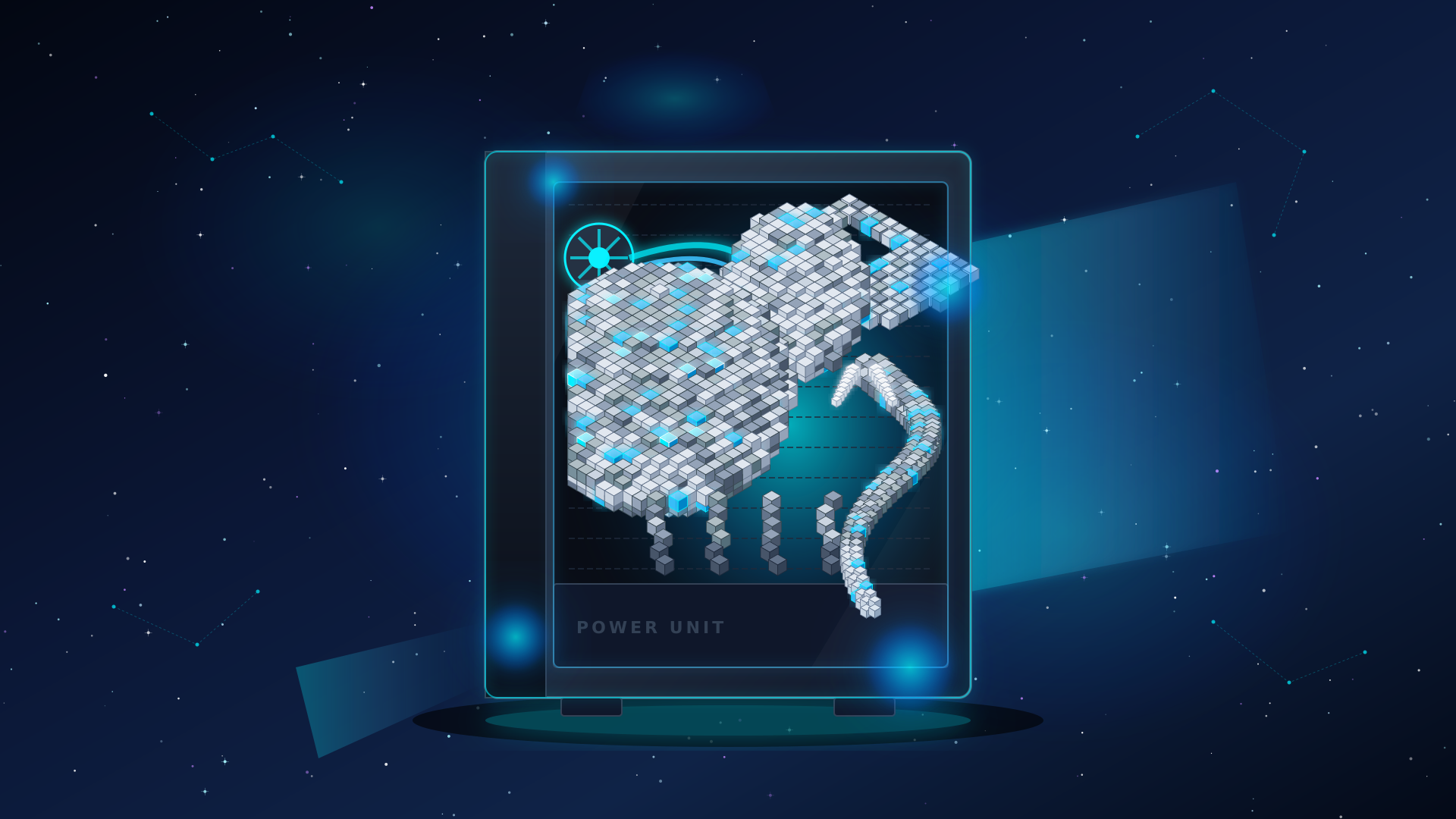
A standard desktop PC equipped with a 12GB gaming GPU can now smoothly run a top-tier 125-billion-parameter language model at a sustained 60 tokens per second.
For years, running models with hundreds of billions of parameters remained the exclusive privilege of hyperscale data centers. Renting multi-GPU rack servers was the non-negotiable price of admission. In 2026, three structural shifts dismantled that barrier simultaneously: the open release of frontier model weights, the maturation of fine-grained Mixture-of-Experts (MoE) architectures, and extreme quantization techniques pushed to their physical boundaries. Open-source inference engine Strata deploys an aggressive, tiered hardware scheduling pipeline to fit Qwen3.8-Flash-Next right beneath an ordinary desk. The marginal cost of frontier AI has shifted from recurring monthly cloud bills to the ambient electricity of a computer you already own. In the process, the real technical bottleneck has migrated from expensive VRAM capacity toward motherboard system memory and SSD read bandwidth.
Fitting 125B Parameters into 12GB VRAM
Cramming 125 billion parameters into 12GB of video memory sounds like trying to squeeze an elephant into a household refrigerator. Yet modern frontier models are far from monolithic slabs of compute. While Qwen3.8-Flash-Next contains 125 billion total parameters, it employs a Mixture-of-Experts architecture featuring 24,576 fine-grained expert networks. For every generated token, the gating mechanism routes work to only the top 10 most relevant experts. As a consequence, the active parameter footprint for any given computation shrinks to just 6 billion parameters.
Strata exploits this extreme architectural sparsity to fundamentally redistribute hardware workloads. It keeps several thousand of the most frequently called “hot experts” permanently resident inside the 12GB of VRAM, ensuring that core, high-frequency mathematical operations run on the fastest available silicon. Meanwhile, the remaining tens of thousands of “cold experts” are stored in host system RAM. This tiered caching interception strategy neatly sidesteps the tight VRAM bottleneck that previously hobbled consumer cards.
System memory and the CPU seamlessly take over the rest of the relay. Whenever an uncommon token requires a cold expert, the engine bypasses the GPU entirely and routes execution to the host CPU, leveraging AVX-512 or AVX2 SIMD vector instructions for parallel computation. This tiered caching architecture dismantles the dogmatic assumption that VRAM alone dictates local LLM viability. Through rigorous systems optimization, consumer-grade hardware can digest massive parameter clusters simply through intelligent scheduling.
Speculative Decoding and Multi-Token Verification Double the Speed
Tiered caching alone, however, cannot extract every ounce of performance from commodity silicon. To accelerate output generation further, the model incorporates an integrated 4-billion-parameter Multi-Token Prediction (MTP) head. This smaller model acts as a scout, rapidly anticipating the next sequence of words. The massive 125B base model then validates these speculative tokens in a single parallel batch. Compared to the conventional autoregressive rhythm of generating one token at a time, batch validation delivers drastically higher throughput.
This cooperative pipeline of speculation and verification boosts final generation speeds by 1.6x to 1.8x. Under the highest-compression Q2_0 quantization profile, a benchmark test rig equipped with an Nvidia GeForce RTX 5070 and an AMD Ryzen 5 7600 clocked an impressive 94 tokens per second. Even with the higher-precision IQ3_XXS quantization profile, throughput remained rock-solid at 62 tokens per second. Optimizing large models is no longer just about blindly pruning parameters; by re-architecting the execution pipeline, the throughput ceiling of consumer hardware has been forcefully raised.
The performance leap extends equally to prompt processing. When ingesting a prompt 32,000 tokens in length, the system processes input at a blistering 2,650 tokens per second. To navigate long documents safely, the runtime chunks text into blocks of at most 8,192 tokens, preventing extended context windows from exhausting available memory mid-task. Qwen3.8-Flash-Next natively supports a 260,000-token context window—expandable up to 1 million tokens via YaRN interpolation—granting a personal computer the ability to ingest and analyze entire novels in one pass.
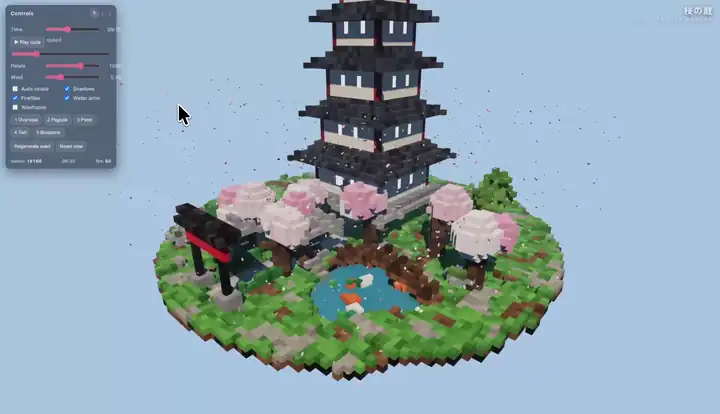 Figure: A voxel pagoda garden generated from a single prompt, running live in the browser. Source: Strata repository README
Local Execution Replaces Cloud Subscriptions
Once generation speeds and context lengths surpass practical usability thresholds, local deployment ceases to be a curiosity for hobbyists. Strata establishes a local server directly on localhost that exposes endpoints fully compatible with OpenAI and Anthropic API specifications. Developers do not need to alter their coding habits or tooling setups. Model weights are pulled automatically from Hugging Face via setup scripts, integrating local desktop hardware into existing AI development workflows with zero friction.
Whether configuring automated coding environments like Cursor or autonomous agents like Claude Code, requests can point directly to this local endpoint. This severs physical dependence on commercial cloud APIs. Developers no longer need to monitor compounding API invoices, nor do they have to accept the security risks of transmitting sensitive proprietary code over external networks. As long as the desktop remains powered on, access to frontier-class intelligence remains unlimited.
The system’s hardware compatibility extends across vendor boundaries. On AMD’s Radeon RX 9070 XT, this 16GB graphics card achieves an identical 60 tokens per second under Q2_0 precision. Strata builds directly upon the proven open-source foundations of llama.cpp and ggml, incorporating state-of-the-art quantization schemes from ISTA-DASLab and Unsloth to pack massive models onto home computers. A robust consumer hardware ecosystem is taking shape: AI compute is repatriating from centralized data centers back to developer desks.
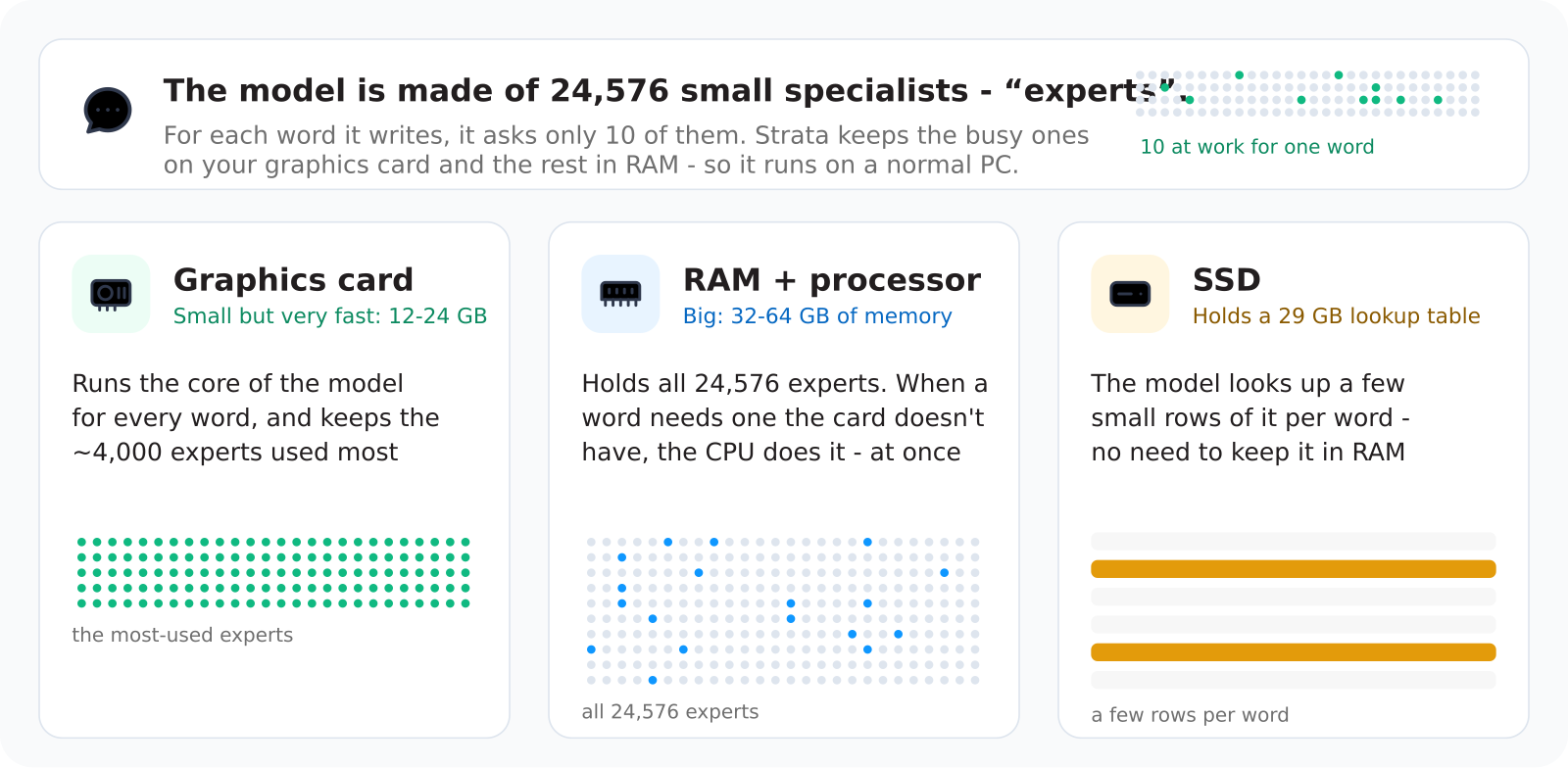 Figure: Official hardware scheduling diagram showing the allocation of data across VRAM, system RAM, CPU, and SSD. Source: Strata repository docs/media
Storage Bandwidth Becomes the True Bottleneck
Migrating datacenter compute to the desktop is not without friction. Once the graphics card ceases to be the sole bottleneck, massive throughput pressure cascades directly onto other hardware components. To sustain speculative execution, the architecture incorporates a 51-billion-parameter n-gram embedding table, which is mapped directly onto the solid-state drive as a persistent lookup structure.
Consequently, storage read throughput emerges as the system’s new pinch point. Massive weight files must be streamed continuously; the default Unsloth UD-IQ4_XS quantized release weighs in at 94GB on disk. If a computer has less than 80GB of physical RAM to hold all expert networks, the runtime must stream missing cold experts directly from the SSD in real time during generation. The moment cross-drive reads take place, fluid generation speeds suffer an immediate, precipitous drop. Once raw compute demands are satisfied, memory bus bandwidth dictates the model’s true performance floor.
The 12GB VRAM allocation is stretched to its absolute physical limits in this setup. If multimodal inputs like images are introduced during text generation, the vision encoder instantly exhausts any remaining memory headroom. The project’s official deployment guidelines explicitly instruct users to reserve 1GB of VRAM via a command-line flag whenever processing images. Without this buffer, the RTX 5070 is left with barely 200MiB of free VRAM, causing the entire process to deadlock.
Running 125 billion parameters pushes current consumer GPU architectures to their physical boundaries. Yet Strata demonstrates that massive parameter counts are no longer the exclusive preserve of cloud hyperscalers. When an ordinary 12GB desktop GPU can sustain over 60 tokens per second across demanding long-horizon workloads, the rules of LLM deployment have permanently shifted. The next breakthrough in personal computing will not hinge solely on raw GPU compute, but on how motherboard interconnects and memory architectures are reimagined for local AI.
Reference Links:
- Strata Repository README and Benchmark Data
- Qwen Model Release Announcement