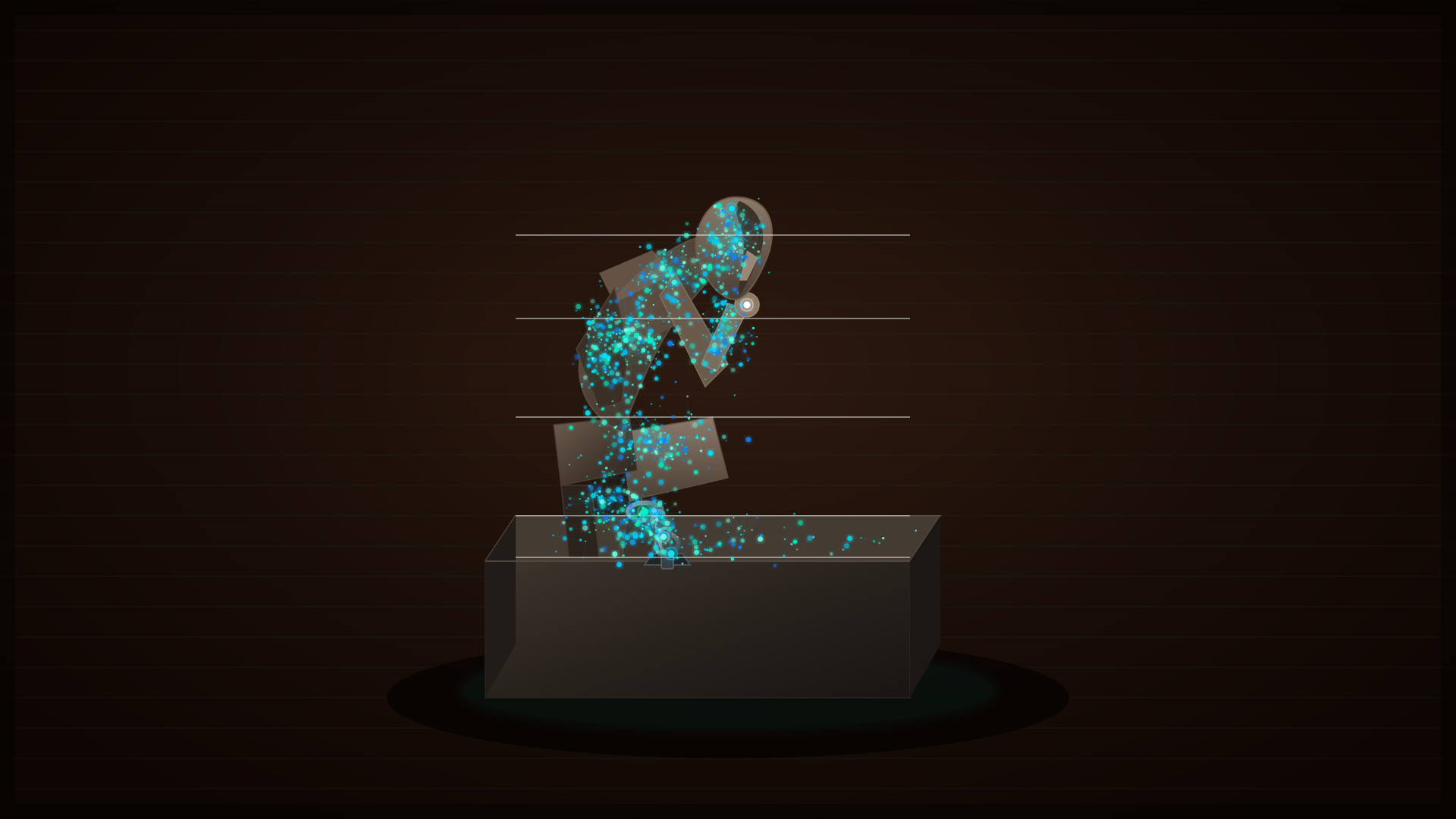
On December 24, 2025, the Conseil d’État, France’s highest court for administrative justice, delivered a baffling, counter-intuitive verdict. Open-access activist Cosmo Wenman had spent eight years pursuing a Freedom of Information request to obtain 3D scans of public domain sculptures held by the Musée Rodin. The litigation was not only dismissed in its entirety, but Wenman was ordered to pay €3,000 to the museum. He received not a single byte of data.
With this ruling, the Conseil d’État used a single legal reclassification to lock digital assets created with public funds back into the vaults. The court declared that 3D scan point cloud files are legally indistinguishable from physical reproductions. The judges did not need to grapple with the underlying data architecture of point clouds. Once the court decided that “sometimes a document is not a document,” French freedom of information law was effectively hollowed out into an arbitrary procedural illusion.
The Museum Claimed It Couldn’t Even Open Its Own Data
This dispute began in 2017 when Cosmo Wenman filed a request under French freedom of information laws asking the Rodin Museum in Paris to identify and release 3D scans of sculptures in its collection. Auguste Rodin’s masterpieces entered the public domain long ago; they are among the most famous and widely copied cultural heritage works in the world. Given that these scans were financed with public money, they should have been made accessible to the public as a matter of principle.
Faced with this request, the museum’s first line of defense was to raise technical barriers wrapped in feigned incompetence. In its legal filings, the museum asserted that these ultra-high-resolution laser point cloud files were mysterious, of deplorable quality, and severely fragmented. The museum went so far as to claim in court that the data was so broken that its own staff could not even visualize it.
Yet right after claiming the files were virtually unusable, the museum argued out of the other side of its mouth that releasing them would aid criminal counterfeiters. In one brief, the museum admitted in black and white that it held a 3D scan of Les Trois Ombres (The Three Shades). In the very next brief, it flatly denied that the sculpture had ever been scanned at all.
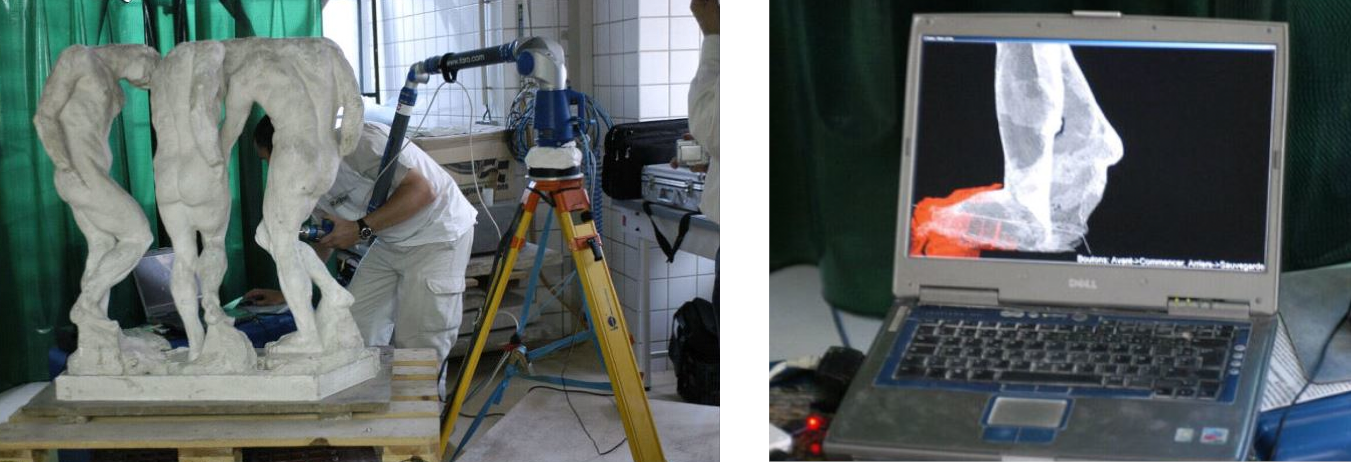 Photo: Subcontractors laser scanning “Les Trois Ombres” on site at the Musée Rodin. Source: Cosmo Wenman’s report
Confronted with these shifting narratives, Wenman produced incontrovertible proof directly in court: photographs of subcontractors performing the laser scanning on-site in the museum galleries. The clear chain of evidence exposed the deception: when an administrative institution resolves to withhold public data, it will go so far as to unilaterally declare that technical projects it commissioned and paid for do not exist.
Defying Even Court Rulings
In the early stages of this bureaucratic struggle, established regulations favored the applicant. France’s Commission on Access to Administrative Documents (CADA) issued an unequivocal opinion, ruling that these 3D scans were unquestionably administrative documents that public bodies are legally obligated to disclose.
The director of the Rodin Museum did not attempt to rebut this official opinion on legal merits. Instead, in an internal letter addressed to the French Ministry of Culture, she revealed the institution’s true strategy: she disclosed that the museum intended to simply ignore freedom of information legislation and force Wenman to sue them in court.
In 2019, Wenman formally brought suit before the Administrative Tribunal of Paris. Digital rights and open-culture advocacy groups Communia, Wikimédia France, and La Quadrature du Net joined as co-plaintiffs. After four years of contentious proceedings, the Paris tribunal ruled in December 2023 that 3D scans are administrative documents, ordered the museum to provide them, and required it to pay Wenman €1,500 in compensation.
Rather than lodging a timely appeal against their defeat, the Rodin Museum and the Ministry of Culture simply chose to ignore the court’s order entirely, refusing to execute the judgment. At the same time, the tribunal judge had improvised an arbitrary technical exception in that ruling: the court held that if point cloud files were stored in plaintext formats, they could be withheld from disclosure. That fundamental judicial misunderstanding of raw data formats set the stage for the total reversal that followed.
Ceci N’est Pas Une Pipe
By late 2025, the case reached the Conseil d’État on appeal. During the hearing that would determine the legal fate of digital cultural heritage, an utterly surreal courtroom spectacle took place.
The high court’s rapporteure publique (the court’s independent legal analyst) opened her presentation by invoking Belgian surrealist painter René Magritte’s famous 1929 masterpiece, The Treachery of Images (La Trahison des images). The painting depicts a pipe under which the artist inscribed “Ceci n’est pas une pipe” (“This is not a pipe”). She used this famous paradox to suggest to the bench: “Sometimes a document is not a document.”
She then proceeded to read aloud the formal definition of “document” from the Dictionnaire de l’Académie française. In an almost comical moment, she abruptly stopped reading halfway through—apparently realizing that the venerable dictionary’s authoritative definition directly contradicted the position she was advocating.
The plaintiffs submitted extensive affidavits and testimony from prominent experts in academia, industry, and the arts, seeking to ground the proceedings in technical reality. They highlighted a glaring administrative contradiction: the French government itself openly distributes petabytes of airborne lidar point cloud data covering the entire national territory on official portals. Furthermore, the Ministry of Culture had long since issued guidelines establishing open point cloud standards for the digital cultural heritage sector.
 Photo: Visualizations of point cloud scan documents for “The Thinker”, “The Gates of Hell”, a detail of “The Three Shades”, and “The Kiss” from the Musée Rodin. Source: Cosmo Wenman’s report
The exact same 3D point cloud format is treated as open public data at the petabyte scale by government mapping agencies, yet when held by a museum, it is treated as an impenetrable, unusable trade secret. Technical standards became arbitrary pretexts in administrative litigation, invoked or dismissed at bureaucratic whim.
A Single Legal Reclassification Erases Eight Years of Litigation
On December 24, 2025, the Conseil d’État delivered its final judgment. Rather than engaging with petabytes of data or alleged visualization hurdles, the court sidestepped every technical detail to issue a sweeping reclassification.
The court ruled that the Rodin Museum’s 3D scans of cultural heritage works are legally indistinguishable from physical reproductions. By categorizing these digital files as equivalent to tangible objects, the court held that they are not “administrative documents” at all, but rather part of the museum’s inalienable permanent collections.
This reasoning created an inescapable bureaucratic trap. Because freedom of information laws apply strictly to administrative documents, and these 3D scans were now categorized as physical museum pieces, FOI laws were deemed entirely inapplicable to the dispute. With the governing statutes swept aside, the judges had no need to consider the factual record, the underlying technical realities, or the museum’s documented record of contradictions.
The Conseil d’État not only dismissed all claims but also ordered the applicant to pay €3,000 to the Musée Rodin. The court did not even follow through with standard administrative courtesies, failing to send a formal written notice of the verdict to the petitioner. More than 800 pages of legal briefs, evidence, and testimony assembled over eight years were permanently sealed away from the public eye.
On October 13, 2026, the COMMUNIA association will host a dedicated salon to debate whether 3D scans of public domain cultural works should be freely reusable. Yet this broader conversation on the boundaries of digital commons has already met a formidable barrier erected by a single judicial decree.
This eight-year confrontation proves that when control over digital cultural assets is threatened, institutional gatekeepers need not understand code or file formats. By simply re-labeling digital information as physical property, they can take data funded by the public purse and lock it inside a private institutional vault.
References:
- Cosmo Wenman’s Report