On September 28, 2026, developer Simon Green finally had a chance to put his home automation setup through a live field test. He had outfitted six household wheelie bins with ultra-wideband (UWB) radio tags, crushing distance measurement errors down to just three centimeters at ten meters. Yet during the three-plus hours the bins spent curbside awaiting collection, the system lost signal entirely. When an “emptied” notification finally trickled in, it was 58 minutes stale—promptly rejected as invalid by his automation scripts.
The experiment highlights a universal engineering reality: sensors deliver raw precision, not absolute truth. Between centimeter-level accuracy and genuinely knowing what took place in the physical world lies an entire chain of fragile RF links.
Ditching RSSI Guesswork: Down to a 3-Centimeter Error at 10 Meters
The initial motivation for the project was remarkably straightforward. Simon’s Home Assistant instance already tracked which bin needed to go out on any given collection day, but it had no way of knowing whether someone had actually wheeled the bin out to the curb. His early solution relied on cheap Bluetooth Low Energy (BLE) beacons paired with an outdoor ESP32 Bluetooth proxy, estimating distance using Received Signal Strength Indicator (RSSI) values.
Relying on signal strength to infer physical distance, however, is a notorious dead end. Radio signal attenuation depends on far more than sheer distance. Brick walls, cars parked in the driveway, multipath reflections off fences, antenna orientation, and even minor battery voltage drops all drag down signal strength. A “weak signal” could indicate that a bin had been rolled 20 meters down the street—or simply that the tag was sitting directly behind a car door. The result was rapid battery drain, wildly drifting distance readings, and outdoor proxies that frequently crashed under load.
UWB adopts a fundamentally different approach. Instead of guessing distances from murky signal amplitude, it directly measures the time of flight (ToF) of radio pulses traveling between two transceivers. Distance estimation becomes simple physics: travel time multiplied by the speed of light. Physical location transforms from an environmental guessing game into a deterministic calculation.
Field benchmark data demonstrated the power of this physical shift. During a rigorous calibration run using a physical tape measure set to 10.1 meters, the system recorded an average reading of 10.09 meters, with a standard deviation of barely three centimeters. By replacing signal intensity mapping with precision timestamps, spatial distance ceased being radio voodoo and became a reliable set of physical coordinates.
$330 for High Precision: You Still Can’t Route Around Antennas and Cars
Upgrading hardware carried a tangible price tag. To track six wheelie bins, Simon initially spent $123.64 on two Makerfabs ESP32-WROVER / DW3000 development boards for proof-of-concept testing. Once confident in the approach, he invested another $330 to purchase ten production KKM K4W tags along with a dedicated programming fixture, bringing total expenditure to $453.64.
These production tags feature a Nordic nRF52833 system-on-chip paired with a Decawave/Qorvo DW3110 RF transceiver, an onboard ST LIS3DH accelerometer, and a substantial CR2477 coin cell battery—a hefty power cell the author noted he had never encountered before. While the hardware specifications were top-tier, UWB is still governed by electromagnetism. Adopting an advanced protocol does not make parked vehicles transparent; physical obstacles remain physical obstacles.
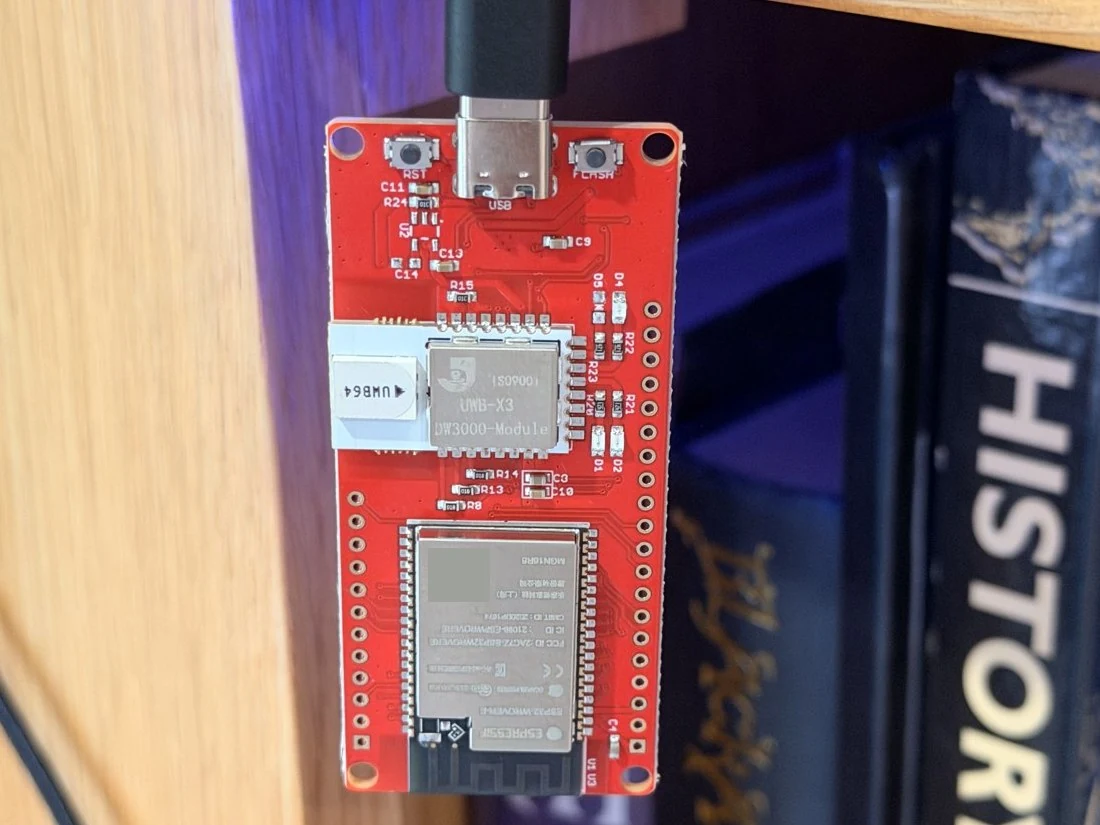 Figure: The Makerfabs ESP32-WROVER development board used for prototyping, showing the UWB module and antenna. Source: Simon Green’s project log
Outdoor walk tests quickly revealed the fragile baseline of the radio link. Over an unobstructed line-of-sight range of roughly 30 meters, distance measurements remained rock-solid, with a single maximum reading reaching 37.28 meters. But whenever a vehicle crossed into the line of sight, the communication path vanished instantly. The sheet-metal body of a car acts as an effective RF shield, completely erasing UWB’s physical advantages.
Antenna orientation introduced an even more dramatic variable. In an edge-of-range test at approximately 10 meters, simply flipping the tag’s circuit board from lying flat to standing upright caused the packet success rate to leap from 37% to 100%. Tuning the radio parameters—dropping the data rate and lengthening the preamble—partially addressed the initial handshake failures at high transmission speeds. Yet the laws of physics remain impartial: high radio frequencies cannot penetrate solid metal, and antenna polarization mismatches ruthlessly chew through already tight link budgets.
Precision Can’t Prevent Packet Loss: A 58-Minute Blackout Swallows the Alert
The core tracking logic established a clear 10-meter boundary: readings under 10 meters were classified as “Home,” while anything beyond was tagged as “Out.” During controlled yard tests, the logic performed flawlessly—until the real-world garden waste collection day on September 28.
The timestamp logs from that morning became undeniable evidence of the system’s blind spot. At approximately 7:05 AM, the bin began moving and successfully crossed the 10-meter perimeter. Immediately after crossing the threshold, however, the tag dropped off the network entirely, failing to deliver a single packet for more than three hours.
At 10:25 AM, the bin re-entered the anchor’s coverage area. The network promptly ingested an “emptied” event payload bearing an internal accelerometer timestamp of 9:27 AM. Having sat trapped in a radio void for nearly an hour, the message was 58 minutes old—well beyond the automation script’s 30-minute staleness tolerance threshold. As a result, the automated push notification declaring “Bin Just Emptied” was suppressed.
Throughout this blackout, the indoor anchor’s MQTT connection remained completely stable, and other stationary bins in the yard reported their ranges without interruption. Exactly why that specific tag failed to reach the anchor from the curbside collection spot remains an open question. Even if an edge node’s distance sensor resolves down to millimeters, the moment the transport link breaks, downstream business logic collapses instantly.
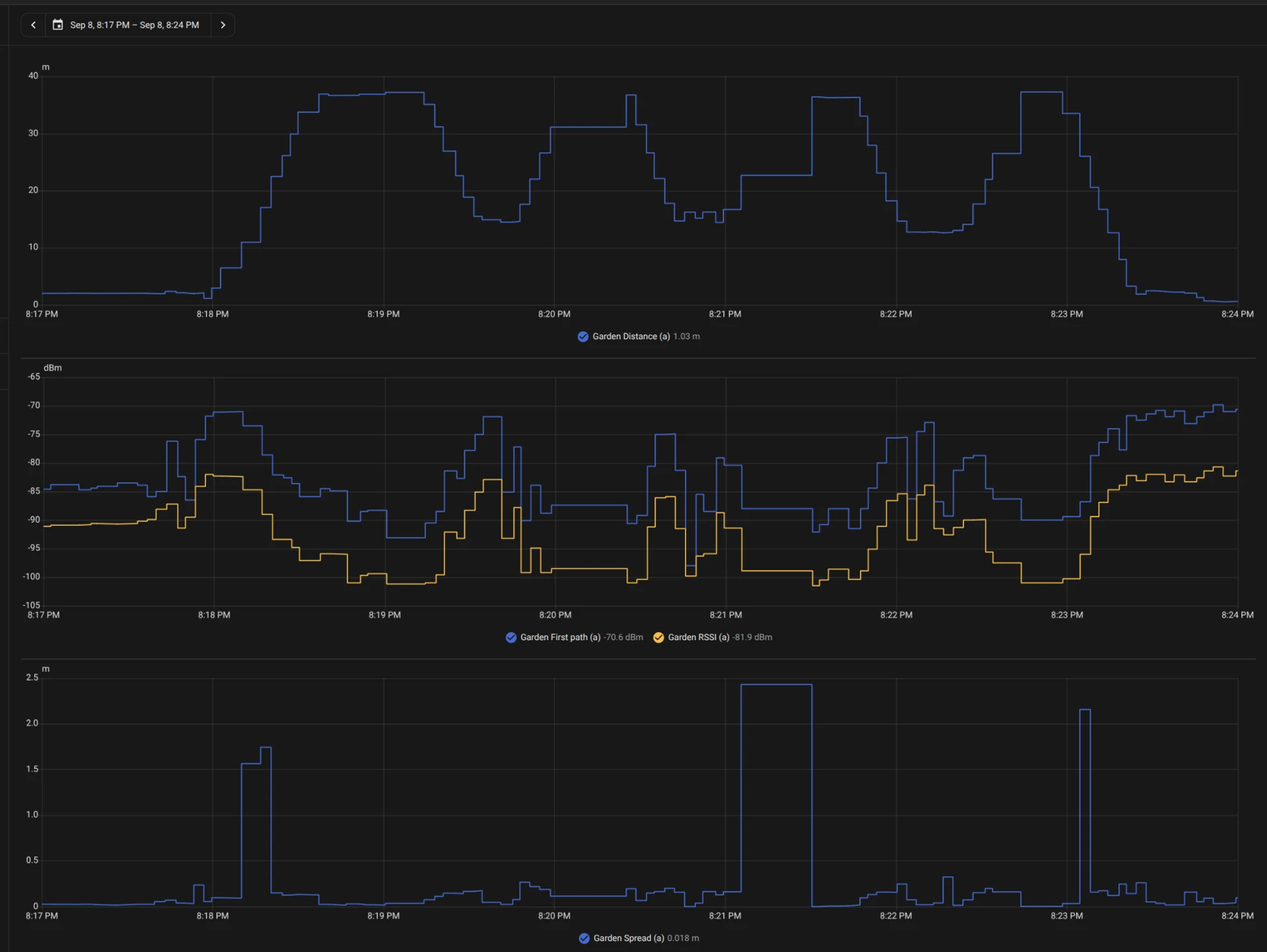 Figure: Distance curve recorded during outdoor walk testing, with diagnostic data on signal strength and measurement dispersion below. Source: Simon Green’s project log
Embracing Disconnection: Beating Missing Telemetry with Presumed States
Confronted with unpredictable RF dead zones, the developer resisted the urge to deploy additional anchor nodes to carpet the yard with coverage. Instead, he reworked the software state machine. Under the original design, prolonged data silence caused an “Out” status to degrade into “Unknown,” injecting chaos into downstream automations.
The revised version took a different stance toward missing telemetry. Once the system observes a decisive departure movement, it locks the bin’s state into “presumed Out.” Even if the device experiences hours of radio silence, or if the Home Assistant server itself restarts, that departed state remains firmly preserved in the database.
Device connectivity is no longer tightly coupled to operational status. Connection health was uncoupled and exposed as an independent diagnostic entity, treating disconnection as an expected network state. For a bin to transition back to “Home,” it must generate a fresh, verified reading inside the 10-meter boundary. Meanwhile, the anchor publishes its ranging telemetry autonomously via MQTT, and Home Assistant automatically provisions virtual devices for each tag. Without relying on external cloud services, the low-level ranging mechanism between anchors and tags keeps running smoothly even if Home Assistant crashes.
Letting go of the fantasy of 100% wireless uptime and baking packet loss into core business logic gave this home IoT setup genuine resilience. As for the lingering challenges—mapping signal dead spots between storage sheds and curb points, weatherproofing the enclosures, evaluating battery drain over weeks of operation, and experimental attempts to track the family cat using four-anchor triangulation—those will have to wait for the next engineering iteration.
Reference Links:
- Simon Green’s project repository