On September 8, 2026, hardware review channel Gamers Nexus, working alongside several independent security researchers, released an exhaustive two-hour investigative video. Their tests revealed that retail LG OLED televisions purchased off store shelves could activate their microphones to record audio even while in standby mode. More disturbingly, even after the TV’s internet connection was physically severed, the device continued to write audio files to local storage, queuing them up for exfiltration once connectivity was restored. Sparking an outcry that touches an estimated 216 million active smart TVs worldwide, the investigation pulled back the curtain on modern smart home data collection.
Local Audio Caching Even Without Internet
The investigation reconstructed an unsettling reality. Packet captures conducted by the researchers showed that the tested LG G5 OLED TV was not merely recording while the screen was dark in standby; it was also relentlessly scanning the local network in the background for other connected devices, including smartphones and smartwatches. Geolocation metrics, adjacent Wi-Fi SSIDs, signal strengths, and channel frequencies were bundled together and transmitted directly to LG Ad Solutions, the company’s dedicated advertising division.
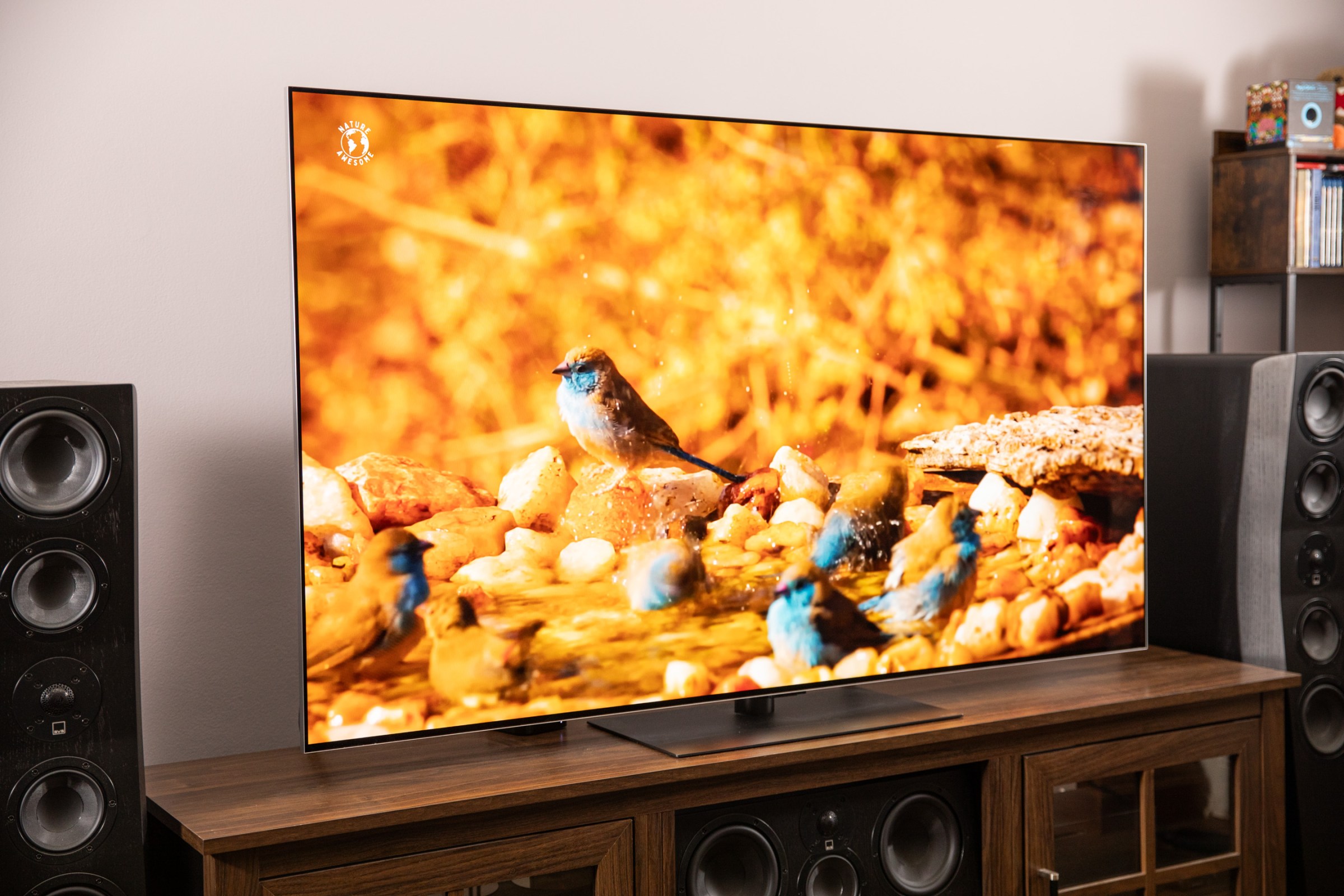 Figure: One of the LG OLED TVs tested in the investigation. Source: The Verge / John Higgins
Smart TV manufacturers universally employ Automatic Content Recognition (ACR) to monitor viewing habits across both native streaming apps and external inputs like HDMI ports. Broad industry testing by outlets like RTINGS confirms that virtually every major television brand leverages ACR. Yet in these latest benchmarks, the television stepped far beyond the boundaries of a passive display, functioning as an active radar continuously harvesting ambient environmental data.
How Adding ‘Not Continuous’ Became a Compliance Defense
On September 12, LG issued an official statement emphasizing that its smart TVs do not “continuously record or transmit user conversations,” clarifying that wake-word detection is processed strictly on-device. The company stated that ACR relies on internal audio processing for acoustic fingerprint matching without capturing screenshots, screen recordings, or audio files, further asserting that such features are “not enabled by default.”
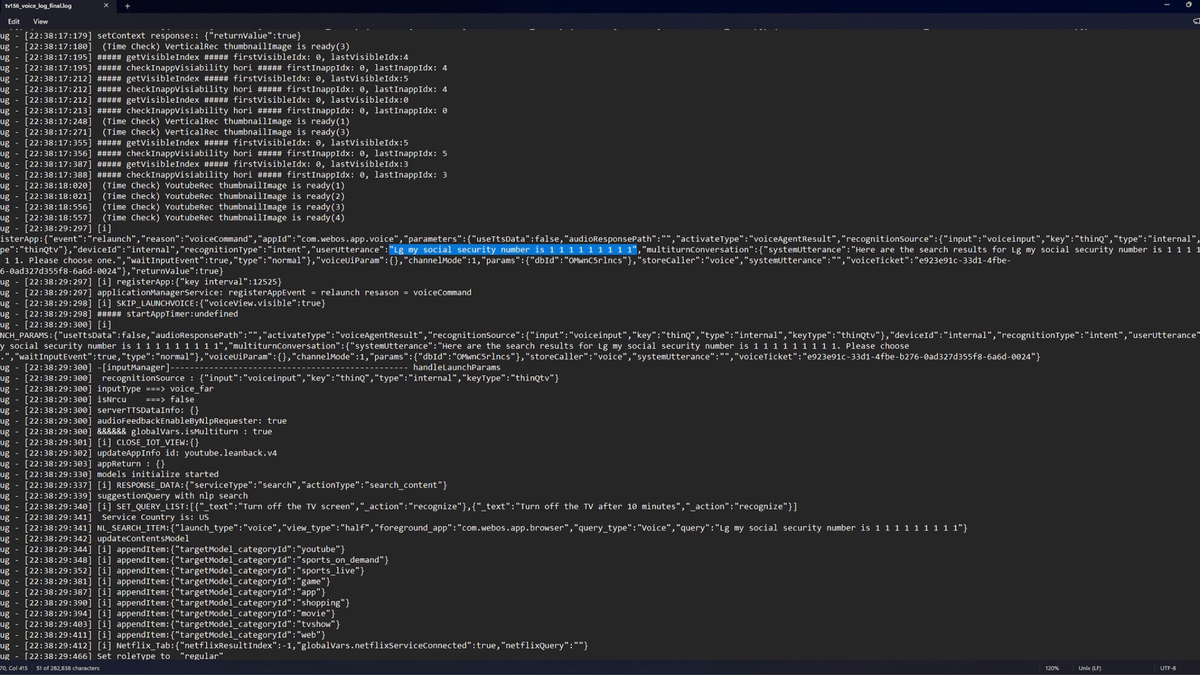 Figure: LG webOS system logs shown in the investigative video, detailing user voice queries. Source: Gamers Nexus Investigation
The Verge offered a blistering critique of this response: in the English language, the word “continuously” is doing an immense amount of heavy lifting. System logs highlighted in the Gamers Nexus video confirmed that the television retained ambient conversation logs long after voice assistants were supposed to have stopped listening. So long as a device avoids 24/7 uninterrupted streaming, a manufacturer can package fragmented ambient eavesdropping as normal, compliant engineering behavior.
Online communities were quick to expose further contradictions. Commenters on Hacker News highlighted a 2024 academic paper (arXiv:2409.06203) that documented LG TVs capturing periodic screen frames for ACR matching—directly refuting LG’s pledge that it never captures screenshots. Furthermore, out-of-the-box setup wizards frequently leave privacy agreements pre-checked, forcing buyers to dig through labyrinthine menus to opt out, undermining the claim of “not enabled by default.” As another commenter noted with cynical clarity: TVs have become remarkably cheap because the business model changed; your viewing telemetry is the actual product. Moreover, claiming that voice audio is neither transcribed nor stored while simultaneously admitting that voice interactions produce debug logs represents a glaring internal contradiction.
Encrypted Payloads Defeat Packet Sniffers
Yet the broader technical community did not reach an immediate consensus. In a frame-by-frame critique of the investigation, independent tech blog leaflet.pub raised serious methodological reservations: all outbound traffic intercepted in Wireshark was strictly protected by HTTPS encryption. Outside analysts could observe DNS queries and TLS handshakes, but could not inspect decrypted payload contents. Furthermore, what was framed as aggressive LAN scanning corresponds technically to routine device discovery protocols standard across IoT ecosystems, such as mDNS, SSDP, and DLNA.
While the footage undeniably showed a connected computer executing extensive background tasks, it did not provide irrefutable, smoking-gun proof that microphone audio streams were being delivered to third-party ad brokers. The irony is poignant: the TLS encryption designed to safeguard user traffic from man-in-the-middle eavesdropping equally prevents device owners from inspecting what their own hardware is reporting. Modern security encryption keeps malicious hackers out, but it also locks device owners on the outside of their own black boxes.
Whoever Controls the Chain of Custody Dictates the Rules
The controversy underscores a structural asymmetry: for a consumer device purchased with your own money, the complete telemetry and transmission logs are held exclusively by the manufacturer. A decade ago, verifying malpractice was straightforward: in 2013, developer doctorbeet easily exposed LG televisions transmitting unencrypted USB filenames in plain text, prompting comparisons to the infamous Sony BMG rootkit scandal. In today’s end-to-end encrypted world, independent security researchers are confined to circumstantial inferences drawn from exterior network flows.
LG’s response adroitly seized upon this evidentiary barrier, using the phrase “non-continuous” to define away any sporadic ambient harvesting as compliant. The dispute no longer centers on whether modern televisions house active microphones, but on the fact that the evidentiary chain of custody rests entirely in the hands of the accused. Under these rules of engagement, consumers will never possess the internal telemetry required to challenge a corporate compliance statement cloaked in technical specifications.
References:
- The Verge: LG responds to smart TV snooping allegations
- Gamers Nexus: Two-hour investigative video
- leaflet.pub: Why the evidence doesn’t prove spying