1,008 GB in 10 Days: Data Center Traffic Crushes a Kitchen Router
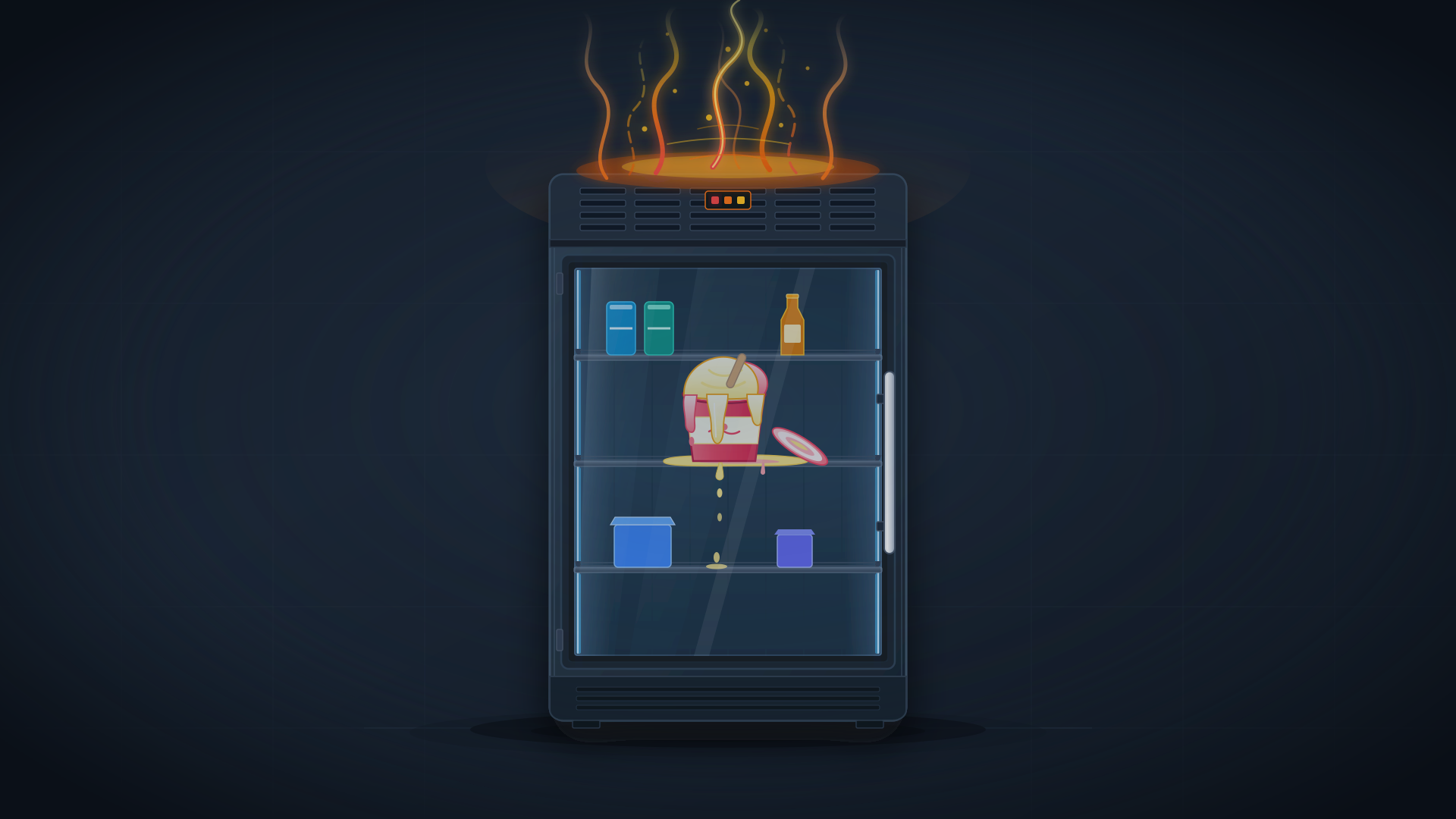
On October 6, 2026, developer Nomad was troubleshooting his parents’ home Wi-Fi. With a decade of IT experience under his belt, he immediately identified an unexpected guest clogging the airwaves: a Keurig smart coffee maker sitting innocently on the kitchen counter. Over the course of just 10 days and 9 hours, the appliance had racked up a staggering 1,008 GB of upload traffic. A machine designed merely to brew hot beverages had congested the household wireless access point, bringing everyday internet connectivity to a crawl.
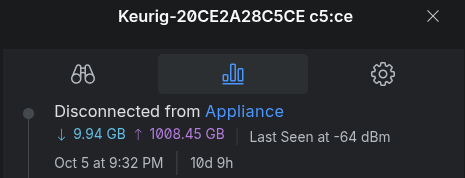 Figure: 1,008.45 GB uploaded across 10 days and 9 hours. Source: Screenshot shared by @NomadsGalaxy
A volume of 1,008 GB is not generated by a few brewing commands or temperature presets; it rivals the entire monthly traffic of a small business web server. When security researchers discovered an LG smart washing machine pushing 3.6 GB of outbound traffic per day, it was widely condemned as an egregious case of corporate over-collection. Yet this Keurig brewer was moving nearly 100 GB daily—roughly 28 times the volume of that notorious washing machine.
This traffic dwarfs any legitimate need for firmware updates or routine telemetry. It certainly wasn’t triggered by someone pressing physical buttons on the countertop. An appliance originally bought to boil water and brew coffee had effectively imported data center-scale network burdens into an ordinary kitchen, shifting from a humble household gadget into an insatiable bandwidth sponge.
Trapped on the LAN, but the Homeowner Foots the Bill
After inspecting packet captures, Nomad discovered that the 1 TB of traffic was not actually traversing the upstream WAN out to the open internet. Instead, it was looping ceaselessly inside the local area network. What was unfolding behind the router was an aggressive, high-frequency metadata sniffing and reconnaissance scan: the coffee maker was relentlessly sweeping the subnet, attempting to catalog and fingerprint every active device on the home network.
Even though the data remained on the local network, the physical consequences landed squarely on the homeowners. Pumping a terabyte of multicast and broadcast discovery traffic over Wi-Fi can easily saturate consumer-grade routers, hogging radio airtime and consuming routing CPU cycles. This continuous reconnaissance costs the manufacturer zero cloud bandwidth dollars, yet the resulting electricity usage and hardware degradation are entirely absorbed by the customer.
After power-cycling the coffee maker and isolating it onto a separate network segment, the abnormal traffic finally subsided. Nomad suspected a firmware bug—perhaps an unthrottled infinite loop in the discovery routine. But that highlights the most insidious aspect of the modern smart home: whether driven by malicious intent or negligent engineering, the operational costs are invariably externalized onto unwitting buyers.
In his post, Nomad clarified that while he generally never dictates what appliances his parents purchase, as the person maintaining their network, he decided on the spot to replace the machine. He refused to let his parents keep a connected gadget capable of going rogue and bricking the entire home network.
Harvesting Eight Layers of Environmental Data for Ad Brokers
 Figure: Keurig smart coffee brewer hardware. Source: Dexerto report
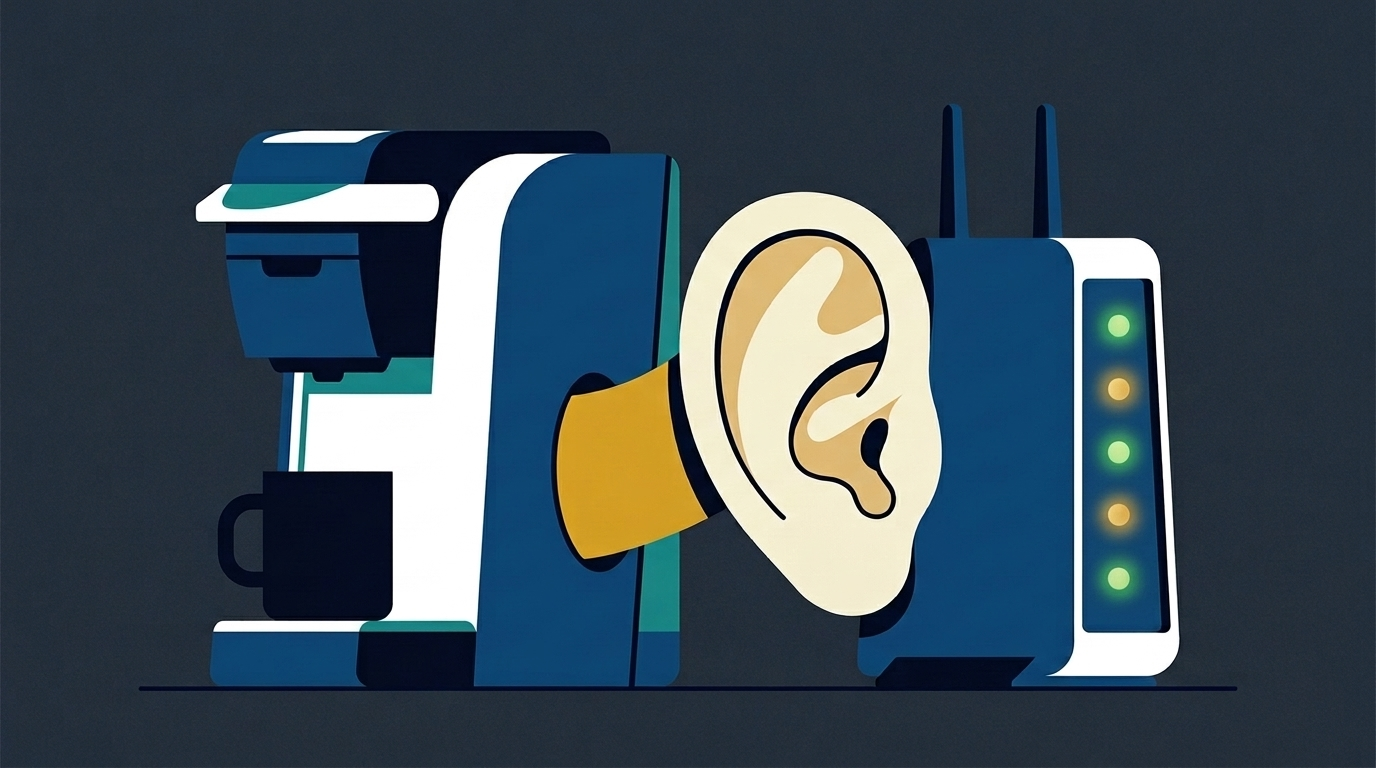
Why would a coffee maker need to snoop around the local network in the first place? The answer is spelled out plainly in Keurig’s official privacy policy. A glance at the February 13, 2026 revision reveals that the company explicitly reserves the right to collect location and network data from its connected brewers, granting the appliance legal carte blanche to surveil the kitchen.
The data harvest goes far beyond basic diagnostic information. Keurig’s policy covers standard IP addresses and GPS coordinates, cellular tower and mobile carrier identifiers, and explicitly mentions querying sensors capable of detecting nearby hardware—including surrounding Bluetooth MAC addresses and Wi-Fi access points.
Keurig makes little secret of where this data goes: aggregating environmental household intelligence to sell to advertisers. That clarifies why a coffee machine wants to know the SSID of your router, and whether competing smart devices are operating within range.
In Hacker News discussions, engineers split into two camps regarding the root cause. One camp maintained that this was almost certainly an unintentional runaway software bug, arguing that no corporate legal team would intentionally design a local scan so noisy that it degrades the user’s Wi-Fi. The other camp pointed out a grimmer economic reality: because local LAN sweeps incur zero server infrastructure costs for the vendor, manufacturers have no financial incentive to optimize or throttle their code. If local reconnaissance runs on the customer’s dime and provides richer profiling data without immediate backlash, vendors are content to let the traffic churn.
From Smart TVs to Air Fryers: An Industrialized Surveillance Supply Chain
A surveillance-prone coffee brewer is hardly an isolated anomaly. The data collection playbook was refined in the living room more than a decade ago. In 2013, smart TV manufacturers rolled out Automatic Content Recognition (ACR), fingerprinting every frame displayed on screen to monetize viewers’ media habits.
By 2024, screenless appliances had joined the data grab as well. The controversy surrounding audio-recording smart air fryers was cut from the same cloth as today’s Keurig incident. Marketed under the convenient banner of “smart home integration,” these gadgets function as Trojan probes stationed throughout our bedrooms and kitchens.
Within this mature industry, safeguards against over-collection are virtually non-existent. Commenters revisited a notorious Sony patent that proposed requiring viewers to stand up and shout brand names during commercial breaks before resuming playback—mockingly dubbed “verification cans.” The patent proved that what restrains intrusive corporate surveillance is not ethical self-regulation, but fear of public outrage. From smart displays to small kitchen appliances, the monetization of private home data has become a standard business model.
The Network Perimeter: A User’s Only Defense
Faced with a coffee maker dead set on indexing their entire local network, non-technical users have virtually no recourse. There is no physical toggle on the control panel to opt out of telemetry, and agreeing to the privacy policy is hardcoded into using the machine’s features.
In online forums, developers cited RFC 2324—the legendary 1998 April Fools’ Hyper Text Coffee Pot Control Protocol (HTCPCP)—joking that home firewalls should return HTTP 418 “I’m a teapot” to silence the brewer. Yet beneath the humor lies a grim truth for smart home consumers.
Manufacturers have turned home appliances into one-way data harvesting outposts. The only viable countermeasure for consumers is deploying VLAN isolation, local firewalls, and DNS sinks like Pi-hole at the router level. Everyday users without networking expertise are left defenseless, forced to tolerate rogue appliances running unchecked across their private subnets.
The business model of household appliances has undergone an irreversible mutation. Consumers used to buy a standalone appliance to boil water; today, they purchase a networked node that treats their home Wi-Fi and electricity as free computational resources. Over 1,000 GB of rogue LAN noise makes one physical reality unmistakable: the person who bought the machine no longer truly controls it.
References:
- Original post on X
- Cybernews report
- Hacker News discussion (item?id=49995495)