On September 8, 2026, OpenAI announced that an ensemble of roughly 10,000 AI agents had solved a 90-year-old Millennium Prize Problem. Yet the announcement was met with friction rather than widespread celebration. The Clay Mathematics Institute (CMI) responded promptly that, under its established bylaws, any formal evaluation for the $1 million prize cannot begin until at least 2029. A century-old enigma was seemingly dismantled by brute-force compute in five days, but human scientific institutions remain fundamentally unequipped to process such velocity.
A 90-Year-Old Hydrodynamic Impasse
On May 24, 2000, the Clay Mathematics Institute designated seven Millennium Prize Problems, attaching a $1 million bounty to each. Among them sat the Navier–Stokes existence and smoothness problem, a cornerstone of classical continuum mechanics. The equations govern the microscopic dynamics of fluid motion, underpinning aircraft aerodynamics, meteorological forecasting, and hemodynamic research in human arteries. In 1934, French mathematician Jean Leray proved that weak solutions exist in a generalized sense. However, whether smooth solutions for three-dimensional incompressible fluids can develop finite-time singularities—points where velocity and vorticity blow up to infinity—has defied resolution for nine decades. The technical barrier was formidable: lacking analytical tools capable of tracking extreme three-dimensional fluid deformations, mathematicians had long been forced into an impasse.
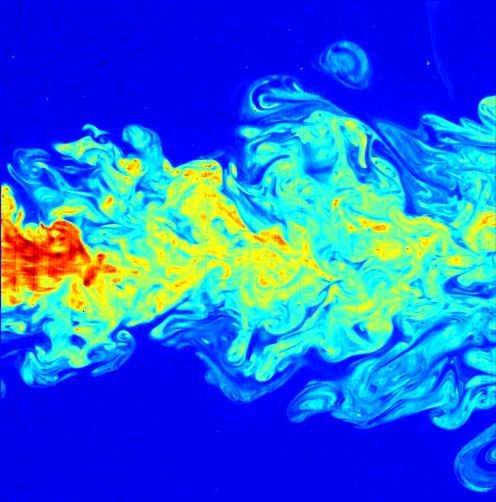 Figure: False-color image of a turbulent jet. The Navier–Stokes equations describe this motion, and the open problem is whether it loses smoothness in finite time. Source: Wikimedia Commons / C. Fukushima, J. Westerweel, Delft University of Technology
$15 Million in Compute Breaches the Dam
In its report titled On the Navier–Stokes Millennium Prize Problem, OpenAI revealed that it orchestrated roughly 10,000 AI agents powered by an unreleased internal model to conduct concurrent proof searches. The initiative launched on September 1, converging on a candidate construction within 88 hours. Subsequently, GPT-6 Astra dedicated 17 hours to synthesizing and compiling a formal verification script in Lean.
Over the run, the system exchanged 4.9 million agent messages and generated 300 billion tokens. The core Navier–Stokes proof alone consumed 2.7 million messages and 130 billion tokens. Calculated at public API pricing, the compute expenditure reached an estimated $15 million. This massive burn of resources transformed abstract mathematical deduction into a compute-intensive engineering campaign.
The conclusion delivered by the model is unambiguous: a smooth fluid initially at rest can develop a singularity in finite time, provided it is driven by a smooth external force and maintains finite total energy. The mathematical construction centers on an inward-spiraling, axially elongated, progressively thinning vortex sheet—an architecture OpenAI vividly likened to “spaghetti” in its technical report.
While the machine-generated code compiled successfully in the Lean environment, interactive theorem provers only confirm syntactic adherence to formal axioms. Compilation neither guarantees that the formulation of the theorem itself is mathematically sound, nor precludes the possibility that the proof exploited subtle flaws in Lean’s underlying kernel. Just five months ago, the formal mathematics community was jolted when underlying bugs in an automated project yielded false-positive verifications. A machine can churn out candidate answers at lightning speed, but establishing true validity still requires human experts to scrutinize its conceptual foundation.
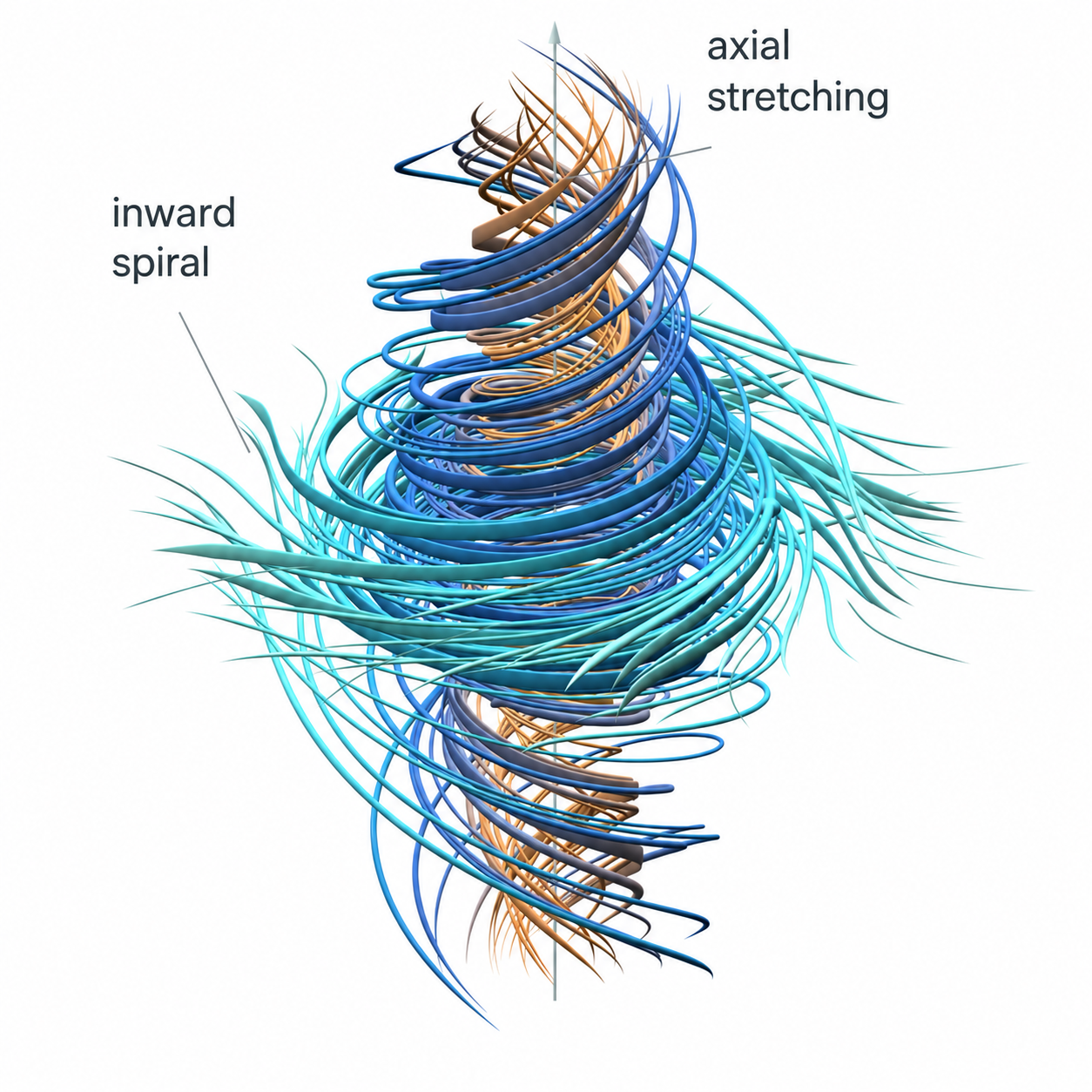 Figure: Vortex structure in the proof: spiraling inward, stretching axially, continuously contracting at the center while accelerating, all under finite total energy. Source: OpenAI
Priority Disputes Expose Structural Vulnerabilities
The breakthrough was immediately embroiled in an unvarnished priority dispute. NYU professor Tristan Buckmaster and Anthropic researcher Levent Alpöge had spent over a year pursuing related singularity constructions, achieving preliminary results on the Boussinesq and Euler equations on August 15. On September 3, alerted by circulating rumors, Buckmaster reached out directly to OpenAI. Three days later, in a phone call proposing a joint paper, OpenAI’s Sebastien Bubeck twice insisted on removing Alpöge from the author list—solely because he was employed by a commercial rival. The demand struck at the bedrock ethos of open scientific collaboration.
Buckmaster flatly rejected the demand and made the correspondence public. OpenAI subsequently issued a statement claiming its team only mobilized on September 1 after hearing external rumors, maintaining that it never accessed the researchers’ work through direct channels. Yet the statement contained notable caveats: OpenAI acknowledged it could not completely rule out whether de-identified data derived from user interactions had been ingested into model training pipelines. Whether indirect telemetry provided the conceptual spark remains an unfalsifiable question.
The episode demonstrated how rumors themselves have become a systemic vulnerability in modern research. As developer Simon Willison noted, simply knowing that a problem is solvable provides sufficient justification for rival labs to launch multi-million-dollar compute sprints to reproduce or preempt the result. The race to deploy brute-force inference is not just altering how theorems are proven; it is rewriting the fundamental rules of scientific competition.
A Deliberately Unhurried Committee
Confronted with this aggressive technical showcase, academic institutions adopted an icy composure. In its official announcement on September 11, the Clay Mathematics Institute did not mention “OpenAI” once. Instead, the institute observed merely that the problem had “apparently been settled.” As commentators on Hacker News pointed out, that single word—apparently—bore the collective skepticism and institutional gravity of the entire mathematical establishment.
The institute reiterated that its evaluation process is deliberately unhurried. Under CMI bylaws, a proposed solution must first be published in a qualifying, peer-reviewed mathematical journal; self-published reports on corporate websites or preprints on arXiv do not qualify. Furthermore, a mandatory two-year waiting period must elapse following publication before CMI will even convene an advisory committee to initiate formal evaluation. By that timeline, even under optimal conditions with frictionless peer review, the work cannot be considered for the prize until 2029 at the earliest.
The institutional chill comes against a backdrop of broader unrest. Following an open letter signed by 25 Fields Medalists and amplified by Terence Tao, the controversy has outgrown the technical merits of Navier–Stokes. The debate is no longer whether a single proof holds; it centers on who possesses the authority to define mathematical problems and validate truth in an era of industrial compute. AI may have cracked one of the hardest nuts in mathematical physics in five days, but the authority to award the prize remains locked inside human deliberative machinery. This friction reflects an intentional institutional defense: machine-generated truths must wait for human comprehension to catch up.
Reference Links:
- OpenAI On the Navier–Stokes Millennium Prize Problem
- Clay Mathematics Institute Announcement
- Tristan Buckmaster Public Statement
- Hacker News Discussion
- 25 Fields Medalists Open Letter