On October 6, 2026, without prior notice, OpenAI published a massive commit to a GitHub repository, dumping 722 mathematical manuscripts generated by frontier models. Across the 372 result families covered by these documents, more than a third came without machine-checkable verification code. Within twenty-four hours, the repository accumulated 9.3k stars and 903 forks—yet 137 of those result families were explicitly flagged by OpenAI itself as potentially flawed.
722 Manuscripts Paired with Just 235 Executable Proofs
Titled “Sharing AI progress in mathematics,” this bulk release represents an enormous body of mathematical deduction. In the repository, 92.1% of the content consists of Lean formalization code, while the remaining 7.8% is LaTeX-typeset documentation. The 722 manuscripts are organized into 372 result families, each comprising a main theorem and supporting lemmas. They span a vast spectrum, from foundational number theory to advanced fluid mechanics.
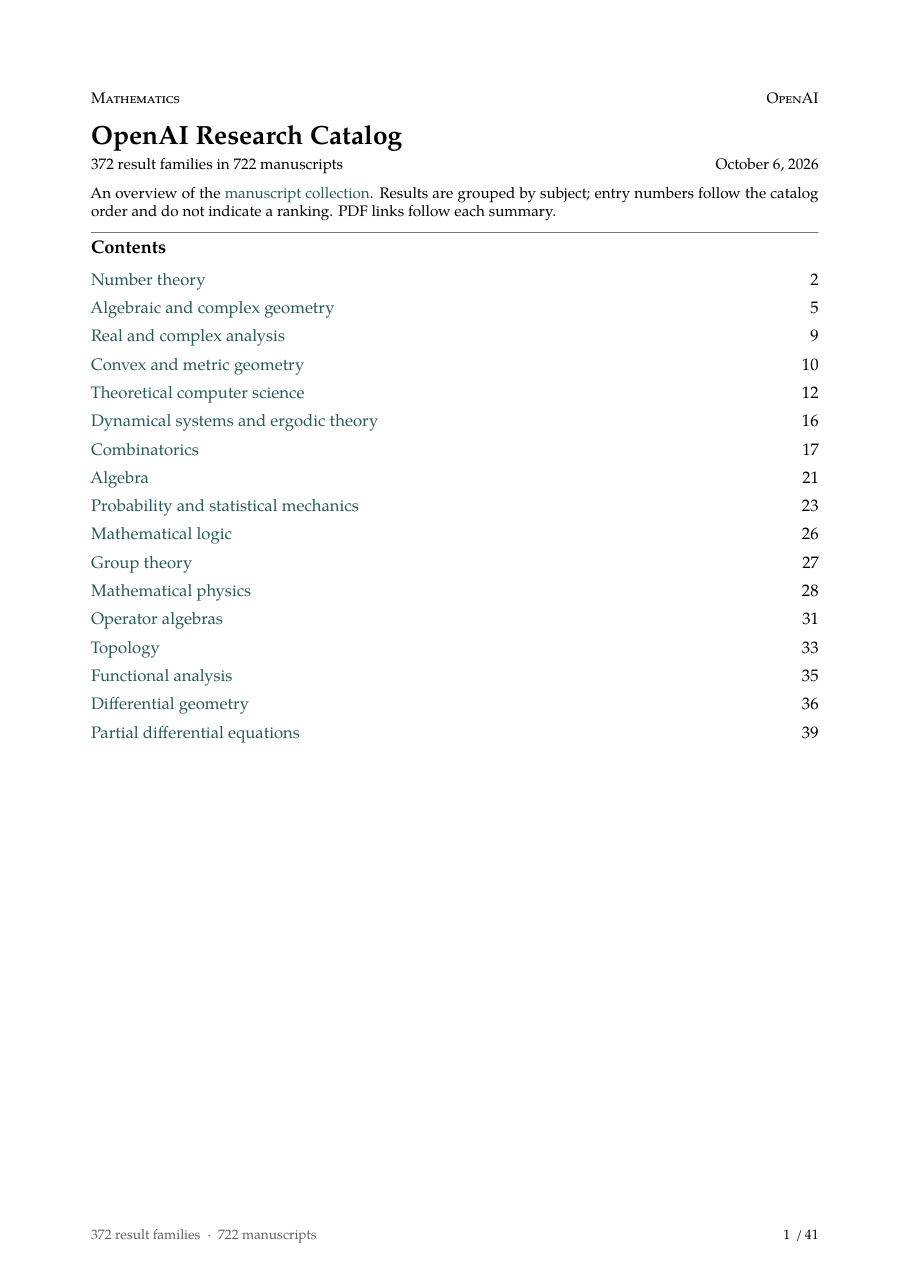 Figure: The cover page of overview.pdf, detailing 372 result families and 722 manuscripts. Source: OpenAI math repository overview.pdf
Yet this immense repository conceals a glaring imbalance: of the 372 result families, only 235 include Lean proofs that actually compile and verify. The remaining 137 documents—flagged by OpenAI as harboring suspected errors or gaps—were simply offloaded onto the open-source community. The team included a 41-page overview.pdf as a master directory, turning the release into a verifiable compute ledger.
According to the disclosures in that ledger, producing one such mathematical result consumed an average of just three hours of ChatGPT Pro inference compute. Raw compute has effectively driven the marginal production cost of mathematical proofs toward zero, but the cost of verification has not dropped in tandem. This vast asymmetry between generation throughput and verification capacity shifts the burden of proofreading onto the mathematical community by default.
Three Hours of Compute Versus Twenty-Four Human Years
Among the unverified manuscripts are attempts at notoriously intractable historical problems. Result 001 tackles Milne’s rational conjecture; Result 002 takes aim at the Birch and Swinnerton-Dyer (BSD) conjecture. Most striking of all, Result 180 presents a full preprint purporting to prove Barnette’s conjecture—yet lacks any executable Lean code.
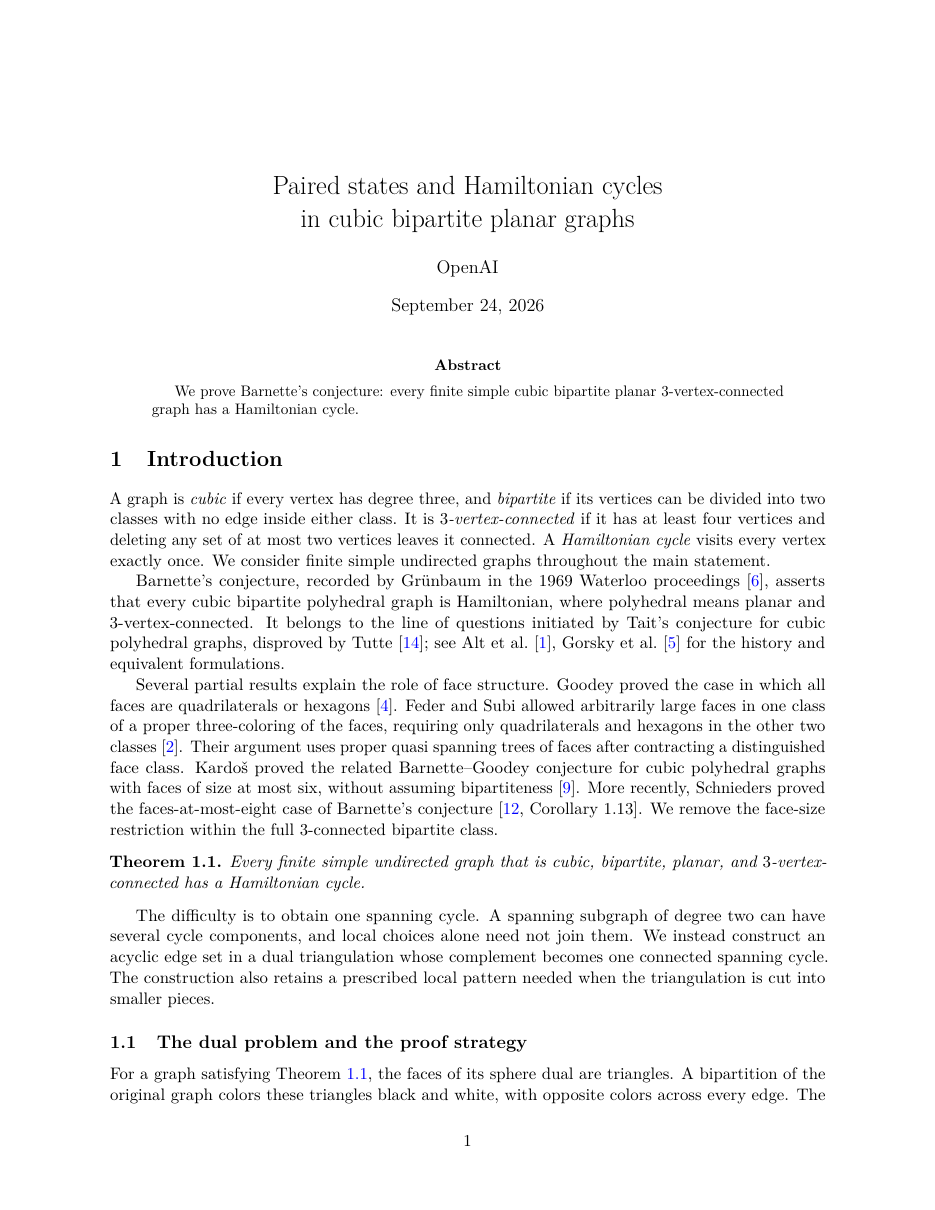 Figure: First page of the paper addressing Barnette’s conjecture, authored by OpenAI. Source: OpenAI math repository preprints directory
Other results exhibit striking engineering ingenuity. Result 376 details a construction that executes universal computation via the Navier-Stokes equations: the model designed a specific smooth external force that causes fluid in a bounded domain to simulate a Turing machine, where a particle entering a designated region corresponds to the machine halting. Work of this caliber once demanded years of interdisciplinary collaboration; today, it appears as hundreds of pages of unendorsed PDFs.
A researcher who had spent 24 years studying Barnette’s conjecture confessed, upon seeing this preprint without formal verification, that it felt like learning an ex-girlfriend had died in a car crash. Faced with such black-box outputs, rank-and-file mathematicians cannot easily verify the integrity of the logical chains—nor do they even possess the computational infrastructure required to reproduce comparable approaches. Compute power and model weights remain locked inside corporate server farms. Reproducing advanced mathematical derivations no longer hinges merely on mastering partial differential equations, but on commanding clusters of tens of thousands of accelerator cards.
An Independent Advisory Group Fails to Stem the Frontier Flood
The core conflict here lies in how the release openly brushed aside guardrails the academic community had sought to erect. As early as September 29, the Advisory Group on Mathematics and Artificial Intelligence (AGMAI)—an independent body convened by OpenAI itself and hosted at Princeton’s Institute for Advanced Study—issued a grave public statement.
AGMAI’s recommendation was clear: frontier AI labs should refrain from unilaterally using proprietary, closed models to claim open mathematical conjectures or flood benchmark leaderboards. Such unilateral moves risk upending centuries of consensus around evaluation, contaminating academic assessment systems.
A mere seven days later, OpenAI cited that very advisory statement in its announcement post while simultaneously releasing all 722 manuscripts online. Although they stated they would continue consulting with the mathematical community on better disclosure practices, action preceded consensus. A commercial entity capable of releasing more than seven hundred high-level manuscripts overnight has, in effect, seized control of the field’s agenda-setting power.
Compute has smashed the barrier to generating candidate solutions. These 722 manuscripts, unpolished yet undeniably imposing, lay bare an uncomfortable reality: manufacturing vast volumes of complex, unverified knowledge has become trivial. The bottleneck in mathematics is no longer finding a path to a solution; it has shifted entirely to who possesses the resources to verify it. And in this emerging knowledge production pipeline, the authority to certify mathematical truth is consolidating, almost unchallenged, into the hands of the few tech giants that own the server clusters.
References:
- OpenAI announcement post
- GitHub repository: openai/math
- Manuscript index: CONTENTS.md
- AGMAI public recommendations
- Hacker News discussion