On September 30, 2026, a 134-page class action complaint was filed in the U.S. District Court for the Eastern District of New York. The plaintiff is an independent pizzeria in San Diego: The Pizza Standard LLC. Acting on behalf of brick-and-mortar merchants nationwide, the small business is taking on Visa, Mastercard, and America’s five largest banks. The core allegation is blunt: the financial behemoths conspired to artificially inflate swipe fees, extracting more than $100 billion annually from physical storefronts across the country.
Filed under docket number 1:26-cv-06087, the lawsuit takes aim at the non-negotiable protocols underpinning modern card payment networks. According to the complaint, interchange rates imposed by card issuers leave merchants with zero bargaining power—what the filing characterizes as “a deadweight toll on virtually every credit card purchase in America,” extracting monopoly rents at rates that “no competitive market would produce.”
Merchants Are Forced to Accept High-Cost Cards
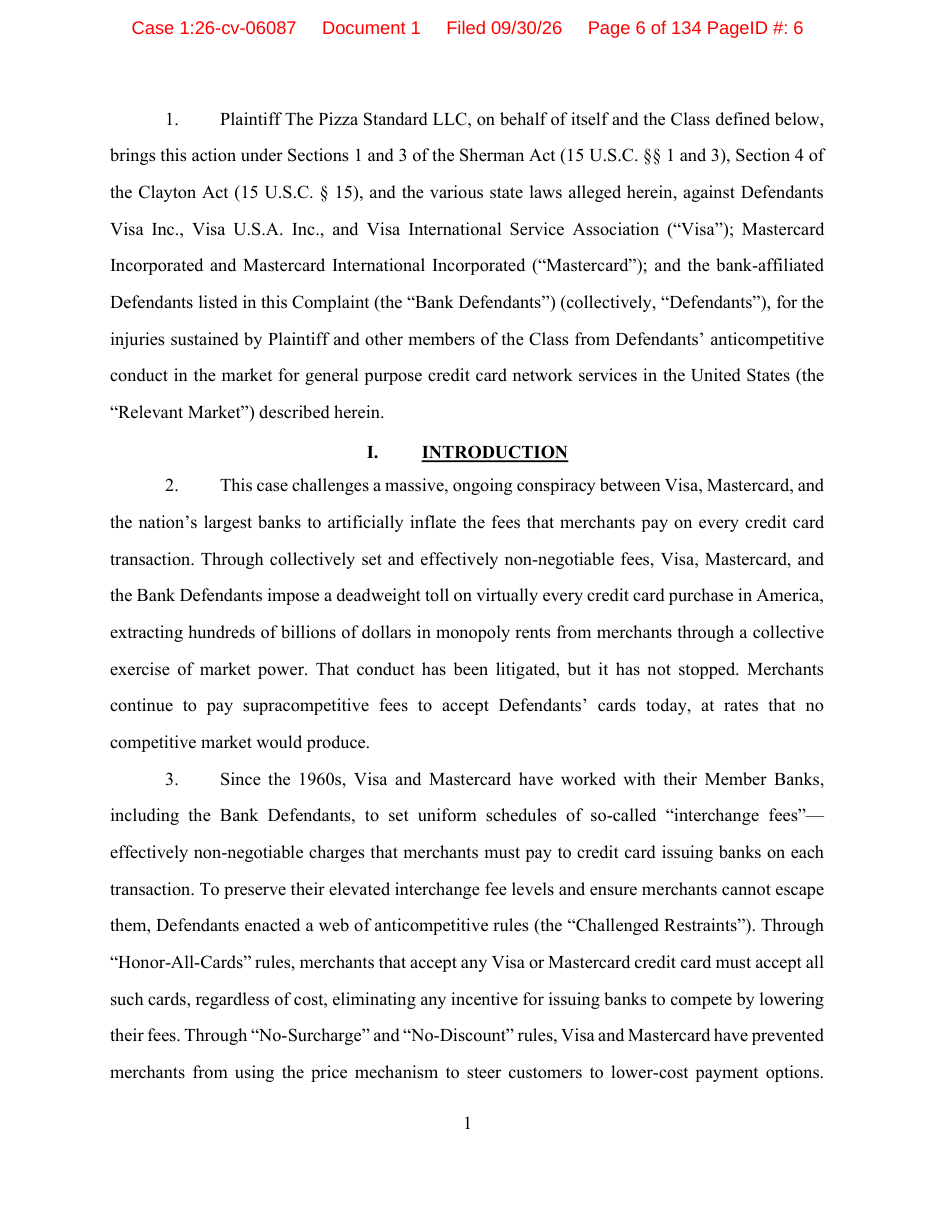 Figure: The plaintiff sues Visa and major banks under the Sherman Antitrust Act and Clayton Act. Source: Public complaint PDF via ClassAction.org
The primary target of this litigation is an interlocking web of anticompetitive rules designed to keep merchants trapped. Under the network rules, if a merchant agrees to accept any Visa or Mastercard credit card, they are obligated to accept every single credit card issued under that brand—regardless of how expensive it is to process.
In reality, the processing costs associated with consumer cards vary wildly. Basic, entry-level credit cards carry minimal processing fees. In contrast, premium cards loaded with lavish cash-back bonuses and airline miles command substantially higher interchange rates. Under the mandatory “Honor All Cards” regime, merchants cannot turn away high-fee premium cards at the register, nor are they permitted to steer shoppers toward cheaper payment methods like debit cards.
By stripping merchants of differential pricing power, the network eliminates the market’s natural feedback loop: card-issuing banks have no incentive to compete by lowering fees to win merchant preference, allowing interchange rates to ratchet higher year after year.
Hiding Payment Costs from the Receipt
In an ordinary competitive market, higher-cost payment rails naturally command higher transaction surcharges. But under the rules imposed by Visa and Mastercard, merchants have historically been barred from passing these processing costs directly to customers based on the specific card presented.
If a customer orders a $20 pizza, the final total remains identical whether they pay with cash, a basic debit card, or an ultra-luxury travel card. Through blanket anti-surcharging and anti-steering rules, payment networks turned hefty processing fees into an unavoidable operational overhead for the merchant. To safeguard razor-thin profit margins, local businesses have little choice but to bake these payment costs into the baseline menu price of every item.
This mandatory cost-masking creates an perverse cross-subsidy: cash and debit customers, who are often lower-income, effectively subsidize the extravagant reward points and cash-back perks enjoyed by premium cardholders. By dispersing these stealth fees across every consumer, the financial giants effectively conceal the sheer magnitude of their toll.
How Major Banks Lock Out Interchange Competition
Behind this hundred-billion-dollar toll road, America’s five largest banks serve as the indispensable enforcers of the status quo. The complaint names Bank of America, Capital One, Chase Bank, Citibank, and Wells Fargo as key defendants. For decades, these institutions have operated under uniform interchange fee schedules established by Visa and Mastercard, completely neutralizing price competition on the merchant side.
If an issuing bank were to unilaterally lower its interchange fee, merchants would naturally have every incentive to favor its cards. Yet in practice, no bank ever breaks rank. Instead, they preserve inflated interchange rates to fund aggressive rewards marketing campaigns on the consumer side. Lowering merchant fees would mean voluntarily slashing their own supernormal profits.
The plaintiffs argue that this collective fee-setting amounts to a horizontal price-fixing conspiracy prohibited by Section 1 of the Sherman Antitrust Act. While the defendants have yet to formally respond in court, the outcome will depend on whether the judiciary is willing to dismantle these long-standing structural restraints.
Why a $5 Billion Settlement Bought Zero Bargaining Power
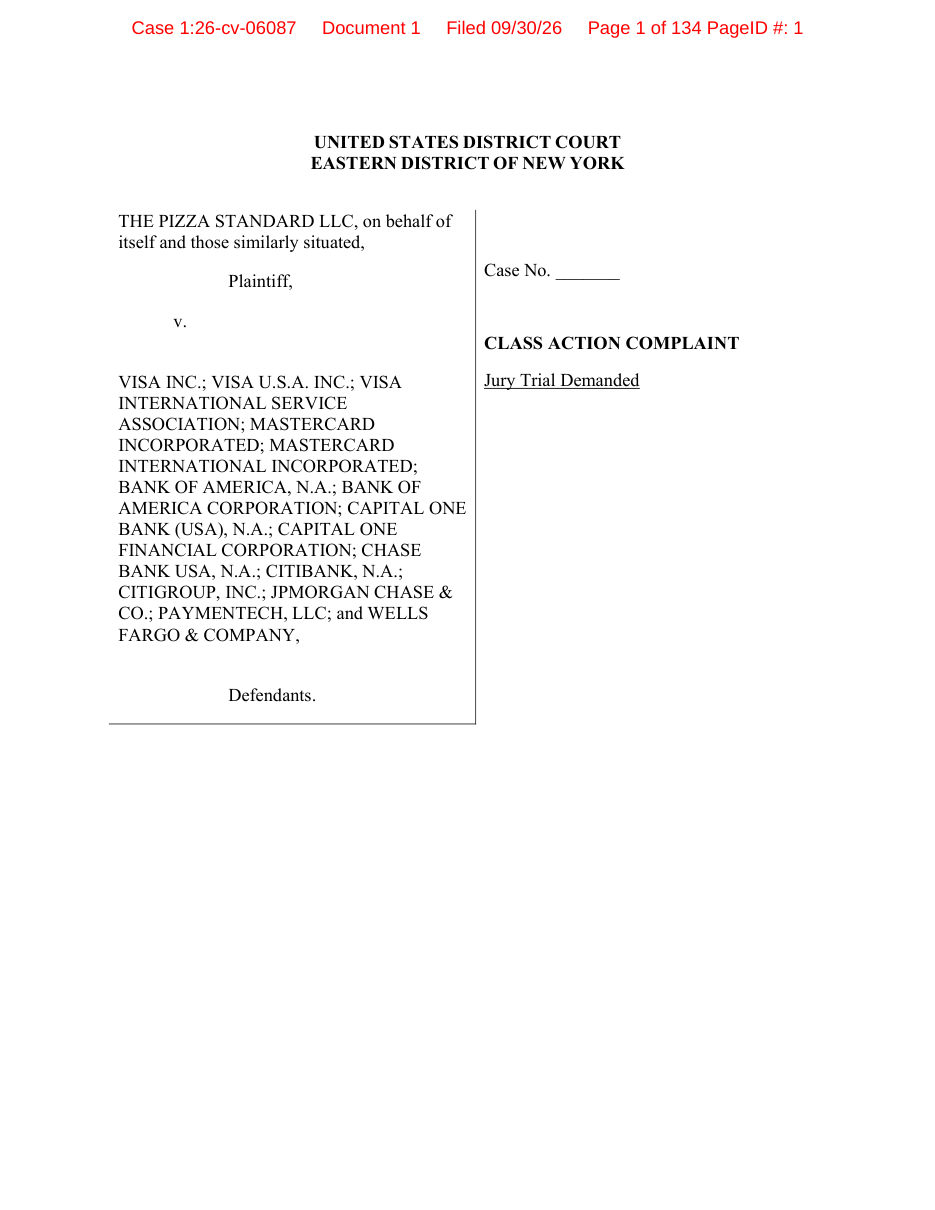 Figure: Complaint header naming the San Diego pizzeria as plaintiff. Source: Public complaint PDF via ClassAction.org
American retailers have challenged payment network fees before. In previous multidistrict antitrust litigation, the payment giants agreed to a class settlement exceeding $5 billion. But against an annual haul of $100 billion in swipe fees, that payout represents little more than a modest cost of doing business.
Crucially, earlier financial settlements offered only backward-looking cash compensation while leaving the underlying anticompetitive rules untouched. Millions of American merchants remained subject to ongoing margin compression, without any structural injunctive relief. As the new lawsuit underscores: a one-time settlement without rule changes simply allows networks to recoup the payout on every subsequent swipe.
Developers and tech practitioners discussing the suit pointed out stark real-world contrasts. Many gas stations now actively push consumers toward ACH bank transfers through dedicated apps, where processing costs hover around $0.30 to $0.60 per transaction (or modern rails like FedNow charging fractions of a cent). In contrast, swiping a premium credit card frequently docks the merchant $2.00 to $2.50 on a routine purchase. A digital transaction generates a nearly two-dollar cost disparity within milliseconds—proving that legacy card network pricing has completely decoupled from the actual computational, network, and bandwidth costs of moving data.
Restoring Price Discovery to the Point of Sale
Throughout community discussions, two specific structural reforms surfaced repeatedly: granting merchants the right to itemize swipe fees transparently on the receipt, and allowing them to decline specific ultra-high-cost card tiers without penalty. Both measures directly attack the restrictive rules targeted in the lawsuit.
When interchange fees are no longer concealed in the sticker price of every good, the true cost of payment rails becomes visible on every receipt. Market forces can finally resume their disciplinary role. If a customer realizes that swiping an ultra-premium rewards card incurs an extra two-dollar line item at checkout, they will naturally opt for a more economical payment method.
What a San Diego pizza parlor is demanding is straightforward: make the cost of every transaction transparent. If this lawsuit manages to crack open the payment rulebook, an opaque billing empire that thrives on consumer blindness will finally face the discipline of real market pricing.
Reference Links:
- ClassAction.org Report
- Complaint PDF
- Community Discussion
- Sherman Antitrust Act Overview