
In mid-August, a massive data center under construction in Ohio secured a financing guarantee capped at $105 billion. That sum is large enough to buy Twitter three times over, or recapitalize two major commercial banks. What makes the deal truly remarkable is that the guarantor did not put up capital or take on direct debt—it was simply a hardware maker: Nvidia.
From Selling Silicon to Selling Guarantees
Zooming out, the $5.4 trillion tech titan is orchestrating an unprecedented financial playbook. Just a week earlier, Nvidia announced a partnership with six Wall Street institutions, including Blackstone and Goldman Sachs, to unlock more than $500 billion in AI infrastructure financing. The operational loop is straightforward: AI startups borrow from Wall Street to purchase GPUs, while Nvidia guarantees the residual value of that hardware.
If a startup defaults, Nvidia pledges to repurchase the equipment at a predetermined price. By putting its own balance sheet on the line, the chipmaker has effectively repackaged risky technology procurement into quasi-guaranteed financial assets. Beginning in July, Nvidia even instituted revenue backstops for emerging compute-rental data centers: if spare compute capacity goes unsold, Nvidia steps in to buy it back at fixed terms.
This financial scaffolding has inflated the industry’s apparent scale. Anthropic, for instance, is committing roughly $35 billion to lease compute from specialized cloud providers—whose data center facilities, in turn, are leased from next-generation infrastructure operators.
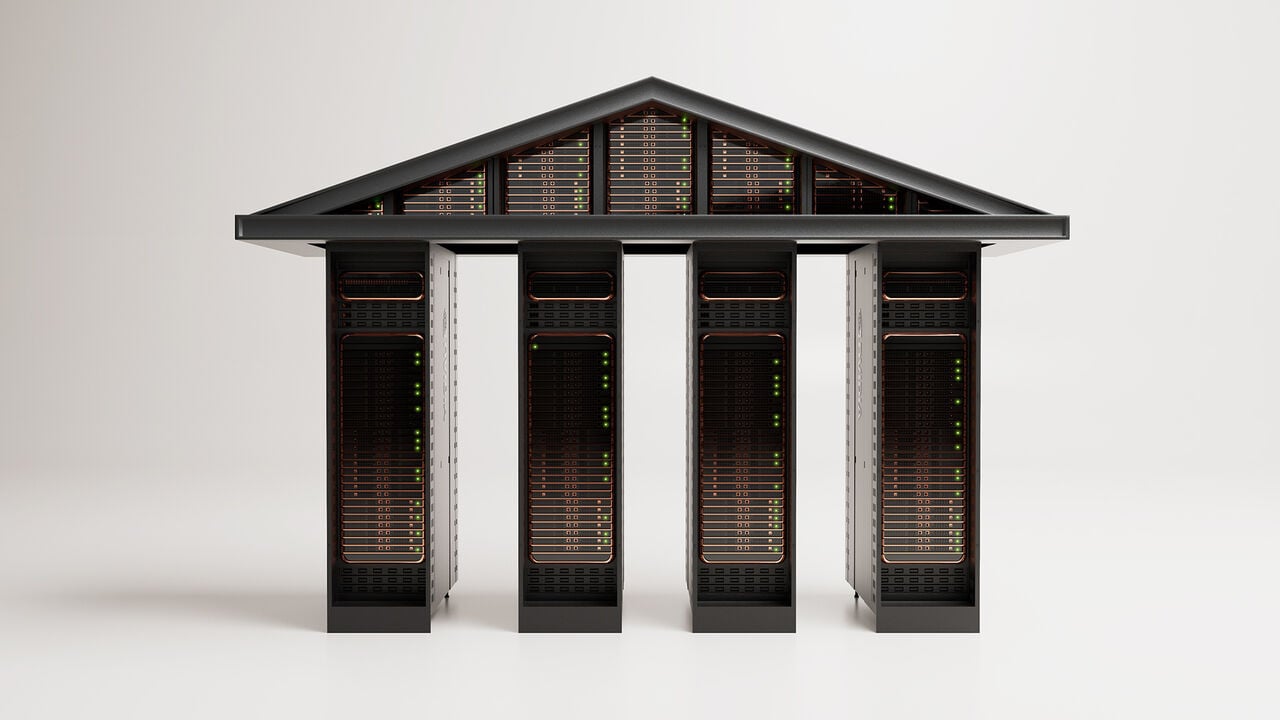 Figure: The web of equity, guarantees, and purchase commitments between Nvidia and its customers. Source: The Economist / Carl Godfrey
When Top Customers Turn Into Chief Rivals
Why would an undisputed chip monopolist turn itself into an industry guarantor? Last year, Alphabet issued 50-year bonds at an interest rate of just 5.7%, whereas AI compute startups face borrowing costs nearly double that. Sky-high capital costs were choking off the expansion plans of second-tier and specialized cloud players.
More critically, Nvidia’s biggest customers are engineering their own departures. Amazon, Google, and Microsoft are projected to deploy around $800 billion in infrastructure capital expenditures this year, but an accelerating share of those budgets is pouring into proprietary, in-house silicon. Custom chips cost barely a third of Nvidia’s hardware and are tailored specifically to their own workloads.
Bloomberg Intelligence forecasts that custom processors will capture half of the AI processor market by the end of the decade. Underwriting next-generation compute-leasing startups is essentially Nvidia’s defensive moat against hyperscalers. Nvidia urgently needs these independent providers to flourish so it avoids having its throat held by a tiny cabal of cloud behemoths.
Conjuring a Credit Foundation Out of Thin Air
The Economist aptly characterized Nvidia’s maneuver as becoming “the central bank of AI.” The Federal Reserve’s balance sheet sits at roughly $6.7 trillion; Nvidia’s orchestration of over $500 billion in financial commitments represents an enormous private stimulus package for the AI sector. This vast credit superstructure currently rests atop nearly $300 billion in potential customer debt.
The entire apparatus hinges on a single conviction championed by Jensen Huang: that AI chips are durable capital assets whose economic lifespans will be continuously preserved by software updates. Market transactions offer some support: three-year-old A100 chips were still securing five-year lease commitments as recently as August.
Yet skeptics remain unconvinced. Prominent investor Michael Burry argued that cloud operators are artificially padding their paper profits by arbitrarily stretching server depreciation schedules from two or three years out to five or six.
 Figure: Capital flows mapped by The Economist: guarantees unlock debt, debt finances GPU purchases. Source: The Economist / Carl Godfrey
Where the Risk Ultimately Lands
This brand of financial engineering concentrates systemic risk to an alarming degree. Unlike a sovereign central bank, Nvidia can neither expand the fiat money supply at will nor set statutory interest rates. Morgan Stanley estimates that Nvidia’s contingent liabilities and obligations could swell to $200 billion by early 2029.
A rupture does not require a total demand collapse—merely a disappointing deceleration in growth. Once the frenzy surrounding AI capital expenditure cools, the revenue guarantees and idle capacity repurchase pledges Nvidia handed out will transform into an immediate liquidity drain.
The volume of credit insurance Nvidia has distributed to the market now vastly eclipses the hardware itself. The wider it casts this credit net, the more inevitable it becomes that the entire industry’s default risk will end up as a staggering bill on Nvidia’s own balance sheet.
References:
- The Economist report
- Bloomberg Intelligence industry forecasts
- SemiAnalysis data center estimates
- Hacker News community discussions