Late in the night of August 6, 2026, GitHub—the world’s largest code repository host—suffered a major outage. Its automation service, GitHub Actions, was hit by widespread failures: jobs queued up for hours without starting, running tasks failed en masse, GitHub Pages suffered degraded performance, and even Copilot’s code review features turned intermittent. A post on Hacker News garnered 299 points and 253 comments within eight hours. Developers quickly pieced together the clues: what pushed the platform over the edge was likely the surge in AI-generated code. Data shared by GitHub COO Kyle Daigle revealed that weekly Actions usage skyrocketed from 500 million minutes in 2023 to 1 billion in 2025, and hit a staggering 2.1 billion minutes this week—quadrupling in just two years.
For non-developer readers, a bit of background: GitHub is the central collaboration platform for software development, housing code for millions of projects worldwide. Actions is its built-in automation engine—an automated assistant for code. Developers define workflow rules, and every time code is changed, Actions automatically tests, builds, and deploys it, turning thirty minutes of manual work into a process that runs in minutes.
 Image: Coverage of the recent GitHub outage. Source: The Register
The official incident report tells a clear story: around 11 PM UTC+8 on August 6, job queues swelled, tasks timed out, and success rates plummeted to 30–40%. As engineers rate-limited traffic and rolled out fixes, only 15% of code change notifications were processed, leaving vast numbers of modifications un-triggered. While job success rates recovered to 99% eight hours later, Copilot and Pages remained flaky, and enterprise data migration services were temporarily suspended. This was no isolated incident: a similar Actions outage occurred on July 29, and GitHub’s official status page recorded 26 incidents in July, followed by 6 more in the first six days of August. Despite GitHub apologizing for the wave of outages in April and executives promising structural overhauls in June, the infrastructure crashed again a month later.
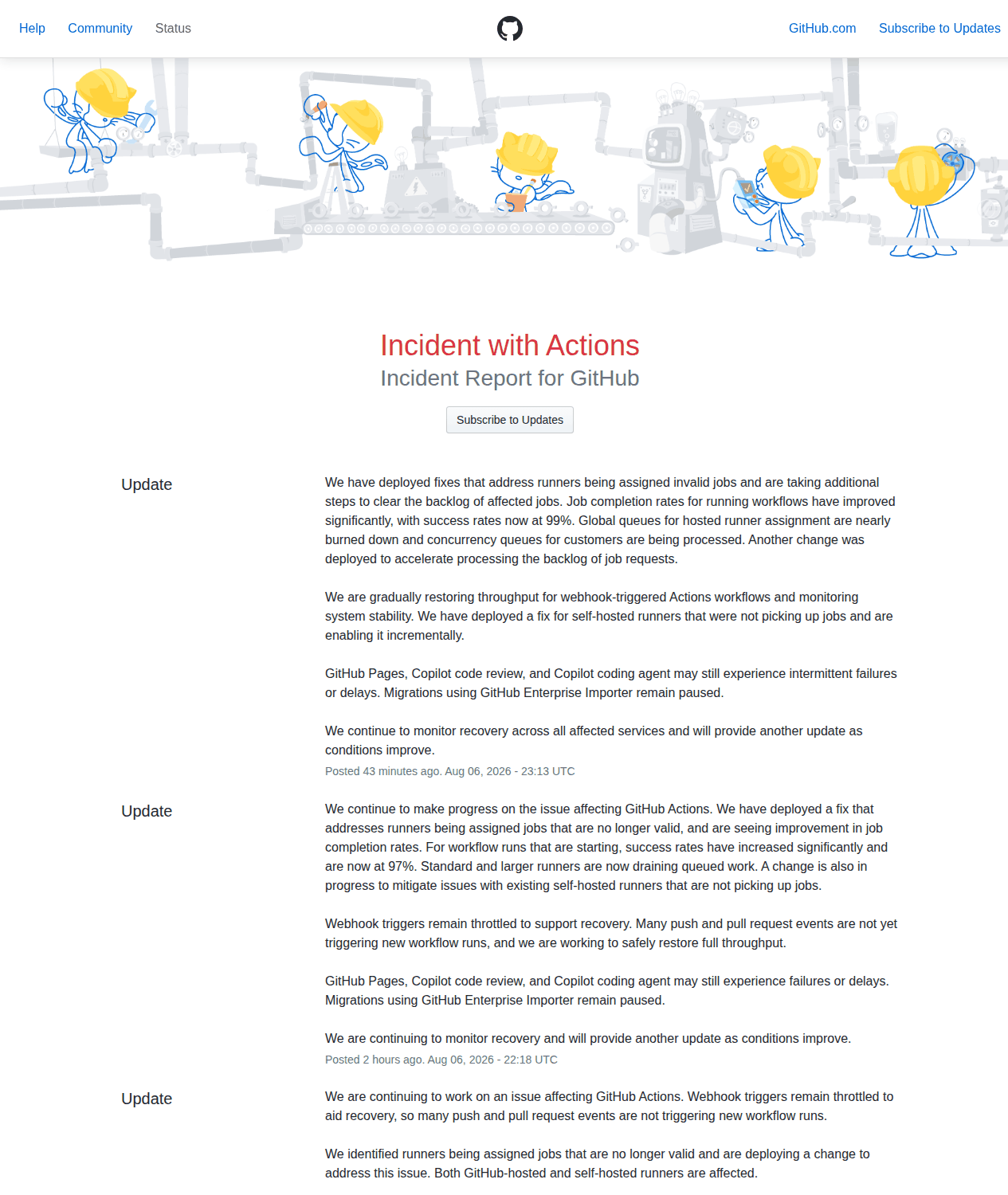 Image: GitHub Status page timeline showing roughly 8 hours from degradation to recovery. Source: githubstatus.com
One detail in the incident log stands out: “Runners were assigned invalid tasks and became stuck in retry loops.” In plain English: worker nodes were given cancelled or dead job tickets; after completing them and discovering they were invalid, they went back to fetch new tasks—only to receive dead ones again. The more congested the queue became, the more invalid jobs accumulated, creating a spiraling feedback loop. This is a textbook breakdown mode for high-load systems.
Where Is the Surge Coming From: AI Quadrupled the Order Volume in the Kitchen
The official statistics paint a dramatic picture. In 2025, GitHub recorded 1 billion total commits for the entire year. Today, it sees 275 million commits a week—a rate that translates to 14 billion commits annually. Actions runtime has quadrupled in two years. In human terms: 21 billion minutes per week means that at any given instant, over 200,000 servers are executing code on GitHub on behalf of developers worldwide. 275 million commits per week means an average of 450 commits per second. The platform must handle 450 incoming requests every second while dynamically provisioning runner machines for each task.
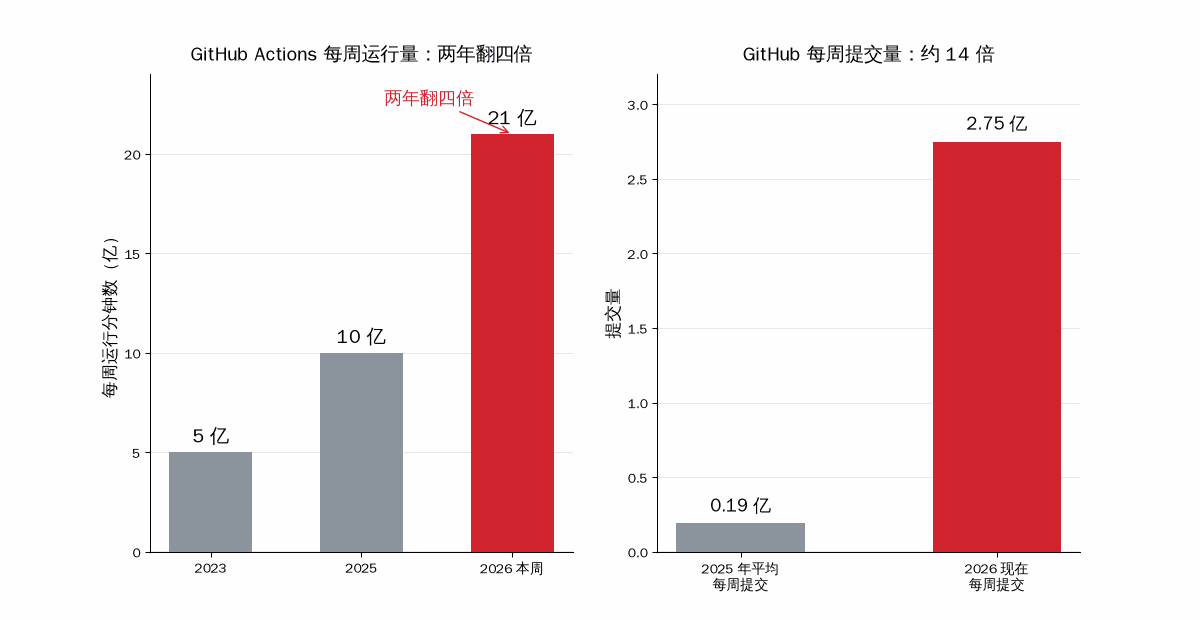 Image: Weekly Actions minutes quadrupled in two years; weekly commits reached roughly 14 times the 2025 weekly average. Source: GitHub official (COO Kyle Daigle), chart by author
Where did this explosion of volume originate? AI-driven development. Modern AI coding assistants can independently read code, write patches, submit commits, and run test suites—cycling through dozens of iterations per session, with every single loop triggering automated CI/CD pipelines. Where a human engineer might commit once or twice a day, an AI agent commits dozens of times daily. Community metrics show that AI-generated pull requests jumped from 4 million per month last September to 17 million in March. Claude Code alone accounts for 2.6 million commits per week—a 25-fold surge in just six months. Human coding is like ordering a meal; AI coding is like multiplying the kitchen’s order volume tenfold overnight.
When orders surge while the kitchen remains unchanged, a chain reaction is inevitable. As veteran systems engineer cortesoft explained on Hacker News, high-load systems built with headroom can still implode when utilization crosses 90–95%. At that point, minor fluctuations trigger a cascade: queues grow, tasks time out, clients retry, and retries create even longer queues. It resembles a highway: running smoothly at 80% capacity, but at 95%, a single tap on the brakes stalls traffic for miles. He noted bluntly that scaling up machines during an ongoing cascade rarely works, because bottlenecks shift to unexpected components.
GitHub Says Fixes Are Underway; Users Say It’s Not Enough
Perspectives from both sides highlight the tension. GitHub officially acknowledged capacity constraints, stating that engineers identified the root cause and deployed remediation measures. Paying customers, however, expressed frustration: one enterprise user utilizing self-hosted runners complained that even their paid infrastructure stalled for an entire day. HN user zehaeva, a GitHub user since 2009, voiced stronger criticism, pointing out that GitHub’s uptime dropped over the past year from “four nines” (99.99%) to “one nine” (90%). Four nines permits less than an hour of downtime per year, whereas one nine implies over thirty days of service disruption annually—a shift he attributed directly to surging AI usage.
Discussions also revisited a broader debate: infrastructure migration. Following Microsoft’s acquisition, GitHub has been migrating infrastructure from bare-metal data centers to Azure. User toomuchtodo recalled that GitHub was noticeably more stable during the bare-metal era, arguing that the migration should have kept baseline workloads on-premise while bursting to the cloud. Others speculated whether aggressive migration timelines played a role. Conversely, another commenter noted that despite Microsoft acquiring GitHub eight years ago, complaints only surged over the past twelve months—coinciding closely with the AI coding boom. While community opinions remain split, two facts stand out: GitHub’s outage frequency has visibly increased, and traffic growth is undeniable.
The Race Between Code Velocity and Physical Infrastructure
Why does this matter beyond software development? Virtually every app update, bug fix, and feature deployment relies on automated CI/CD pipelines like GitHub Actions. When the platform stalls for a day, release schedules across thousands of engineering teams collapse. At a deeper level, this reflects a fundamental clash between digital productivity and physical constraints. AI can accelerate code production exponentially, but expanding data centers, servers, and network bandwidth remains a physical process bound by hardware supply chains. GitHub set a 10x capacity expansion target last October and revised it to 30x in February, yet traffic continues to outpace growth. Reports even surfaced that Microsoft temporarily leased capacity from rival cloud provider AWS to alleviate load on GitHub—a stark illustration of the underlying strain.
“Automate everything” is the most enticing promise of the AI era. But the reality is that tasks generated by software automation must ultimately wait in physical server queues. This GitHub outage serves as a clear signal: when everyone produces code faster, the scarcest resource becomes the physical infrastructure that carries it. AI output speed is a software problem; infrastructure expansion is a physical one. When physics fails to keep up with software, the foundation beneath our tools begins to crack.
Reference Links:
- GitHub Status: Actions and Pages Incident Report
- HN Discussion (item?id=49198302)
- The Register: Latest GitHub outage squeezes Actions, Pages to death
- Waxell: GitHub’s AI Agent Crisis: What 9 Outages Cost
- danilchenko.dev: GitHub’s AI Agent Problem: 17 Million PRs, Five Outages, and a Kill Switch