20 Minutes to Total Shutdown: How Single-Point Dependency Shatters Engineering Pipelines
At 13:40 UTC on August 17, 2026, the official GitHub Status page raised an incident alert. Over the next 20 minutes, domino-like failures cascaded across the platform: API services degraded at 13:41, automated CI/CD builds on GitHub Actions stalled at 13:42, event callbacks via Webhooks broke at 13:44, issue tracking (Issues) failed to load at 13:46, and by 13:58, code review mechanisms (Pull Requests) were completely inaccessible. By 14:31, AI assistant Copilot had also degraded, putting developer collaboration around the globe at a standstill.
According to the status page and security media monitoring, site and API error rates hit 20% during peak failure, while raw file and release asset downloads suffered error rates as high as 50%. Large enterprise teams relying on centralized authentication found both SAML (Security Assertion Markup Language) and OIDC (OpenID Connect) authentication channels blocked, breaking cross-domain identity management via SCIM and team provisioning mechanisms. User complaints on monitoring platform Downdetector began surging as early as 13:30, showing that real-world impact was spreading well before official status announcements.
This centralized crash laid bare the fragile architecture of modern software engineering pipelines: when identity authentication, code collaboration, and automated deployments are anchored to a single node, localized disruptions easily amplify into full-process paralysis. Although Microsoft later acknowledged the global incident and initiated mitigations, it refrained from disclosing specific technical root causes.
 Figure: The GitHub status page indicates degraded services across API, Actions, and Pull Requests. Source: Cyber Security News
The Hidden Cost of Self-Hosting: Is GitLab Private Deployment Really a Viable Way Out?
In the immediate aftermath, a Hacker News thread discussing alternative hosting options quickly rocketed to 463 points with hundreds of comments. Many engineering teams, frustrated by recurring outages, reconsidered private deployment options such as self-hosted GitLab. Veteran engineers who had maintained self-hosted GitLab instances for over six years confirmed that private deployments do achieve significantly lower annualized downtime compared to public cloud platforms.
However, the hidden ledger of private hosting carries a heavy price tag. Engineering calculations shared on Hacker News showed that running a reliable private code platform requires not only dedicated servers starting at 16GB of RAM, but also 1 to 3 dedicated DevOps engineers for daily maintenance. Even more demanding are frequent security vulnerabilities: teams must monitor vulnerability disclosures weekly and apply patches immediately, as any operational slip can leave private code repositories exposed to attacks.
Cloud hosting trades infrastructure control for freedom from maintenance toil; self-hosting private cloud appears to restore autonomy, but shifts all availability risk directly onto the team’s operational budget. For the vast majority of small and medium-sized teams, the annual salary expenses of dedicated DevOps staff far outweigh the cost of a few sporadic cloud outages.
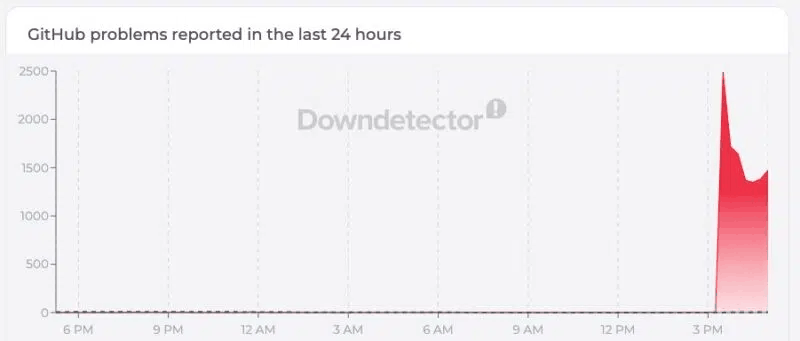 Figure: Downdetector recorded a massive surge in user error reports during the GitHub outage. Source: IT-Connect
Unviable Business Models: Why No True Alternative to GitHub Exists
In parallel discussions on Lobsters, engineers reached a sobering consensus: while technical alternatives to GitHub abound, virtually no true commercial replacements exist. Economic modeling on Hacker News noted that users are generally only willing to pay $5 to $10 per month for code hosting. This low average revenue per user (ARPU) is incapable of supporting an independent company to build and operate high-availability infrastructure that rivals hyperscale data centers. As forum commenter jm4 observed, in the cloud computing era, selling lattes yields higher gross margins than selling pure code hosting.
Code hosting platforms long ago evolved beyond simple storage utilities. They have built formidable network effects through code reviews, continuous integration, and developer social graphs. Even after spending the past year without a Chief Executive Officer (CEO) and enduring a 9-hour GitHub Actions outage on August 6, 2026, GitHub’s massive developer ecosystem remains virtually unshakeable.
The fundamental mismatch between low user spend and massive infrastructure capital expenditure dictates that pure hosting competitors cannot survive independently; code hosting inevitably becomes a strategic loss-leader within tech giant cloud ecosystems. Developers are not blind to the underlying risks, but the collaboration convenience delivered by network effects completely overshadows outage risks.
Increased Transparency, Unchanged Risk: What the New Status Dashboard Reveals
Back in April 2026, GitHub rolled out a revamped status reporting framework featuring granular incident severity ratings and 90-day availability metrics. This institutional update has made incident propagation paths and blast radiuses far clearer than in the past.
Yet, increased transparency has not translated directly into structural system resilience. Fine-grained health monitoring allows users to observe module degradation in real time, but without heterogeneous backup arrangements, transparency serves primarily as an incident notification rather than an escape hatch.
Refining monitoring metrics improves risk visibility without eliminating the underlying concentration of code hosting infrastructure. When every engineering team relies on the exact same status dashboard to confirm that work has halted, transparency itself becomes part of the single point of failure.
The Reliability Ledger: The Tech Industry’s Shared Gamble on Cloud Uptime
The GitHub outage represents a concentrated symptom of single-point infrastructure dependency. Over the past decade, the global software industry enjoyed enormous collaborative efficiency powered by centralized cloud platforms, while collectively assuming the systemic risks of infrastructure homogenization.
Every major downtime event ignites enthusiastic debates in developer communities regarding fallback plans. Yet because self-hosting is costly and developer networks are non-portable, the vast majority of teams remain right where they are once services recover. As long as infrastructure economics and network effects stay unchanged, the balance sheet between “platform reliability” and “user alternatives” will remain impossible to reconcile.
Reference Links:
- Official GitHub Status Page Report
- Cyber Security News Outage Tracking
- IT-Connect Downdetector Data Analysis
- Hacker News Discussion: Incident with Github.com
- Ask HN Discussion: Alternatives to GitHub
- Lobsters Discussion: GitHub has alternatives, but no replacement