On August 7, 2026, an independent benchmark ranked Alibaba’s latest frontier model number one globally. Qwen3.8 Max claimed the top overall position on Artificial Analysis’s “Agentic Index”—marking the first time a Chinese model has surpassed top US competitors in autonomous task completion. Ranked behind it are OpenAI’s GPT-5.6 Sol and Anthropic’s Claude Fable 5.
The news gained rapid momentum on Hacker News. Within hours of posting, the thread garnered 391 points and 251 comments. In a community known as home to some of the world’s most discerning engineers, the top-voted comment summarized the sentiment: “China has caught up, that’s the core of this news.”
A New Benchmark with a Different Exam Paper
First, who is behind this benchmark? Artificial Analysis is an independent evaluation organization that doesn’t sell models; it simply benchmarks models under standardized environments. In previous years, benchmarks focused on static evaluations like Q&A and mathematical reasoning—essentially traditional exams where the model answers questions.
In June this year, the benchmark shifted focus. The new Index evaluates “Agentic” capabilities: assigning the model a real computer environment to browse the web, write code, interact with software, and execute multi-step workflows from end to end. The evaluation covers 44 professions across 9 industries, with automated grading verifying task outputs. The overall score is weighted from two core evaluations: real workplace tasks and multi-step tool operations in banking scenarios.
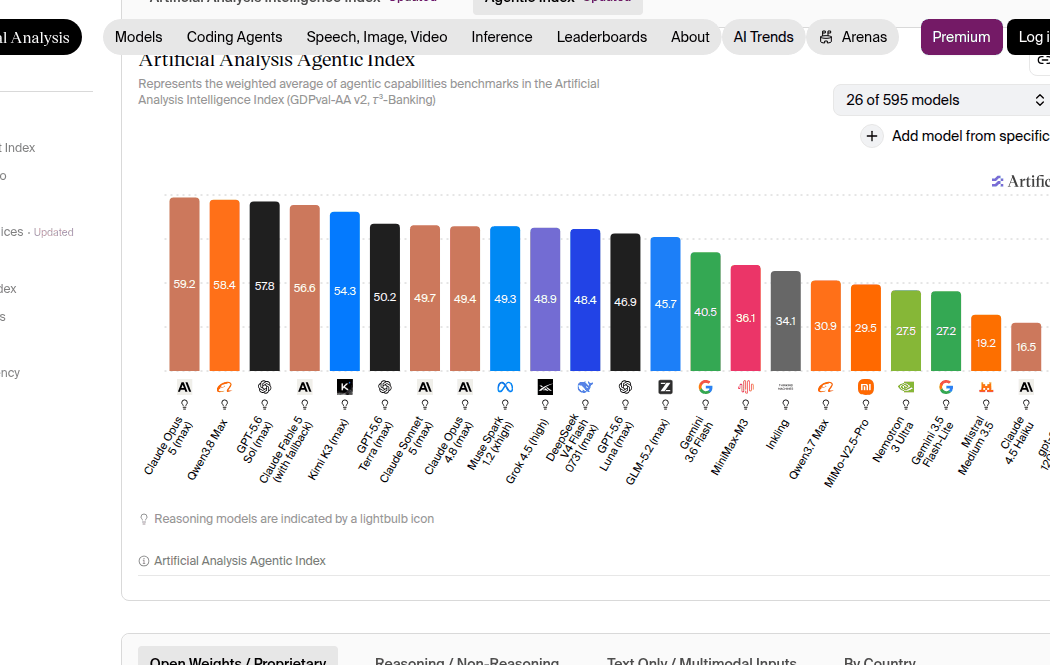 Figure: Artificial Analysis Agentic Index Leaderboard (Screenshot as of August 7, 2026). Source: artificialanalysis.ai
Qwen3.8 Max scored 58.4, followed by GPT-5.6 Sol at 57.8 and Claude Fable 5 at 56.6. The top spot remains highly volatile—the gap between Qwen3.8 Max and Anthropic’s flagship Opus 5 is less than a point, with the lead switching back and forth in recent days. From an engineering standpoint: execution capabilities among top-tier models are neck-and-neck, with no single player holding a permanent lead.
Beyond the single top spot, Chinese models occupy a prominent row on the leaderboard. Chinese models take two of the top five spots and four of the top thirteen—including Moonshot AI’s Kimi, DeepSeek, and Zhipu AI’s GLM alongside Alibaba’s Qwen. Just two to three years ago, the upper ranks of such benchmarks were dominated exclusively by US companies.
The paradigm has shifted from “who answers questions best” to “who completes tasks end-to-end.” Great Q&A performance doesn’t guarantee execution; successful execution shows knowledge is actually put to work.
Chatting vs. Getting Work Done: What’s the Real Difference?
The difference lies in three key dimensions.
First, multi-step planning. Chatting is a single-turn answer; getting work done is a sequence of coordinated actions. It’s like delegating to an intern: compare flight prices across three platforms, pick the cheapest option, email the itinerary, and book a hotel—all while retaining the overarching goal at every step. Standard chat models frequently lose context midway through multi-step workflows.
Second, tool invocation. An intern relies on web search, phone calls, and desktop software; an AI agent operates browsers, CLI command lines, and spreadsheets. Qwen3.8 Max achieved a score of 86.1 in the Computer Use evaluation, outperforming GPT-5.6 Sol’s 83.2. Performance remained consistent across various coding assistant environments—demonstrating that the capability resides in the base model rather than a specific wrapper application.
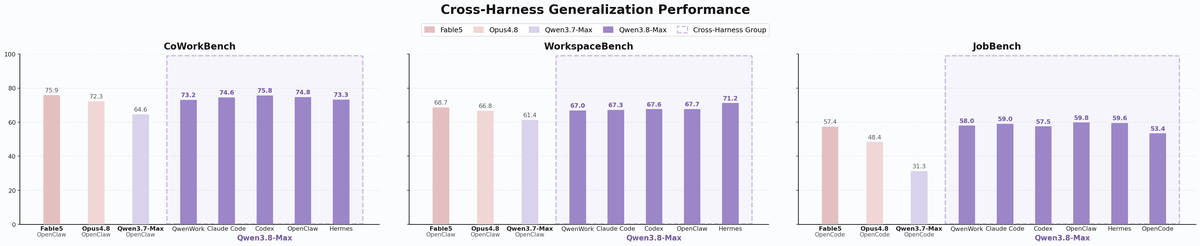 Figure: Qwen3.8-Max performance across various workplace environments. Source: qwen.ai official blog
Third, real-time self-monitoring and course correction. The model inspects its work as it proceeds: fixing UI alignment when layouts skew, or adjusting direction when output strays. This self-correcting feedback loop is a defining characteristic of this model generation, enabling autonomous operations for hours without drifting off track.
How Capable Is It in Real Scenarios?
Alibaba published several empirical benchmark results, three of which stand out:
E-commerce simulation over a simulated one-year period: Operating with a starting capital of $100,000 across multiple online stores, the model navigated nearly 600 suppliers—including 152 fraudulent operators—while managing typhoon supply disruptions and promotional demand surges. Ending balance reached $416,000 (a 4.16x return)—38% higher than the runner-up and 152% higher than the previous generation flagship.
Chip design: Given an initial circuit for an encryption chip containing 8,298 logic gates, the model executed 500 iterations of code modification, simulation, and debugging. It reduced the gate count to 678, shrinking chip surface area by 81%.
Algorithm competition: In an algorithm competition featuring 526 human teams, the model competed independently over 24 hours and outperformed 87% of human teams—reading rules, tuning models, and making 45 submission decisions entirely autonomously.
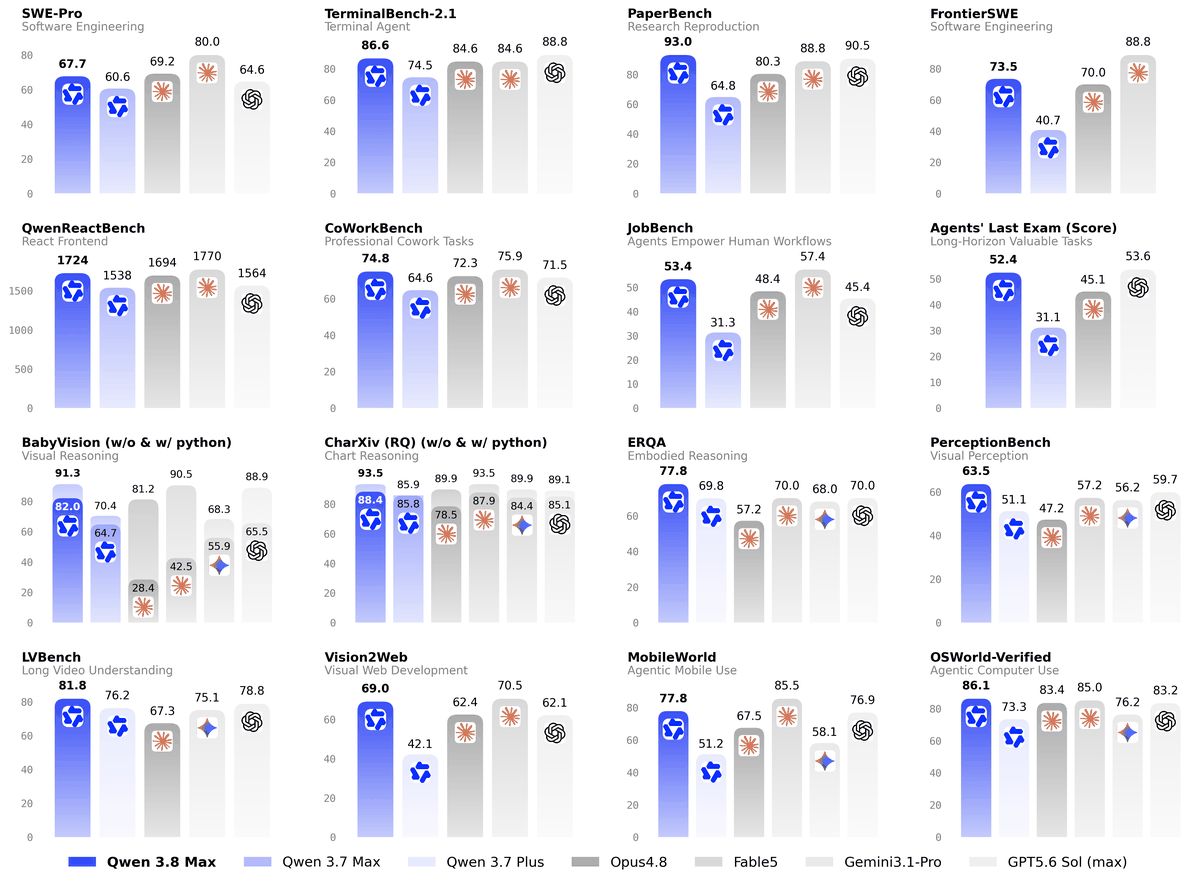 Figure: Qwen3.8-Max official performance benchmark comparison (vs. GPT-5.6 Sol, Claude Opus 4.8, etc.). Source: qwen.ai official blog
These metrics originate from Alibaba’s self-reported disclosures and await comprehensive third-party replication. Standard engineering prudence applies: the general directional capability is convincing, while exact margins warrant further validation.
Capable, But Verbose and Expensive
Reaching the top spot is computationally costly. Evaluation data indicates Qwen3.8 Max averages 64 interaction turns for tasks that previous models completed in 14 turns. Input token volume expanded by roughly 15x, while output tokens reached 145 million. Greater thoroughness comes at the price of increased verbosity and compute consumption.
In generation speed, Qwen3.8 Max sits mid-pack at 67 tokens per second, compared to Gemini 3.6 Flash’s 213 tokens per second. A full agentic evaluation run accumulated a compute cost of $1,741.
There remains a clear gap between capability and cost-efficiency. On API pricing, however, Qwen charges $2 per million input tokens and $6 per million output tokens—significantly below comparable US offerings. Alibaba also announced it will open-source the model weights next week, marking the first time a Max-tier flagship model goes open-weights. Open sourcing allows any organization to deploy locally, pushing operational costs down further.
What the Community Is Debating
With top scores clustered closely, community debate on Hacker News has intensified. One camp argues the tight clustering indicates model distillation—suggesting smaller models are training on outputs from larger flagship models. Counter-arguments contend that learning from synthetic model outputs violates no legal framework and mirrors human learning processes.
Engineers have also shared personal cost trade-offs: after spending $15 on DeepSeek to complete complex software projects, several noted questioning their ongoing $200/month OpenAI subscriptions. While anecdotes do not constitute proof, the growing prevalence of such feedback is shifting market expectations.
Legal disputes form another thread. Commenters noted that past settlements by major tech firms without admission of guilt leave underlying IP questions unresolved. Others interpret the score convergence as a sign that LLM capabilities are approaching a temporary plateau. Whether a plateau exists will depend on how challenging the next benchmark revision proves to be.
What This Means for Everyday AI Usage
The aspect of this competition most relevant to everyday users lies beyond the leaderboard numbers.
Over the past two years, AI provided answers: drafting copy or answering questions. Now, AI provides completed outcomes: hand over a stack of receipts, and it formats them into a spreadsheet sent to your inbox; mention a business trip, and it independently searches flights, compares rates, and books accommodations. Integrating these agentic capabilities into mobile applications is now purely a matter of time.
Leaderboards will continue to fluctuate. But the direction is clear: the next era of AI belongs to models that get the job done.
Reference Links:
- Artificial Analysis: Agentic Index Leaderboard
- HN Discussion (item?id=49200652)
- Alibaba Cloud / Qwen Official Blog
- MarkTechPost Coverage
- VentureBeat Evaluation Report