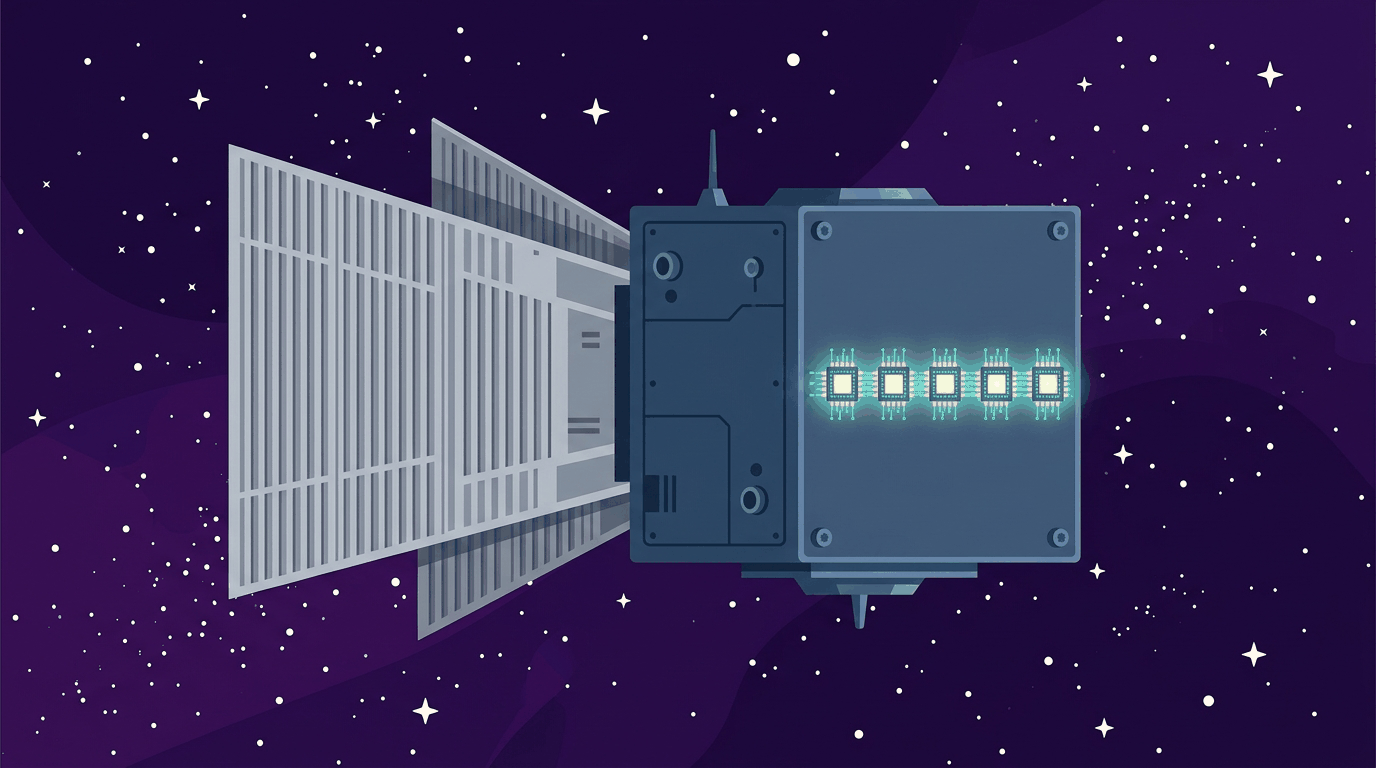
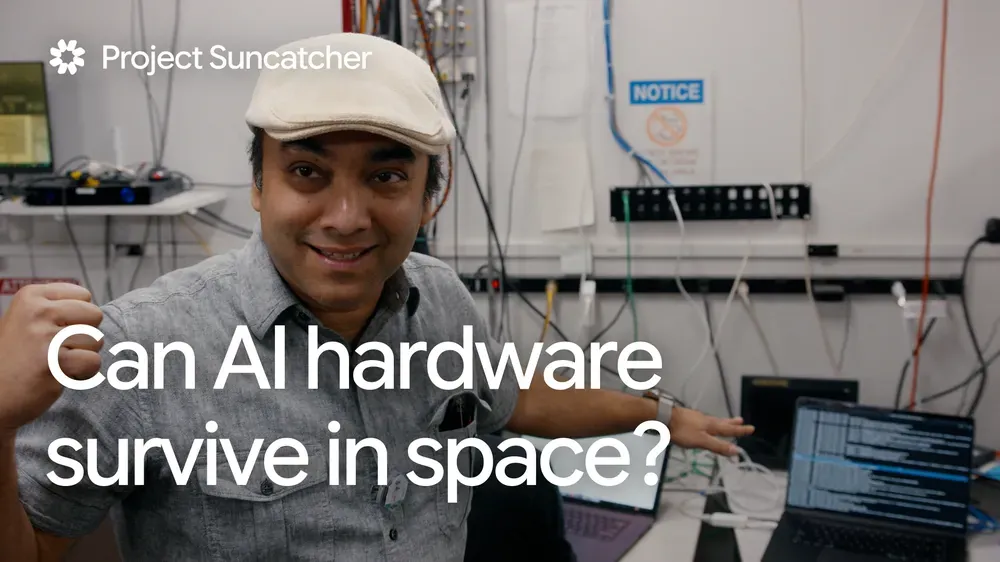
On September 24, 2026, SpaceX’s Transporter-18 rideshare mission lofted a routine manifest of orbital payloads. Tucked among them was a far more speculative experiment: a prototype satellite for Google’s Project Suncatcher. Developed in partnership with Planet Labs, the spacecraft carries a Trillium TPU chip primed to crunch machine learning workloads in orbit. Tech giants are no longer content building hyperscale facilities next to deserts or glaciers—they are attempting to launch computing infrastructure directly into space.
On Hacker News, however, the ambitious initiative sparked little poetic romanticism about celestial frontiers. The submission garnered a modest score of 82, yet drew over 138 granular technical comments. Rather than marveling at grand vistas, engineers immediately pulled out scratchpads to calculate the cold physical balance sheet: while orbital solar panels capture up to eight times more solar irradiance than those on Earth, space has no moving air. How, exactly, do you dissipate the massive, concentrated heat plume generated by a modern TPU without convection?
On Earth, the critical bottleneck for AI training and inference has already migrated from raw compute to power availability and datacenter cooling. Google’s radical response is to seek an orbital datacenter bathed in perpetual sunshine. Yet moving compute clusters to orbit simply trades one severe terrestrial energy constraint for a formidable, unyielding wall of physics.
Surviving Ten Minutes of Brutal Shock: The Hardware Must First Reach Orbit
Before sensitive silicon can operate in space, it must survive the violent physics of rocket launch. During the initial ten-minute ascent into orbit, the hardware bay is battered by ferocious acoustic and mechanical vibration, with sustained accelerations spiking up to 10g. For a complex packaged component like a TPU, localized stress peaks can reach an astonishing 50g to 100g. A single micro-fracture in a solder ball or wire bond would terminate the mission before it ever reaches the vacuum.
Google’s engineering team subjected the hardware to rigorous three-axis vibration profiles in ground laboratories, faithfully reproducing the harsh acoustic and shock environment of launch. As project engineers acknowledged, extreme stress tests rarely run smoothly without incident, yet the commercial TPU hardware ultimately endured the mechanical assault. The test provided a stark empirical validation of modern commercial packaging: under severe physical shock, state-of-the-art semiconductor packages possess significantly more structural headroom than conventional aerospace wisdom often assumes.
Once safely settled into orbit, the next adversary is invisible: galactic cosmic radiation. Stripped of Earth’s protective atmospheric blanket, bare silicon is continually bombarded by high-energy particles capable of triggering single-event upsets (SEUs) in logic circuits. These bit flips introduce silent, catastrophic corruptions into numerical calculations—a fatal flaw for distributed, highly synchronized AI training workloads that demand strict numerical consistency.
To evaluate radiation resilience, researchers brought the entire computing stack to the Crocker Nuclear Laboratory at the University of California, Davis. They subjected the Trillium TPU to direct, continuous proton beam bombardment while actively running AI inference workloads to monitor error rates. Preliminary results indicated that the TPU’s total ionizing dose (TID) tolerance exceeds the cumulative radiation dose expected over a five-year mission in low-Earth orbit. The fact that commercial-off-the-shelf (COTS) AI hardware can withstand such harsh radiation environments proves its baseline survivability. Yet surviving radiation is merely the entry ticket.
Gaining Eight Times the Solar Irradiance at the Cost of Convective Cooling
Google’s core motivation for hoisting compute into orbit is the tantalizing energy density of low-Earth orbit. In sun-synchronous orbits, satellites evade cloud cover and diurnal day-night cycles, basking in near-continuous solar illumination. Solar arrays operating in orbit can generate up to eight times more electricity per unit area than equivalent ground installations. Project Suncatcher’s ultimate ambition is to link constellations of interconnected satellites capable of executing heavy machine learning workloads directly in space.

On paper, the orbital energy equation looks immaculate. In reality, it comes at the expense of nature’s most generous engineering luxury: convective cooling. Inside a terrestrial datacenter, dozens or hundreds of kilowatts per rack are whisked away by howling fan arrays or high-flow liquid cooling loops. Whether air- or water-cooled, terrestrial thermal management relies on fluid media to transport thermal energy into the vast atmospheric heat sink.
In the vacuum of space, however, conduction and convection paths into the environment cease to exist. Thermal energy trapped in the silicon has nowhere to go except through thermal radiation—the slowest and least efficient of all heat transfer mechanisms. What makes TPUs particularly demanding is their intense heat flux: massive wattage concentrated across tiny die areas. Without an immediate, ultra-fast thermal escape route, the silicon would self-destruct in its own several-hundred-degree heat within seconds.
To tackle this thermal bottleneck, the engineering team designed a coupled thermal system utilizing embedded heat pipes routed to expansive radiative radiator panels. Ground-based thermal vacuum (TVAC) chambers were built to replicate the severe thermal cycling and vacuum of orbital space, testing whether concentrated thermal loads could be rapidly and evenly dispersed across wide radiating surfaces. But strapping large radiators and heat pipes onto a satellite dramatically increases dry mass and volumetric footprint, making every gram of launch capacity exponentially more expensive.
Inter-Satellite Bandwidth and Maintenance: The Ground Truth of Orbital Infrastructure
Even if TVAC testing confirms that thermal dissipation is feasible for an isolated unit, scaling up to an orbital cluster of dozens of TPUs encounters punishing physical constraints. An orbital datacenter cannot simply be built by boxing up ground racks in aluminum shells and launching them on rockets.
Under Project Suncatcher’s roadmap, future satellites would each house tens of TPUs, flying in close orbital swarms. That brings up the second critical question raised in the Hacker News debate: how do you interconnect nodes with enough bandwidth? Contemporary distributed AI training requires terabits per second of low-latency inter-chip bandwidth. Traditional microwave RF links lack both the throughput and the latency profile needed for synchronous parameter synchronization. Transitioning to inter-satellite optical laser communications introduces immense pointing precision requirements and astronomical hardware costs.
Furthermore, launch economics and orbital maintenance present an unforgiving tradeoff. In a terrestrial datacenter, a technician can walk down a hot aisle and hot-swap a failed blade in minutes. An orbital compute node that suffers hardware degradation immediately transforms into expensive space junk. While radiation testing indicates total dose tolerance over five years, cumulative thermal fatigue from orbital day-night cycles and micrometeoroid impacts remains an unquantified risk. How such degradation affects long-term tensor precision remains an unvalidated black box.
Thermal Dissipation: The Ultimate Frontier in the AI Compute Wars
Google has been transparent that Project Suncatcher remains an exploratory research project. Official timelines suggest the next tangible milestone will not arrive until 2027. This mission is an early rehearsal to validate technical hedge options for the next decade rather than an imminent commercial deployment.

Beneath the surface, the project reflects the intense energy anxiety confronting tech giants. Having exhausted terrestrial playbooks—direct nuclear power procurement, advanced liquid cooling, and 24/7 grid balancing—hyperscalers are naturally looking to the unconstrained solar flux of space. Yet this orbital experiment underscores the unyielding physical realities governing the next phase of the compute race: raw FLOPS per watt are no longer the sole arbiters of viability.
Relocating AI infrastructure to the vacuum of space shifts the primary engineering challenge away from semiconductor benchmarks. In orbit, the critical metrics become radiator surface area and the efficiency with which every single watt of heat radiates into the cosmic void. When eight times more solar irradiance floods into fragile silicon, compute visions remain grounded in physics unless that heat can escape—in a realm where the wind never blows.
References:
- Hacker News Discussion (item?id=49830606)
- Official Google Blog