When testing your reaction time on a simple visual reflex app, you tap the screen the split second the light switches from red to green. One try clocks in at 180 milliseconds; the next suddenly slips to 220 milliseconds. Most people chalk up these tens of milliseconds of variance to a momentary lapse in concentration or an unsteady finger. Yet new findings in cognitive neuroscience suggest that the hidden switch governing response speed is tucked away in the rhythm of your breath.
A Quest for Sleep Apnea Solutions Uncovers a 41-Millisecond Shift
On September 28, 2026, a research team from Northwestern University published their findings in the journal iScience. The authors work in cognitive neuroscience—the interdisciplinary field investigating how neural circuits generate perception, memory, and motor action. The team was originally exploring clinical interventions for obstructive sleep apnea, a condition where breathing repeatedly pauses or becomes shallow during slumber. To establish a baseline of waking physiological metrics, they designed a standard psychomotor reaction test.
The researchers recruited 35 volunteers and seated them before computer displays. The task was straightforward: whenever an on-screen red square turned yellow, the participant had to click a button as fast as possible. Throughout the session, sensors placed directly beneath their nostrils recorded every inhalation and exhalation with millisecond precision.
When the team analyzed the data, the results caught them entirely by surprise. When participants clicked the button while exhaling, their reaction times were, on average, 41 milliseconds faster than when inhaling. When volunteers held their breath, their motor response speeds matched the heightened performance observed during exhalation.
To rule out fatigue as a confounding variable, lead author Erika Yamazaki compared response latencies across varying levels of sleepiness. The data revealed that whether participants felt sharp and fully alert or groggy and drowsy, the exhalation speed advantage remained remarkably consistent.
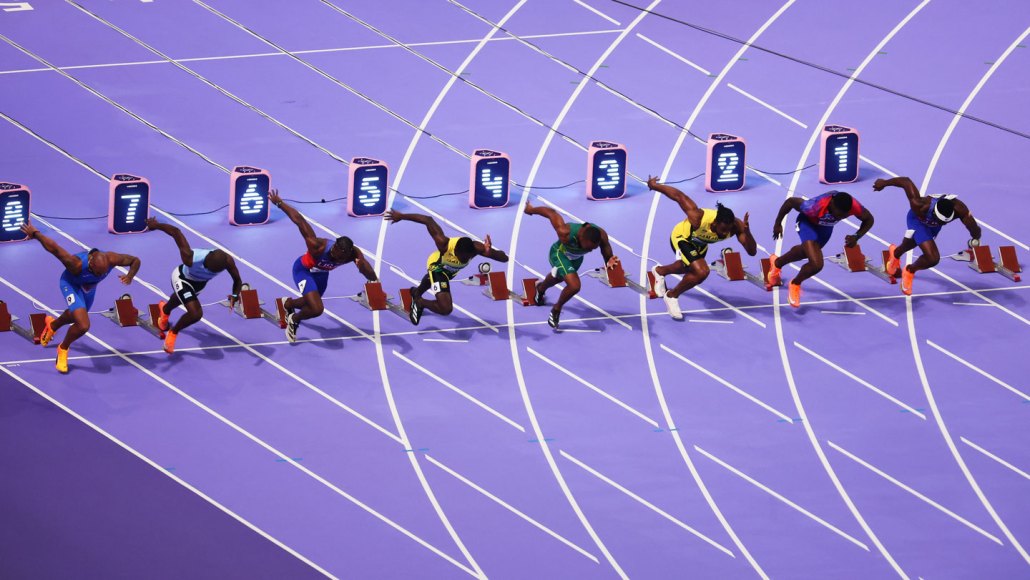 Figure: A sprinter launching from the blocks, where milliseconds determine victory. Source: Science News
Forty-one milliseconds might sound negligible, but in elite competition, that split second rewrites history. In the men’s 100-meter final at the 2024 Paris Olympics, gold medalist Noah Lyles edged out second place by a mere five thousandths of a second (5 milliseconds). A 41-millisecond delay is more than eight times that winning margin—a gap wide enough to plunge the Olympic champion straight off the podium into fourth place.
Brain Waves Locked to Breath: How Alertness Follows Respiratory Cycles
The reason finger reflexes are tethered to respiration stems from neural synchronization across the central nervous system. Senior author Ken Paller explains that as air streams through the nasal cavity, it stimulates specialized olfactory and mechanosensory neurons, transmitting rhythmic pacing signals upward into higher brain regions.
The human brain constantly generates electrical fluctuations known as brain waves (electroencephalogram, or EEG, reflecting the synchronized firing of neuronal populations). Landmark research in 2016 demonstrated that inhaling and exhaling act like an internal conductor’s baton, orchestrating rhythmic oscillations across widely distributed cerebral circuits.
During exhalation or breath-holding, the brain’s motor preparation networks enter a heightened state of readiness. When the visual cue strikes the retina, motor commands travel down descending neural pathways unimpeded, discharging physical movement with minimal latency.
The fluctuation in button-press latency indicates that baseline alertness is dynamically modulated by the respiratory cycle, keeping cortical excitability locked in step with the rhythm of breathing.
Exhaling Favors Quick Reflexes, but Inhaling Speeds Complex Recognition
This exhalation advantage appears confined to simple motor reflexes. In a landmark 2016 study, participants were asked to recognize emotional facial expressions, distinguishing between faces displaying fear versus surprise.
In that task, which demanded substantive cognitive processing—the sequence of perceptual identification, memory retrieval, and deliberate evaluation—the behavioral dynamic flipped entirely. Participants identified emotional expressions significantly faster when inhaling than when exhaling.
 Figure: Researchers recorded breathing patterns alongside button-press response latencies. Source: Neuroscience News
These divergent findings illuminate how the brain prioritizes its computational resources. Pressing a button when a color turns yellow is a pure reflex requiring little cortical deliberation, where motor readiness during exhalation takes precedence. Facial recognition, by contrast, requires querying stored memory banks. The act of inhalation enhances sensory sampling, helping the brain synthesize incoming visual information to make an accurate appraisal.
Paller emphasizes in the paper that tasks involving complex cognition engage far more intricate interactions with respiratory rhythms. The behavioral rules governing rapid reflexes cannot be broadly extrapolated to higher-order cognitive judgments.
Evolutionary Wiring: Why the Body Gates Motor Actions to the Exhale
From an evolutionary standpoint, coupling neural impulses to respiration confers distinct survival advantages. During inhalation, animals sample their surroundings for olfactory cues and visual anomalies—a phase dedicated to intensive environmental surveillance.
During exhalation or momentary breath-holding, sensory intake pauses, core musculature stabilizes, and the central nervous system pivots its energetic bandwidth toward motor output. Whether a predator lunges at prey or an early hominid dodges falling debris, explosive physical action is mechanically and neurologically primed to release upon the exhale.
This chance laboratory finding opens fresh avenues for competitive athletics and industrial ergonomics. While individuals cannot consciously time every millisecond of breathing in daily life, breath control may represent a critical, overlooked physiological variable in auto racing, esports, and high-stakes operations where split-second reflexes are paramount.
The brain appears to utilize respiration as an intrinsic metronome, scheduling electrical impulses to fire when execution is most efficient.
The Rhythm of Response: How Breath Primes Split-Second Action
A fingertip tapping glass is far more than a localized muscular twitch; it is the culmination of coordinated neural oscillations locked to the rise and fall of breath. From the yellow flash on screen to motor neurons firing in the arm, a 41-millisecond acceleration highlights the precision with which the nervous system orchestrates action.
Inhale to gather information; exhale to unleash the strike. Beneath conscious awareness, the respiratory cycle steadily tunes the cadence of human alertness.
References:
- Science News Reporting
- iScience Original Research Paper