
In October 2026, Christie’s listed an unconventional artifact from the history of science and computing: a small, slightly yellowed roll of paper mounted in a gallery frame. The paper is creased, densely printed with hexadecimal strings, and measures just 41 × 210 mm. On the reverse of the frame, a handwritten note reads “Property of David Waitzman.” Cataloged as Lot 150 with an estimate of $2,000 to $3,000, it had already attracted multiple bidding rounds by publication time.
Unlike classical scientific manuscripts filled with mathematical proofs, this artifact is a real network packet physically transported across Norway by a homing pigeon in 2001. In an experiment known as CPIP (Carrier Pigeon Internet Protocol), the bird acted as a living physical layer link, completing a genuine IP datagram transmission. The outside world has long treated the episode as an elaborate hacker prank. Yet the numbers that technologists have joked about for over three decades—55% packet loss and round-trip times stretching past 100 minutes—are precisely where its real engineering value lies. Network protocols are magnificent because they can model any transmission medium. But the physical laws governing that medium will always define the unyielding outer limits of the system.
55% Packet Loss Exposes Physical Link Fragility
The paper trail began on April 1, 1990, when network engineer David Waitzman published a technical proposal under the standard IETF title RFC 1149: “A Standard for the Transmission of IP Datagrams on Avian Carriers.” Written with deadpan technical rigor, the memo detailed how feathered creatures could form point-to-point network links. In its abstract layered model, physical copper and fiber cables were replaced by avian leg bones, and the final encapsulation step required operators to roll paper strips tightly. Eleven years later, members of the Bergen Linux User Group (BLUG) in Norway decided to take this satirical specification and turn it into operational reality.
On April 28, 2001, a 5-kilometer field trial was carried out between two pigeon lofts in western Norway. Ground operators manually executed the physical encapsulation layer. A commercial printer converted binary IP packets into hexadecimal text strips, which were taped to the legs of homing pigeons and released. Once the birds reached their destination, the receiving team detached the paper slips, digitized them using a flatbed scanner, ran optical character recognition (OCR) software to turn the text back into binary data, and injected the resulting packets directly into the host machine’s network stack.
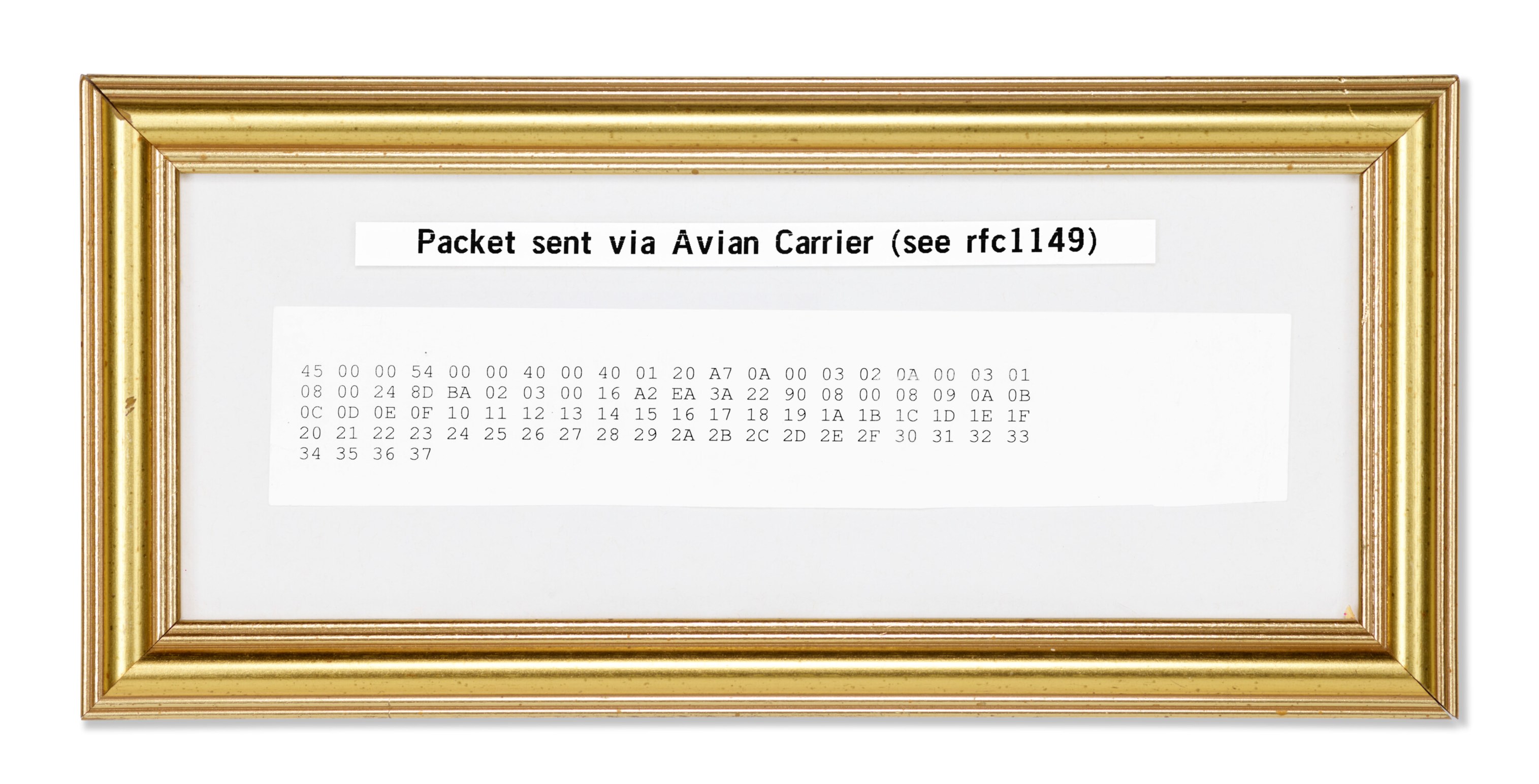 Figure: The original framed paper packet printed with hexadecimal data once strapped to a pigeon’s leg. Source: Christie’s official auction catalogue.
The test bench transmitted nine ICMP echo requests to the target host and received four replies. A staggering 55% of the transmitted packets were lost in transit. While the official trial log attributed some lost slips to human handling errors, sending live animals across mountain drafts realistically replicated the most hostile transmission environments imaginable. Packet loss here was not merely a punchline; gusty crosswinds, predator attacks, and moisture-damaged paper offered a tangible demonstration of physical-layer vulnerability. The intricate retransmission and timeout mechanisms built into TCP/IP were designed specifically to survive this kind of unpredictable substrate.
Multi-Million Millisecond Latencies Break TCP Handshakes
The original terminal log preserved an iconic command: ping -c 9 -i 900 10.0.3.1. The system sent nine probe packets spaced 900 seconds—15 full minutes—apart. The raw console output revealed immense variance in round-trip times (RTT) across the four packets that survived. The fastest round-trip took 3,211,900.8 milliseconds (about 53.5 minutes), while the slowest dragged on for 6,388,671.9 milliseconds—well over an hour and forty-six minutes.
 Figure: The homing pigeon serving as an avian physical carrier. Source: Wikimedia Commons.
Latencies measured in millions of milliseconds spell instant death for interactive networking. Across fiber optics or high-grade copper, electromagnetic signals routinely cross continents with double-digit millisecond latency. But on a non-standard link propelled by carbon-based lifeforms, the five-kilometer gap and biological flight speeds formed a temporal barrier that algorithmic optimization could never breach.
Over a 90-minute response cycle, establishing a standard Transmission Control Protocol (TCP) three-way handshake becomes practically impossible. Default operating system timeouts trigger aggressive retransmissions within seconds, rapidly flooding transmission buffers with duplicate packets and inducing congestion-control deadlocks. High-latency, high-bandwidth sneakernets are familiar to modern systems engineering—AWS Snowmobile literally transports exabyte-scale storage clusters in semi-trailers over public highways, where latency is measured in days but total throughput dwarfs residential broadband. The four pigeons carrying hex-printed strips proved the theoretical tolerance of the IP suite under extreme latency. Protocol designers can imagine whatever abstractions they wish, but application architectures must ultimately pay for physical bottlenecks.
An Absurd Experiment Proves Layered Decoupling
RFC 1149 enjoyed an afterlife far longer than anyone anticipated. The engineering community treated the protocol with rigorous seriousness, publishing formal extensions over subsequent decades. In 1999, RFC 2549 specified Quality of Service (QoS) guarantees for avian carriers, and in 2011, RFC 6214 introduced IPv6 support to the pigeon network. Behind this ongoing running joke lies the foundational architectural triumph of the TCP/IP stack: clean decoupling between network-layer routing and the underlying transmission medium.
Whether the physical substrate consists of electrical pulses over copper wire, light pulses through glass fiber, or tiny strips of paper taped to a bird’s leg, the IP layer remains entirely indifferent to the medium. As long as binary payloads can be shuttled from source to destination, the stack treats the interface as a conforming link. This strict abstraction boundary was the exact architectural secret that allowed the early Internet to tie together disparate, incompatible computer networks across the globe with ferocious interoperability.
French National Assembly deputy Martine Billard famously cited this open-source test in parliament during debates on the controversial HADOPI anti-piracy law to demonstrate technical fundamentals. When a datagram bearing a destination IP address can be printed in hex, scanned into an OS stack, carried over valleys by a bird, and accurately trigger an operating system kernel response, it acts as the ultimate architectural stress test. There is no magic in computer networking—only layered physical systems connected by agreed-upon standards.
Backyard Engineering Fetches $2,000 at Christie’s
In its lot notes, Christie’s characterized the artifact as a premier example of the Internet’s venerable tradition of “elegant mischief.” Veteran engineers still remember the feeling in 2001 when Slashdot first picked up the story from Bergen: the sheer delight of discovering kindred spirits halfway across the globe willing to spend real time and money validating a decade-old April Fools’ joke purely to explore the outer edges of engineering reality.
That narrow strip of paper commands a place in a fine auction catalog because it stands as a historical anchor, capturing the raw creative spirit of engineers pushing back against rigid systems. Modern digital infrastructure has largely been consolidated into cloud hyperscalers, with low-level protocols layered beneath complexities that ordinary developers rarely touch directly. Over two decades ago, open-source hackers could comfortably venture into a backyard with spare computer gear and racing pigeons to test the boundaries of global protocols. That hands-on, grassroots spirit now inspires a deep collective nostalgia across the tech industry.
Sealed behind glass in a 41 × 210 mm frame, the paper strip has completed its tour of duty as a network medium. Looking back at its 55% packet loss and 90-minute delays, the enduring power of this legendary technical joke becomes clear: it succeeded because it showed absolute deference to physical law. Protocol specifications can describe frictionless virtual worlds, but when confronted by mountain head-winds and avian exhaustion, they must yield to the real world—and print a quiet timeout error across a terminal screen.
Reference Links:
- Christie’s Lot Details (Lot 150)
- Lobsters Discussion (RFC 1149 packet auction)
- Wikipedia: IP over Avian Carriers