
In July 2026, a line chart generated by a SQL query blew up in programmer circles. The curve dives from a monthly average of 207,000 in 2014 all the way down to 1,226 in July 2026 — a 99.4% drop.
What does that mean? A site where two hundred thousand people once went to ask questions every month now has only about a thousand people a month still willing to speak up. And that site is Stack Overflow — the world’s largest programmer Q&A platform.
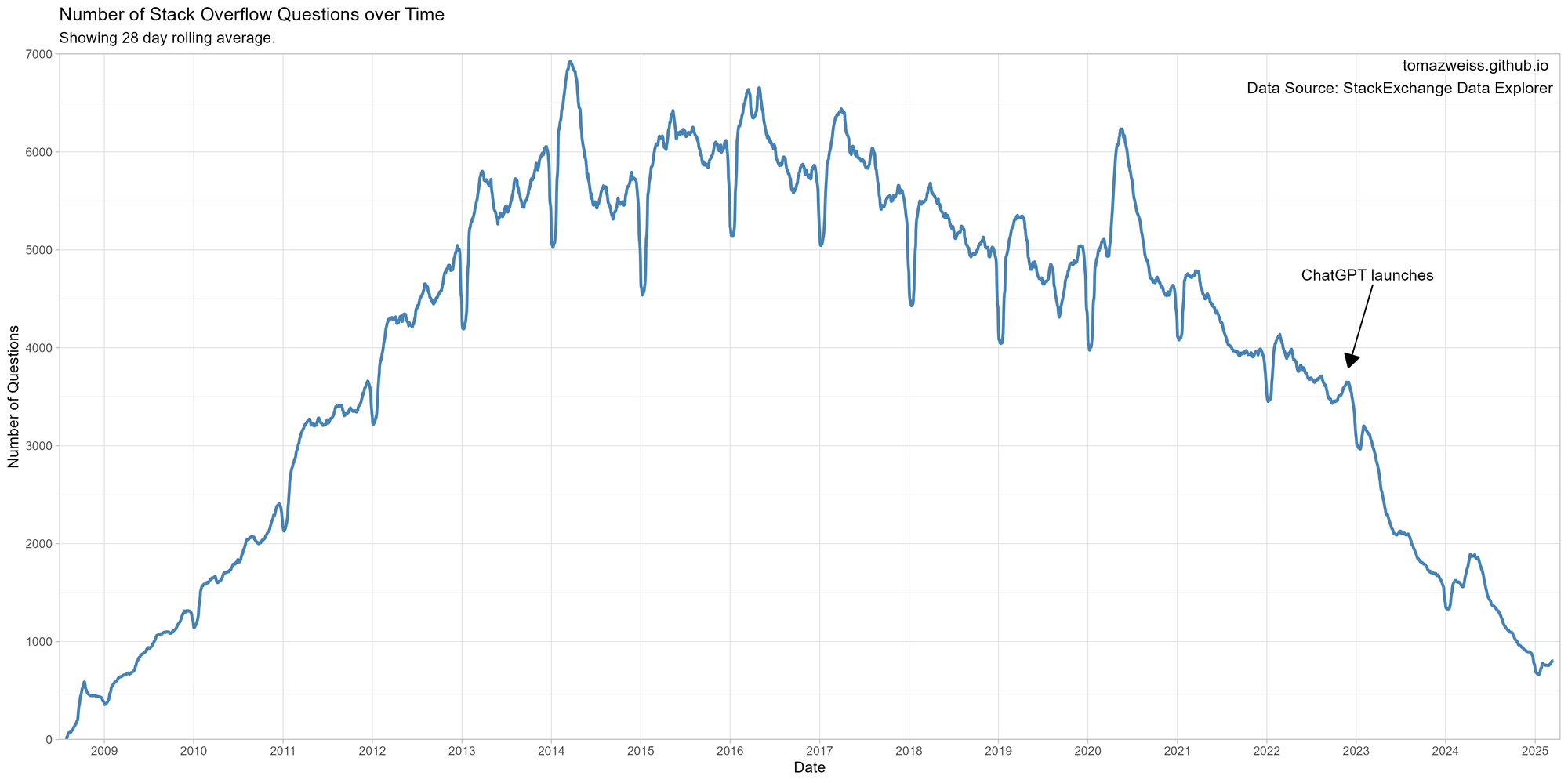 Source: Tomaž Weiss, plotted from StackExchange Data Explorer data
When I saw this curve, my first reaction was a complicated sense of melancholy. A knowledge base that ran for sixteen years and accumulated tens of millions of Q&A entries is turning into a historical relic at a visible pace.
But if you think this is just the “ChatGPT killed Stack Overflow” story, then you’ve missed the part actually worth discussing. Behind this curve lies a threefold tragedy: a community that disintegrated from within, was then hit by an external shock, and was finally dealt a coup de grâce by its own management.
It was once irreplaceable
First, let me introduce Stack Overflow (hereafter SO) in a way anyone can understand. You can think of it as a Q&A site built specifically for people who write code, but far stricter: questions have formatting requirements, answers get voted and ranked, and the best answer gets a green checkmark and stays pinned to the top forever. The whole site had no ad banners, no popups, only questions and answers — clean, efficient, extremely useful.
After launching in 2008, SO quickly became the tab that stayed permanently open in every programmer’s browser. You hit an error writing code, you Google it, and the first result was almost always a question on SO, with a highly upvoted answer below that solved your problem in a few words. How good was that experience? So good that many people never registered an account — they only searched, only read, never asked — because other people’s questions already covered everything you’d ever run into.
Its monthly question volume peaked around 2014, at about 207,000. It slowly declined afterward but held steady in the six figures. Everything looked solid, until November 2022, when ChatGPT launched.
AI substitution: from slow slide to cliff-edge fall
There’s a very clear dividing line in that chart — November 2022. Before it, SO’s monthly question volume had already been slowly shrinking by a few percent a year. After it, the curve turned straight down, as if the floor had been pulled out.
The reason isn’t hard to understand. Previously, when a programmer hit a problem, they had to Google first, click into SO, dig through several similar-but-not-identical questions, and sometimes the answer still didn’t quite match their situation. The whole process could take ten minutes, or half an hour.
Now, you open ChatGPT (or China’s Kimi or Tongyi Qianwen), paste the error message straight in, and get an answer tailored to your specific situation in seconds. It won’t complain that your question wasn’t clear enough, won’t say “this has already been asked,” won’t send you to read a beginner tutorial first. You can even follow up with “that last method didn’t work, is there another way,” and it will patiently give you another option.
A comment from the HN discussion captured this experience gap precisely:
“You throw an error message with zero context at an AI and it will do its best to guess where the problem is. A lot of the time it actually guesses right. On SO, the response you’re most likely to get is — ‘Question closed, because it doesn’t meet our formatting standards.’”
This isn’t to say AI’s answers are necessarily more accurate than SO’s experts. But AI does one thing SO never could: it never makes you feel stupid.
Community gatekeeping: dying slowly before AI even arrived
Many people think SO’s decline started with ChatGPT’s release. But data researchers noticed a much earlier signal long ago: SO’s monthly question volume had already been slowly declining after peaking in 2014, and that decline had nothing to do with AI.
So what caused it?
An HN user named lynndotpy wrote a comment that resonated with many:
“Any social organization needs to think carefully about its inclusion-exclusion boundary. SO set an extremely high bar for participation — which made veterans comfortable, but made newcomers find their questions constantly shut down. That’s how they slowly killed the site.”
Put simply, SO built a strict “quality control” system: questions had to be properly formatted, couldn’t duplicate existing ones, couldn’t be “opinion-based,” couldn’t be too broad. If they didn’t comply, senior users would vote to flag them as “duplicate,” “not a real question,” or “off-topic,” and they’d be closed — unable to receive answers anymore.
The intent behind this system was good — avoid the site turning into a swamp of junk questions. But in practice, it gradually evolved into a tool for exclusion. A former top SO answerer recalled his experience on HN: in a niche technical field’s Q&A community, he’d carefully written dozens of high-quality answers and, within two weeks, became the field’s top contributor. The result: a moderator far below his level of knowledge but more senior in tenure began nitpicking his answers word by word, finding all kinds of reasons to edit his content. He lasted a month and then quit, never to return.
An even more typical experience goes like this: you’re a newcomer who just entered the field and hit a real problem. You spend half an hour carefully describing the background, attaching code and the error message, and post it on SO. Ten minutes later, the question is flagged as “duplicate,” pointing to another question. You open that “duplicate” link and find it’s not the same problem at all — it just uses the name of the same software library. You want to appeal, and find you need a high enough “reputation” to vote to reopen. And the fastest way to accumulate reputation is to answer other people’s questions. But as a newcomer, you haven’t even figured out your own problem yet — how could you possibly answer someone else’s?
It’s a perfect vicious cycle. A large number of potential new users, after one or two experiences of being closed, would never try to ask again. They turned into the “search-only, never-ask” silent users mentioned earlier. And when AI tools appeared and could replace even the search step, these silent users became the first batch to leave entirely.
Management’s “finishing blow”
If SO had only suffered the two blows of community gatekeeping and AI substitution, it might have continued to exist as a niche but stable knowledge base — after all, there are always complex problems AI can’t handle, and always some people who trust human experts’ judgment more.
But SO’s management made a decision that sharply worsened the situation: forcibly stuffing AI into every feature.
In 2023, SO launched its own AI Q&A feature, “OverflowAI.” This was in principle a reasonable defensive strategy — if AI is stealing users, why not build one ourselves? But the problem was that SO’s management chose the crudest possible implementation: embedding AI-generated content all over the site, including automatically displaying AI answers on question pages, force-popping AI summaries in the search bar, and making it impossible to turn off even when a user explicitly indicated they didn’t want AI.
For SO’s remaining core users — the ones who insisted on manually asking and answering questions on the site — this was nothing short of a betrayal. The reason these people were still using SO was precisely that they didn’t trust AI’s answers and were willing to spend time waiting for human judgment. And now, the first thing they saw when they logged in was an AI-generated answer, of uneven quality, sometimes even wrong, but placed in the most prominent position.
An HN user wrote:
“SO still had a chance to survive, because it was the best place for AI skeptics to ask questions… until SO management stuffed AI into every corner too, and drove those people away as well.”
The irony of this approach: SO was itself one of the data sources for training ChatGPT. OpenAI made heavy use of SO’s Q&A data when training its models, and that data was exactly what countless programmers had volunteered over sixteen years. Now the AI trained on that data has, in turn, replaced SO, and SO’s management has stuffed AI back onto the site — forming a strange loop: community contributes → trains AI → AI replaces community → community declines → management embraces AI → remaining users leave for good.
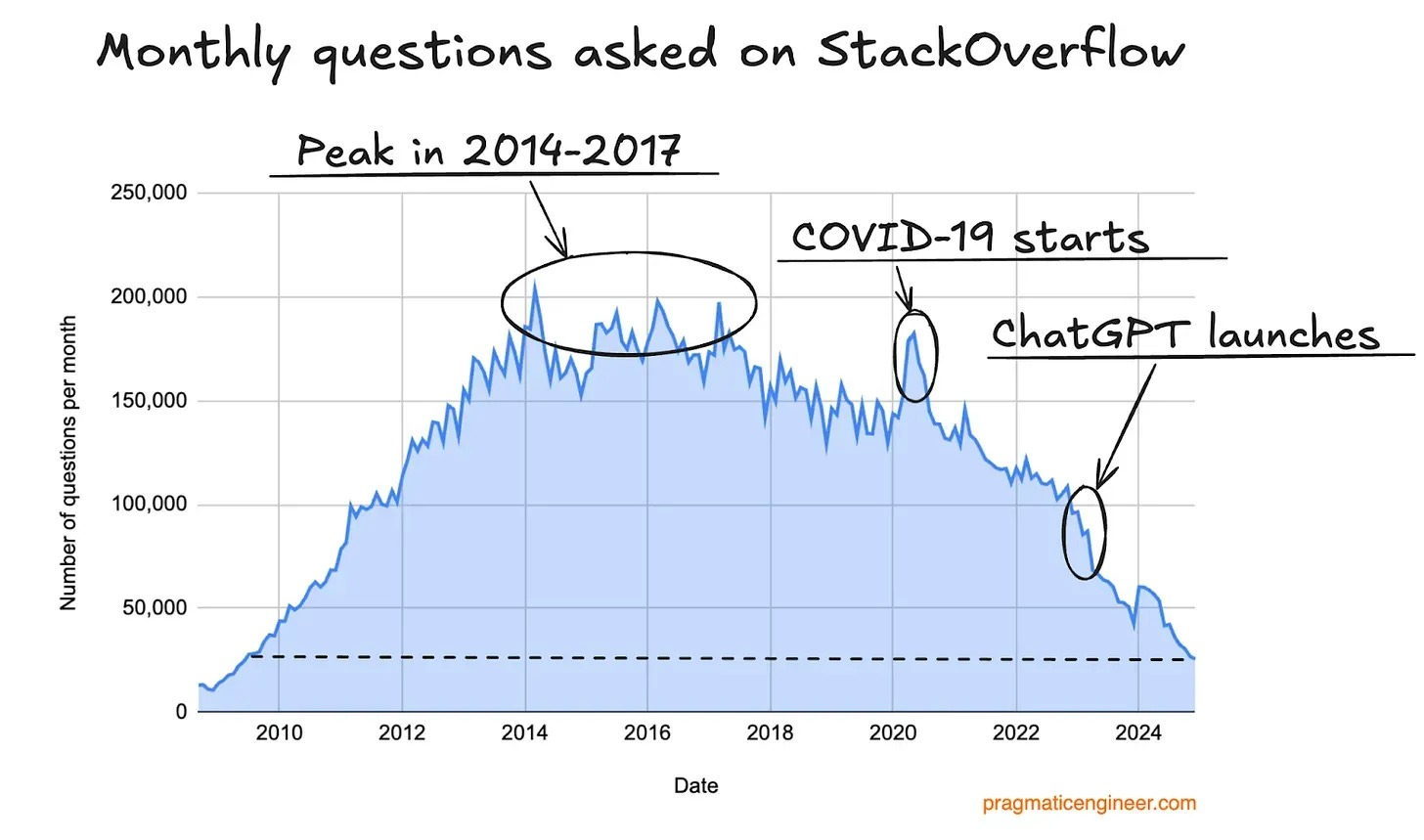 Source: Eric Holscher, plotted from StackExchange Data Explorer data
What was lost is more than a website
I don’t want to tell SO’s story as a simple “bad guys wrecked a good site.” Its quality-control mechanism genuinely protected content quality in the early days, setting SO apart from the Reddit-style or forum-style formats that easily get buried under spam. Many veteran users still miss that clean, efficient knowledge base to this day.
But when a community turned “protecting quality” into “excluding newcomers,” it started down an irreversible downhill road. Newcomers can’t get in, veterans retire, switch careers, or go inactive, and the community naturally shrinks. AI’s arrival merely accelerated the process dramatically.
The deeper question: when people no longer ask and answer in public spaces, where does the knowledge go?
Previously, a programmer would post a question on SO, someone would give an answer, and that exchange would be permanently preserved, searchable, and continually improvable by later readers. That’s “public knowledge” — everyone benefits.
Now, the same question gets typed into ChatGPT’s chat box. The answer is generated, the problem is solved, but that exchange stays forever inside that private conversation window. It won’t be found by later learners, no one will correct its possible errors, and it won’t accumulate into new public knowledge.
SO’s decline doesn’t just mean the death of a website; it also means that updates to one of the internet’s largest human knowledge bases have stopped. In the future, when you hit a new-technology problem that emerged after 2025, you may no longer find a community-vetted answer on SO — because after that year, there simply weren’t enough people asking anymore.
The end of an era
As of July 2026, SO’s monthly question volume sits at 1,226. Will this number keep dropping? Judging from the trend of recent months, the answer is most likely “yes.”
Some call this a “double suicide”: SO’s community culture was already slowly committing suicide before AI arrived, and management’s AI decisions delivered a precise finishing blow to its remaining life.
This story seems to have no villain — or rather, everyone has their reasons. Veteran users protecting content quality was legitimate, management introducing AI was a commercially reasonable choice, and ordinary programmers choosing more efficient AI tools is perfectly understandable. But when every role did the “reasonable” thing, the result was a sixteen-year knowledge base heading toward its end.
This isn’t the first internet platform crushed by technological change, and it won’t be the last. But for those who, on late night after late night, solved a problem or learned something new thanks to a stranger’s answer on SO, this line chart plunging to the bottom looks a lot like an old friend’s obituary.
Reference links:
- StackExchange Data Explorer: Stack Overflow monthly question count
- HN discussion (item?id=48956949)
- “Stack Overflow’s decline” — analysis by Eric Holscher
- “The Decline of Stack Overflow” — data analysis by Tomaž Weiss
- “Graph Shows How StackOverflow Usage Has Collapsed Since The Advent Of AI” — OfficeChai


