Stuffing Matter into a Black Hole: Information Capacity Depends Only on Surface Area
When packing for a move, people naturally look at a cardboard box’s volume. A box measuring half a meter on each side encloses 0.125 cubic meters of space. Everyday experience tells us that doubling the dimensions multiplies the clothes it can store. Throughout human history, our intuitive understanding of capacity has been fundamentally tied to three-dimensional volume.
Yet in the presence of black holes, this millennia-old intuition collapses. In the 1970s, physicists Jacob Bekenstein and Stephen Hawking calculated black hole entropy—a physical measure of a black hole’s quantum information capacity. They uncovered a profoundly counterintuitive result: as matter falls into a black hole, its information capacity increases strictly in proportion to its surface area, completely independent of its interior volume.
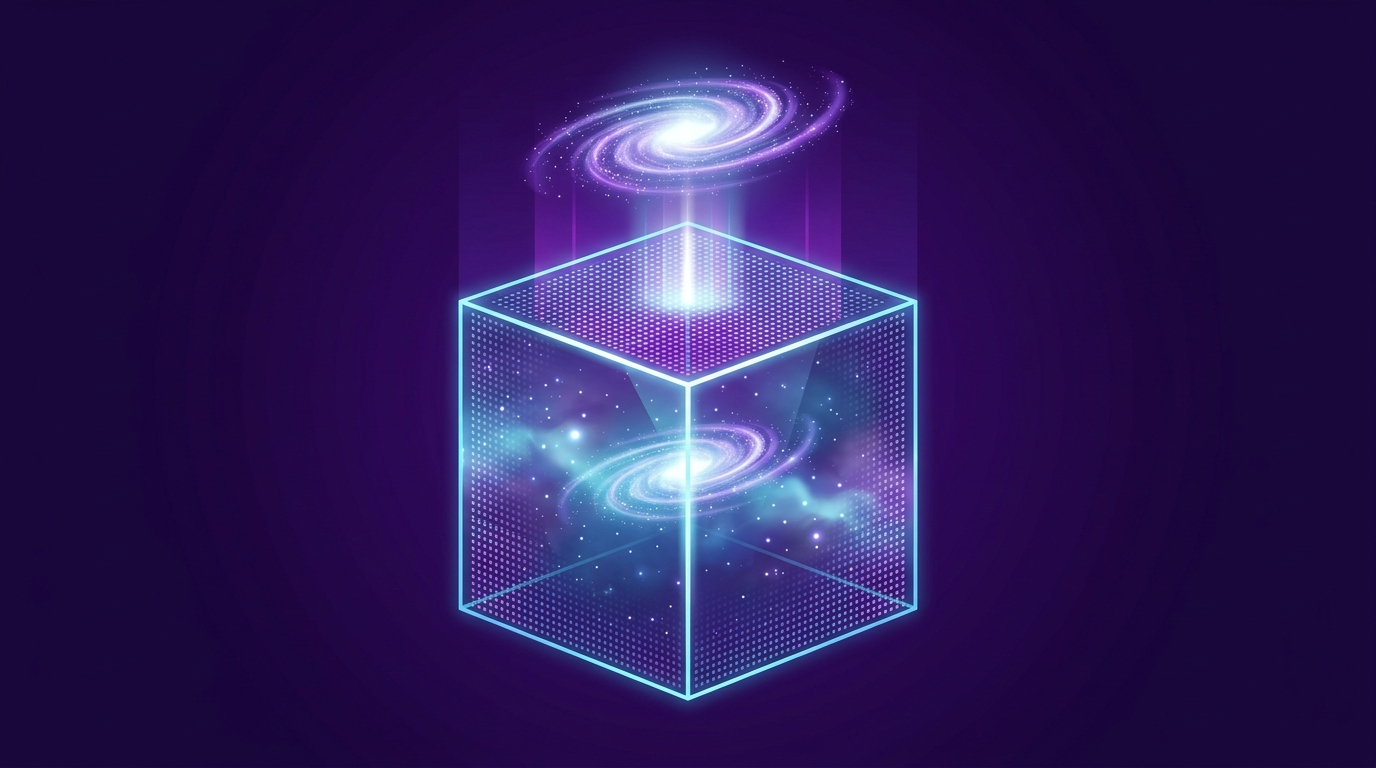
If how much a container holds depends entirely on its surface area, the vast 3D interior suddenly looks like unnecessary decoration. In the 1990s, Stanford University physicist Leonard Susskind formulated the Holographic Principle. The theory posits that every phenomenon occurring inside a three-dimensional space can be fully encoded on its two-dimensional boundary. Susskind famously argued that a black hole is literally a hologram. Reflecting on the initial reception of his proposal, he admitted it sounded outlandish even to him at the time, yet among all possible solutions to black hole paradoxes, it proved to be the most compelling.
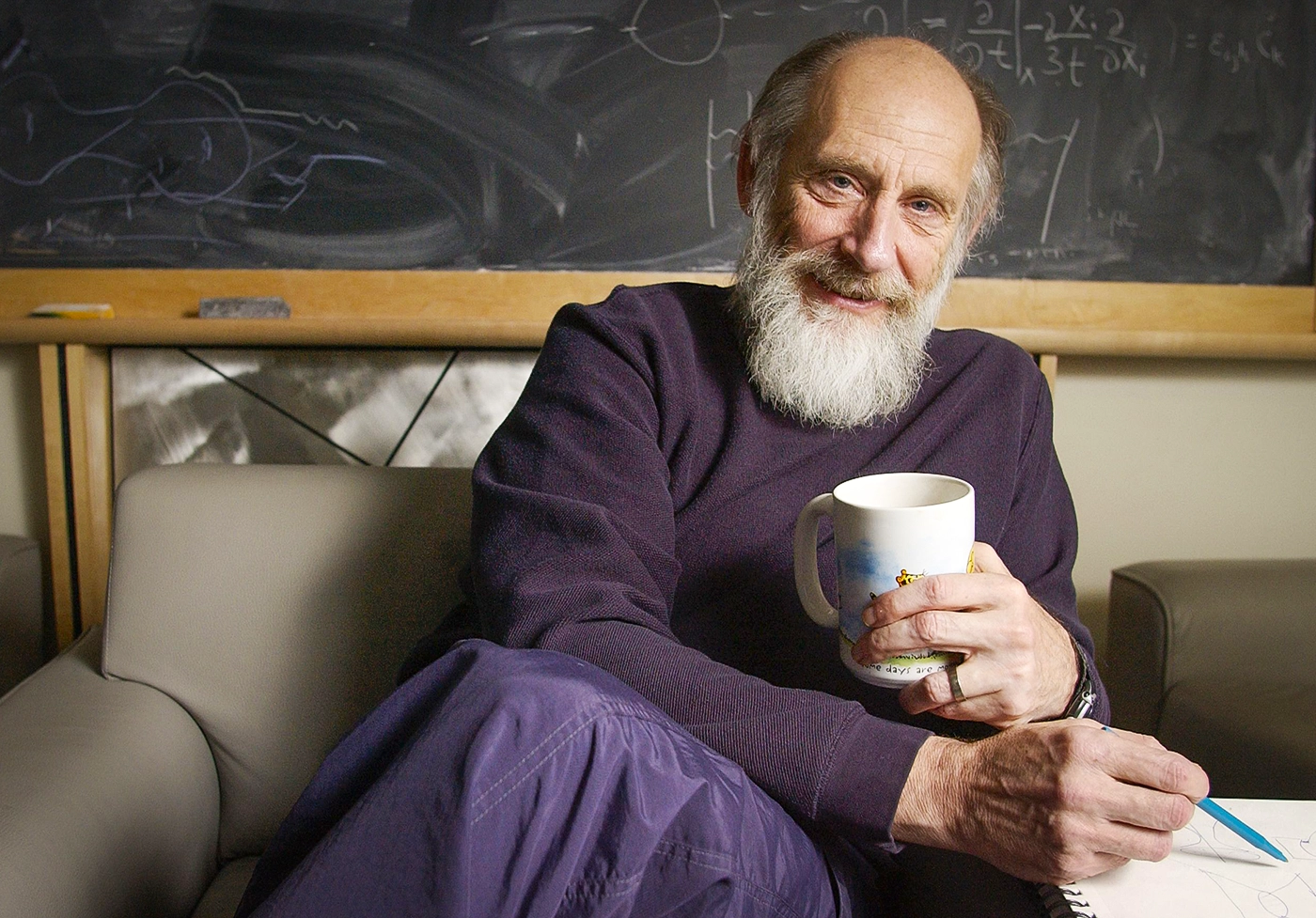 Physicist Leonard Susskind, who proposed in the 1990s that “black holes are literally holograms.” Source: Quanta Magazine (Linda A. Cicero, Stanford News Service)
Electromagnetism Cancels Out, but Gravity Traps Internal Information on the Boundary
In daily life, electromagnetism involves two kinds of charges: positive and negative. If you pack a collection of charged particles into a box, positive and negative charges cancel each other out internally. Measuring the electric field outside gives no clue about how individual particles are configured within.
Gravity behaves entirely differently. It recognizes only positive mass—there is no negative mass or negative gravitational charge. The moment matter is placed inside a box, its mass warps the fabric of surrounding spacetime. This curvature propagates unimpeded all the way to the outer boundary of the box.
Laurent Freidel, a theoretical physicist at the Perimeter Institute, provides a concrete rationale: because gravity cannot be cancelled out by negative charges, every subtle rearrangement of matter inside leaves an indelible, unique imprint on the boundary. In a gravity-dominated universe, filling a box with stuff and painting its surface are physically equivalent. Spacetime curvature on the surface locks in everything happening inside.
Three 1997 Papers Unified the Snow-Globe Universe with Mathematics
Between 1997 and 1998, physicist Juan Maldacena and his colleagues published three landmark papers introducing the AdS/CFT correspondence (Anti-de Sitter / Conformal Field Theory duality). This mathematical framework bridges a gravitational, three-dimensional bulk space with a flat, two-dimensional boundary devoid of gravity. These three works quickly became the most cited papers in the history of theoretical physics, amassing tens of thousands of citations.
To visualize this mathematical duality, picture the interior space as a curved snow globe. The interior is a 3D Anti-de Sitter spacetime governed by gravity. The glass surface, by contrast, represents an entirely different domain: a boundary free of gravity, ruled solely by quantum mechanics. Maldacena demonstrated mathematically that these two seemingly incompatible worlds are equivalent representations of the same underlying physics.
Physicist Bartek Czech of Tsinghua University offered a compelling analogy: a medical CT scan requires hundreds of cross-sectional X-rays to reconstruct the 3D architecture of neurons in the brain. The holographic principle implies that taking a single photograph of the brain’s outer surface would suffice to reconstruct every internal neuron. Even skeptics such as Latham Boyle of the University of Edinburgh concede that standard mathematics offers no conventional explanation for such an astonishing match.
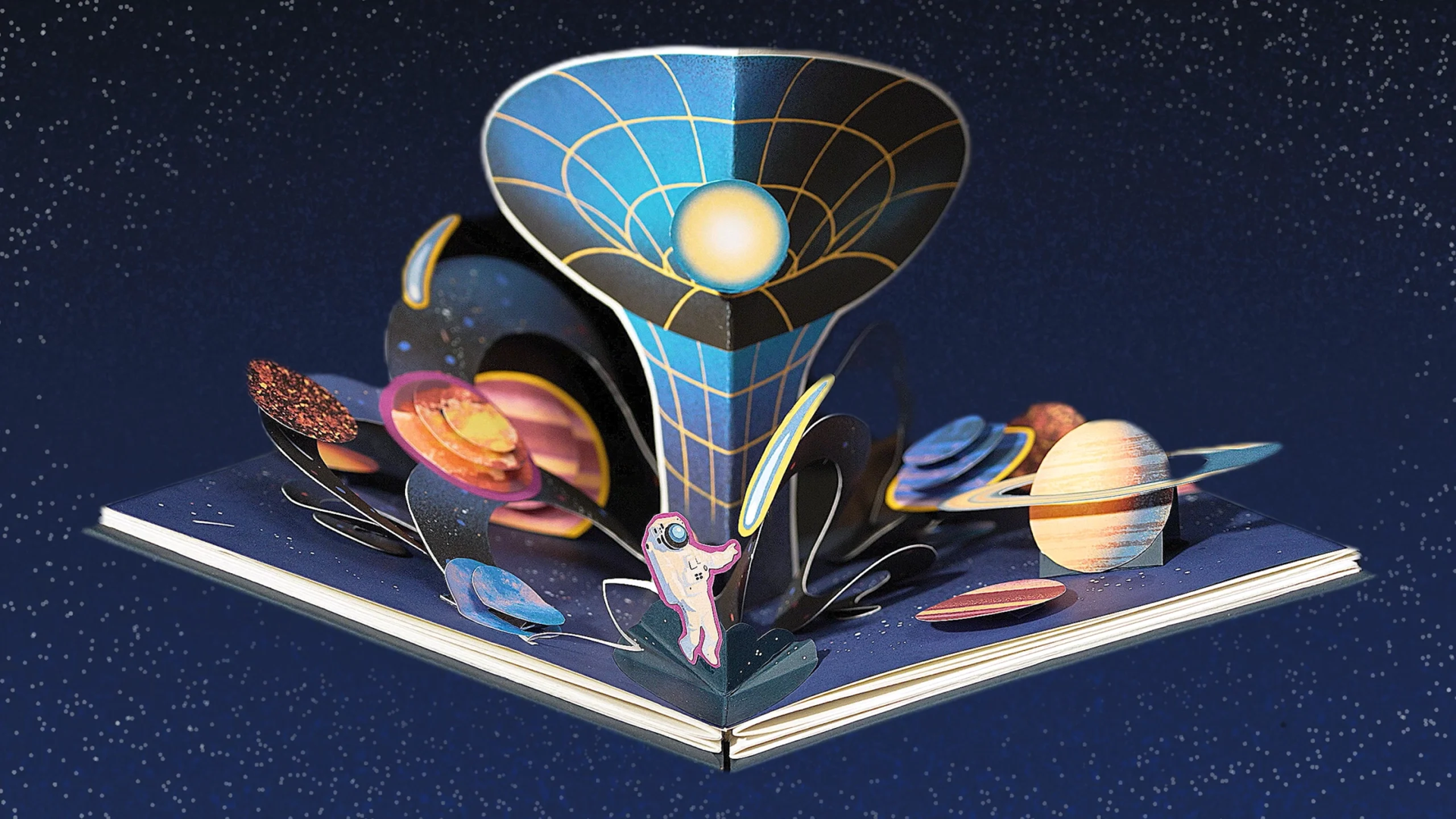 Conceptual illustration of the holographic principle. Source: Quanta Magazine (Illustration by Ada Zejun Shen)
Cosmic Expansion and Quantum Entanglement: The Deep Debate Behind the Hologram
While the snow globe provides mathematical rigor, our actual universe is not an inwardly curved Anti-de Sitter space. Astronomical observations demonstrate that our universe is undergoing accelerated cosmic expansion—meaning we inhabit an outwardly curved de Sitter space with no natural outer glass shell to act as a projection screen.
Proponents of the holographic principle argue that an ant deep within a snow globe cannot directly sense the curvature of its outer glass; humanity is currently in the position of that ant. Yet skeptics like Boyle raise fundamental objections. He argues that black holes exhibit two distinct forms of entropy: a volume entropy reflecting the interior particles, and an entanglement entropy capturing quantum correlations across the horizon. Boyle contends that holographic theories conflate both quantities scaling with area with a true physical equivalence.
Conversely, Brandeis University physicist Brian Swingle stresses that gravity and quantum mechanics are far from incompatible. Rather, they are inextricably interwoven: gravity itself may emerge from underlying quantum entanglement. This debate has galvanized physicists to explore whether quantum information is the fundamental building block of spacetime itself.
From 3D Pixels to Zero-Dimensional Points: Physicists Are Redefining Reality
Vijay Balasubramanian, a theoretical physicist at the University of Pennsylvania, outlines three distinct possibilities for the nature of reality. In the first scenario, the 2D boundary is the true physical substrate, and the 3D world is akin to a computer game rendered from boundary qubits. In the second, the 3D volume is genuinely real, and the holographic duality is merely a miraculous mathematical coincidence. In the third, neither description is fundamental—both are approximations of a deeper, yet undiscovered theory.
Charles Cao of Virginia Tech has demonstrated that three-dimensional information can be losslessly compressed into the quantum state of a two-dimensional boundary. Susskind and his collaborators have pushed this concept even further with radical holographic models that attempt to encode the entire universe onto a single zero-dimensional quantum dot. Balasubramanian goes one step further, speculating that even our perception of the flow of time might emerge from a fundamentally timeless substrate.
From black hole thermodynamics to the mathematics of the snow-globe duality, the holographic principle challenges our most deeply held assumptions about physical space. Because gravity lacks negative charge, boundary curvature inexorably preserves interior configurations, making a full box and a painted surface physically indistinguishable. Three-dimensional reality may well be a grand illusion—projected from quantum information inscribed upon the outer edge of the cosmos.
Reference Links:
- Quanta Magazine Coverage