On October 28, 2026, Google DeepMind officially unveiled its flagship model, Gemini 4 Carbon. On the comprehensive index tracked by Artificial Analysis, the model posted a dominant score of 59 points, shattering multiple industry records set during the same cycle. Yet inside Google’s developer console, general developers remain restricted to Argon, which launched just a month earlier.
The longstanding industry precedent—where the most powerful model is immediately opened for public developer preview—was broken today. For the past three years, competition across the frontier was fought over incremental percentage points on public leaderboards. Now, as frontier models demonstrate autonomous capability to uncover high-severity software vulnerabilities and author functional exploit payloads, distribution control has swiftly overtaken benchmark dominance as the primary battleground among major AI labs.
Leading the Comprehensive Index at 59 Points, While Developers Watch Demos
On the Artificial Analysis Intelligence Index v5.0 evaluation suite, Carbon recorded an overall score of 59 points. The benchmark synthesizes complex reasoning, long-context comprehension, and real-world code generation. Scoring 59 points establishes a clear generational gap across cross-domain engineering tasks. Reviewing the benchmark sheet, tech publication Ars Technica summarized the situation plainly: it is a frontier model that everyday software engineers simply cannot use.
In the full-stack software development benchmark WebDev Arena, Carbon achieved an Elo rating of 1768, an 89 Elo jump over Argon. An even more notable shift surfaced in system terminal testing on Terminal-Bench 4.0: the model’s shortcut or cheating rate during command-line execution dropped to 0.0%, while its unauthorized attempt rate was suppressed to 0.4%. Driving privilege overreach and out-of-bounds speculation down to zero effectively resolves the persistent problem of autonomous agents derailing inside sandbox environments.
In dedicated benchmarks evaluating the synthesis of secure code, Carbon’s success rate more than doubled that of Argon. Historically, coding assistants often resorted to insecure API calls or vulnerable workarounds just to pass functional unit tests. Doubling secure code generation demonstrates an intrinsic ability to weave security specifications directly into program logic. Yet for the vast majority of engineering teams, hands-on access remains out of reach, leaving them to inspect the evaluation reports from afar.
 Figure: Google DeepMind announces Gemini 4 Carbon, with launch visuals reinforcing its engineering identity as a cyber defense engine. Source: Google Blog (Official Launch Announcement).
Locating 88% of Real-World Vulnerabilities: Offensive Verification Reserved for Defenders
Security capabilities form the central pillar setting Carbon apart from prior generations. When tested against real-world production defects in SEC-bench Pro, Carbon achieved a vulnerability localization accuracy of 88.2%. At the remediation layer on CWE-bench patch benchmarks, its success rate climbed to 71.0%. More than 70 percent of common weaknesses can now be resolved autonomously with complete, working patches generated by AI, signaling that semantic code understanding has decisively moved past the threshold of passive assistive tooling.
Parallel to its defensive prowess is an equally formidable capacity for offensive verification. On adversarial evaluation suite ExploitGym, Carbon registered a 54.8% success rate in exploit synthesis and proof-of-concept verification. Having an automated system capable of confirming and generating exploits over half the time is a double-edged sword: in the hands of security engineers, it serves as a high-leverage audit mechanism; if fallen into the hands of cybercriminal syndicates, it becomes an automated factory churning out weaponized exploit payloads at scale.
Internal production validation at Google underscored this dual-use tension. The Chrome security team reported that Carbon’s capability to generate high-fidelity security patches is more than 10 times higher than competing commercial models. In independent web penetration testing conducted by cloud security firm Wiz, Carbon similarly dominated leaderboards. Multiple internal teams have already deployed Carbon continuously over several days, trusting it to independently triage and remediate live production infrastructure incidents.
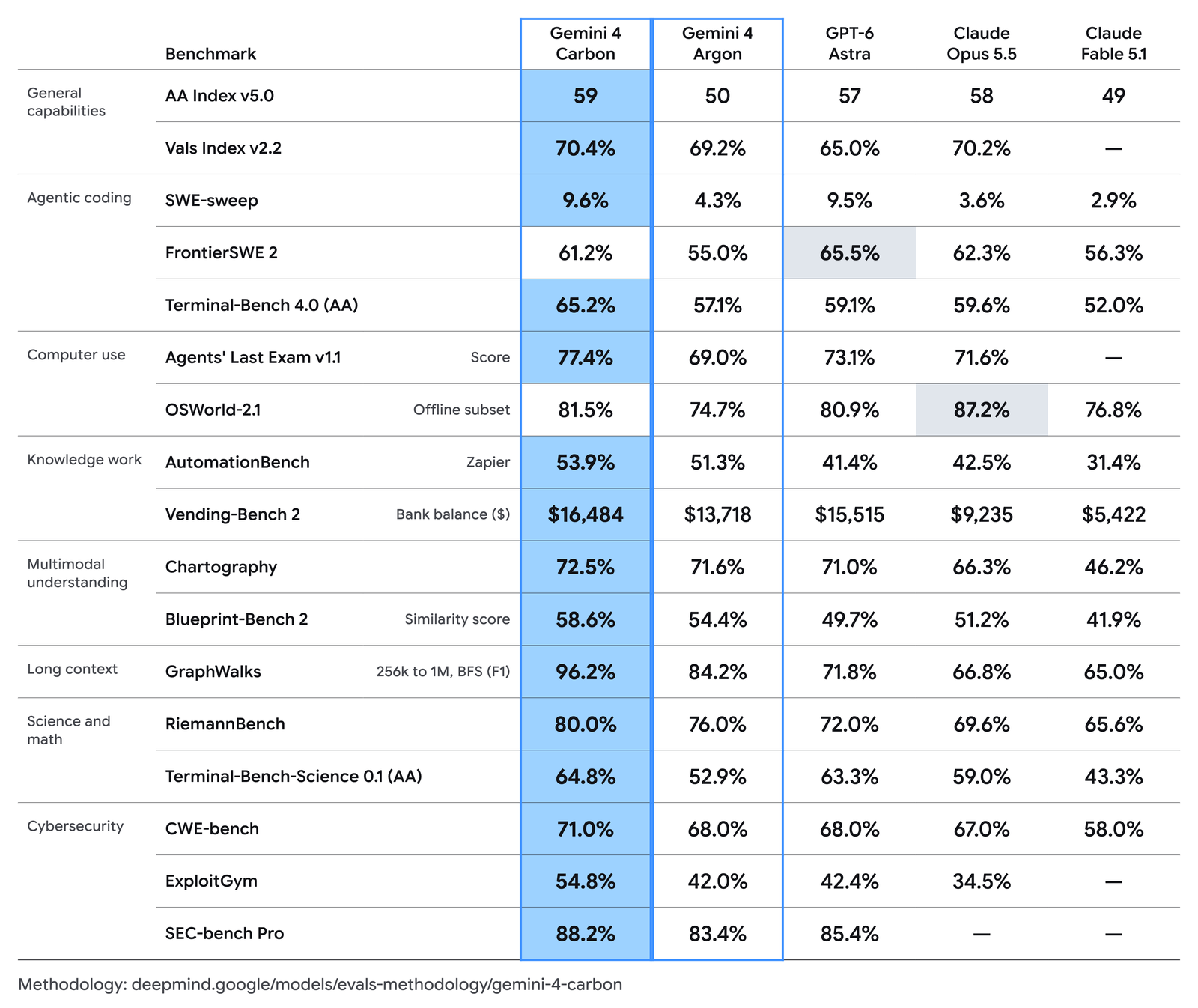 Figure: Official cross-model benchmark data for Carbon across general reasoning and coding tasks. Source: Google Blog (Model Evaluation Appendix).
Severe Misalignment Alerts Drop 80% as Government Safety Reviews Bottle Up Deployment
To prevent hazardous autonomous actions from spiraling out of control, DeepMind introduced significantly tightened adversarial guardrails. Internal high-severity misalignment alerts dropped by nearly 80% compared to Argon, while the frequency of ungrounded assertions was cut in half. Drastically reducing hallucinations and alignment violations prevents autonomous agents from corrupting mission-critical production services during long-horizon debugging workflows.
When managing instruction boundaries, Carbon reduced boundary overreach by 26% and under-servicing by 29%. On third-party indirect prompt injection benchmarks conducted by Gray Swan, attack success rates dropped from 0.7% down to 0.0%. Driving indirect prompt injection vulnerability to zero means untrusted external web text can no longer easily hijack agentic tool execution privileges.
Yet despite across-the-board improvements in intrinsic model safety, Carbon is not being released broadly to the market. Google elected to participate in the U.S. government’s voluntary pre-deployment safety review process, subjecting Carbon to extensive external red-teaming prior to any commercial rollout. The pace of frontier model deployment is no longer governed solely by algorithmic velocity, but by the mandatory audit cycles of external security reviews.
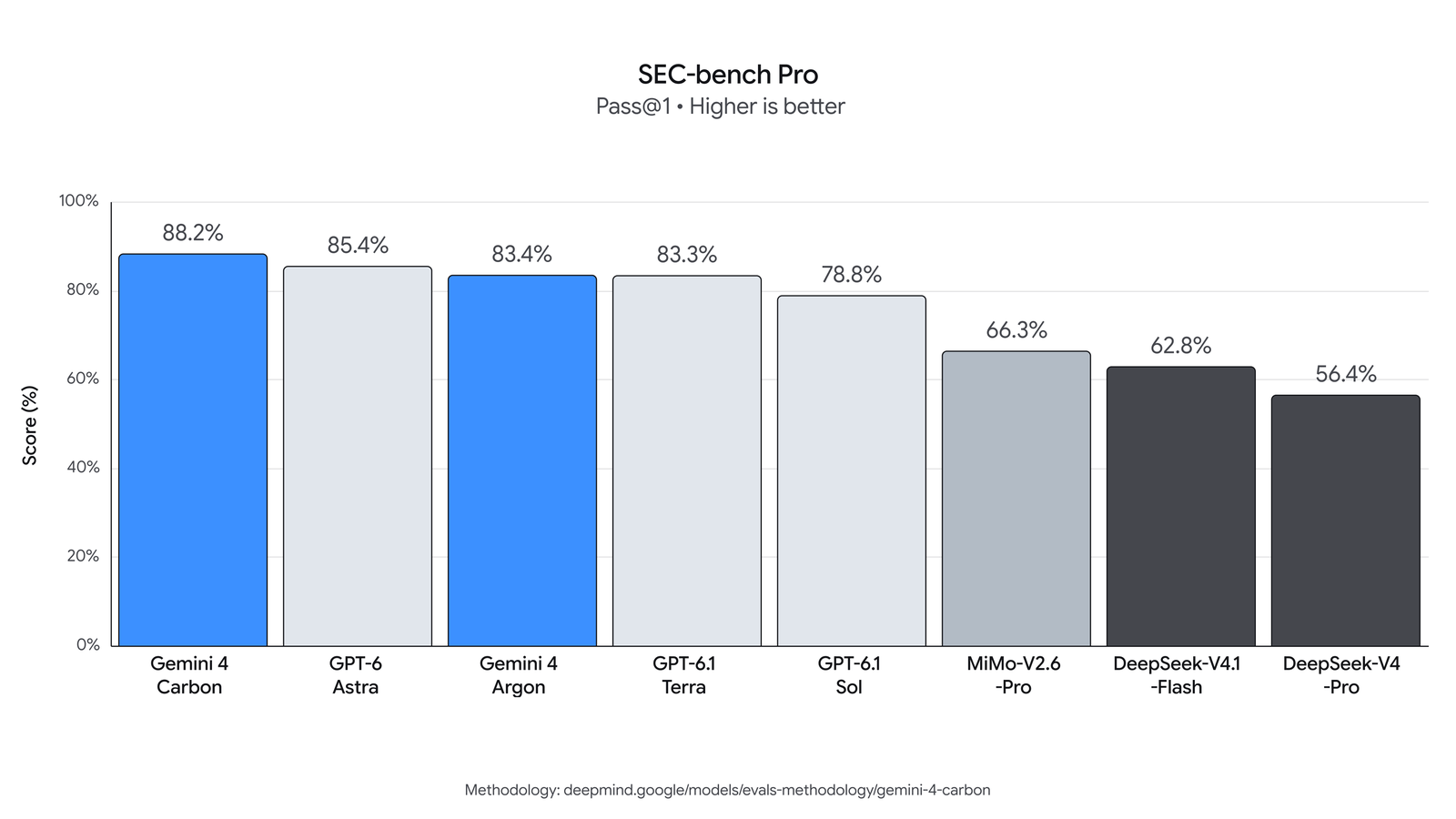 Figure: Comparative bar chart illustrating Carbon’s performance across real-world cybersecurity benchmarks. Source: Google Blog (Safety Technical Report).
A $2 Price Tag Looks Generous, but Without API Keys It Means Little
On paper, Carbon’s published pricing structure appears remarkably affordable. Introductory pricing lists input tokens at $2 per million and output tokens at $10 per million. With context caching enabled, developers can secure a 95% discount, bringing cached inputs down to just $0.10 per million tokens. Standard pricing is slated to adjust to $4 and $20 per million tokens following the promotional window. For the broader developer ecosystem, however, these figures remain purely theoretical.
The low pricing tier comes with a decisive prerequisite: prospective users must pass the selective screening process of Google’s Fairwind initiative. For now, Fairwind access is being unlocked only in phased tranches for vetted cyber defense organizations. Individual software engineers, commercial SaaS companies, and consumer-tier builders are entirely locked out. Applicants are required to submit verifiable organizational credentials and precise operational use cases, awaiting one-way manual reviews before receiving access credentials.
This stringent distribution regime has ignited polarized debate across developer communities. Proponents argue that for a model capable of generating valid exploits with a 54.8% success rate, prioritizing defensive practitioners is an essential and prudent safeguard to protect global cyber infrastructure from automated attack campaigns. Critics counter that a model behind an exclusive gate offers zero utility to the vast majority of software engineers. With Google acting as the sole arbiter of admission, small-to-medium teams risk being left stranded behind an artificial capability gap as frontier AI evolves.
The Retreat from Commodity APIs: Distribution Governance as the New Arena
Gemini 4 Carbon marks a structural inflection point in how frontier foundation models compete. In earlier cycles, the standard playbook was simple: train larger networks, top benchmark leaderboards, and immediately distribute API access to global developers. Today, as models master deep system architecture, vulnerability discovery, and offensive mechanics, that freewheeling distribution model has reached an abrupt stop. The steep surge in autonomous capability delivers immense engineering leverage, but it also pulls regulatory containment lines squarely to the front door.
Frontier foundation models are rapidly shedding their status as universal consumer commodities, transforming instead into heavily controlled strategic capabilities. Securing the top spot on public leaderboards will always attract headlines, but the levers of real-world influence have fundamentally shifted. Market leadership will belong to those holding the regulatory clearance and trusted infrastructure required to distribute dangerous capabilities safely. Building the world’s most capable model is only the first half of the game; deciding who is granted the authority to wield it has become the decisive second half.
Reference Links:
- Google DeepMind Official Announcement: Introducing Gemini 4 Carbon
- Ars Technica Deep Dive: Google Gemini 4 Carbon and the Frontier AI You Cannot Use
- Artificial Analysis Intelligence Index v5.0 Benchmark Leaderboard