In November 2026, Google Search’s AI Overview began serving users a striking piece of industry news: a security researcher with 14 Chrome CVEs had supposedly been awarded a record-shattering $1,333,337 bug bounty. The search card neatly laid out the recipient, the astronomical sum, and the target project, even contrasting the payout against standard bounty tiers.
In reality, not a single dollar had landed in her bank account. The seven-figure reward never existed outside of a misconfigured database field and a self-deprecating joke on social media.
A Misconfiguration Hands Over Database Edit Rights
The central figure in the incident is security researcher Lyra Rebane. Long immersed in low-level browser internals, Rebane had reported 14 vulnerabilities across Chromium. The root of this particular episode traced back to a logic flaw she reported in 2022.
The issue resided in Chromium’s Background Fetch API. Under the right conditions, an attacker could pull a victim’s browser into a distributed botnet simply by getting them to load a malicious page or iframe. Because designing a clean patch proved intricate, the report languished in Google’s tracking pipeline for years. When the fix was finally completed in February 2026, Google awarded her a standard $1,000 bounty.
The turning point arrived during subsequent triage. In May 2026, Ars Technica published an article noting that Google had accidentally made the exploit details public before the patch had properly landed across all channels. Google scrambled to flip the issue back to private. Amid the administrative reshuffle, someone mistakenly reassigned Rebane from the external reporter role to that of an internal verifier.
In Google’s Buganizer issue tracker, external reporters can normally only view tickets and leave comments. Once elevated to a verifier, the system unlocks privileged edit controls. Crucially, the field that records bounty payouts, vrp-reward, had no role-based isolation separating financial metadata from triage status. As a verifier, Rebane suddenly possessed unrestricted write access to the underlying record.
A $1.33M Joke Sails Through Automated Moderation
In November 2026, Rebane revisited the ticket and noticed unfamiliar buttons on the interface. Probing the boundaries of her newfound permissions, she overwrote the $1,000 figure with $1,333,337—a nod to hacker leetspeak and an absurd figure in the history of Google’s Vulnerability Reward Program.
The edit took place at 22:38:15 UTC. Fourteen seconds later, she marked the ticket as verified. Knowing that internal audit logs would inevitably catch the change, she posted about it on X. On November 7, she announced that her flaw had snagged a record $1.33M bounty, immediately puncturing the brag in the punchline: “or maybe I just gained edit access to a field I shouldn’t have.”
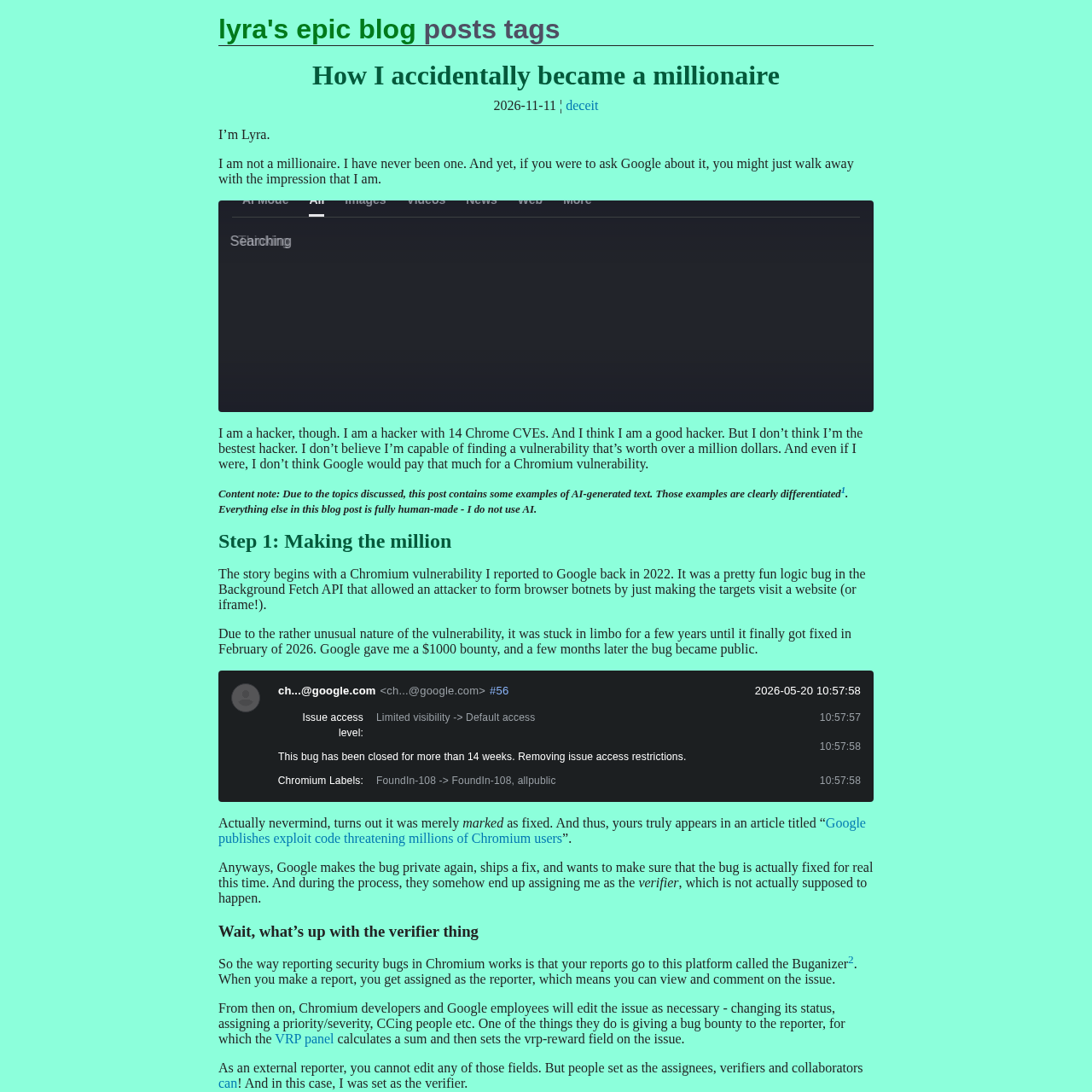 Figure: Lyra Rebane clarifies on her blog that she never became a millionaire, sharing system records showing the flaw’s actual $1,000 bounty. Source: lyra.horse screenshot.
The post spread rapidly across the security community. In the early hours of November 8, Rebane posted an unambiguous follow-up clarifying that while the database entry was genuine, Google had never paid out the sum—the whole affair was merely a self-deprecating prank highlighting a permissions slip.
Automation promptly derailed the context. An “experimental AI contributor” running on X’s Community Notes slapped a label on the tweet, asserting that she had fabricated the screenshot. Rebane pushed back immediately, pointing out that the database record was real and that the failure lay in Google’s access controls. Following her rebuttal, the flawed AI note was quietly retracted, contributing nothing to factual verification. Automated moderation had spent its compute scrutinizing pixels while completely missing the post’s obvious sarcasm.
A Three-Stage Pipeline Elevates Satire to Search Headlines
Had the chain broken on social media, the joke would have faded within hours. Instead, downstream automated systems took the baton. An automated AI podcast service named Daily Vibe Casting scraped the trending post, instantly converting it into an audio segment and a published web article.
The webpage carried a small disclaimer stating “content generated by AI,” yet the model treated the opening sentence of the tweet as established fact. It syndicated the story across the web under headlines announcing that researcher Rebane had secured a historic $1,333,337 payout. The pipeline consulted no official advisories, checked no follow-up clarifications, and focused purely on the eye-catching dollar amount.
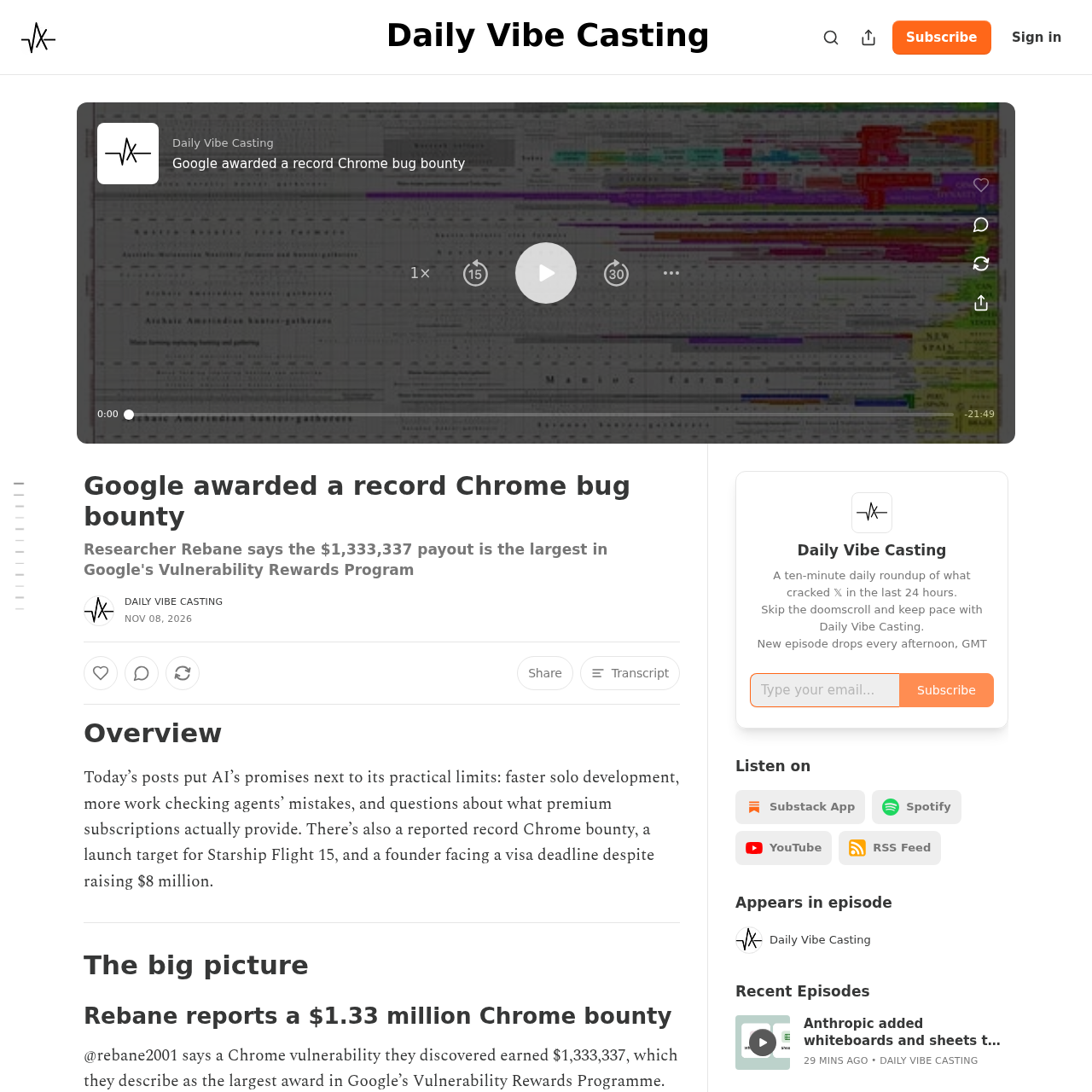 Figure: Automated AI news podcast Daily Vibe Casting packages the satirical tweet into record-breaking industry news. Source: dailyvibecasting.com page screenshot.
The final leg of the relay landed back on Google’s own front page. When users queried phrases like “highest Chrome bug bounty,” Google’s AI Overview synthesized the synthetic coverage into an authoritative summary card. The engine confirmed the windfall as real and heralded the researcher as a record-breaking phenom.
Searching her name produced “millionaire” as the primary knowledge snippet. The industry’s premier search engine had become a rumor amplifier. A self-effacing joke, processed through scraping, rewording, and automated summarization, emerged bearing the implicit stamp of search authority. An unmonitored assembly line had transformed casual banter into structured, authoritative misinformation.
Automated Systems Citing Each Other Erase Verification
The $1.33M figure would never have survived basic human scrutiny. Under Google’s published Chrome VRP guidelines, even the most critical full-chain sandbox escapes top out at $250,000—a bracket awarded to elite security firms like XBOW and top individual researchers. Google has never awarded seven figures for a browser exploit.
Rebane’s previous highest disclosed bounty was $18,000 for an SVG clickjacking bug. Faced with a number inflated by more than 500% over the program’s official ceiling, not a single automated node flagged an anomaly. Google engineers revoked her permissions around 2:00 AM and reset the field to $1,000. Yet for days afterward, AI Overviews on the search frontend continued to inform the public that she was a millionaire.
This illustrates a systemic flaw in generative information consumption: language models treat the output of previous models as primary evidence. The AI podcast ingested a raw tweet; the search engine’s summarizer ingested the AI podcast. As data cycled across models, the author’s real-time debunks were filtered out as noise while the sensational figure was repeatedly reinforced.
Traditionally, entering authoritative knowledge bases required verified provenance. Today’s LLM-driven supply chain operates with minimal human oversight. Scraping scripts, synthetic text generators, and overview engines mesh together seamlessly, elevating unchecked jokes into certified facts through synthetic cross-referencing.
Falsehoods Require No Malicious Intent
This incident concluded as a harmless technical farce, yet the architectural vulnerability it exposes is severe. Lyra Rebane never intended to deceive anyone; every public post explained the exact mechanics of the mishap. But once human writing enters the automated processing pipeline, vital contextual qualifiers are casually stripped away.
If a malicious actor deliberately leveraged this loophole for reputation sabotage or market manipulation, existing algorithmic defenses would struggle to hold. An attacker need only seed tailored claims across bot accounts and synthetic niche blogs. Search engines lacking basic sanity checks would readily digest the slop. When authoritative search cards elevate falsehoods to the very top of the page, general readers have no way of knowing the foundation rests on a fleeting prank.
Hallucinations are merely a symptom; the fundamental engineering dilemma is the absence of verification gates across the information pipeline. Permissions failures, social bot misjudgments, content-farming scrapers, and search summarizers all prioritize delivery speed over accuracy. On an unmonitored assembly line, a developer’s inside joke and vetted journalism carry identical clearance.
Search engines once built trust through external hyperlinks and provenance. Today, in the race to offer frictionless answers, AI summaries bypass source verification to synthesize premature conclusions, passing off probabilistic guesswork as settled truth. So long as generation remains untethered from verification, manufactured reality will keep conquering the top of the search page—and next time, there may be no author willing to debunk their own windfall.
Reference Links:
- Lyra Rebane’s original blog post: How I accidentally became a millionaire
- Daily Vibe Casting AI podcast coverage page
- Google Buganizer Issue Tracker Access Control documentation
- Ars Technica coverage on Chromium vulnerability disclosure mishap