The September 22 Truce: Competing on Billing Instead of Raw IQ
On September 22, 2026, the two best-funded frontier AI labs on Earth simultaneously slashed the prices of their flagship products by nearly half. Anthropic released Claude Opus 5.5 at a 40% discount compared to its predecessor, while OpenAI unveiled GPT-6 Sol and Luna, reducing rates by another 50% relative to recent promotional tiers. Across both announcements, published just hours apart, benchmark charts were relegated to footnotes; in their place were dense tables detailing fractions of a cent per token. With generational gaps in model capability no longer creating clean separation, the front lines of competition have shifted squarely to the price sheet.
This synchronized price adjustment was no coincidence. It marks an inevitable defensive pivot as returns on raw scaling flatten. When introducing Opus 5.5, Anthropic devoted extensive space to showcasing reduced input and output overhead, openly acknowledging that at current performance plateaus, fractional benchmark gains rarely translate into noticeable UX improvements. Behind that candor lies an inescapable reality: when new architectures can no longer lap the competition in cognitive power, labs must squeeze their rivals on infrastructure margins instead. OpenAI followed an equally pragmatic playbook. Sol and Luna continue the precedent of commoditizing high-tier intelligence, reserving the apex halo model for Astra while aggressively driving high-volume production pricing to the absolute floor.
Over the past two years, each major version release triggered intense developer debates over multi-step reasoning benchmarks and context window expansion. Today, the centerpiece of any launch is the per-million-token rate card. For autonomous coding agents and background orchestration loops running thousands of iterations daily, marginal score differences make almost no difference to real-world task completion. The engineering metric has flipped: what matters most is not how high a model scores, but what remains in the company account once the test suite finishes running.
Anthropic Slashes Agent Workload Costs by 60%
Looking past the headline cuts reveals that Anthropic executed a surgical strike against a very specific workload. Standard input pricing for Opus 5.5 dropped a modest 20%, from $5.00 to $4.00 per million tokens. But cache reads plummeted by 60%, landing at an unprecedented $0.20 per million tokens. This asymmetric pricing structure serves as a direct pitch to engineers building complex, context-heavy coding agents. In realistic enterprise refactoring and agentic execution pipelines, agents repeatedly ingest massive repository snapshots, making cache retrieval the single largest line item on the monthly API invoice.
 Figure: Key visual from the Claude Opus 5.5 launch page. Source: Anthropic official announcement.
An early access engineer reported using Opus 5.5 to complete a 680,000-line cross-framework codebase migration in under twenty-four hours. Under previous pricing structures, the repeated context pulling required for an undertaking of that scale would have bankrupted an independent developer; under the new pricing model, it falls comfortably within indie-hacker reach. Anthropic clearly ran the numbers: use modest input/output discounts to keep general-purpose API users engaged, while using aggressive cache-read cuts to lock in engineering teams treating AI as routine automated labor. Targeted compute relief threatens competitor balance sheets far more effectively than indiscriminate across-the-board discounting.
OpenAI Uses Promotional Rates as a Baseline Anchor
While Anthropic targeted specific algorithmic access patterns, OpenAI’s pricing maneuvers leaned heavily on narrative financial engineering. GPT-6 Luna debuted at $0.10 for inputs and $0.50 for outputs per million tokens, marketed as a 50% price drop compared to GPT-5.6. A closer inspection of historical invoices reveals that this 50% reduction was calculated against a short-term promotional tier rather than standard enterprise list prices. By anchoring comparisons to temporary discount baselines, OpenAI created the illusion of dramatic savings while masking the fact that Luna delivers virtually flat capability gains.
OpenAI inadvertently revealed its own underlying cost strains in the launch copy. The company disclosed that internal researchers consume a median of $600 worth of API tokens every single day, with the top 10% racking up daily bills exceeding $7,000 per person. That ferocious internal burn rate illustrates just how hypersensitive modern software engineering and automated refactoring workflows are to per-token pricing. When merely dogfooding your own tools costs thousands of dollars per engineer per day, commercial adoption demands pricing that looks low enough to survive budget reviews.
Although both giants cut prices on the same day, their economic leverage points diverge substantially:
| Model | Input Price (per M tokens) | Output Price | Cache Read Price | Pricing Baseline |
|---|---|---|---|---|
| Claude Opus 5.5 | $4.00 | $20.00 | $0.20 | Compared to prior gen list price |
| GPT-6 Luna | $0.10 | $0.50 | Estimated higher by community | Compared to temporary promo price |
| GPT-6 Sol | $2.00 | $10.00 | Undisclosed | Compared to temporary promo price |
This comparison highlights two distinct commercial strategies. OpenAI aims for optics with low headline entry points, whereas Anthropic concentrates discounts on caching—the most capital-intensive, high-frequency access layer of agentic execution.
Burning $8,708 to Run a Single Benchmark
Beneath the flurry of rate reductions lies another inconvenient truth: frontier intelligence has evolved into an unsustainable luxury. Benchmarking firm Artificial Analysis awarded Opus 5.5 an intelligence index score of 58, ranking it first among 212 tested models. Securing that top spot, however, required running 260 million tokens through the API, generating an eye-watering evaluation bill of $8,708.20 for a single run. For comparison, the median token consumption across equivalent full-suite benchmarks is around 88 million tokens. Proving that a model is marginally smarter now requires spending a small fortune in raw compute.
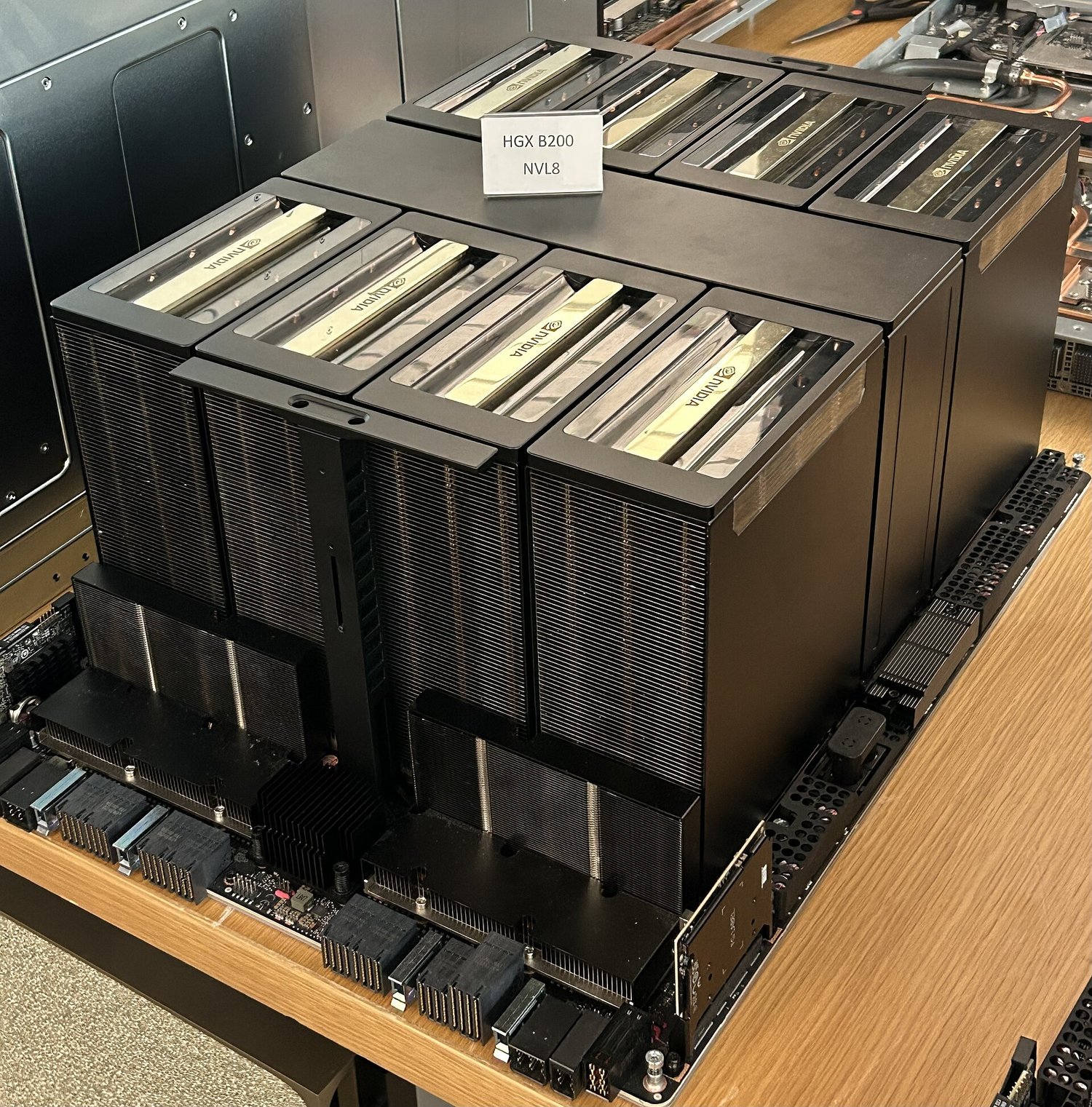 Figure: NVIDIA DGX B200 compute cluster node. Source: Wikimedia Commons, CC BY-SA 4.0.
Independent benchmarkers have responded by bifurcating their leaderboards into “Smartest” and “Smartest per Dollar”—and the reigning champions of raw intelligence routinely fall outside the top 90 on cost efficiency. The razor-thin margins celebrated in corporate launch slides are frequently subsidized by brute-force token generation, speculative branching, and repeated retries. This distorted return on investment signals that scaling raw compute to win benchmark trophies has reached an economic dead end. Unless everyday developers can observe tangible gains on modest double-digit monthly bills, leaderboard podium finishes remain vanity trophies confined to corporate research labs.
Calling for a Slowdown as Commercial Defense
Alongside the price cuts, Anthropic sought to capture the moral high ground through regulatory discourse, though developer response highlights a less altruistic commercial reality. The Opus 5.5 release prominently cited the lab’s earlier essay, Why We Must Pace the Frontier, while confirming that the new model enforces safety guardrails equivalent to Fable 5.1. On Hacker News, commentators pointed out that “pacing” in motorsport is the job of the safety car: it does not exist to speed up the pack, but to slow down everyone trailing behind. While Anthropic could simply moderate its own internal release velocity, it continues calling for industry-wide regulatory brakes.
Tying price drops to strict regulatory overhead effectively builds a defensive moat disguised as public safety. Due to heightened capabilities in biology and cyber operations, accessing Opus 5.5’s advanced tiers requires verified institutional credentials, alongside mandatory reasoning modes designed to thwart knowledge distillation. Imposing stringent compliance barriers forces open-source challengers and fast-following rivals to shoulder matching audit and legal burdens. When raw architectural breakthroughs slow down, shaping industry governance becomes the ultimate lever to delay competitors.
The simultaneous launch of these aggressive pricing schemes makes one thing abundantly clear: frontier labs are compensating for slowing architectural gains. Anthropic’s targeted cache reductions directly address the pain points of engineering teams, while OpenAI’s promotional arithmetic preserves low headline entry barriers. Yet whether paying $0.20 for cache reads or $0.10 for inputs, the underlying dynamic is unchanged. When burning 260 million tokens yields only fractional benchmark leads, frontier AI has ceased being an era of pure scientific breakthroughs—it has become a war of cost accounting. The next winner will not be determined by intelligence indices in launch keynotes, but by who can keep engineers from triggering fraud alerts on their corporate credit cards.
Reference Links:
- Claude Opus 5.5 Official Release
- GPT-6 Sol and Luna Official Release
- Hacker News Discussion (item?id=49803892)