
In 2026, Singapore introduced FirstDate, an official matchmaking service where civil servants authenticate directly using the national digital identity system. After completing an onboarding questionnaire, participants encounter no infinite grids of profile photos. Explicitly declaring war on swipe fatigue, the system surfaces only one prospective match at a time, deliberately pacing the romantic pursuits of young public servants.
One Match at a Time: Ending the Endless Swipe
This approach directly challenges the illusion of infinite optionality manufactured by commercial dating platforms. Elizabeth, a 29-year-old employee at Singapore’s Ministry of Defence, noted that while the user interface feels comparable to commercial competitors, the risk of romance scams is virtually eliminated. In this verified, real-name ecosystem, the person on the other end of the screen is an authenticated fellow public servant also seeking a committed relationship.
 Figure: FirstDate is designed for Singapore government employees aged 21 to 35. Source: Getty Images / BBC
Powering the service behind the scenes is the 2012 Nobel Memorial Prize-winning Gale-Shapley deferred acceptance algorithm. This mathematical framework matches two groups of equal size based on individual preference rankings, simulating iterative rounds of proposals and rejections until reaching a stable configuration where no two participants would mutually prefer each other over their assigned partners.
Historically, this algorithm has solved centralized allocation problems like public high school admissions and medical residency matching. By deploying it into the dating landscape, the Singaporean government is testing whether mathematical optimization can push romantic matching to its theoretical limit. Rather than an ordinary social network, FirstDate operates as a state-orchestrated experiment in demographic resource allocation.
Commercial Apps Optimize for Retention; Governments Optimize for Marriage
For-profit dating applications are structurally disincentivized from having users delete them; their business models hinge on platform retention. Commercial operators present an endless stream of fresh faces to maximize daily active screen time, turning companionship into an engagement funnel. Singapore’s government-backed platform stands in stark contrast: its sole objective is to match two individuals and exit the picture as quickly as possible.
While private platforms monetize idle attention, the machinery of the state deploys game theory to address singlehood. This divergence reflects Singapore’s long tradition of proactive state intervention. As early as 1984, the government founded the Social Development Unit (SDU) to organize social mixers for university graduates in an effort to head off a projected fertility decline.
Although the SDU was eventually dismantled after facing criticism over elitism, state intervention in family formation never genuinely left the public stage. In 1985, a sister initiative was set up to promote marriage among non-graduates. Today, that legacy of state-sponsored courtship has completed its transition from hotel ballrooms to algorithmic matchmaking.
The state’s underlying motivation creates counterintuitive user mechanics. Administrators do not care how long users linger in the app; ideally, once matched, users never return. Features designed to manufacture habit-forming stickiness have been stripped away, leaving only pure matching throughput.
A Nobel Prize in Economics Cannot Calculate Long-Term Romance
The Gale-Shapley algorithm is mathematically elegant, yet applying it to human relationships instantly reveals its mechanical boundaries. It presumes that individuals possess complete self-knowledge, requiring participants to articulate a rigid, immutable hierarchy of desired partner traits on an initial questionnaire.
In mathematical game theory, stability merely means that at the exact instant matching concludes, no two participants could mutually trade partners for a preferable outcome. Yet a game-theoretic equilibrium has little to do with whether two individuals can navigate the messy realities of living together for a decade. The algorithm guarantees a sound process, but offers no assurance of enduring relational satisfaction.
Human preferences undergo profound shifts over extended timeframes. The superficial traits that look appealing on an intake card frequently bear no relation to what an individual truly values after six months of cohabitation. Static questionnaires simply cannot capture the dynamic adaptability and mutual compromise essential for long-term domestic life.
The algorithm excels at finding local mathematical optima, but cannot reconcile the irrational nature of human affection. A state-run platform can filter out fraud, but it cannot shoulder the emotional labor required to maintain a marriage. Deep intimacy cannot be reduced to static parameters in source code.
A SGD 70,000 Subsidy Cannot Halt the Fertility Freefall
The demographic backdrop prompting Singapore’s initiative has reached emergency territory. In 2025, resident births in Singapore fell below 30,000 for the first time in six decades, while annual deaths rose steadily to 26,000. Conventional policy levers have proven insufficient to halt the demographic decline.
To counter this trajectory, Prime Minister Lawrence Wong announced aggressive policy interventions in August 2026. Under the revised family framework, qualifying households receive nearly SGD 70,000 in cumulative state financial support per child up to age 17. The administration is attempting to use direct fiscal transfers to overcome young adults’ anxieties regarding the financial burden of childrearing.
Yet such unprecedented financial outlays underscore the intractability of the underlying demographic crisis. When monetary subsidies reach their fiscal limits, policymakers discover that persistently high singlehood rates represent the primary bottleneck to childbirth, prompting direct state intervention at the courtship phase.
Singapore is far from alone in this strategy; governments across East Asia are increasingly intervening in matchmaking. The Tokyo Metropolitan Government unveiled its own municipal AI dating application in September, pointing to early metrics showing 265 resulting marriages. Confronted with record-low birth rates, governments are mobilizing every administrative tool at their disposal to lift demographic indicators.
The Under-35 Civil Servant Filter Stirs Age and State Anxiety
Despite remaining in a pilot phase, FirstDate’s stringent entry criteria have sparked widespread debate. The platform is restricted exclusively to government employees aged 21 to 35, a dual-filter restriction that has drawn heavy criticism across social media.
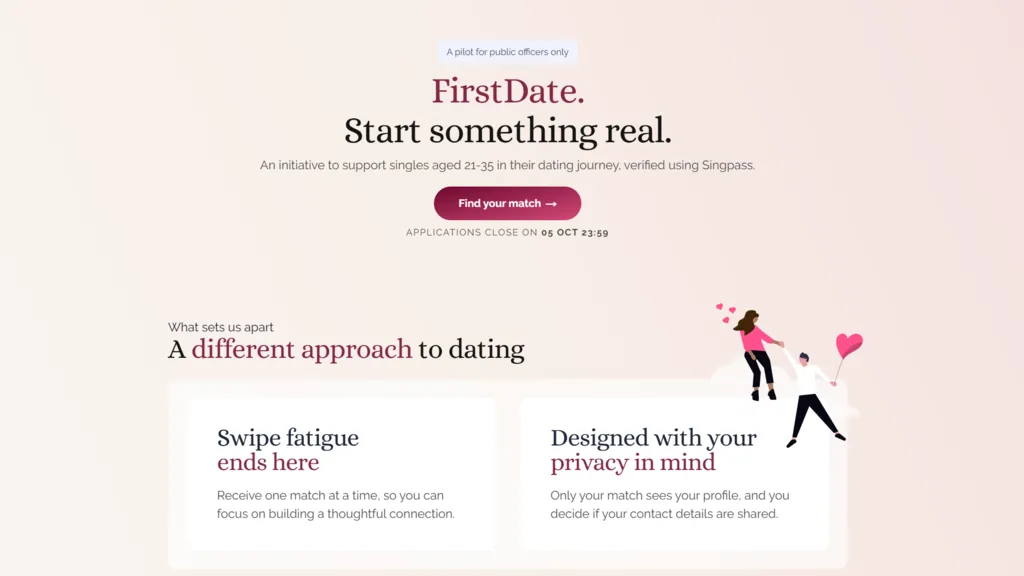 Figure: Visuals of FirstDate released by the Government Technology Agency of Singapore. Source: Government Technology Agency of Singapore / BBC
Capping eligibility strictly at age 35 lays bare the state’s clinical demographic calculus. Online critics have argued that the initiative is not aimed at alleviating individual loneliness, but rather at maximizing total fertility rates. Because obstetric risks rise after 35, the system effectively sidelines older singles from state-backed matching.
Restricting access to civil servants has generated equal controversy. Proponents argue the requirement guarantees baseline identity verification and trust. Opponents, conversely, worry that a long-ruling state apparatus is encroaching too deeply into citizens’ private lives. These conflicting perspectives have turned the application into a lightning rod for broader societal anxieties.
Ultimately, the Gale-Shapley algorithm guarantees only that upon execution, no two participants would mutually prefer to defect from their pairing; whether that partnership endures over time is an entirely separate question. By introducing this algorithm into civil service dating, the Singaporean government has vividly exposed both what mathematics can guarantee and what remains forever beyond its reach.
References:
- BBC Report
- Hacker News Discussion