
The replacement cycle for budget smartphones has now stretched well past three years. Mainstream buyers have largely stopped obsessing over benchmark scores. Instead, daily frustrations are triggered by sudden “Storage Full” warnings, or touchscreens going unresponsive and erratically registering ghost inputs in the rain or through sweaty fingers.
On October 15, 2026, tipster Evan Blass revealed official promotional materials for the Nubia V90 Pro. ZTE Nubia’s upcoming entry-level contender offers a 512GB storage configuration paired with a 1,000-nit wet-touch display as standard. The phone preserves a slim 7.7mm chassis while incorporating a 108MP primary camera and splash-resistant construction.
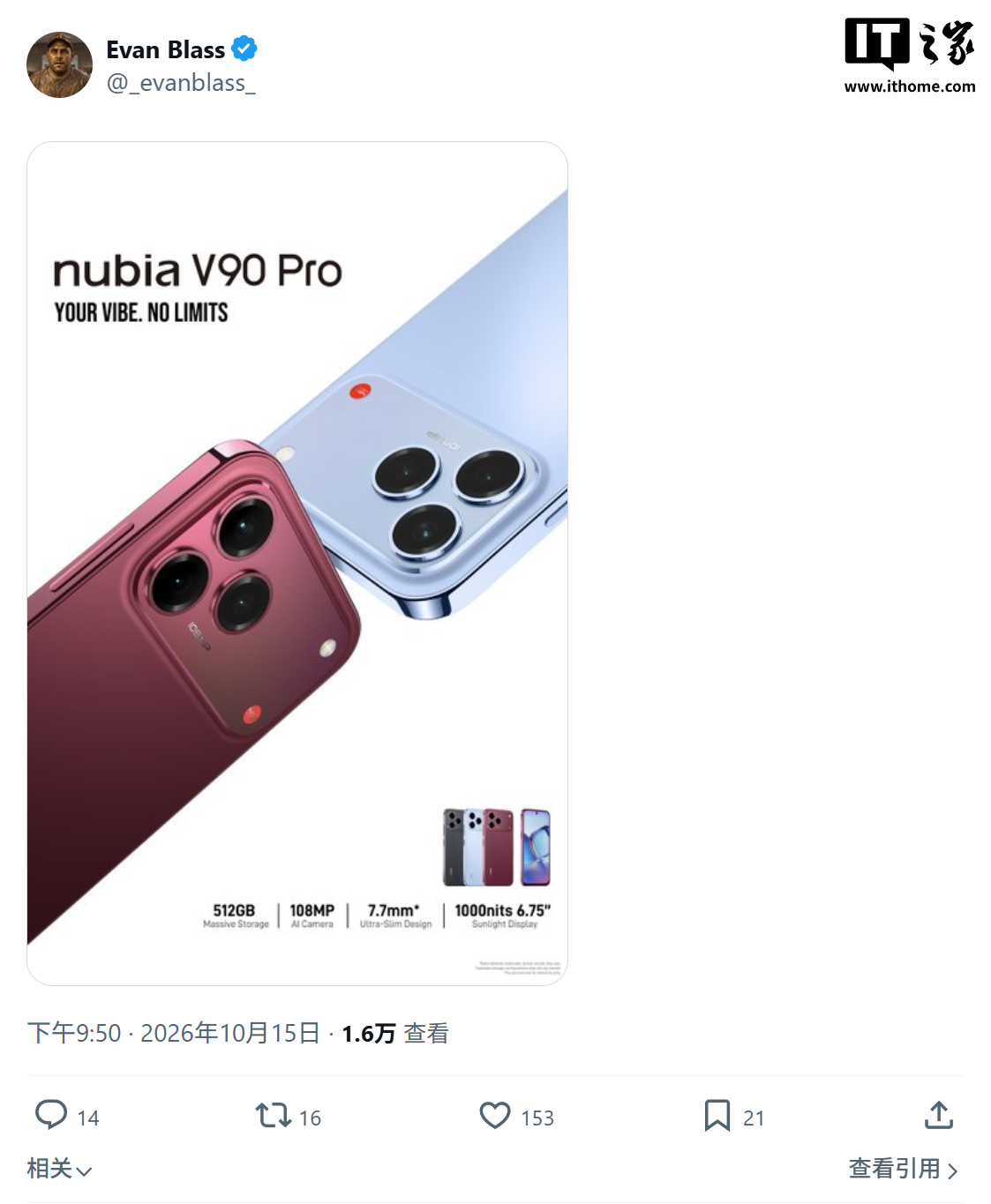 Figure: Official promotional materials shared by Evan Blass, highlighting 512GB storage, a 108MP main camera, a 7.7mm chassis, and a 1,000-nit daylight screen. Source: Evan Blass (@evanblass).
512GB Storage Breaks the Budget Capacity Bottleneck
Entry-level handsets have long been constrained by 128GB and 256GB storage ceilings. The preceding Nubia V80 Pro topped out at 256GB, while the older V70 typically shipped with 128GB. Mainstream messaging apps and short-video caches expand by dozens of gigabytes each year; keeping a single messaging app on a device for three years often demands upwards of 80GB alone.
Running out of local storage remains the primary catalyst forcing budget phone users to upgrade. Once available flash memory drops below 10%, background I/O throughput and fragmentation handling degrade precipitously, causing stuttering animations and app crashes. Frequently purging photo galleries and deleting chat histories introduces an exhausting maintenance chore.
The democratization of high-capacity flash storage in entry-level phones stems from shifting NAND flash production costs. With higher yields in 3D NAND fabrication, the bill-of-materials (BOM) premium for larger capacities has fallen into the low teens of dollars. For typical everyday write volumes of several gigabytes, modern wear-leveling algorithms easily guarantee a read-write lifespan exceeding five years.
The V90 Pro doubles the previous generation’s upper limit to 512GB. Generous onboard storage frees users from having to micromanage offline video downloads or work documents. High-capacity flash memory breaks the premature obsolescence cycle of low-cost smartphones; abundant physical headroom safeguards long-term I/O stability over years of daily service.
Wet-Touch Meets Dust and Water Resistance: Reliable Operation in Rain and Sweat
Standard capacitive touchscreens measure variations in electrical charge to register touch coordinates. When raindrops coat the outer glass, the conductive liquid bridges adjacent sensing channels, triggering widespread false touches across the touch controller. Outdoors, this manifests as erratic scrolling, phantom taps, or outright touch unresponsiveness.
Budget smartphone users encompass gig economy couriers and daily commuters alike. Delivery riders race against the clock in pouring rain to accept orders and consult GPS navigation. Grocery shoppers and home cooks regularly handle screens with wet or greasy fingers. When touch input drops at critical moments, constantly wiping the screen causes friction and delay.
Nubia outfits the V90 Pro with a 6.75-inch hole-punch display supporting wet-touch tracking, delivering a peak brightness of 1,000 nits. The touch controller combines self-capacitance and mutual-capacitance scanning to filter out electrostatic interference caused by continuous liquid films in real time. High peak brightness ensures daylight legibility, while the wet-touch algorithm prevents false triggers and dropped inputs when raindrops strike the glass.
The chassis integrates dust- and splash-resistant seals, noticeably improving durability under harsh operating conditions. Internal rubber gaskets block moisture ingress, while reinforced frame corners minimize the risk of display cracking from accidental pavement drops. Wet-touch technology turns laboratory splash-resistance ratings into dependable, all-weather usability; continuous touch interaction under adverse conditions is no longer reserved for premium flagships.
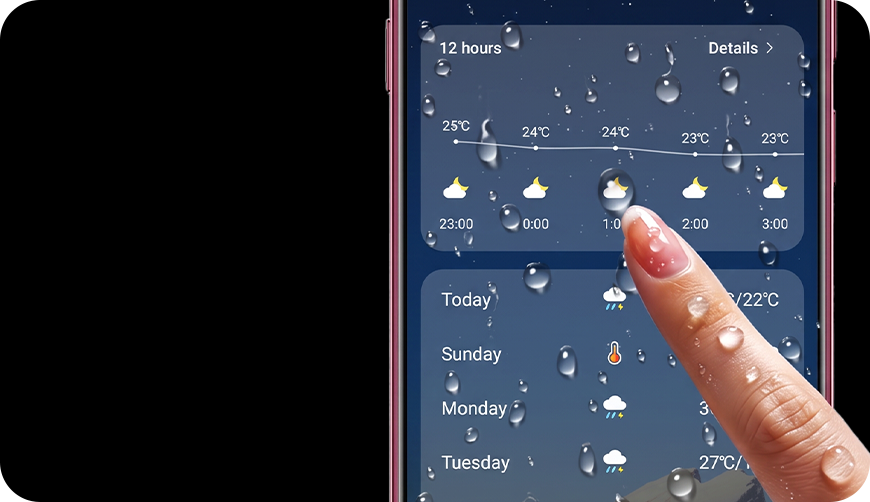 Figure: Official marketing material demonstrating touch interaction under water droplets, eliminating ghost touches and dropped inputs caused by liquid residue. Source: ZTE Nubia official promotional materials.
Fitting a 108MP Sensor into a 7.7mm Profile: Smart Budget Compromises
Designing hardware for the budget segment remains a strict exercise in bill-of-materials balancing. The V90 Pro maintains a sleek 7.7mm thickness while preserving a 3.5mm headphone jack and a dedicated physical shortcut key. The rear primary camera steps up to a 108MP sensor bearing Neo Vision branding, visually aligning the phone with premium design cues.
Focusing resources on key selling points inevitably requires calculated discipline elsewhere. The 108MP primary shooter utilizes a large 1/1.67-inch sensor supporting 9-in-1 pixel binning for 12MP output. However, the throughput of an entry-level image signal processor (ISP) remains modest. Multi-frame night captures typically take roughly a second of processing time, and the camera module omits optical image stabilization (OIS).
Within the three-ring camera housing on the rear, the auxiliary sensors primarily handle depth mapping and macro shots. To manage production costs, the core processing platform relies on a proven Unisoc chipset, while the display utilizes a high-brightness LCD panel. A high refresh rate and generous battery capacity ensure a fluid day-to-day experience when scrolling through social media.
By skipping expensive curved OLED panels, the manufacturer channeled its budget into hardware features ordinary consumers rely on every day. This product formula closely matches user expectations for practical durability. Strategic engineering decisions focus directly on primary camera resolution and slim ergonomics; pragmatic trade-offs preserve an aggressive entry-level price point.
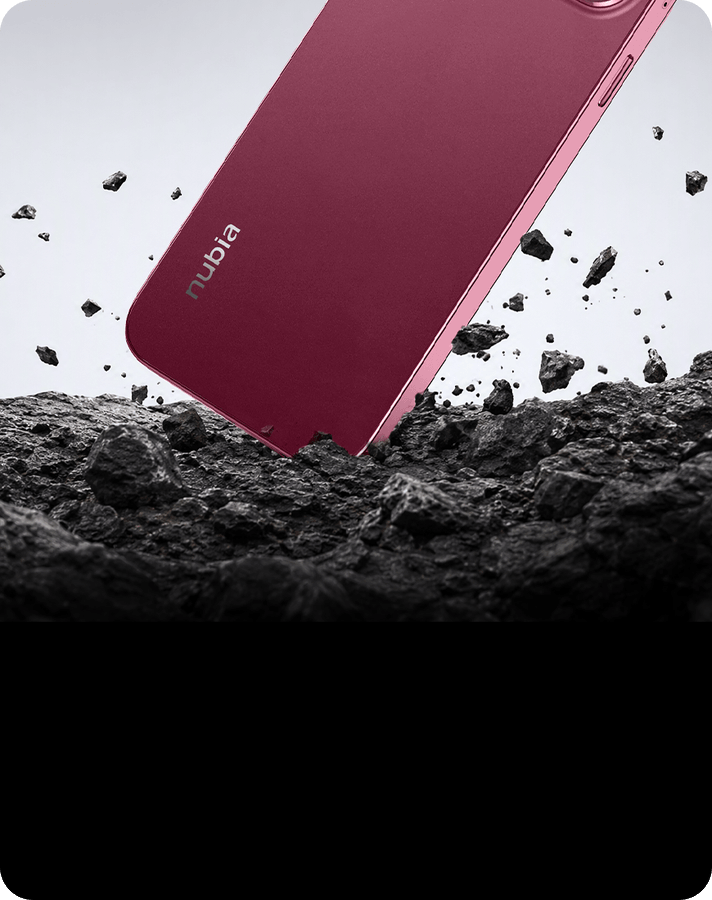 Figure: The rear camera module undergoing liquid splash testing, showcasing 108MP branding and Neo Vision imaging. Source: ZTE Nubia official promotional materials.
From Spec Races to All-Weather Reliability: Redefining Everyday Utility
Reflecting on the entry-level smartphone market over recent years, manufacturers often leaned heavily into marketing gimmicks. Empty audio tuning buzzwords and washed-out, high-refresh panels with poor color accuracy frequently headlined launch campaigns. Yet paper specifications could never mask sluggish software or fragile construction.
Consumer expectations for budget handsets are straightforward. A dependable daily driver does not need to run demanding 3D games at maximum graphical settings. It simply needs to survive everyday drops and pull up digital payment QR codes instantly in a downpour.
512GB of onboard storage eliminates the recurring anxiety of deleting photos. Wet-touch capabilities remove frustrating touch failures during rainy commutes. As upgrade cycles stretch out, budget handsets serve as the bedrock of mass consumption. Everyday buyers refuse to pay for surplus computing power, placing genuine value on longevity and all-weather dependability instead.
The rules of engagement in the entry-level space are shifting toward practical durability. The Nubia V90 Pro exemplifies hardware resources aligned directly with high-frequency real-world needs. When everyday smartphones confront rain, grease, and full storage head-on, mobile technology truly returns to its role as a durable, dependable tool.
Reference Links:
- Official Nubia V90 Pro promotional materials and renders leaked by Evan Blass on X.
- Technical analysis on ZTE Nubia V90 Pro specifications and design by Notebookcheck.
- Feature coverage on high-capacity storage and wet-touch capabilities in budget handsets by Tudocelular.