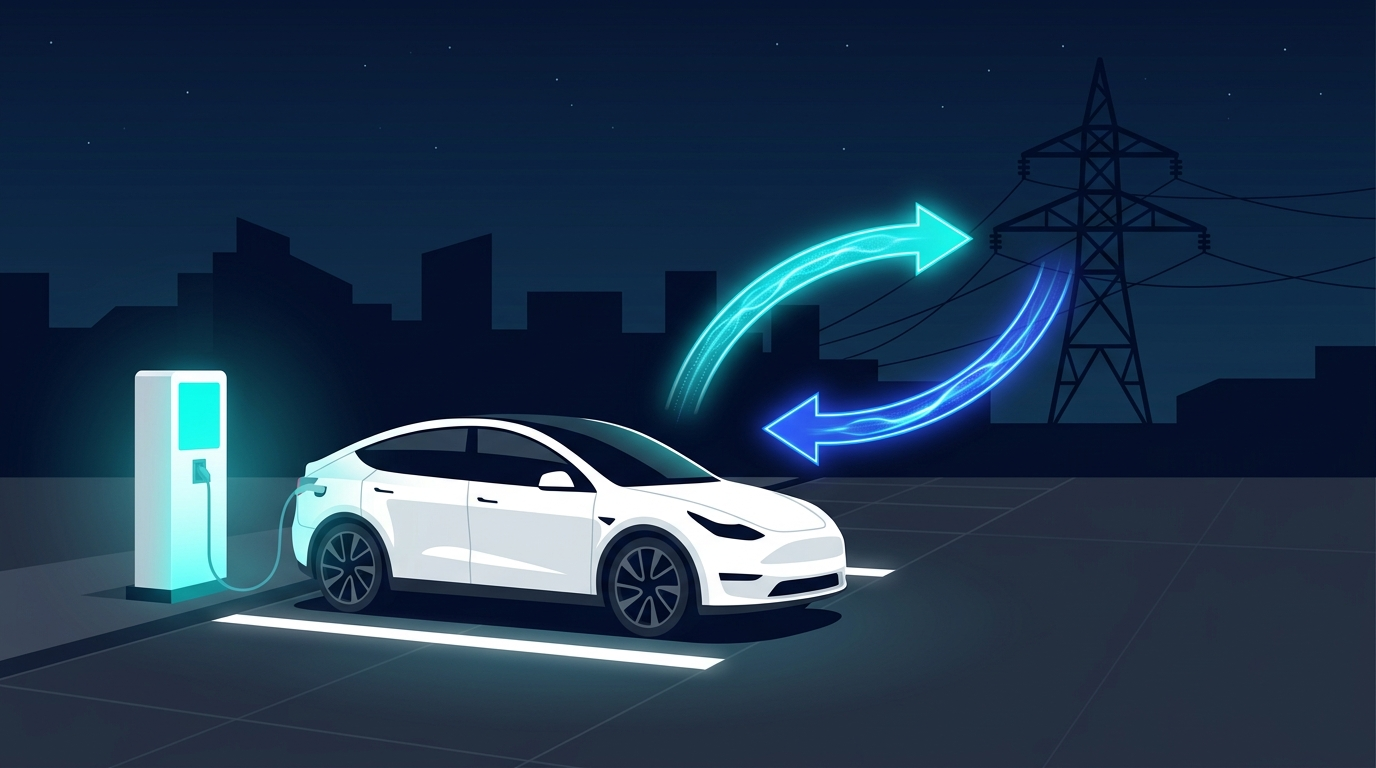
On October 16, 2026, Chery Green Energy signed a strategic cooperation agreement with Mingsheng Group, a subsidiary of State Grid Anhui Electric Power. The two parties officially put into commercial operation a large-scale vehicle-to-grid (V2G) interactive hub in Wuhu, Anhui Province.
Concurrently showcased at the event was the Xunlong Supercharge demonstration station at Chery’s R&D Innovation Center. Equipped with 1440 kW ultra-high-power charging infrastructure, the hub can add 500 kilometers of driving range in just five minutes. Beyond ultrafast charging, the more profound shift across these stations lies in bidirectional energy flow. Once parked, vehicles no longer simply consume power—they act as active energy storage assets delivering electricity back to the grid.
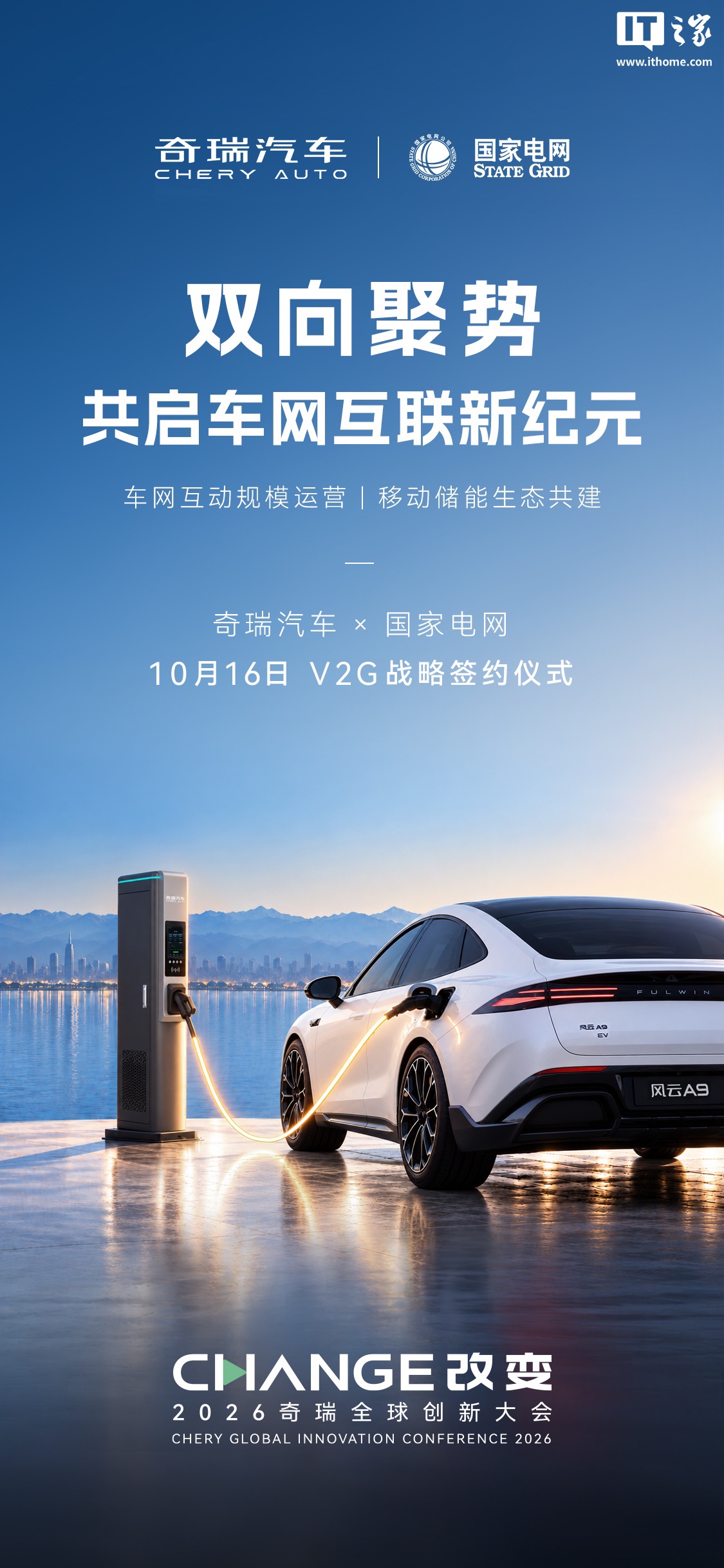 Photo: Strategic partnership poster from Chery Automobile and State Grid, showcasing the bidirectional charging-capable Fulwin A9. Source: Chery Automobile official release.
Nighttime Charging, Daytime Discharge: Parking Spots Become Distributed Storage Hubs
Over their operational lifecycle, private passenger vehicles spend more than 90% of their time stationary in parking spaces. Historically, these idle battery packs experienced gradual calendar aging without generating any tangible economic return.
The operating model pioneered at the Wuhu hub centers on “charging by night, discharging by day.” EV owners slow-charge overnight at residential chargers to take advantage of low valley tariffs. After commuting to office parks or industrial zones in the morning, drivers plug into AC V2G charging piles. During afternoon peak demand hours when regional grid stress peaks, the onboard traction battery reverses power flow and discharges back into the grid.
This operational paradigm activates idle private assets into dynamic, dispatchable grid resources. Vehicle owners do not need to make dedicated trips to remote battery energy storage facilities; everyday parking downtime during working hours directly translates into power sales revenue. Stationary vehicles are transformed into distributed energy storage nodes, redefining the asset economics of personal electric mobility.
Betting on AC Architecture: Moving the Inverter Onboard to Slash Charger Costs
While the automotive and utility industries have explored vehicle-grid integration for years, most initiatives remained stalled in localized pilots. The primary physical bottleneck impeding commercial scale has been the prohibitive capital expenditure of high-power DC V2G chargers.
Bidirectional DC V2G charging hardware requires complex, high-power AC/DC inverter and step-up conversion modules inside each pile. Hardware procurement and grid civil engineering costs regularly reached tens or even hundreds of thousands of yuan per station. These capital requirements proved too onerous for charging network operators to scale widely.
Chery broke through this impasse by shifting the focus to an AC V2G architecture. Engineers integrated bidirectional inverter control directly inside the vehicle’s onboard charger (OBC). This simplifies ground-based AC charging piles down to essential building blocks: handshake communications, metering and billing, and basic electrical safety protection.
As a result, pile hardware costs fall to the level of standard residential slow chargers. Commercial underground garages and residential communities no longer require extensive, cost-prohibitive distribution grid retrofits. Migrating core inverter hardware from ground chargers into vehicle chassis eliminates the financial hurdle to mass V2G deployment.
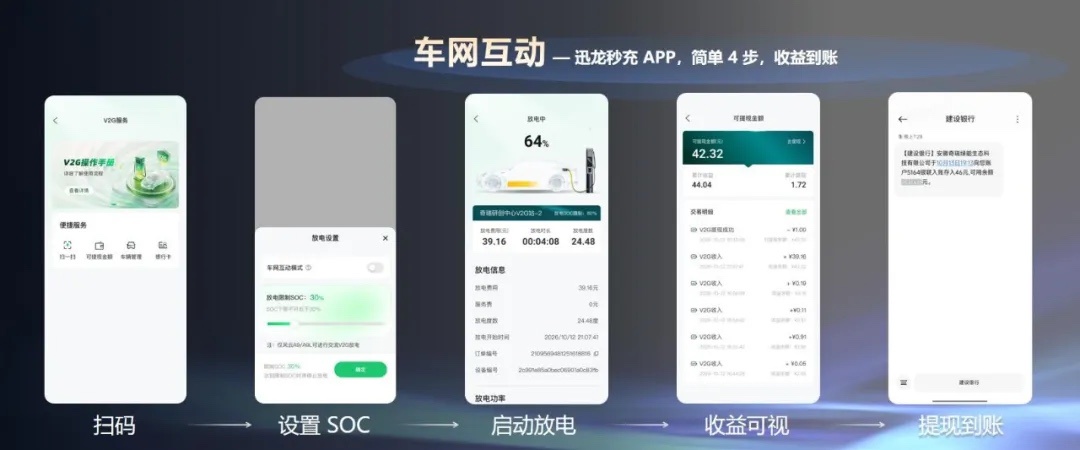 Photo: Xunlong Supercharge client app interface, demonstrating QR-code discharge, SOC threshold configuration, and revenue settlement workflows. Source: Chery Green Energy official interface.
Capping Discharge at 30% SOC: Protecting Battery Health via Shallow Cycling
The primary consumer reluctance toward vehicle-to-grid power feeding has always centered on battery degradation. Battery packs represent 30% to 40% of an electric vehicle’s total bill-of-materials. If participating in grid backfeeding were to prematurely degrade the battery for a few thousand yuan in electricity revenue, owners would refuse to adopt it.
To address this, Chery implemented strict physical safety boundaries within its vehicle control software. The companion Xunlong Supercharge application enforces a strict lower discharge floor. Drivers can configure customized shutoff thresholds, with the system setting a default floor at 30% State of Charge (SOC).
Everyday vehicle-to-grid interaction is confined strictly to the 30% to 80% SOC operating envelope. Electrochemistry testing demonstrates that lithium battery capacity loss predominantly occurs under edge conditions. Deep over-discharge near 0% accelerates cathode crystal degradation, while sustained high voltages at 100% full charge similarly accelerate chemical aging.
Modern automotive-grade lithium iron phosphate (LFP) cells feature cycle lives exceeding 3,000 cycles. Shallow cycling restricted to the stable mid-state SOC range imposes negligible wear on usable battery lifespan. Simultaneously, cloud-based battery management telemetry tracks cell voltage differentials and internal impedance in real time. Software-enforced 30% SOC minimum floors paired with cloud diagnostics alleviate owner anxiety over battery degradation and revenue sharing.
Breaking Down the 3,000 RMB Annual Math: Grid Peak-Shaving Demands Create Real Value
The economic viability of vehicle-to-grid feed-in relies on peak-to-valley time-of-use (TOU) tariff spreads and grid auxiliary peak-shaving subsidies.
In Anhui, a major industrial manufacturing hub in the Yangtze River Delta, industrial electricity tariffs climb substantially during summer and winter peaks. Overnight residential valley rates typically hover around 0.3 RMB per kilowatt-hour. During high-demand afternoon peak hours, industrial electricity rates frequently exceed 1.2 RMB per kWh, creating a price spread of 0.9 RMB/kWh or higher.
Operational data from the Wuhu demonstration site shows that a single Fulwin A9 sedan connected to an AC V2G charger discharges approximately 24.5 kWh of electricity per session. After subtracting transaction and operational handling fees, the vehicle owner earns nearly 40 RMB in net profit per discharge. Based on an owner discharging two to three times per week, cumulative annual peak-shaving revenue comfortably exceeds 3,000 RMB.
For grid dispatch operators, this incentive model is equally compelling. Building new pumped-storage hydroelectric plants requires multi-year lead times, while containerized electrochemical energy storage carries steep initial capital expenditure per megawatt-hour. Incentivizing EV owners with clear revenue sharing offers grid operators a flexible peak-shaving resource with exceptionally low marginal cost.
From One-Way Consumers to Bidirectional Hubs: Millions of EVs Reshaping the Grid
As electric vehicle penetration accelerates, uncoordinated mass charging threatens to impose severe localized strain on municipal distribution grids.
If tens of millions of electric vehicles plug in simultaneously upon arriving home on weekday evenings, local substation transformers face intense demand spikes. Treating electric vehicles merely as passive consumers of electricity would force grid operators to spend billions on redundant substation expansions.
Bidirectional vehicle-to-grid integration transforms this passive load into an active balancing reservoir. Today, the total energy storage capacity installed in China’s operating new energy vehicles already exceeds thousands of gigawatt-hours (GWh). Mobilizing even a fraction of this mobile storage capacity can fulfill municipal peak-shaving and valley-filling requirements.
Solar and wind power are inherently intermittent. During midday solar generation peaks, parked electric vehicles can absorb surplus renewable energy at low tariffs. In the evening, as household and industrial loads surge, vehicle batteries gradually return stored energy to the grid. Bidirectional power flow converts an asymmetric dependency into a symbiotic ecosystem, seamlessly integrating personal mobility fleets into modern energy infrastructure.
Chery and State Grid’s practical deployment in Wuhu provides a reproducible blueprint, proving that V2G is ready to graduate from isolated experiments into daily commercial operations. Cars are no longer just transportation tools—they are unlocking new revenue streams across the entire new energy value chain.
References:
- Chery Automobile official press release and Weibo announcements.
- State Grid Anhui Electric Power integrated energy service reports.
- National Development and Reform Commission (NDRC) and National Energy Administration (NEA) guidelines on vehicle-grid interaction.