
In the gear kits of traditional ultrarunners, specialized outdoor watches have long been notorious for their bulk. A full-featured GPS watch capable of tracking a 100-kilometer race often tips the scales at over 70 grams. Under the blazing midday sun on an alpine ridge, dim color screens easily wash out with harsh glare, leaving runners squinting to decipher faint contour lines.
On October 15, 2026, Suunto officially launched its latest performance sports watch, the Suunto Race 3S, priced domestically in China at 3,999 RMB. The new model compresses the bare watch head down to an astonishing 38 grams while integrating a 3,000-nit peak brightness AMOLED touchscreen and a Grade 5 titanium bezel.
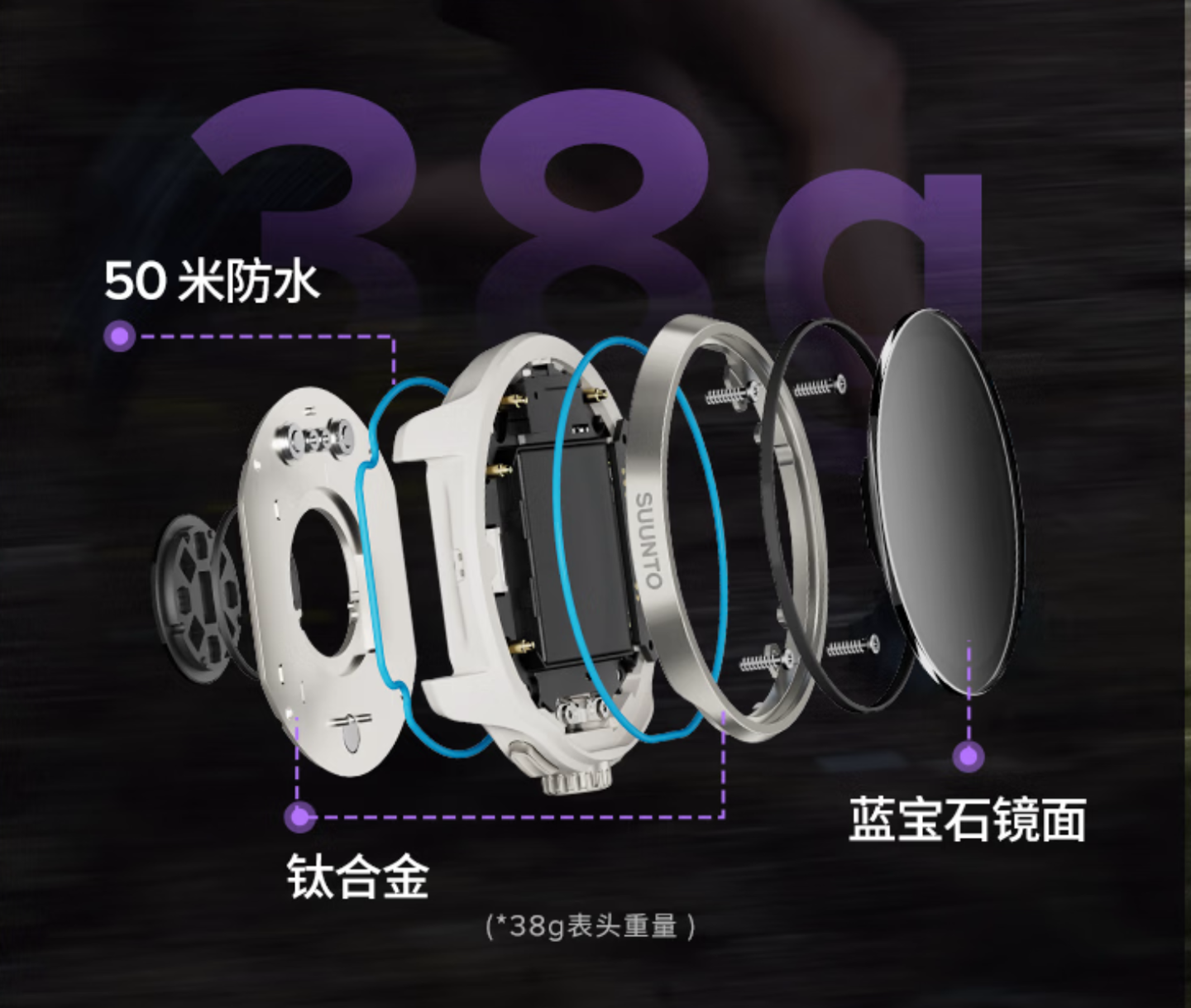 Figure: Structural teardown of the Suunto Race 3S, showcasing the Grade 5 titanium bezel, sapphire crystal, and 38-gram watch body. Source: Suunto official announcement.
Ending Harsh Glare Blindness: 3,000 Nits Reimagines Trail Navigation
Outdoor watches have historically relied on memory-in-pixel (MIP) reflective displays. MIP screens excel under direct sunlight and sip very little power. However, their color fidelity is severely constrained, typically limited to just 64 colors. When rendering intricate topographic contours and dense satellite terrain imagery, they lack crucial depth and visual separation.
While AMOLED screens offer vivid colors, outdoor legibility under harsh sunlight has remained a persistent hurdle. The original Race S maxed out at 1,000 nits. On exposed ridges, ambient daylight regularly exceeds 100,000 lux. Insufficient backlight output causes catastrophic screen washout, forcing runners to physically shade their wrists with their other hand just to check the trail.
The Race 3S addresses this with a 1.32-inch AMOLED touchscreen boasting 3,000 nits of peak brightness and a sharp 466×466 resolution. Paired with anti-reflective sapphire crystal coating, harsh specular reflections are dramatically curtailed. Dense forest trails and topo elevation lines retain crisp definition. Descending high-speed singletrack, a runner can identify trail forks with a mere glance. An ultra-bright display eliminates glare-induced hesitation; vibrant color outdoors no longer compromises topographic legibility.
Grade 5 Titanium Sheds Excess Grams: 38g Body Offsets 100km Arm Fatigue
Ultramarathon trail racing is an unforgiving test of endurance. Completing a 100-kilometer course often demands over 20 continuous hours and tens of thousands of repetitive arm swings. Adding just a few dozen grams to the wrist compounds over time into noticeable joint fatigue and tendon strain.
Most flagship outdoor watches carry substantial heft. The prior Race 2 weighed 75 grams, and comparable competitors regularly sit between 70 and 85 grams. A bulky watch chassis tends to bounce vigorously on fast, rocky descents. Beyond chafing delicate wrist skin, this bouncing compromises the skin contact of the rear optical heart rate sensor, leading to severe sensor cadence lock and telemetry anomalies.
The Race 3S adopts a Grade 5 titanium bezel, balancing featherlight construction with robust impact and scratch resistance. Engineers overhauled the internal layout, bringing the bare watch head down to just 38 grams. Paired with its stock silicone strap, total weight comes in at only 56 grams, with case thickness trimmed to a svelte 11.4 millimeters.
On the rear, Suunto upgraded the optical biometric package to a 4PD 6LED configuration beneath a gently curved glass backplate that contours snugly against the wrist. The trimmed-down mass minimizes inertial bounce during downhill impacts, substantially enhancing optical heart rate sampling fidelity. Grade 5 titanium marries durability with effortless wear; cutting dead weight directly improves long-duration biometric tracking quality.
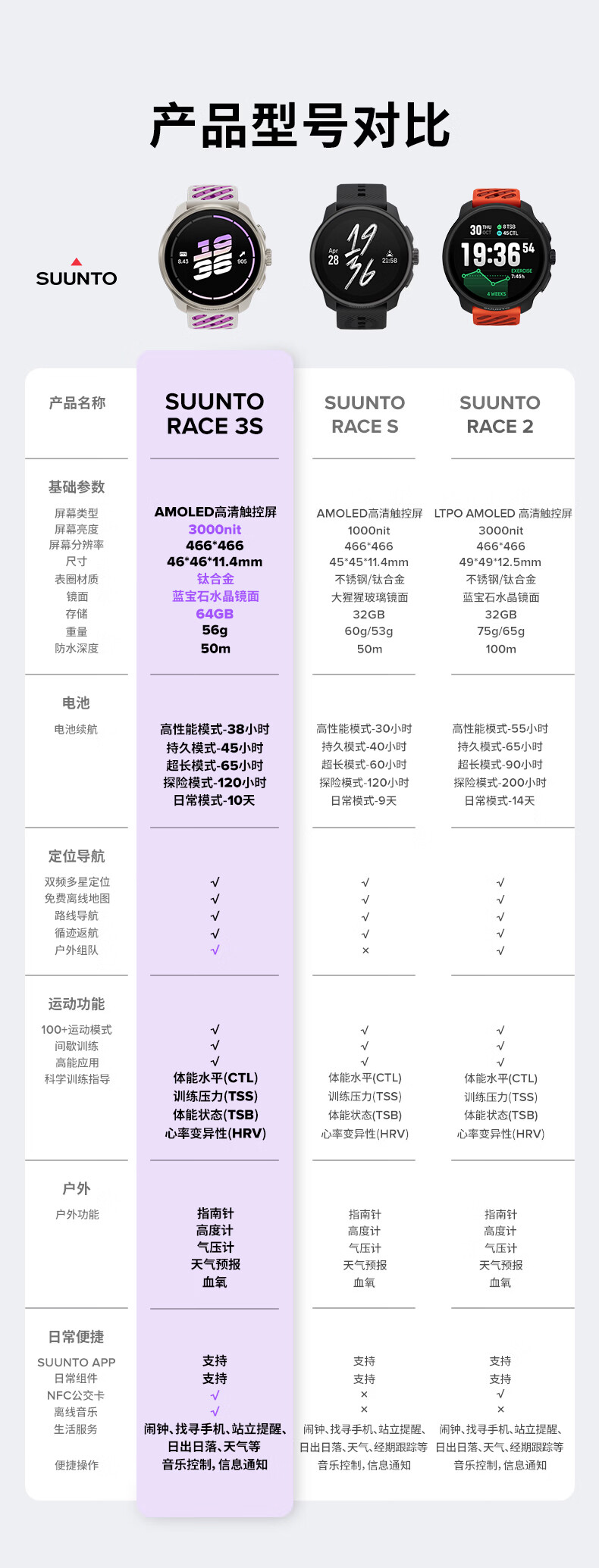 Figure: Official specifications matrix comparing display brightness, case materials, battery configurations, and offline mapping storage across generations. Source: Suunto official announcement.
Silicon-Carbon Anode Enables 38-Hour Dual-Frequency GNSS: Small Size Without Battery Compromise
Downsized sports watches traditionally pay a steep toll in battery life. Due to internal chassis volume constraints, compact designs struggle to house substantial battery cells. Engaging high-accuracy dual-frequency satellite tracking often drains them in under 24 hours—falling well short of long-distance mountain ultras.
The Race 3S leverages a high-energy-density silicon-carbon anode battery, packing robust energy reserves into its 46mm chassis. In top-tier all-systems dual-frequency GNSS mode, continuous tracking hits 38 hours. In endurance single-frequency mode, tracking extends to 45 hours, while daily smartwatch battery life remains solid at 10 days.
A 38-hour dual-frequency tracking window comfortably covers a non-stop 100-kilometer mountain race, freeing athletes from hauling auxiliary battery packs or mid-course charging cables. Internal storage has expanded to 64GB, ample for storing complimentary global offline topographic maps. Deep in off-grid wilderness, full routing and contour navigation stay instantly accessible. High-density cell chemistry bridges the gap between form factor and stamina; for the first time, a compact watch packs the autonomous endurance required for hundred-kilometer ultras.
A Premium Price Shift: High-End Hardware Faces the Software Frontier
These substantial hardware leaps come with a correspondingly higher price tag. Independent gear analyst DC Rainmaker pointed out in his deep-dive review that the Race 3S commands a notable price hike over its predecessor, positioning it firmly in the premium category.
Certain trade-offs also accompany the compact form factor. The watch chassis lacks a dedicated physical LED flashlight, meaning runners navigating darkness still rely entirely on their headlamps. Rapid map zooming occasionally incurs a momentary one-second tiled redraw lag. For global markets, offline music storage remains confined to local audio file transfers, while certain advanced training analytics continue to require a subscription model.
Nevertheless, material investments are undeniable. Transitioning from stainless steel to Grade 5 titanium and from mineral glass to sapphire crystal substantially drives up production overhead. In regional markets like China, Suunto added transit NFC card support and NetEase Cloud Music offline playback, bolstering everyday lifestyle utility. Compared to heavyweight titanium flagship competitors commanding upwards of $1,000, the Race 3S offers a uniquely compelling option for athletes who prioritize agility. Premium build materials justify the steeper investment; refining the companion software ecosystem will determine its long-term appeal among elite athletes.
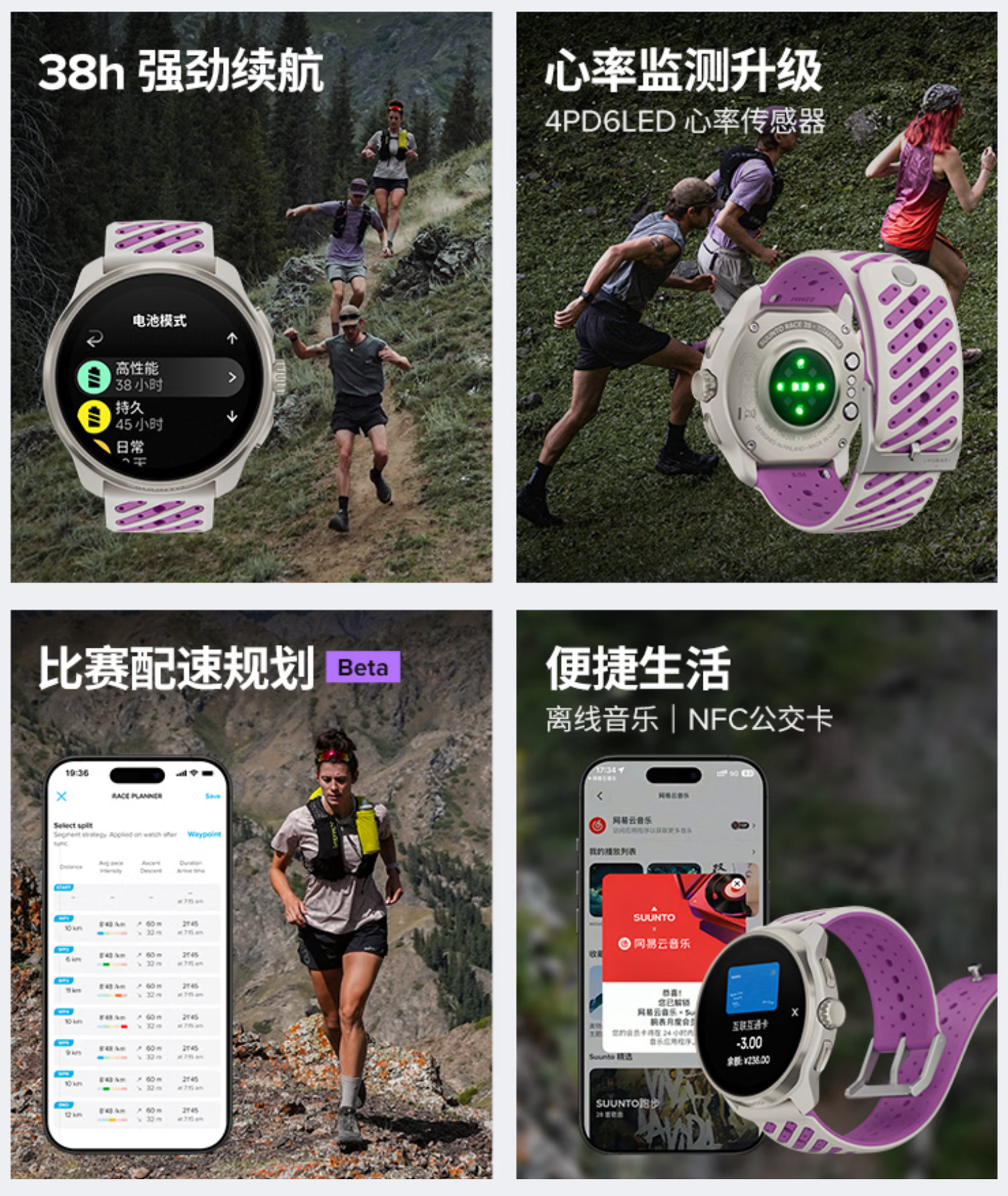 Figure: Overview of key Suunto Race 3S capabilities, spanning 38-hour battery longevity, biometric sensing, race pacing tools, and daily lifestyle features. Source: Suunto official announcement.
Specialized Tools Return to Pure Agility: Bright, Compact Designs Rewrite Outdoor Standards
Outdoor performance gear long fell into the trap of size worship. Bulky bezels and oversized batteries were frequently mistaken as the sole benchmarks of true professional credibility.
The Race 3S showcases an alternative engineering philosophy. A 3,000-nit display overcomes the harsh daylight visibility barrier, while Grade 5 titanium and dense silicon-carbon chemistry preserve structural resilience and stamina within a 38-gram envelope. Runners are no longer forced to choose between crisp navigation and wrist relief.
Integrating bright visuals and rugged materials into a lightweight silhouette represents a shift toward design restraint. The battleground for modern sports watches is evolving: delivering crystal-clear environmental awareness and reliable endurance, all wrapped in an agile form factor.
Reference Links:
- Suunto Official Launch & Technical Specifications.
- DC Rainmaker In-Depth Review & Multi-Device Data Comparison.
- Suunto Official Announcements & Regional Store Product Details.