On October 12, 2026, Anker officially unveiled its flagship high-capacity portable power station, the SOLIX S5000. Housing a massive 5,024Wh lithium iron phosphate (LiFePO4) battery pack, the entire unit weighs in at 44 kg (97 lbs). Its headline engineering achievement is replenishment speed: driven by a dual-input charging architecture, the station goes from completely flat to 100% in just 99 minutes.
Historically, recharging a 5kWh-class power station took the better part of a full day. If users forgot to charge their unit overnight prior to heading out, they often found themselves stranded with a dead battery. The S5000 brings a 4,500W high-power charging topology to mobile energy storage, officially transitioning portable power into an on-demand, instant-dispatch era.
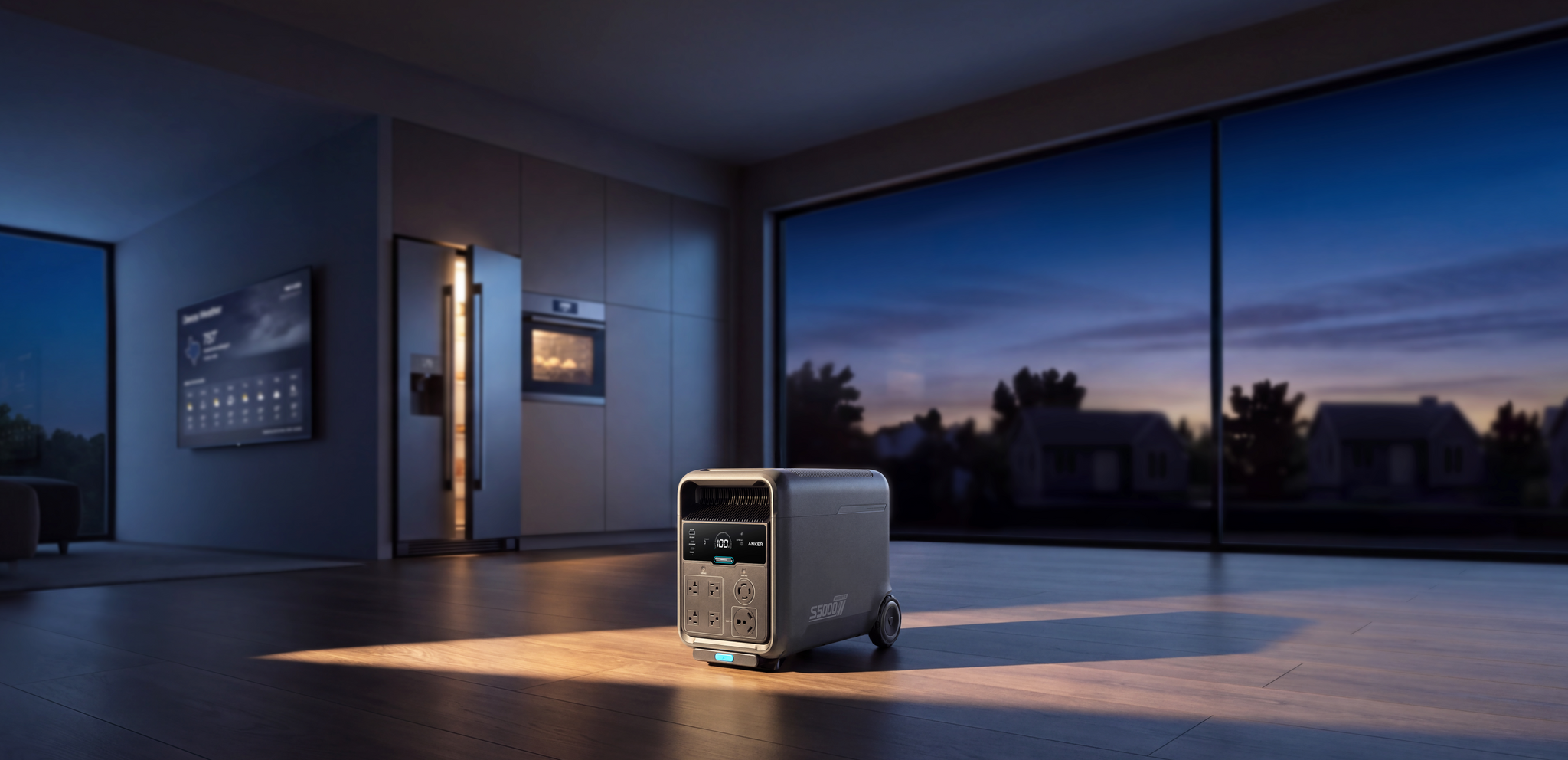 Image: The Anker SOLIX S5000 features a compact trolley form factor with wheels and a pull-out handle, sporting dual-voltage AC outlets and high-power interfaces on the front panel. Source: Anker Official Product Specifications (ankersolix.com)
5,024Wh in 99 Minutes: Mobile Power Stations Cross the 1C Charging Threshold
For years, the portable power station industry has grappled with an asymmetry between charge and discharge rates. A typical 5kWh unit can deliver several kilowatts of continuous load, but grid recharging has frequently been capped at 1,800W. On a standard 120V household circuit, topping up 5kWh of battery capacity routinely demands nearly four hours.
These prolonged recharge cycles severely diminished the turnaround efficiency of large battery banks. Whether on remote field shoots, overland expeditions, or multi-day road trips, users could not afford half a day of downtime just waiting at an outlet. That charging latency turned many large-capacity battery packs into single-use emergency fail-safes rather than active everyday workhorses.
The S5000 reworks high-voltage charging topology from the ground up. When plugged into a 240V dedicated AC outlet, its input power leaps to a full 4,500W. With a charge-power-to-capacity ratio nearing 1C, the entire station returns to 100% capacity in just 99 minutes.
Beyond grid AC input, the S5000 integrates a versatile multi-source charging matrix. The chassis features two independent solar input channels supporting up to 2,000W high-voltage solar and 1,000W low-voltage solar respectively, combining for a total solar input capacity of 3,000W.
S5000 Multi-Source Charging Architecture & Measured Recharge Times:
- 240V High-Voltage AC Grid: Up to 4,500W input, 0 to 100% recharge in 99 minutes
- 120V Standard AC Grid: Up to 1,800W input, 0 to 100% recharge in ~190 minutes
- Dual-Channel Solar PV Array: Up to 3,000W input (2,000W HV + 1,000W LV), ~120 minutes under ideal conditions
- Dedicated Gas Generator Input: Up to 4,500W direct input, 0 to 100% recharge in 99 minutes
This fundamentally alters how users plan their power needs. Rather than running a noisy, overnight charge cycle before an outing, the brief interval spent packing gear and loading a vehicle is now more than enough to fully restore the battery. Ultra-fast charging removes energy replenishment as a logistical roadblock.
314Ah Grid-Grade Cells Enter Consumer Hardware: 44kg Chassis Handles 8,000W Surge
Squeezing multi-kilowatt fast charging and 5kWh of capacity into a manageable trolley relies squarely on cell-level advances. The S5000 adopts large-format 314Ah prismatic LiFePO4 cells, a specification originally perfected for utility-scale containerized grid storage. Long proven in industrial installations, these cells deliver high volumetric density and exceptional thermal and electrical consistency.
By adopting large prismatic cells, Anker minimized internal wiring harnesses, interconnects, and module brackets. The battery pack’s total part count dropped by nearly one-third, substantially increasing effective volumetric and gravimetric energy density.
The entire unit tips the scales at 97 lbs (approximately 44 kg), with exterior dimensions of just 27×56×39 cm. By comparison, Anker’s previous-generation flagship SOLIX F3800 packed 3,840Wh yet weighed 60 kg. The S5000 delivers 31% more energy capacity while trimming overall weight by 27%.
Anker Flagship High-Capacity Mobile Power Generations Compared:
- SOLIX F3800: 3,840Wh battery capacity, 6,000W rated output, 60kg net weight, 64Wh/kg energy density
- SOLIX S5000: 5,024Wh battery capacity, 4,500W rated output (8,000W surge), 44kg net weight, 114Wh/kg energy density
- Expansion Scalability: Supports up to 5 external expansion battery packs, scaling total system capacity to 30kWh
On the output side, the power station offers generous headroom. The inverter delivers 4,500W of continuous AC output with an 8,000W peak surge rating. Its physical interface lineup includes a 240V NEMA L14-30R receptacle, an RV-ready TT-30R port, and 100W USB-C PD outputs—easily absorbing the sudden inrush currents of high-draw deep-well pumps and central air conditioning compressors.
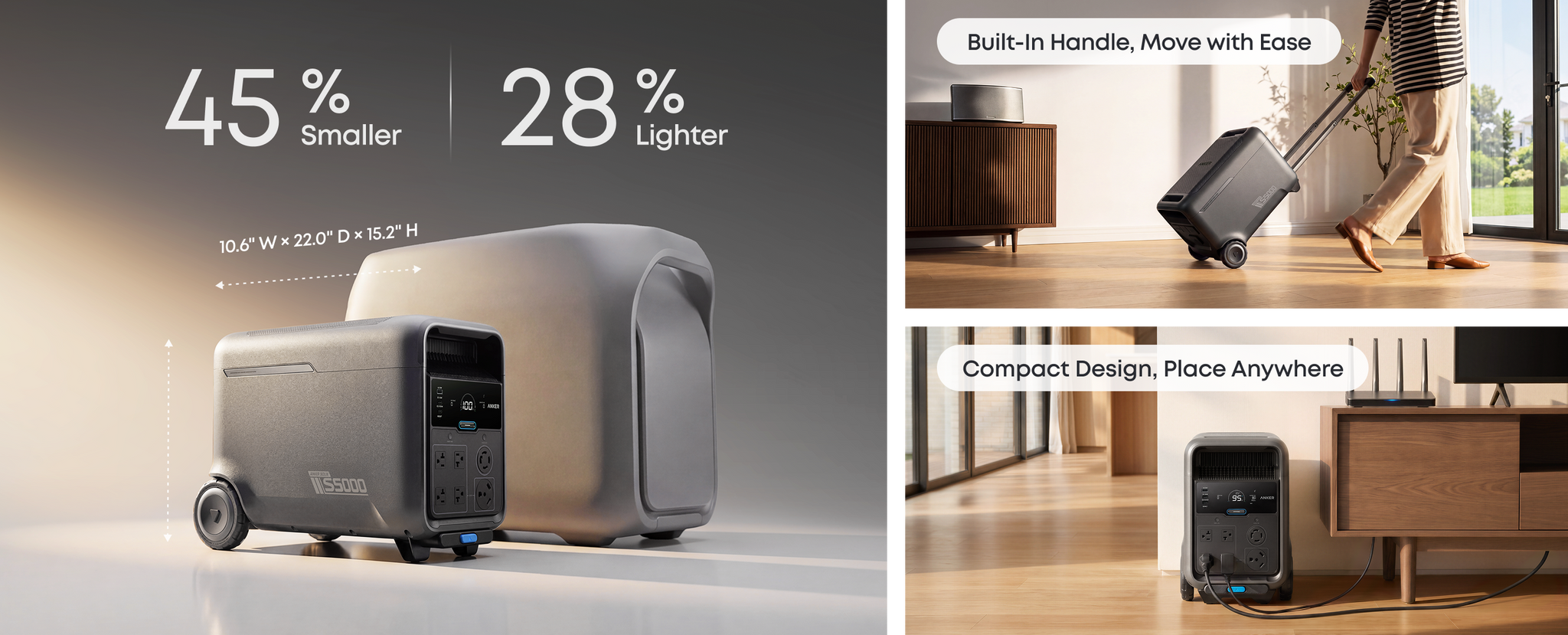 Image: Packing 5kWh into a 44kg, 56cm-long chassis, the S5000 is noticeably more compact than rival units in its capacity class. Source: Anker Official Test & Comparison Data (ankersolix.com)
Standby Draw Drops to 8.8W: 96% Inverter Efficiency Rewrites the Energy Loss Ledger
For emergency backup systems on standby around the clock, inverter idle power consumption represents a steady, invisible drain. Typical inverters in this capacity bracket consume between 30W and 50W when left switched on. After sitting idle for just a few days, self-discharge and parasitic inverter draw can bleed away one or two kilowatt-hours of stored energy.
High standby consumption undermines the entire premise of an emergency power supply. During sudden grid blackouts or severe storms, homeowners have often discovered their emergency reserve substantially drained by its own idle electronics. This phantom power loss erodes trust in mission-critical home backup systems.
The S5000 features a completely redesigned inverter drive stage. In 120V standby mode, its idle consumption drops to just 8.8W, and only 13.7W in 240V standby mode. Under a typical 1,000W AC load, the unit reaches a conversion efficiency of 96%, well above the 86% industry average.
Inverter System Key Performance Metrics:
- 120V Inverter Standby Draw: 8.8W (industry typical: 30–50W)
- 240V Inverter Standby Draw: 13.7W
- 1,000W Load Inverter Efficiency: 96% (industry average: ~86%)
- UPS Switchover Transfer Time: < 10ms (meets industrial-grade continuous power standards)
- Steady-State Operating Noise: 30 dB (comparable to ambient library noise)
Such minimal parasitic loss qualifies the unit as a viable 24/7 online UPS. When municipal grid power cuts out, the automatic transfer switch kicks in under 10 milliseconds, preventing sensitive home NAS storage rigs, desktop workstations, and medical CPAP/oxygen concentrators from resetting. With steady-state noise capped at 30 dB, the system runs quietly enough for interior living quarters.
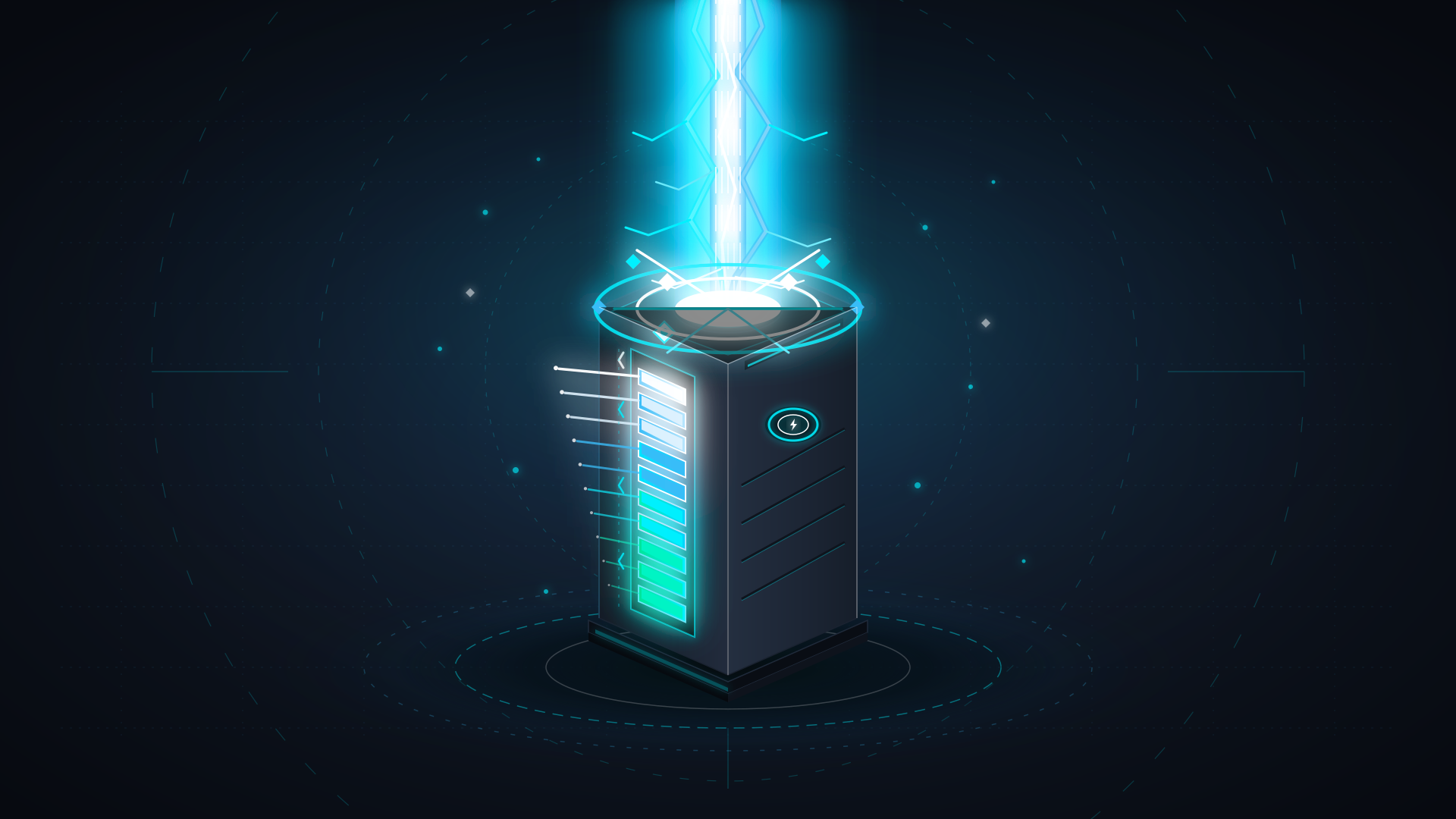
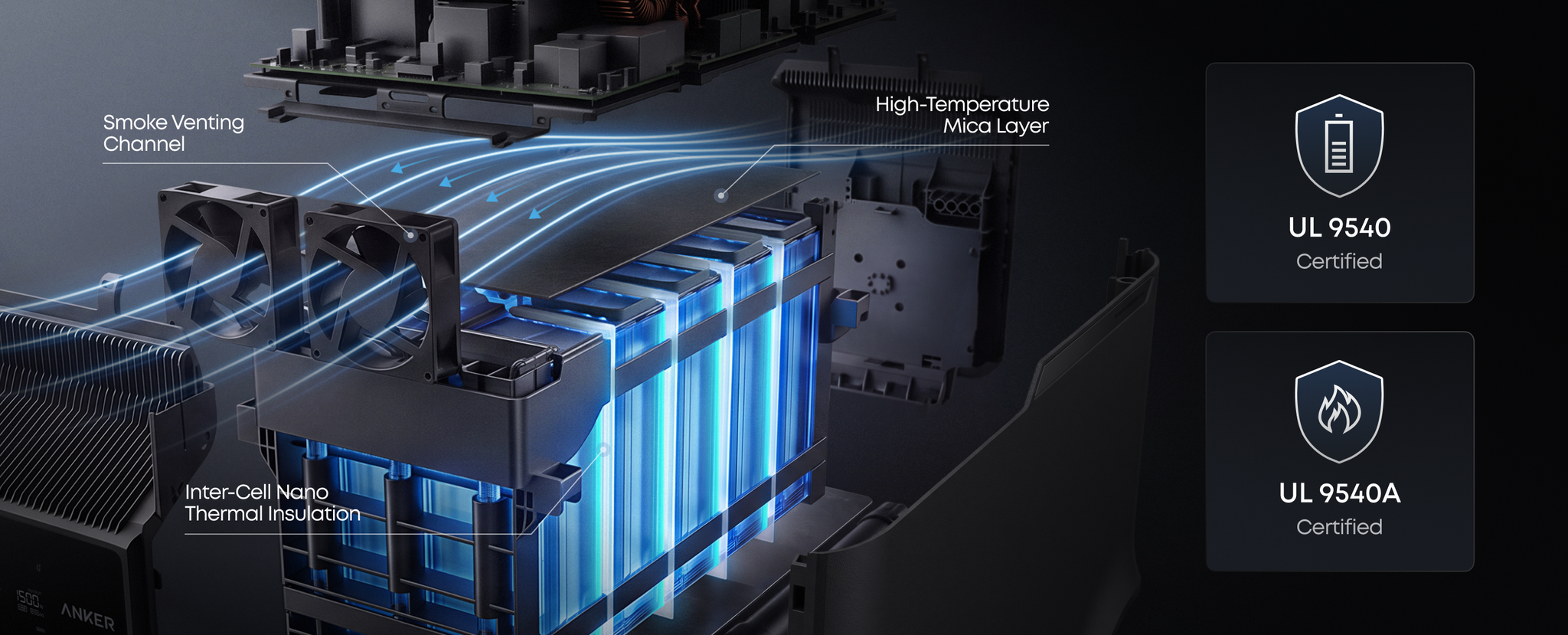 Image: The internal chassis integrates 314Ah large prismatic cells and carries UL 9540 and UL 9540A safety certifications. Source: Anker Official Technical Architecture Diagram (ankersolix.com)
4,500W Fast Charging Demands 240V: High-Power Replenishment Still Faces Real-World Constraints
While this high-speed charging architecture represents a significant technological leap, it introduces distinct environmental constraints. Outside of specialized electrical setups, maximum charging speeds cannot always be tapped on demand.
Achieving the full 4,500W recharge requires direct connection to a 240V AC split-phase circuit. Standard 120V household wall outlets cap input at 1,800W, stretching full recharge time back to 3.2 hours. Older residences lacking 240V outlets near garage or utility spaces will face electrical upgrade and installation costs, meaning mainstream residential buyers must weigh infrastructure retrofits before seeing full benefits.
Solar recharging likewise relies on physical acreage. Maximizing the 3,000W solar ceiling demands fully populating two separate array circuits. Deploying that many photovoltaic panels off-grid requires tens of square meters of open space. In overcast or rainy conditions, solar replenishment rates inevitably drop significantly.
Furthermore, continuous high-C fast charging places intense demands on thermal management. Although the unit holds UL 9540 and UL 9540A certifications, multi-kilowatt currents generate substantial internal heat. How effectively the forced-air cooling system maintains long-term thermal stability during peak summer heat remains to be seen in extended real-world testing, and battery degradation under sustained fast-charging cycles warrants continued observation.
Instant Turnaround Reshapes Mobile Power: Big Storage Escapes the Slow-Charge Bottleneck
Tracking the trajectory of portable energy storage, the sector has transitioned from small power banks to slow-charging, heavy backup boxes. Historically, large batteries were held back by limited charging wattage, leaving users at the mercy of protracted recharge cycles. Prolonged downtime prevented large batteries from being utilized in continuous, high-frequency rotation.
Anker’s pairing of industrial 314Ah cells with a 4,500W input architecture breaks that compromise. Combining 5kWh of usable capacity with a 99-minute recharge transforms mobile energy storage into high-turnaround, primary infrastructure. When topping up multi-kilowatt-hour packs fits neatly into ordinary meal or packing breaks, the operational barrier to mobile electricity largely disappears.
In time-of-use (TOU) tariff markets, the unit also enables practical peak-shaving and energy arbitrage. Households can gulp cheap off-peak power in 99 minutes during early-morning valleys and discharge it during costly daytime peaks, expanding the economic rationale of residential backup hardware.
From passive emergency insurance to proactive daily energy dispatch, technical maturity is bridging the gap between stored kilowatt-hours and turnaround time. Large-scale portable power stations have cast off their slow-charge shackles, evolving into versatile, high-turnaround energy terminals ready for daily duty.
Reference Links:
- Anker Official Product Specifications
- Notebookcheck Coverage
- UL 9540 Energy Storage System Safety Testing Standards