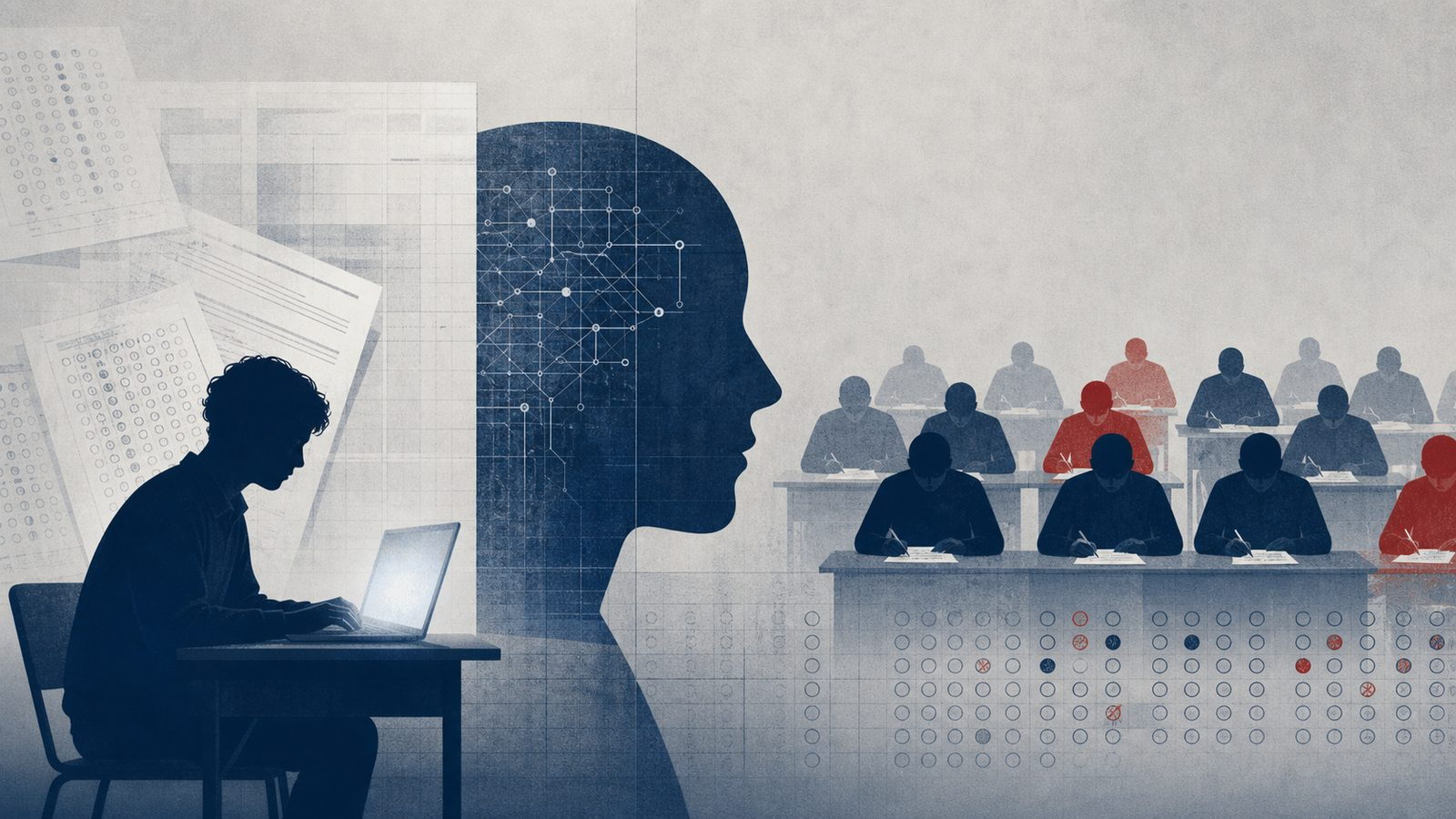
In late May 2026, Brown University computer science professor R. Serrano sat in his office grading finals. Something was off. Some students had scored over 30 points higher than on the midterm. Certain answers shared eerily identical phrasing. Several submissions showed a near-perfect “semantic relationship” with the exam questions — the kind of precision you only get from someone who has already seen the answer key.
He looked again. Out of 96 students, he identified roughly 50 who had used AI to cheat. The class average plummeted from 96 on the midterm to 48 on the final — not a dip to 85, but a full collapse by half.
“It took me a long time to accept it,” Serrano later told El País. “When I realized half my students had cheated, what I felt wasn’t just disappointment — it was a deep helplessness toward the entire system.”
A Professor’s Conscience and a Campus Shooting
To understand the complexity here, you need some context.
In March 2025, a shooting occurred on the Brown University campus. One of Serrano’s students was struck and later died from complications. The event profoundly reshaped Serrano’s approach to teaching — he began rethinking the student-teacher relationship, trying to bring more understanding and compassion into the classroom.
So when he uncovered mass AI cheating on the final exam, his first reaction wasn’t anger. It was bewilderment. He spent a long time wrestling with a question many people are afraid to look at directly: When a teacher extends genuine trust and understanding to students, what do the students do with it?
Eventually, he reported the case to the university’s academic integrity board. But he was also thinking about a deeper question: should universities fundamentally redesign how they assess students?
How AI Helps Students Cheat
The popular image of “cheating with AI” is simple: a student opens ChatGPT, pastes in the exam question, and copies the answer. What Serrano found was far more sophisticated.
Some students used browser extensions that popped AI-generated answers directly onto the exam page, positioned precisely beneath each question. Others used split-screen on their phones — exam questions on the top half, an AI chat window on the bottom. Some had pre-trained custom models by feeding in their class notes, past exams, and textbook PDFs, then asking the model during the exam to “answer this question using my knowledge.”
The elegance of these methods is that they bypass traditional anti-cheating detection. Browser extensions run locally, never touching a server. In split-screen mode, exam proctoring software only sees the exam window “in the foreground” and misses the AI chat on the other side. And models fine-tuned on a student’s own notes generate text that closely matches their writing style — even Turnitin-styled AI detection systems flagged them as clean.
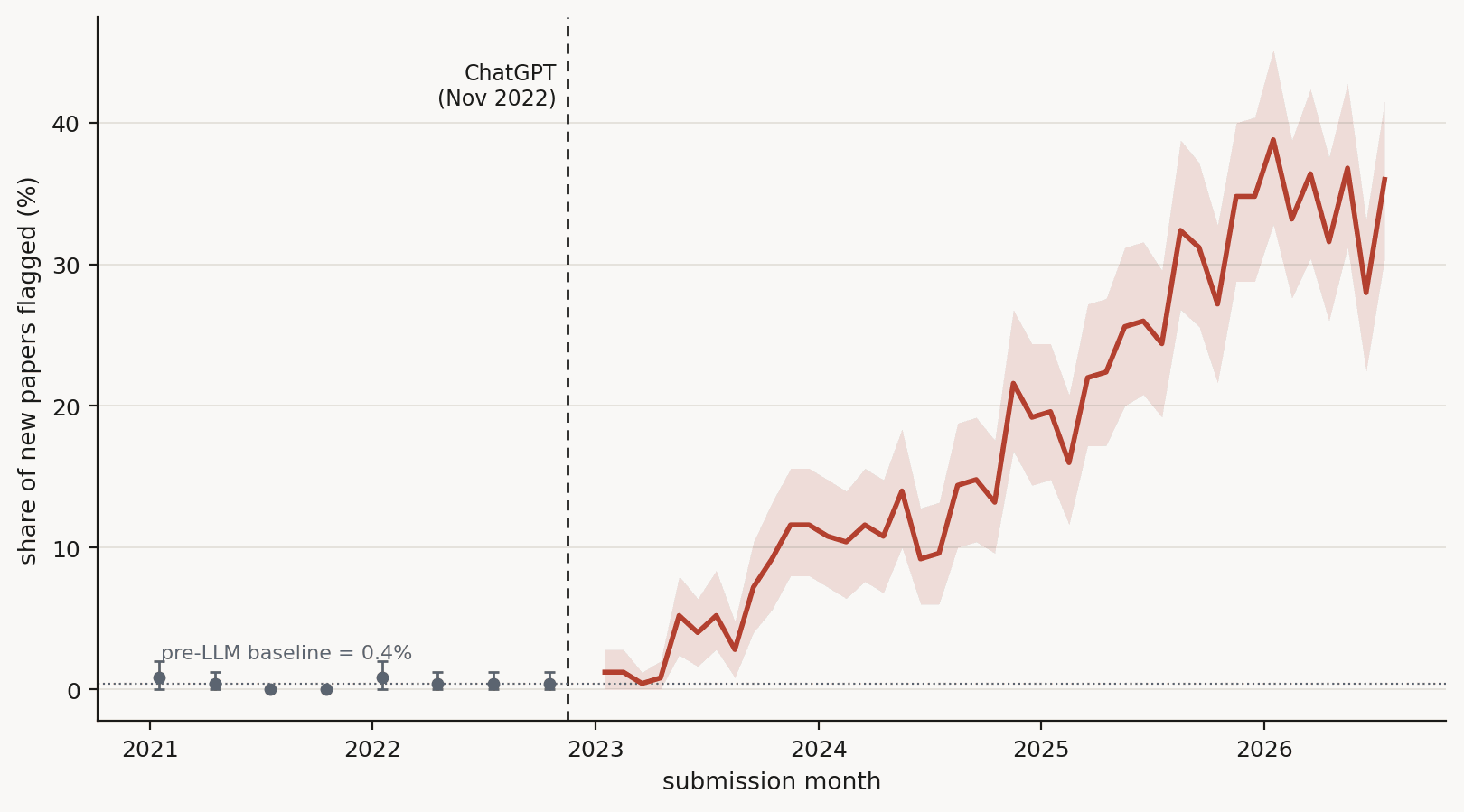
Turnitin is itself part of the problem. Since 2025, multiple cases have surfaced where non-native English speakers’ original essays were falsely flagged as AI-generated, forcing them to prove their innocence. Earlier in 2026, Yonsei University in South Korea saw a similar incident: a professor using an AI grading tool incorrectly flagged numerous students’ answers as cheating, triggering a mass student protest. When detection systems both miss real cheating and falsely accuse innocent students, the “fight tech with tech” approach hits a dead end.
Why Online Exams Are Breaking Down
At the end of every semester, two competing narratives circulate on campus.
One comes from students: AI is a great tutor. When you’re struggling with lecture notes at 3 a.m., you can ask AI to explain. When you’re stuck on a paper, AI can help outline ideas. Fix grammar, translate papers, generate code scaffolding — AI genuinely helps many people learn.
The other comes from professors: AI is a cheating machine. The assignments turned in this semester are abnormally high quality, but nobody can answer questions in class. The gap between coursework and exam performance is absurdly wide. And the most disheartening part: you give a student sincere trust, and they give you back an AI-generated perfect answer.
Both narratives contain real truth — and that’s the problem. They describe the same thing. The same AI chat window that helped a student understand Fourier transforms one moment is outputting exam answers the next. There is no technical way to distinguish “assisted learning” from “substituted thinking.”
Cheating tools — purpose-built services that help students “use AI to cheat without getting caught” — are tearing this gray zone wide open. These tools let students activate an “invisible cheating mode” with one click: a semi-transparent AI window overlaid on the exam page. The proctoring software records a clean screen. The student’s eyes see nothing but AI-supplied answers.
”Back to Paper and Pencil, Handwritten, In the Classroom”
The top-voted comment on Hacker News came from a familiar name: recursivedoubts, also known as Carson Gross, creator of the lightweight front-end framework htmx. Gross is also a university computer science instructor. His comment was direct and specific:
“Degrees are losing signal value, not because students are getting dumber, but because schools are letting them slide.”
Gross published a long post on his personal blog detailing his approach. He now runs in-person, handwritten tests every three weeks. Students can bring one sheet of handwritten notes — no printouts allowed. All questions are open-ended, no multiple choice. Questions might ask for pseudocode, or show a code snippet and ask students to annotate and explain it, or write an essay response.
Students have complained, but they also admit this method genuinely forces them to learn the material.
His logic: when AI can help anyone complete programming assignments, pass online exams, and generate plausible-looking essays, the number of institutions that can still reliably verify whether someone has actually mastered the material has shrunk. Job interviews can use AI. Online certification platforms can use AI. Remote assessments can all use AI. The one scenario where AI still can’t participate: a person sitting in a classroom, answering questions with a pen on paper.
“Universities are now in a unique position — they can provide a high signal-to-noise proof of student ability to the outside world,” Gross wrote. “A university degree might actually become more valuable in the AI era, because the means of verifying knowledge have become rare.”
This argument sparked fierce debate on Hacker News.
The opposition raised concrete problems. What about students with dysgraphia or typing disabilities? What about students who are slow writers? What about subjects like programming and data analysis that require hands-on work — you can’t replace those with paper exams. Making a student hand-write a SQL query without a database to verify it against — what exactly is being tested?
The supporters countered: typing disabilities can be accommodated through testing-center assistive equipment. Slow handwriting isn’t necessarily a disadvantage — it forces students to condense their knowledge into concise, distilled notes before the exam, which is itself deep learning. And for programming exams, you can use air-gapped computer labs.
Even more striking was one statistical observation on Hacker News: “The vast majority of the world’s best universities still hold in-person, offline exams. Some have preserved the oral examination tradition — sitting down and talking with a professor for 20 minutes. AI has changed a lot of things, but on this one point, AI just gave them a ‘told you so’ card.”
Is a Transcript Still Worth Anything?
The Brown case forces people to confront a question larger than “cheating”: If you know students at this university can use AI to ace final exams, what does a 3.8 GPA on that transcript mean to the outside world? Should employers trust it? What about graduate schools?
This isn’t hypothetical panic. In early 2026, Princeton University decided to end its 133-year-old “Honor Code” tradition — where students policed themselves against cheating, with violators judged by their peers — because “the student body can no longer be trusted to police itself.” A 133-year tradition of self-governance, toppled by AI.
In his interview, Serrano pressed an even sharper question: doesn’t the university’s entire business model depend on its degrees being worth something? If employers stop believing in degrees, what is the university even for? “If our diplomas no longer stand for ‘this person is competent,’ what function does the university have left?”
One overlooked detail: a significant portion of Brown’s endowment comes from parents willing to pay full tuition. What happens when wealthy parents learn the school allowed mass cheating and responded with a slap on the wrist? Brown’s sluggish institutional response may also be entangled with this invisible conflict of interest — addressing the cheating means admitting the problem exists, and admitting it exists means panic.
Paper and Pencil Is a Temporary Fix
Carson Gross is thinking about bolder solutions: network-isolated computer labs — old machines set up as an offline exam environment where students write code and solve problems; oral examinations — sitting down with a student for 15 minutes tells you everything about their real grasp of the material. He also admits the scaling problem is nearly insurmountable: “Some of my classes have over 100 students. Fifteen minutes of oral examination per student is 25 hours. That just doesn’t fit current teaching schedules.”
A larger trend is already building. More and more universities across the U.S. are bringing back in-person handwritten exams. The New York Times reports that from the Ivy League to state universities, “blue books” are reappearing on desks — in the face of AI, paper and pencil happen to be the lowest-cost anti-cheating system available.
I’m not sure this is right. Handwritten exams exclude students with dysgraphia, disadvantage slow writers, and don’t work for subjects like programming and data analysis that require practical work. They just happen to block AI cheating in its current form.
The more fundamental question might be: what should universities actually teach, and what should they actually test? If the tasks AI can do for students — reciting definitions, plugging numbers into formulas, writing standard-format essays — happen to be exactly what exams have always tested, then maybe the problem isn’t the exam format. Maybe it’s the exam content itself that needs to be redesigned.
Closing
This article is not written for the students at Brown, nor for any specific cheater. It points at a larger question: when you design a social system, do you assume participants will follow the rules, or do you assume they’ll take shortcuts? If the answer is the latter, then the system you designed is itself the problem.
Professor R. Serrano ended with a question: do universities still have the courage to face their own students? Can universities still say, with a straight face, “we are producing competent people”?
That question doesn’t belong to Serrano alone. It belongs to everyone.
Reference Links:
- El País: AI fraud at Brown University — “academic integrity is at risk”
- Hacker News discussion (125 points, 159 comments)
- Carson Gross (htmx): “The University In The AI Era”
- Brown Daily Herald: Brown CS professor catches around 50 students for alleged AI cheating
- NYT: Blue Books Return as AI Spurs Shift to Handwritten Exams
- Princeton Alumni Weekly: End of the Honor Code