3 Cents vs. $3 per Task: A Tie at the Top
On July 31, 2026, independent benchmarking firm Artificial Analysis added DeepSeek’s latest model to its “Frontier” leaderboard—placing it right alongside American flagship models costing dozens of times more. What makes this landmark placement so striking is that it is by far the cheapest model on the entire board. Sitting ahead of it are Claude Opus 5 (61 points) and GPT-5.6 Sol (59 points), both charging $2 to $3 per task. DeepSeek’s new release scored 50 points while costing just 3 cents per task.
To put these numbers in context, the Intelligence Index is an independent evaluation that tests models on real-world workloads, spending actual API dollars—over $72 in API fees were spent evaluating this model alone. The test suite assesses complex tasks like writing production code, operating computer interfaces, and solving banking-grade reasoning problems. A score of 50 places the model in the top-tier bracket, tied with Gemini 3.6 Flash and ranking third among open-weights models.
The “3 cents per task” figure represents the average cost to complete the standardized test suite across models. On the exact same workload, DeepSeek costs $0.03, compared to $2.34 for Claude Opus 5 and $3.15 for Claude Fable 5. That is a difference of more than two orders of magnitude.
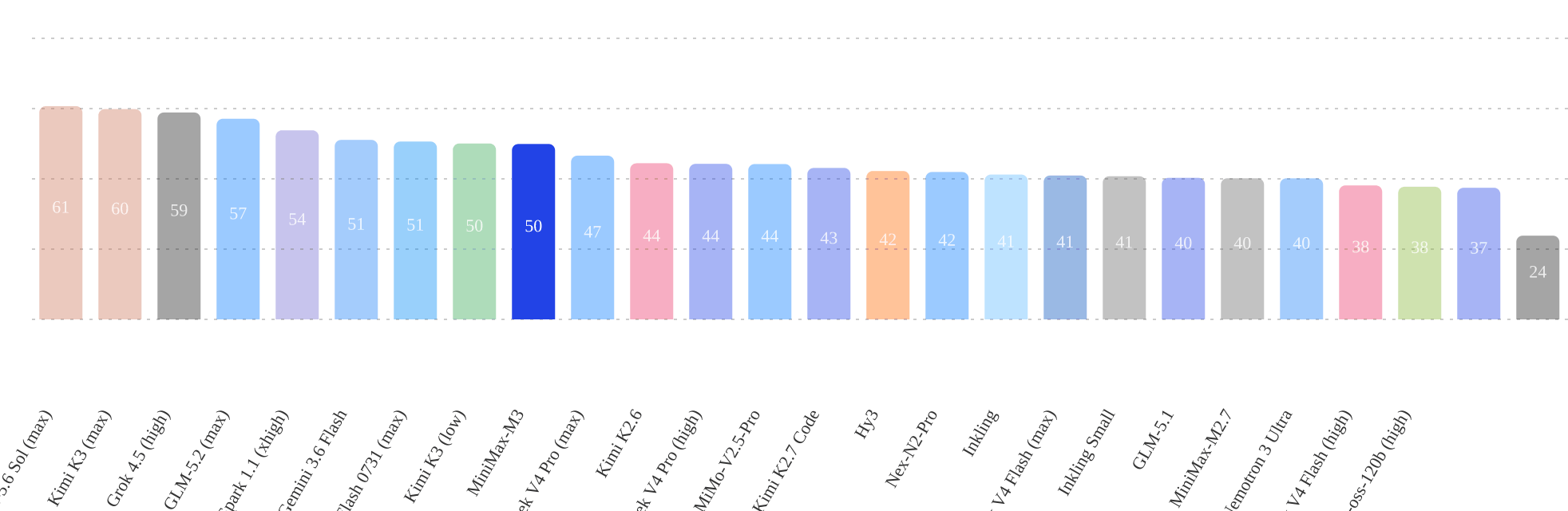 Figure: Artificial Analysis Intelligence Index comparison, blue bar highlighting DeepSeek’s new model entering the top tier with 50 points. Source: artificialanalysis.ai
This is not a minor incremental release. The previous Flash release from April scored 40 points; this update delivers a 10-point leap. On a 100-point scale where single points separate multiple leaderboard ranks, 10 points is a dramatic jump.
Beyond benchmark scores, two hardware-level specifications stand out. It features a 1-million-token context window—roughly equivalent to 1,500 A4 pages of text—allowing it to ingest entire financial reports or large codebases without losing context. Crucially, its weights are fully open source, available for anyone to download, deploy, and commercialize under the MIT license. A model that is simultaneously cheap, open-weights, and top-performing hits a rare sweet spot.
Why It’s Cheap Yet Capable: Three Secrets Behind the Economics
The first secret lies in the post-training stage. Model development occurs in two phases: pre-training on vast datasets to build foundational knowledge, followed by post-training with curated data to refine reasoning and instruction following. Pre-training dictates what a model knows; post-training determines how effectively it applies that knowledge.
DeepSeek kept the underlying model architecture and parameter count identical to its predecessor, focusing entirely on re-engineering the post-training strategy. By skipping the capital-intensive pre-training phase, they eliminated the largest cost driver. Re-achieving a 10-point gain without touching pre-training provides the structural foundation for its low pricing.
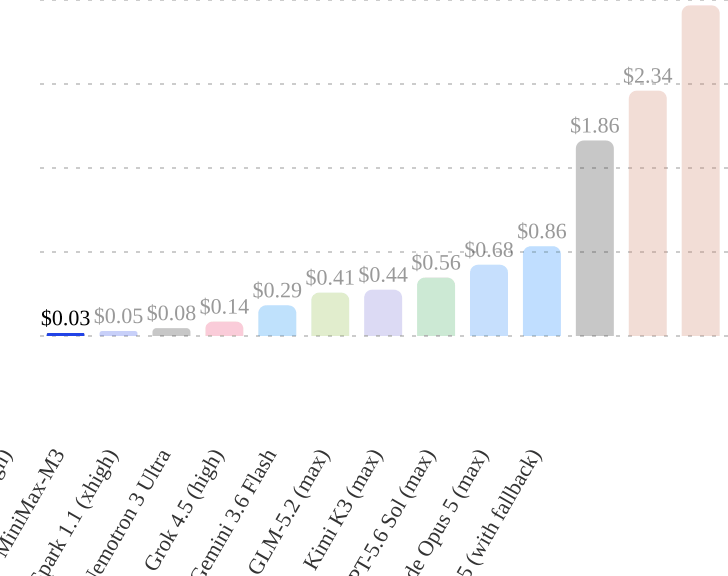 Figure: Average cost per standardized task, showing DeepSeek’s new model at just 3 cents, 100x cheaper than the most expensive alternative. Source: artificialanalysis.ai
The second secret is Sparse Mixture-of-Experts (MoE) inference. Although the model contains 284 billion total parameters, it activates only 13 billion parameters per query. Rather than loading the entire parameter space for every output token, the routing mechanism inspects the prompt and routes computation through only the relevant expert sub-networks.
This architecture offers dual benefits: total capacity remains massive, but active compute during inference is lightweight, drastically lowering energy and hosting costs. DeepSeek has refined MoE architectures over multiple generations, turning compute efficiency into a core competitive moat.
The third secret stems from the open-weights ecosystem. An MIT license allows third-party cloud providers and infrastructure resellers to host the model globally. As deployment volume scales across hosting providers, per-query infrastructure overhead drops.
DeepSeek’s official API pricing is set at $0.14 per million input tokens, dropping to $0.003 when hitting context cache. Achieving this price point relies on simultaneous cost optimization across architecture, training methodology, and open infrastructure.
Silicon Valley’s Chart Meets Real-World Data
The announcement sparked immediate debate on Hacker News, heightened by a serendipitous timing overlap. Just one day earlier, OpenAI had published an official chart claiming to “push the price-performance frontier,” plotting its models along an efficiency curve. Within hours of Artificial Analysis publishing its benchmark results, a developer plotted DeepSeek’s new data point directly onto OpenAI’s official graphic: it landed precisely on the frontier line.
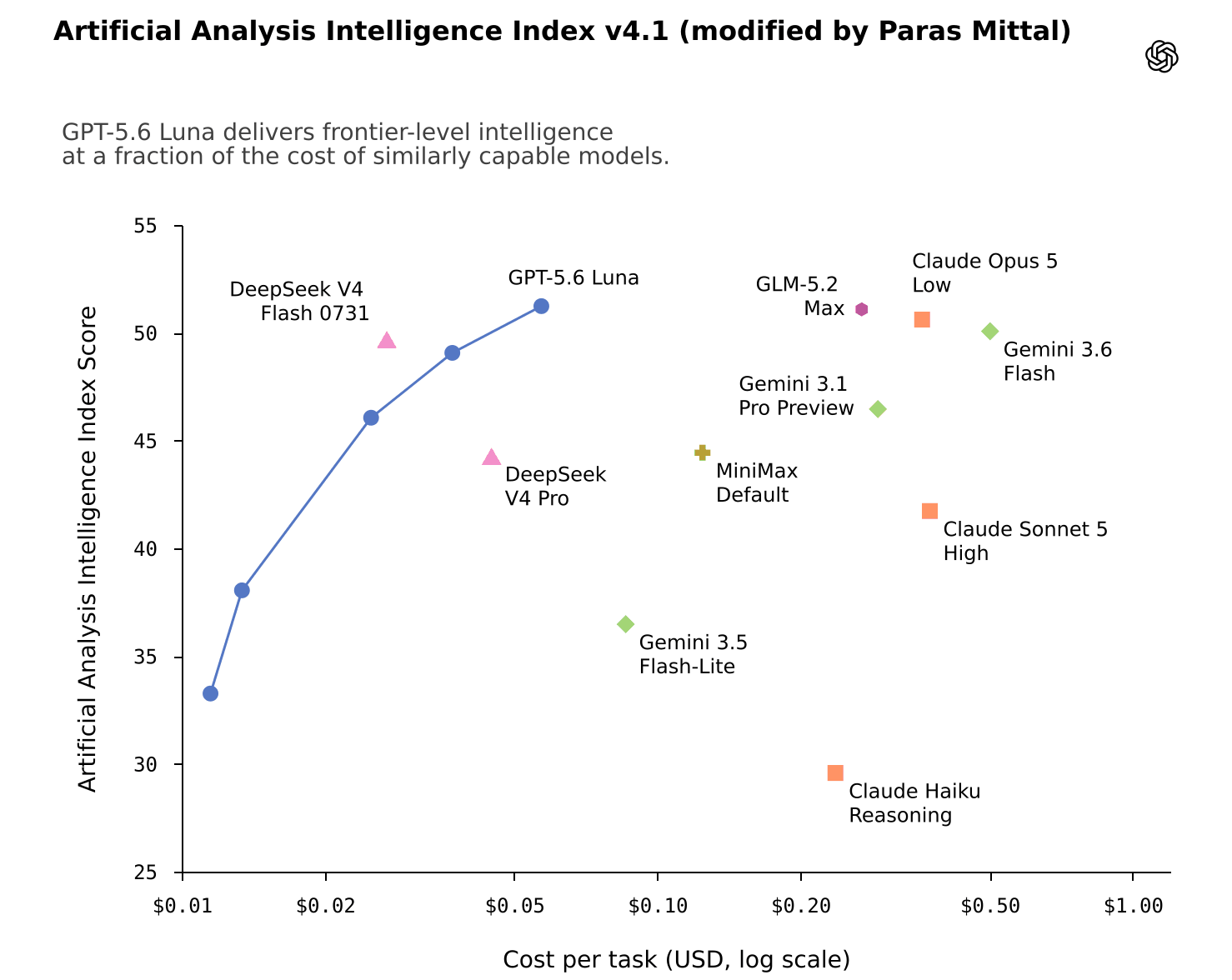 Figure: Community-submitted data point for DeepSeek’s new model plotted onto OpenAI’s official “Price-Performance Frontier” chart. Source: files.parasmittal.com
In AI industry parlance, the “frontier” denotes top-tier capability, a space historically dominated by proprietary US models. For the past two years, flagship frontier pricing remained high. DeepSeek’s initial viral moment in early 2025 proved that near-frontier performance could be delivered at a fraction of the cost.
Eighteen months later, a similar pattern is unfolding. The Hacker News discussion thread gathered over 500 points and nearly 300 comments within hours. For developers, the price delta is stark: running heavy agentic workflows at Silicon Valley rates can quickly accrue substantial API bills, whereas at 3 cents per task, compute constraints largely evaporate.
Unbeatable Pricing, But the Broader Math Is Nuanced
Developers in the discussion shared real-world billing logs: conducting full-day coding sessions via DeepSeek’s direct API cost only a few cents, virtually eliminating “token anxiety.” When per-query costs differ by a factor of 100, monthly development expenses scale down proportionally, enabling far more aggressive testing and iteration.
However, community feedback also highlighted trade-offs. Users noted that accessing the model through third-party resellers like Fireworks or OpenRouter—which offer explicit “zero data retention” guarantees—incurs higher costs and less transparent caching tiers. Privacy-preserving infrastructure requires additional overhead, raising final invoices.
This disparity has prompted debate over API margins and whether base pricing reflects long-term unit economics or strategic positioning. While the low pricing is an empirical reality, discussions surrounding underlying infrastructure margins remain ongoing.
What the Price War Means for Developers and Users
Even for users who do not interact directly with raw APIs, backend infrastructure shifts influence end-user products. Consumer AI assistants, mobile search integrations, and document summarization tools increasingly rely on high-efficiency backend models.
Over the past year, usage quotas across consumer software have shifted from strict daily caps to generous allowances, driven directly by falling backend inference costs. As underlying model costs decrease, application providers can offer larger context windows and higher rate limits to end users.
For developers and product teams, the practical takeaway is to re-evaluate model selection based on task requirements. For standard coding, document analysis, and conversational workflows, a 3-cent task cost model delivers performance surprisingly close to $3 flagship endpoints at a fraction of the budget. With additional model releases anticipated across the industry later this year, compute efficiency continues to re-shape the AI landscape.
Reference Links:
- Artificial Analysis: DeepSeek V4 Flash 0731 Intelligence, Performance & Price Analysis
- HN Discussion: DeepSeek V4 Flash 0731 Benchmark Release (511 points / 282 comments)
- OpenAI Official Blog: Pushing the Price-Performance Frontier (Published July 30)
- OfficeChai: DeepSeek V4 Flash 0731 Delivers Opus 4.8-Class Performance at a Fraction of the Cost