Just a week into August 2026, an AI scorecard took the developer community by storm. DeepSeek V4 Flash, a lightweight open-weights model from China, scored 365 points on the ARC Prize—widely regarded as the industry’s toughest AI reasoning benchmark—taking first place on the efficiency leaderboard. While US flagship models cost around $2.00 per problem, DeepSeek solved them for just 4 cents.
Shortly after the results were published, the submission surged on Hacker News, accumulating 382 points and 233 comments in just five hours. One top-voted comment put it bluntly: “US AI labs are in big trouble.”
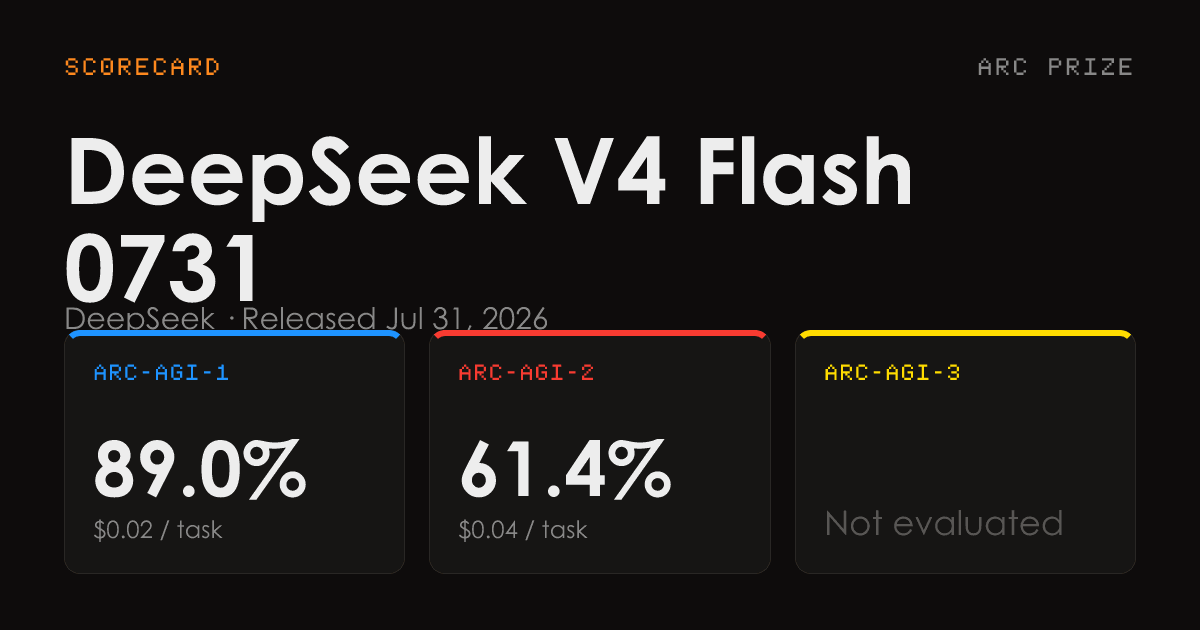 Figure: Verified scorecard published by ARC Prize official for DeepSeek V4 Flash 0731. Source: arcprize.org
What the Test Actually Measures
To understand the significance, we first need to look at what the ARC Prize is and why it is dubbed the “Gaokao of AI.” The test tasks are deceptively simple: visual pattern puzzles using small colored grid boxes. Given three example transformations, the model must infer the underlying rule and construct the fourth pattern. An average adult human can solve them easily, scoring around 85 points.
AI, however, has been stuck on these puzzles for years. In 2024, even the strongest US frontier models barely scored in the 30s or 40s. These puzzles cannot be solved by memorizing a dataset—the underlying patterns vary infinitely, and seeing similar problems in training offers little help. The benchmark creator wagered on a single premise: an AI that merely memorizes answers will fail, while one that passes can genuinely “think.”
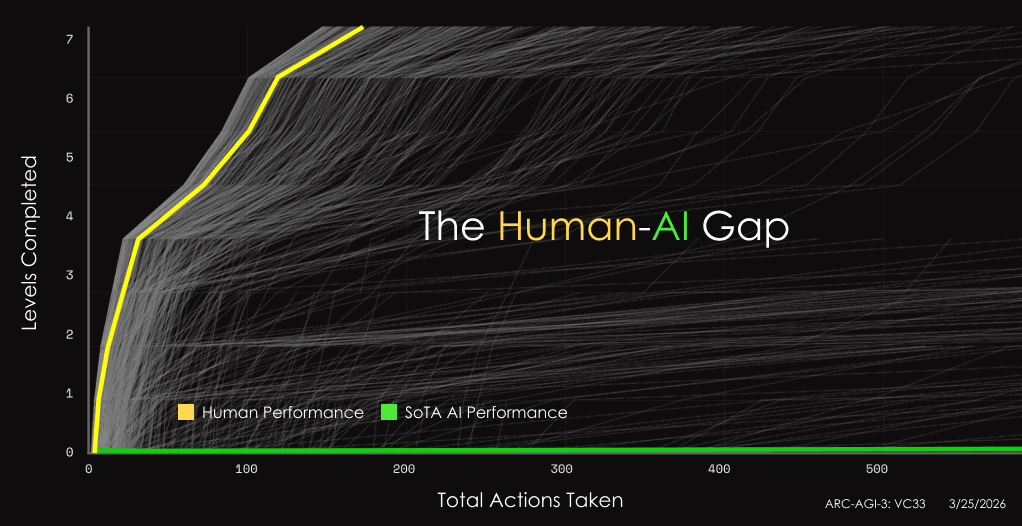 Figure: The score gap between humans and AI as shown on the official ARC Prize website. Source: arcprize.org
DeepSeek took the upgraded benchmark suite, ARC-AGI-2, which is even trickier than the original version. Out of 100 max points, it scored 61.4. While not the absolute highest raw score, when factored alongside cost, the implications are profound.
Two Leaderboards, Two Different Games
The ARC Prize actually maintains two leaderboards: one for raw accuracy and one for efficiency. The official website explicitly notes that true intelligence is not just solving difficult problems, but doing so using minimal compute and resources.
Comparing the two leaderboards reveals a striking contrast. Anthropic’s flagship Claude Opus 5 scores 90.4 on the upgraded suite but costs $2.06 per task. DeepSeek scores 61.4 at just 4 cents per task—a ~50x cost difference. OpenAI’s top-tier GPT-5.6 Luna finds itself in an even more awkward position: 59.6 points (lower than DeepSeek) at more than 4 times the cost.
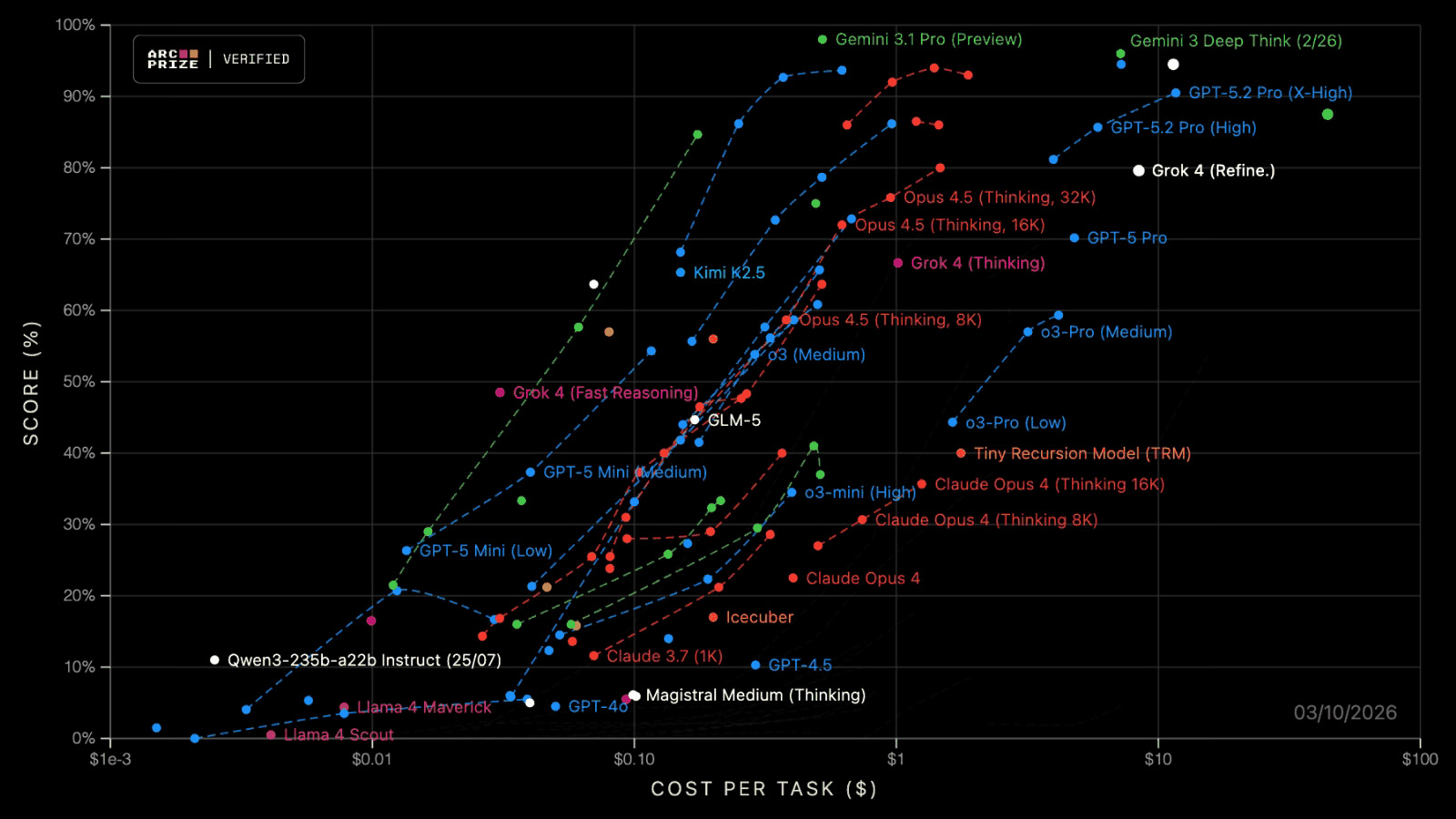 Figure: Scatter plot on the ARC Prize leaderboard. The horizontal axis represents cost per task, while the vertical axis represents score. Upper-left models are the most cost-effective. Source: arcprize.org
This is what “topping the leaderboard at 365 points” means: on the efficiency leaderboard, DeepSeek V4 Flash 0731 left all American rivals behind. For raw score, US flagships still hold the crown; but “most capable” and “most cost-effective” now belong to two separate entities.
While US companies dominate the raw accuracy leaderboard, the shift at the top of the efficiency board sends a much stronger signal to the commercial world. Enterprises pay for AI based on API invocation volume, not benchmark rankings.
The Secret to Low Cost: Thinking Longer During Inference
Where does this low cost come from? First, we must understand a key rule of the benchmark: models are allowed extra compute time to “think longer” before submitting an answer. The model can iteratively reason and draft solutions, a process known as “inference-time compute.” A model doesn’t need to be a massive genius outside the test; spending extra time drafting during test time can yield strong results. But drafting burns electricity—whoever minimizes the cost of drafting wins.
DeepSeek pushed the “small model + intensive reasoning” paradigm to its extreme. V4 Flash has 284 billion total parameters, but activates only 13 billion parameters per token—much like a large army deploying a specialized tactical squad only when needed. Furthermore, with weights fully open-sourced, anyone can download and self-host the model, removing intermediary markups. Official API pricing is $0.14 per million input tokens and $0.28 per million output tokens—one to two orders of magnitude cheaper than US flagships.
The significance of open source extends far beyond cost savings. Companies can run the model on their own infrastructure, ensuring data privacy, uncapped usage, and custom domain fine-tuning. For closed-source US tech giants charging per-request subscriptions, this represents a fundamental disruption to their business model—the price war is just the tip of the iceberg.
Behind “$5 a day” lies a milestone: average developers can afford “top-tier reasoning” for the first time. In the past, this level of reasoning was billed per request and so expensive it was reserved only for mission-critical tasks. Now, it can run 24/7 in the background monitoring everything.
Real-World Experience at $5 a Day
Developers in the community are already taking advantage of this shift. Developer LaurensBER shared on Hacker News that while running 5 to 6 active work sessions with 12-way concurrency, he couldn’t spend $5 a day even when trying. His $200/month Claude subscription is now gathering dust—while Claude remains more capable, the friction of “calculating quota before querying” makes going back unappealing.
What truly excites developers is the new workflows unlocked by low pricing: when automated tests fail, let the AI fix them; when test coverage falls short, automatically generate test cases on commit; server logs, security audits, and every exception now warrant investigation. Tasks that were once “worth doing but too expensive for AI” are now standard routines.
No single scenario seems revolutionary on its own, but multiplied across every developer, team, and day, it bends the cost curve permanently. When intelligence becomes cheap enough to waste, affordability itself becomes a core capability.
Big Trouble for US AI Labs
This is the root of Silicon Valley’s anxiety. One of the top comments on Hacker News read: “US AI labs are in big trouble.” Unless blocked by national security executive orders, no international customer will continue paying a premium for proprietary frontier models when open-weights alternatives deliver the same work for pennies while offering self-hosting and custom tuning.
Others calculated a pragmatic budget breakdown: tasks like log monitoring, auditing, and data quality verification are prohibitively expensive on flagship models, but perfectly suited for low-cost models. The demand was always there; people simply couldn’t afford it until now.
Of course, arguments for the indispensability of mega-models remain valid. Another commenter pointed out that while simpler tasks can be handled by low-cost models, the real benchmark comes with complex multi-step tasks running over 24 hours where error accumulation degrades smaller models. The future likely belongs to a hybrid architecture: “large models as commanders, cheap models as foot soldiers.”
Judging by current trends, the competition is shifting from “who is strongest” to “who is most cost-effective.” Much like mobile phones evolving from luxury items to everyday commodities, raw performance is no longer the scarcest resource.
The above analysis is based on official ARC Prize documentation and public community discussions. The author was not involved in the development of these projects; perspectives are subject to interpretation and feedback is welcome.
Reference Links
- ARC Prize: DeepSeek V4 Flash 0731 Results Page
- ARC Prize: Leaderboard Page
- HN Discussion (item?id=49214008)
- DeepSeek Official API Documentation
- Artificial Analysis: DeepSeek V4 Flash Pricing & Benchmark
- vLLM Recipes: DeepSeek V4 Flash Model Description