All life on Earth stems from a single common ancestor—a statement printed in every biology textbook and embedded as a foundational memory of life’s history. But a new study published in Science Advances on August 5 fires a shot across the bow of this long-standing consensus: the transition from non-living matter to life may have occurred twice on Earth. Proposing this radical idea is a research team led by William Martin at Heinrich Heine University Düsseldorf in Germany.
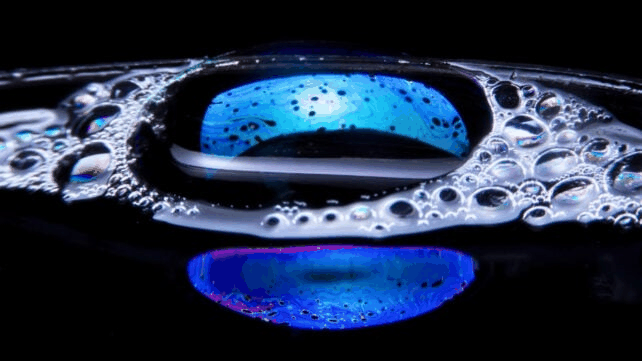
Image: Conceptual artwork of two glowing bubbles against a dark background. Credit: sciencealert.com
“The first lesson in biology textbooks might need to be split into two lessons.” Two months ago, such a claim would have been dismissed as fringe science. Today, it appears in a peer-reviewed paper complete with a chain of evidence and a novel algorithm. A lively debate has erupted on Hacker News, accumulating over 70 comments as evolutionary biology enthusiasts split into two camps. To understand the row, one must first look at what the textbook originally taught.
Why Textbooks Claimed There Was Only One Ancestor
Biology textbooks assert a single origin for all life based on compelling, seemingly ironclad evidence. Every living organism on Earth—from E. coli and mushrooms to housecats and human beings—shares the exact same genetic code: three letters on a DNA strand translate to a specific amino acid. This translation table is universal across the planet with virtually zero margin for error. Furthermore, all living things share the same core machinery: ribosomes, ATP, and basic metabolic pathways.
This body of evidence is as unique as a fingerprint. Two independent inventors could not write manuals in the exact same language with identical punctuation. Consequently, mainstream evolutionary biology concluded that 3.8 to 4.0 billion years ago, there existed a Last Universal Common Ancestor (LUCA), from which all extant life descended. The tree of life had a single trunk, and textbook history was written accordingly.
The New Study Targets the Metabolic Puzzle
The paper zeroes in on the oldest chicken-and-egg dilemma in origin-of-life research: metabolism requires enzymes, yet enzymes are themselves products of metabolism. Where did the very first enzyme come from?
The widely accepted answer is that early Earth environments performed the work of enzymes. Near hydrothermal vents on the ocean floor, naturally occurring metals such as nickel, iron, and palladium catalyzed chemical reactions, turning simple molecules like hydrogen, carbon dioxide, ammonia, and hydrogen sulfide into amino acids and nucleotides. The study quantifies this pathway: transitioning from these raw materials to life-essential molecules requires a network of roughly 400 reactions. A 400-step assembly line cannot be built overnight; it must be climbed step by step.
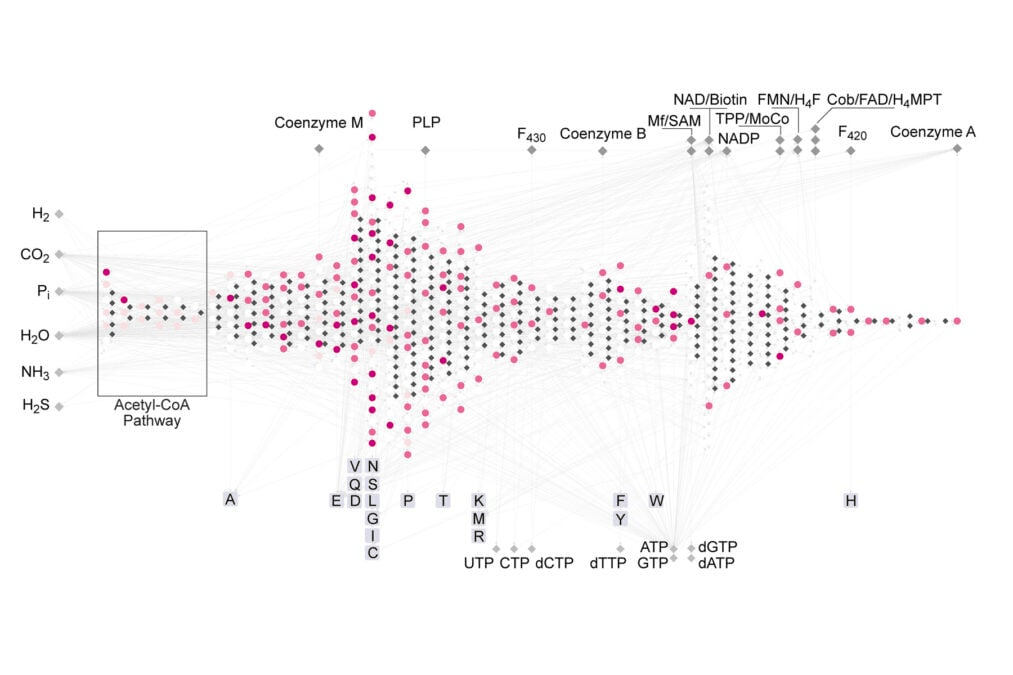
Image: Early metabolic network of approximately 400 reactions reconstructed in the study. Credit: sciencealert.com (paper figure)
The researchers charted a timeline for enzyme evolution by comparing the three-dimensional structures of core metabolic enzymes across bacterial and archaeal genomes. Using a novel algorithm, they ordered these enzymes by structural complexity to infer the sequence of their emergence. The results were intriguing: LUCA’s enzymes covered only about half of the necessary metabolic reactions, while the remaining half relied on catalysis by environmental metals. In other words, our common ancestor “outsourced” half of its metabolic chemistry to the environment.
Two Lineages, Crossing the Finish Line Independently
Following this evolutionary timeline, the team divided the evolution of catalytic capability into four distinct stages:
- Stage 1: Total reliance on environmental metals.
- Stage 2: Protocells produced the first rudimentary enzymes to assist metal catalysts.
- Stage 3: Enzyme diversity expanded, steadily reducing dependence on environmental metals.
- Stage 4: Cells completely shed reliance on the geochemical environment, becoming self-sufficient, “free-living cells.”
The crucial discovery lies just before Stage 4. The divergence between Bacteria and Archaea occurred before either lineage fully graduated into self-sufficiency. That is, both branches independently walked the final stretch of the journey from metal-dependent protocells to autonomous life. The evidence: enzymes catalyzing identical metabolic reactions in the two lineages possess entirely different 3D structures. The researchers describe this as “parallel invention”—two factories operating without shared blueprints independently built machines that perform the exact same function.
An additional experiment provided a key piece of the puzzle. While all modern life uses ATP as energy currency, synthesizing ATP itself requires complex enzymes that did not exist during life’s inception. The team demonstrated that naturally occurring phosphite combined with trace palladium in hydrothermal vent conditions can phosphorylate molecules in water overnight without ATP or enzymes. Relying initially on environmental shortcuts solved the energy hurdle, allowing enzymes to evolve gradually—making early evolutionary steps far more plausible.
Two Origins or One Early Divergence?
William Martin summarized the core takeaway: “There is one origin of the genetic code, but two origins of life.” The confidence behind this statement stems from his definition of being “alive”: only autonomous, free-living cells qualify as truly alive, and bacteria and archaea reached that status independently.
Dissenting voices were equally vocal. Critics argue that under this strict definition, protocells attached to mineral surfaces and requiring geochemical energy would be classified as “non-living,” despite undergoing self-replication and Darwinian evolution. One sharp commenter drew an analogy: humans cannot synthesize Vitamin C and must obtain it from the environment; by the same logic, are humans not truly alive? Others pointed out that because both lineages share identical DNA, RNA, and protein machinery, the scenario resembles two branches sprouting from a single tree rather than two separate origins, rendering the phrase “two origins” misleading.
Proponents counter that this new framework resolves a long-standing anomaly: why bacterial and archaeal cell membranes possess completely different chemical compositions. If they had shared a fully formed free-living ancestor, their cell membranes should not be so radically distinct. Ultimately, the debate hinges on how one chooses to define “life”—a question that lab experiments cannot resolve with a simple stroke of a pen.
If Life Can Start Twice Here, What About the Universe?
The aspect of the study that most excites the public lies in its astrobiological implications: if the transition from non-living matter to life occurred twice on the same planet under similar geochemical conditions, the hurdle for life’s emergence might be significantly lower than previously assumed. In astrobiology, this suggests that the factor in the Drake Equation representing the fraction of suitable planets that actually develop life should be adjusted upward. Consequently, the odds of finding life on Mars, Europa, or Titan look far more promising.
Skeptics quickly pointed to the Fermi Paradox: if life originates so easily, why hasn’t a third or fourth independent form of life emerged on Earth today? Discussions offered a vivid explanation: any newly forming protocell on a modern geochemical surface would be consumed almost instantly by existing microorganisms. Furthermore, following the Great Oxidation Event 2.5 billion years ago, Earth’s atmosphere became rich in oxygen, effectively eradicating the reducing environments that nurtured early life. Higher barriers do not mean the door is closed forever, but modern Earth is certainly no longer the gentle cradle it once was.
Is It Time to Rewrite Biology 101?
Stepping back, even if this study’s conclusions are fully accepted, the foundation of a single origin remains solid: the genetic code has one source, the ribosome has one source, and the two lineages later engaged in horizontal gene transfer. Much later, an ancient archaeon endosymbiotically engulfed a bacterium—which evolved into the mitochondrion—paving the way for eukaryotic life, including humans.
What actually changes is the classic textbook diagram of the tree of life: near its base, there may be two independent trunks that split while still in a primitive state, growing separately into modern Bacteria and Archaea before expanding into today’s vast biological forest.
We may never directly observe what transpired in the chemical primordial soup four billion years ago. This research offers a script far more detailed—and contentious—than the simple single-origin narrative. What is clear is that it quietly raises the stakes on the question of whether life is common in the cosmos. The next time humanity discovers even a single living bacterium beneath the Martian regolith, this debate will find its ultimate judge.
Reference Links:
- ScienceAlert: Radical Study Suggests Life on Earth Arose From Non-Living Matter Twice
- Original Paper: Intermediate Stages in the Origin of Metabolism at a Phosphorylating Hydrothermal Vent (Science Advances, August 5, 2026)
- Heinrich Heine University Düsseldorf Press Release: Two Origins of Life
- Phys.org: Two origins of life: Free-living cells may have emerged twice
- Hacker News Discussion (item?id=49209572)