Strolling along a beach and picking up a seashell, you would rarely stop to ponder whether its spiral coils to the left or to the right. Throughout the natural world, a species’ chiral preference is virtually set in stone. Snails and mollusks do not collectively decide to reverse their orientation overnight. In the microscopic marine realm, however, the story is far more volatile.
Drifting across the global ocean are billions of planktonic foraminifera (forams)—single-celled protists that construct perforated, calcium carbonate shells, usually measuring less than a millimeter across. When these organisms perish, their protective tests rain down upon the seafloor, accumulating layer upon layer into a natural geological archive spanning 560 million years.
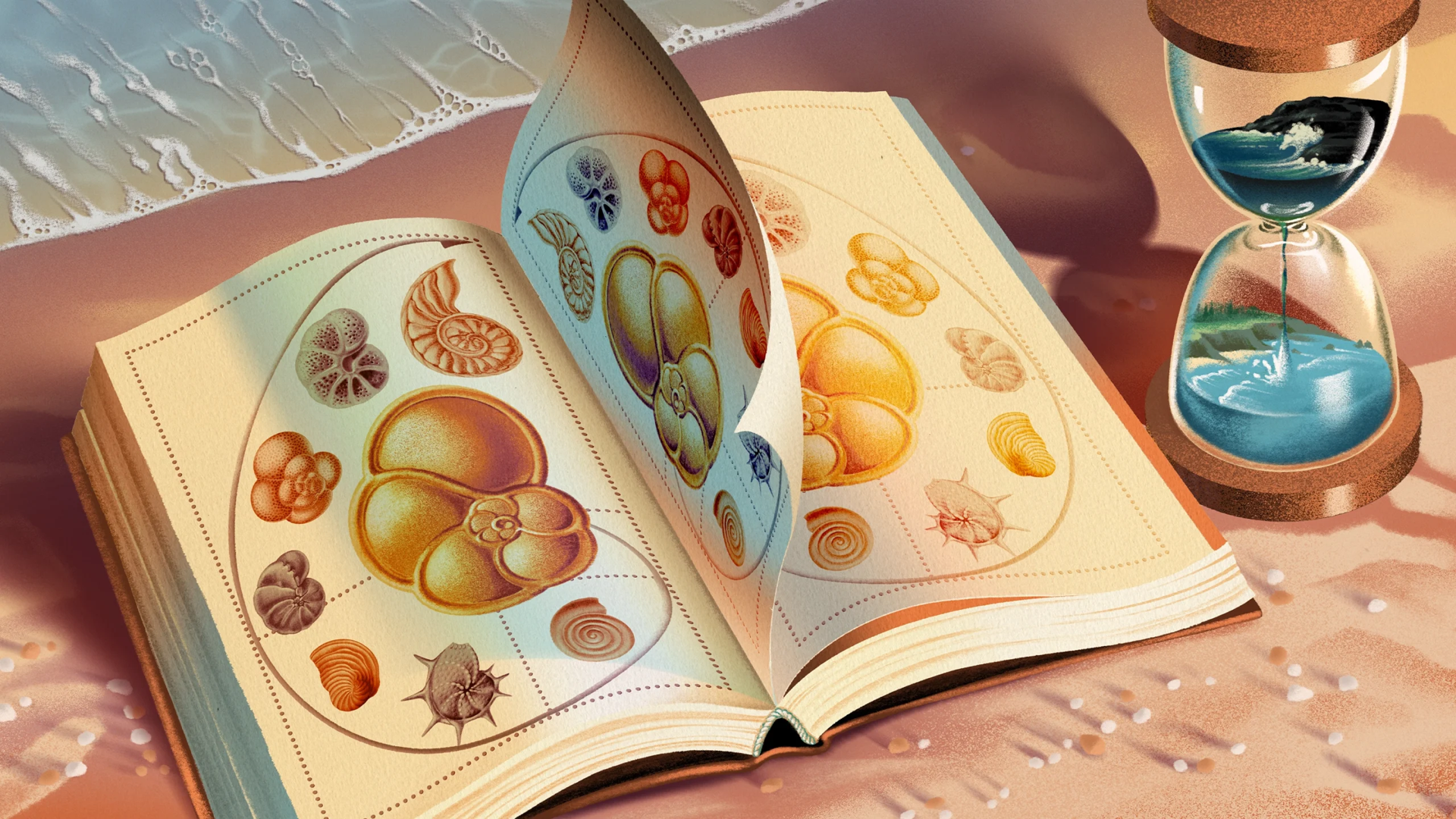 Figure: Coiled shells and the chirality flip. Credit: Quanta Magazine
A Temperature Hypothesis That Misled Science for Half a Century
In the early 1950s, Swiss micropaleontologist Hans Bolli began examining these deep-sea sediment cores. He discovered that certain foram species exhibited an overwhelming directional preference: in some populations, up to 97% of individuals coiled their shells exclusively in one direction. Even more bizarre was the fact that this preference was not permanent across geological time. Every few thousand years, the coiling orientation across the entire globe flipped in lockstep.
Scientists initially believed they had stumbled upon an ancient paleothermometer. In 1959, marine geologist David Ericson proposed a compelling hypothesis: ocean temperatures dictated chirality. In cold glacial climates, shells spiraled to the left; during warmer interglacial periods, they coiled to the right. The explanation was so elegant and intuitive that for the next half-century, paleoclimatologists routinely used foram coiling ratios to reconstruct Earth’s past climate swings.
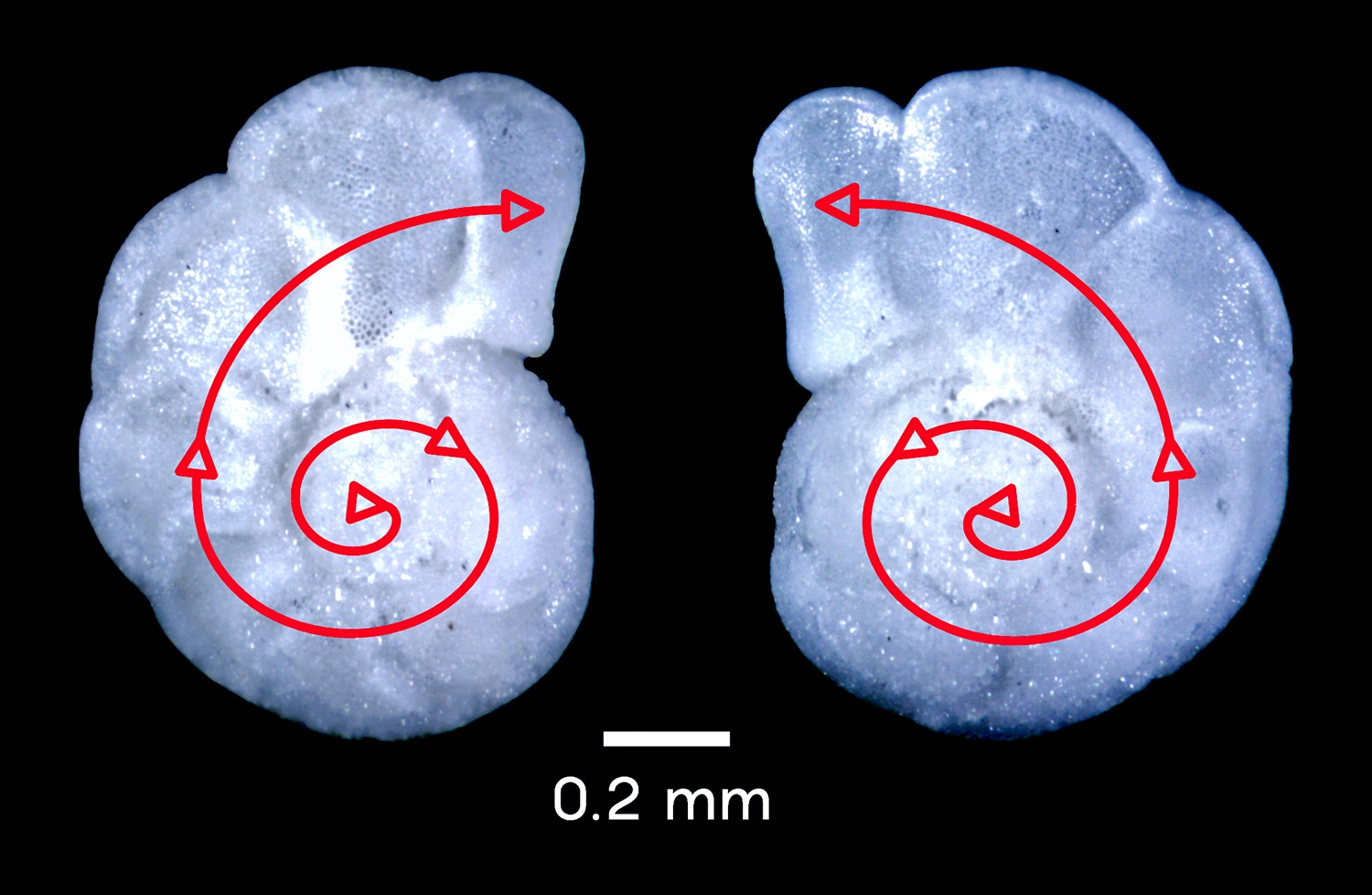 Figure: Coiled shells illustrating left-handed (sinistral) and right-handed (dextral) chirality. Credit: Quanta Magazine
Gene Sequencing Cracks the Thermal Rule
The rule built on macroscopic morphology was eventually dismantled at the molecular level. In 2006, geneticist Kate Darling demonstrated that the left-coiling and right-coiling variants of Neogloboquadrina pachyderma were not mere climate morphs, but two entirely distinct species masquerading under a single physical guise. In 2013, evolutionary paleobiologist Yurika Ujiié drove the final nail into the coffin.
Analyzing samples across multiple ocean basins, Ujiié confirmed that shell chirality failed to correlate with water temperatures. The temperature hypothesis had officially collapsed.
Fossil Records Reveal Abrupt Evolutionary Sweeps
Recently, a research team led by Bridget Wade at University College London laid out 56 million years of fossil records from across the world’s oceans. They observed that 15 million years ago, Paragloborotalia siakensis abruptly transitioned from a mixed-coiling population to an exclusively left-coiling one. The shifts occurred across ocean basins and latitude belts with astonishing synchronization.
Traditional theories of gradual evolutionary adaptation could not explain such rapid, worldwide uniformity.
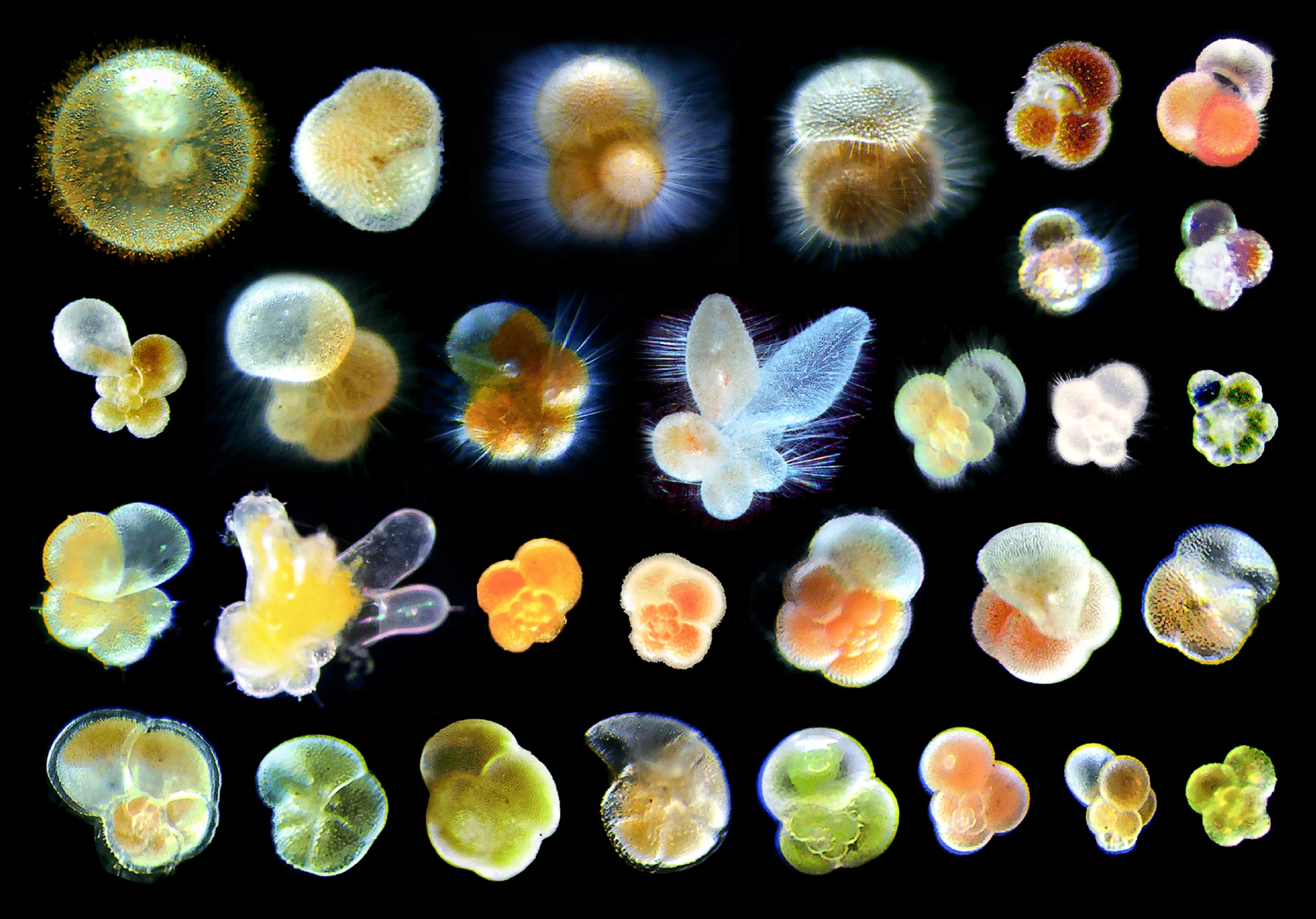 Figure: Thirty living foraminifera species in a grid, all under 1 millimeter across. Credit: Quanta Magazine
How Cryptic Species Conquered the World’s Oceans
If climate was not forcing this synchronized shift, the answer had to be written into the genome. A groundbreaking explanation emerged: these worldwide chirality flips represent the unmistakable tire tracks of “cryptic species”—lineages that are genetically distinct despite appearing morphologically identical—sweeping across the planet.
Consider the dynamics of pandemic viral variants. When a distinct subpopulation possessing a decisive survival advantage emerges in a localized sea, it rides global ocean currents like a dominant lineage, sweeping across every major basin. In doing so, it spreads its uniform coiling direction worldwide, rapidly displacing preexisting incumbent populations.
On a geological timescale, this turnover happens in the blink of an eye. The global thermohaline circulation takes roughly 1,000 years to overturn Earth’s seawater once. A dominant lineage establishing global supremacy over a thousand years appears instantaneous within the rock strata.
The synchronized flipping of foram shell spirals provides an unprecedented bookmark in the fossil record. For the very first time, it allows scientists to witness how an evolutionary sweep driven by cryptic species carrying advantageous traits can conquer an entire planet in a geological heartbeat.
Reference Links:
- Quanta Magazine Report
- PNAS Paper


