From Sell-Side to Buy-Side: Cloudflare Completes the Agent Economy Loop
On August 4, 2026, during its inaugural “Agents Week,” Cloudflare officially introduced Cloudflare Wallets and cloudflare.pay. Speaking at the launch event, CEO Matthew Prince emphasized that the web is undergoing a structural shift from human-driven browsing to agent-driven commerce. When autonomous agents request services online, service providers need a reliable way to verify who is behind the request.
Current AI agents face severe friction whenever they attempt to interact with new APIs. Registration forms are engineered exclusively for human users; agents lack persistent identities as well as native payment tools. As a result, agents are frequently forced to hand verification and payment steps back to human operators, or simply abandon the task altogether.
Just one month earlier in July 2026, Cloudflare launched the Monetization Gateway, leveraging the HTTP 402 status code to solve the sell-side equation—enabling API providers to monetize requests from AI agents. The release of Wallets and Handle targets the buy-side directly, giving agents dedicated budgets and human-readable identities to execute web transactions autonomously.
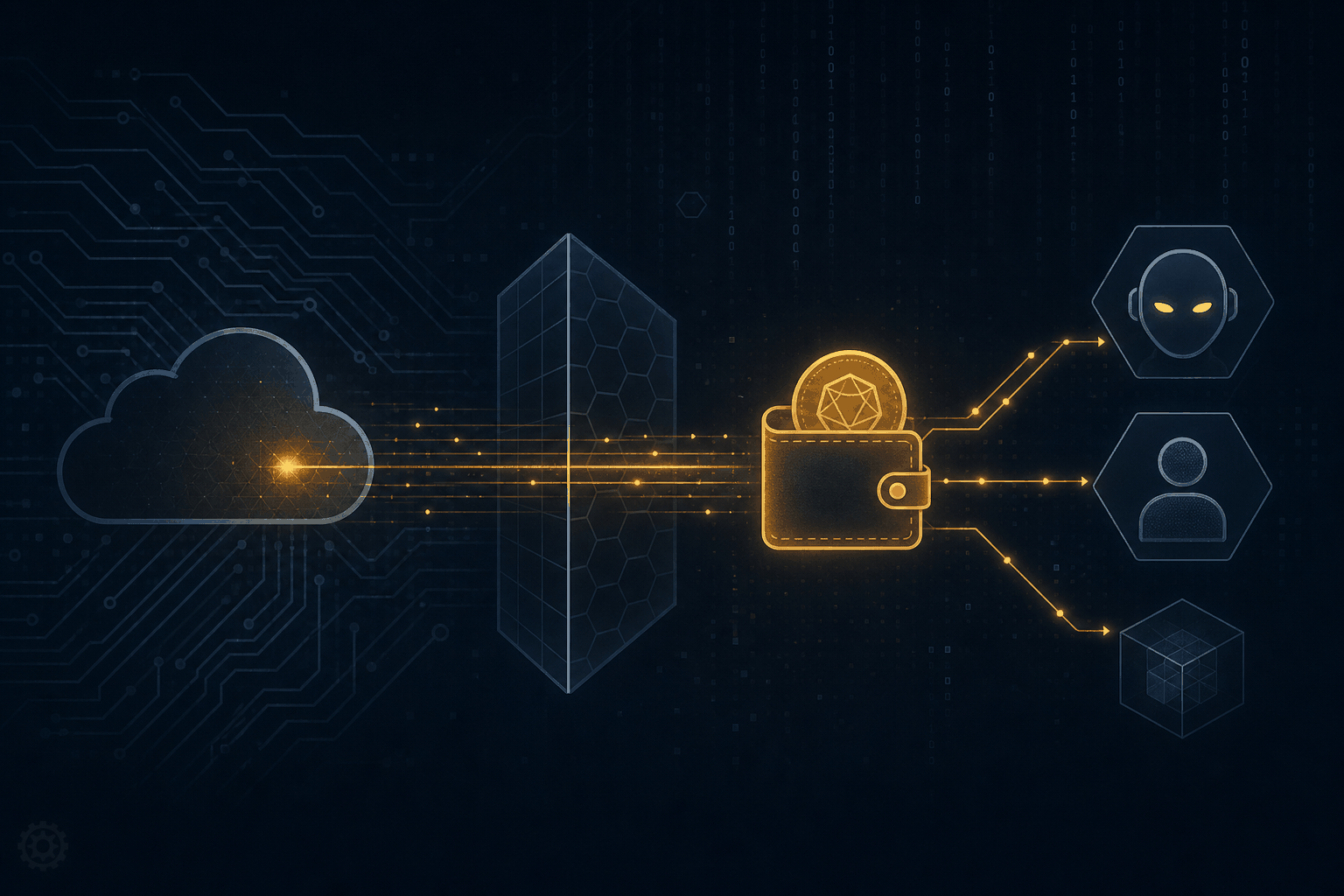
 Figure: Official release visual for Cloudflare Wallets and cloudflare.pay. Source: blog.cloudflare.com/wallets/
By bundling identity issuance and payment settlement into its cloud infrastructure suite, Cloudflare has officially kicked off the race for agent economy infrastructure.
Tiered Wallet Architecture: Isolating Prompt Injection Risks with Hard Limits
Cloudflare Wallets adopts a dual-layer architectural design composed of a master Account Wallet managed by a human administrator and lightweight Virtual Wallets provisioned for individual AI agents. The Account Wallet manages central funding and high-level financial strategy, while Virtual Wallets supply API keys for day-to-day transactional requests.
Human operators can configure three strict rules on every Virtual Wallet: a weekly spending allowance, a merchant allowlist, and a maximum single transaction size. Whenever an agent encounters an expenditure that breaches these limits, it triggers an exception flow, requesting manual approval from the human supervisor.
Far from restricting agent capability, these hard limits actually expand their scope of autonomous operation. As Cloudflare noted in its technical blog post, if an agent is granted a $10 spending threshold, managers can delegate tasks with confidence without fearing thousands of dollars in unexpected bills. Even if an agent falls victim to a prompt injection attack, the attacker can only exhaust the limited balance allocated to that specific agent.
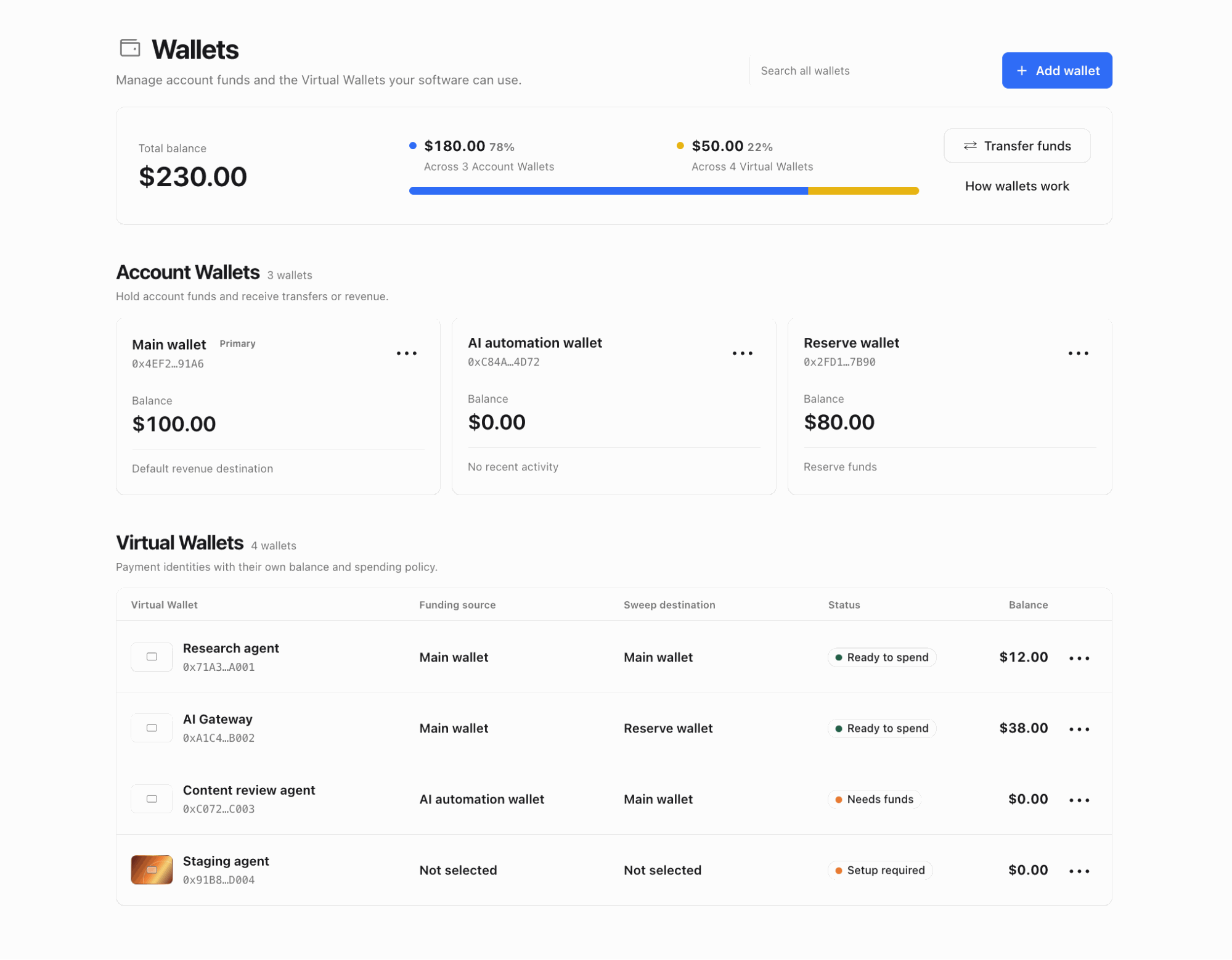 Figure: Tiered authorization architecture of Account Wallet and Virtual Wallet. Source: blog.cloudflare.com/wallets/
In enterprise engineering workflows, organizations can maintain a central Account Wallet pool while issuing dedicated Virtual Wallets to each employee’s AI agent with a weekly inference budget of $100. If automated monitoring flags an anomalous spike in transaction frequency, administrators can instantly step in to adjust rules, ensuring automated spending remains fully controlled.
cloudflare.pay: Issuing Digital IDs for AI Agents
Beyond financial transactions, persistent identity verification stands as another major bottleneck in agent commercialization. Without reliable identity validation, service providers cannot prevent abusive users from spinning up dozens of agents to siphon off free-tier usage, prompting many API platforms to block AI agents outright.
cloudflare.pay solves this by assigning each agent a human-readable Handle (for example, research.example.cloudflare.pay). Bound to the owner’s primary Cloudflare account, the Handle maps complex cryptographic keypairs to intuitive domain identifiers, operating similarly to how DNS maps IP addresses to domain URLs.
This identity layer integrates seamlessly into Cloudflare’s existing security ecosystem. Through deep integration with Web Bot Auth, Turnstile, and Bot Management, unidentified agents are no longer subject to blanket IP blocks. Instead, they are prompted to provide self-verifying credentials. The existence of a persistent identity allows API providers to safely offer free trials and targeted marketing incentives to autonomous agents.
For low-level payment clearing, Cloudflare selected the x402 protocol alongside stablecoins as core infrastructure. Spearheaded by the Linux Foundation’s x402 Foundation, financial and technology leaders including Visa, Mastercard, Amex, Stripe, and Circle have joined the alliance to establish a unified micro-payment network for AI agents.
Squatting Chaos: Lack of Domain Verification Triggers Identity Crisis
Despite the compelling product vision, the initial roll-out triggered heated debate within the developer community. According to third-party analysis from Wavect, the August 4 launch only opened name reservations for cloudflare.pay, while Account Wallet deposits, Virtual Wallet authorization, and the Monetization Gateway remain on waitlists or in active development.
The Hacker News community voiced sharp criticism regarding the reservation mechanism. Developer merek pointed out that domain squatters had already registered his company’s official name along with numerous related variations. Because cloudflare.pay omitted DNS domain ownership verification during the initial reservation phase, it immediately created substantial risks of brand impersonation and fraud.
Developers also raised concerns regarding Cloudflare’s platform strategy. Some community members argued that Cloudflare is attempting to position itself at every middle layer of web interaction to extract platform rents, while noting that Handle allocations lacked the advance notice and fair competition mechanisms historically deployed by tech giants like Meta.
Privacy and tracking were also central points of contention. If an agent presents a uniform cloudflare.pay identity across every visited site, third-party services can perform cross-site tracking without relying on HTTP cookies. Furthermore, real-world merchant adoption of stablecoins will ultimately determine whether this payment network can achieve broad commercial adoption.
From Traffic Control to the Settlement Layer of the Agent Economy
Examining Cloudflare’s product roadmap over the past year shows that Wallets is part of a deliberate long-term strategy. From launching Pay Per Crawl in July 2025 to co-founding the x402 Foundation with Coinbase, and introducing Temporary Accounts for instant Workers deployment without registration, Cloudflare has systematically laid down key building blocks.
Data from Cloudflare Radar reveals that by June 2026, automated bot traffic accounted for 57% of all HTML page requests. While this figure includes traditional search crawlers and monitoring scripts, the trend towards automated agents controlling web traffic has become irreversible.
With control over nearly half of global CDN traffic and bot mitigation gates, Cloudflare is extending its governance from network traffic to commercial transactions. The launch of buy-side wallets and identity frameworks signals an ambition to transform internet infrastructure into the clearing house of the agent economy. As features roll out over the coming months, whether this architecture successfully unlocks agent-driven commerce will depend heavily on the pace of security guardrails and ecosystem compliance.
References:
- Cloudflare Blog: Announcing Cloudflare Wallets
- Cloudflare Press Release: Cloudflare Gives AI Agents an Identity and a Wallet
- Wavect Analysis: Cloudflare Wallets for AI Agents
- Hacker News Discussion: Cloudflare Wallets (story 49175461)