A developer managed to cram Moonshot AI’s open-weights flagship model, Kimi K3, into just 29GB of RAM—roughly the memory capacity of a standard consumer PC. While it ran, asking it “What is the capital of Italy?” required 31 seconds of contemplation before producing a 16-word answer.
 Image: Kimi K3, Moonshot AI’s flagship model open-sourced in late July. Source: github.com/MoonshotAI
This achievement made rounds across developer communities over the past few days. Gathering over 130 upvotes and 50 comments on Hacker News, responses ranged from awe to healthy skepticism. Here is a breakdown of the technical facts and debate for non-coder enthusiasts.
Why Big Models Eat So Much Memory
To understand the feat, we first need to clarify how massive Kimi K3 actually is.
Kimi K3 is the latest flagship model released by Moonshot AI in late July 2026, featuring a staggering 2.78 trillion parameters.
Parameters can be thought of as numbers stored inside the model’s neural network. The intelligence of an AI relies on performing mathematical operations over these vast arrays of numbers—generally, the more parameters, the smarter the model, but also the larger its footprint. At native precision, K3 spans 1.42TB in its official release version, which cannot even fit onto a standard 1TB SSD.
When executing inference, a model must load these parameters into RAM (the computer’s working memory) for processing. Squeezing 1.42TB of data into a 29GB memory pool presents a nearly 50x capacity deficit.
Normally, models of this scale exist strictly in cloud data centers equipped with thousands of specialized servers, multi-GPU clusters, and terabytes of system memory. When you send a prompt via an App, computation occurs on server racks before streaming back the response.
Why Bother Running Flagship Models Locally?
If cloud services are fast, convenient, and reliable, why are engineers going to extreme lengths to run them locally? The motivations are quite practical.
First is privacy. Every prompt sent to cloud APIs leaves your machine and travels to third-party servers. While casual chat history may seem benign, enterprise contracts, confidential codebases, patient records, and financial statements are strictly prohibited from leaving internal perimeters by many organizations. Keeping data on-device remains the strongest driver for local AI.
Second is cost. Cloud providers charge per token. While cheap for light usage, batch processing or heavy agentic workflows quickly accumulate substantial API bills. Local inference requires a one-time hardware investment—once you own the drive and pay for electricity, inference is free.
Third is offline autonomy. Local LLMs run without internet connectivity and remain immune to service outages, API price hikes, or policy changes by cloud vendors.
Finally, there is pure developer curiosity. A dedicated “local inference” community thrives on pushing hardware limits—making seemingly impossible models execute on consumer-grade hardware. This open-source project, named WASTE, published its entire implementation and experimental logs on GitHub.
How Kimi K3 Fits into 29GB RAM
The first key technique is quantization—reducing the numerical precision of model weights.
Originally, model parameters are stored as high-precision floating-point numbers. Quantization truncates fractional precision, storing weights in 4-bit or 3-bit representations. K3’s official release was already compressed to 4-bit (1.42TB), and WASTE further quantized its Mixture-of-Experts (MoE) weights down to 3-bit, reducing the raw weight file to 982GB.
However, compression alone is insufficient to bridge 982GB to 29GB. The real trick lies in memory offloading.
Kimi K3 utilizes a Mixture of Experts (MoE) architecture comprising 896 expert sub-networks. Crucially, generating each single token only activates 16 experts, leaving the remaining 880 idle. Think of it like a giant hospital where a multi-disciplinary consultation only summons a dozen doctors while others remain on standby.
WASTE pins the frequently accessed backbone parameters (27GB) permanently in RAM, while keeping the 880 idle experts stored on the SSD, dynamically streaming parameters into memory on demand.
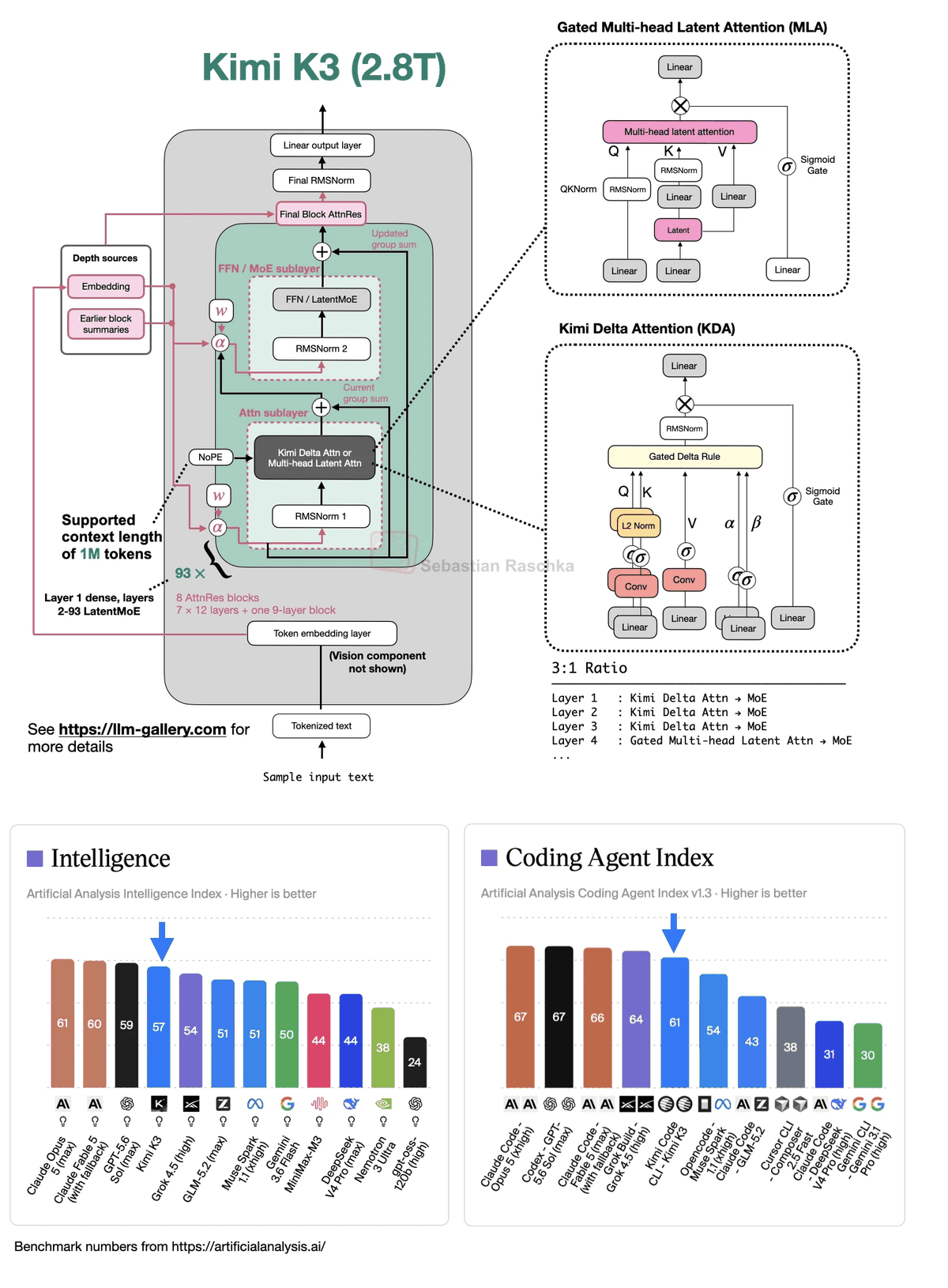 Image: K3 architecture overview—Mixture of Experts with new attention mechanisms, totaling 2.8T parameters. Source: sebastianraschka.com
The major trade-off is speed. For every generated token, the system must stream 17GB of expert data from the SSD. High-speed internal PCIe NVMe drives (reaching 12.78 GB/s) can barely keep up; using an external USB drive (0.94 GB/s) stretches generation latency to 13 seconds per word.
Setting up this pipeline is also non-trivial. Converting the 1.42TB FP4 release weights into the 982GB format requires nearly 5 hours of preprocessing, alongside specialized high-throughput NVMe storage.
Thus, “29GB RAM” represents the host system memory footprint, not the total model size. The 29GB memory pool does not hold the entire model—it only houses the active backbone. While a 32GB machine can launch the process, 64GB RAM is recommended to avoid OS page swapping, which can degrade speed by another 8x.
The Cost of Heavy Quantization
Quantization is not a free lunch. Reducing numerical precision inevitably impacts output quality. Benchmarks from the Unsloth team show that 2-bit quantization retains roughly 90% alignment with original output quality, while 1-bit quantization drops alignment to around 80%.
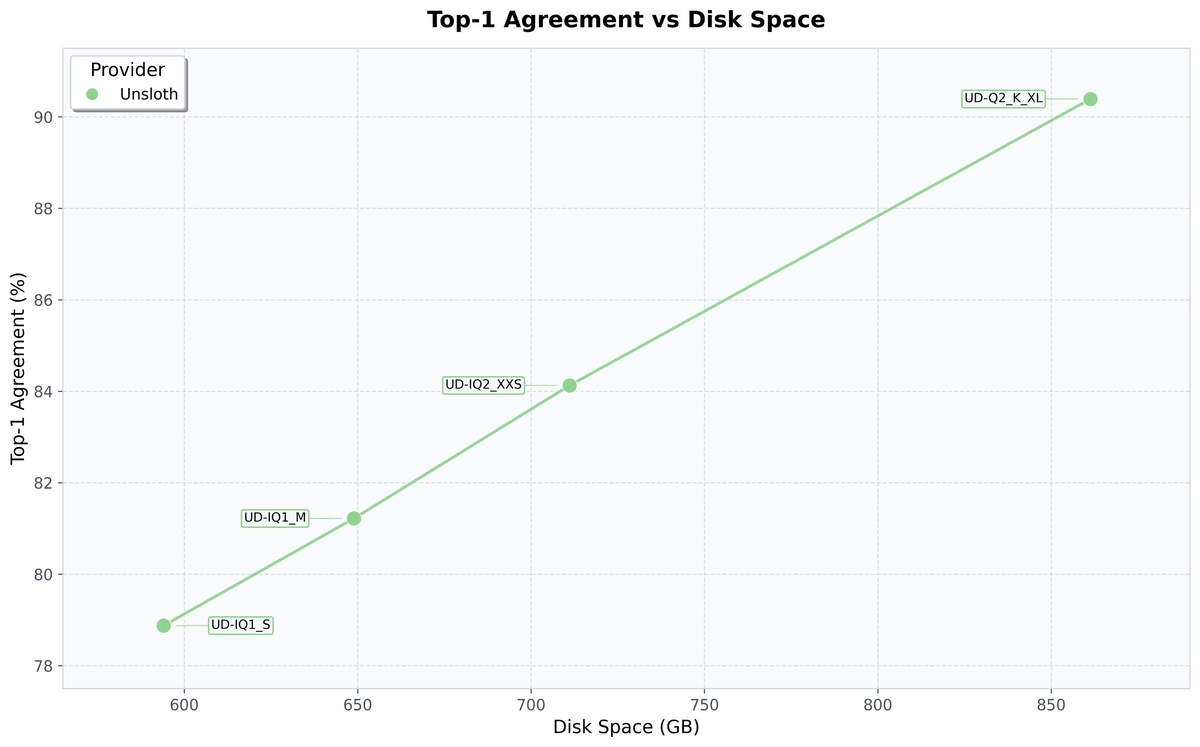 Image: As quantization compresses model footprint smaller, output divergence relative to native precision increases. Source: unsloth.ai
Furthermore, quantization quality depends heavily on execution technique. Two different 1-bit quantization implementations of the exact same model can yield up to a 20x variance in downstream perplexity and reasoning quality. Quantization is an intricate engineering craft, not a simple truncation of bits.
0.5 Tokens/Sec: The Divide Between “It Runs” and “It’s Usable”
At 0.5 tokens per second, generating a short 16-token answer takes 31 seconds, while a 128-token response requires 6 minutes. Because K3 is a reasoning-first model that outputs internal chain-of-thought tokens before providing a final response, local latency is further compounded.
The project authors maintain an admirable degree of engineering honesty: they do not claim practical generation speed, but rather demonstrate feasibility. Layer-by-layer verification against official reference implementations confirmed numerical error margins within millionths. To their knowledge, this marks the first public demonstration of streaming a 1T+ parameter model from SSD on consumer PC hardware.
Conversely, running smaller models on local hardware delivers a vastly different experience. The 48-billion parameter Kimi-Linear requires 19GB storage and can boot within a 1.87GB memory allocation, achieving 10.7 tokens/sec on standard computers. When K3 is deployed on datacenter GPUs, it streams at over 100 tokens per second.
A vast chasm separates “it runs” from “it is usable.” On one side lies an impressive engineering milestone; on the other lies a smooth daily workflow.
The Cloud vs. Local Debate
This project reignited an ongoing debate between local inference advocates and cloud proponents.
- The Local Camp values data privacy, zero subscription fees, offline functionality, and complete system control. For enterprise compliance, non-exportable data leaves local execution as one of the few viable options.
- The Cloud Camp prioritizes speed (tens to hundreds of tokens per second), instant access to state-of-the-art models, zero hardware maintenance, and seamless scalability.
On Hacker News, several engineers questioned whether 29GB RAM could legitimately claim to run a 2.78T model, noting that the dense backbone parameters alone require ~115GB in native precision. The project team responded that 3-bit MoE quantization combined with NVMe streaming makes the math hold up.
Such rigorous debate benefits the ecosystem. Local inference performance has repeatedly overcome skepticism precisely through this cycle of challenge, verification, and iteration.
Conclusion
A 29GB RAM requirement yielding 0.5 tokens per second is far from a drop-in replacement for daily AI tools. Yet, placed on a historical timeline, the progression is remarkable: two years ago, running a tens-of-billions parameter model on a consumer PC was front-page news; today, trillion-parameter models are becoming accessible. As NVMe bandwidth increases, quantization algorithms refine, and architectures optimize, this boundary will continue to shift.
For most users today, opening the Kimi App remains the fastest path to answers. But next time an app displays “Generated by Cloud,” it is worth appreciating the massive engineering infrastructure streaming those words to your screen.
Reference Links:
- GitHub: sqliteai/waste repository
- HN Discussion (item?id=49123386)
- Hugging Face: moonshotai/Kimi-K3 discussion thread #148
- Sebastian Raschka: Kimi K3 Architecture Notes
- Unsloth: Kimi K3 Local Running Documentation
- Apidog Blog: How to Run Kimi K3 Locally