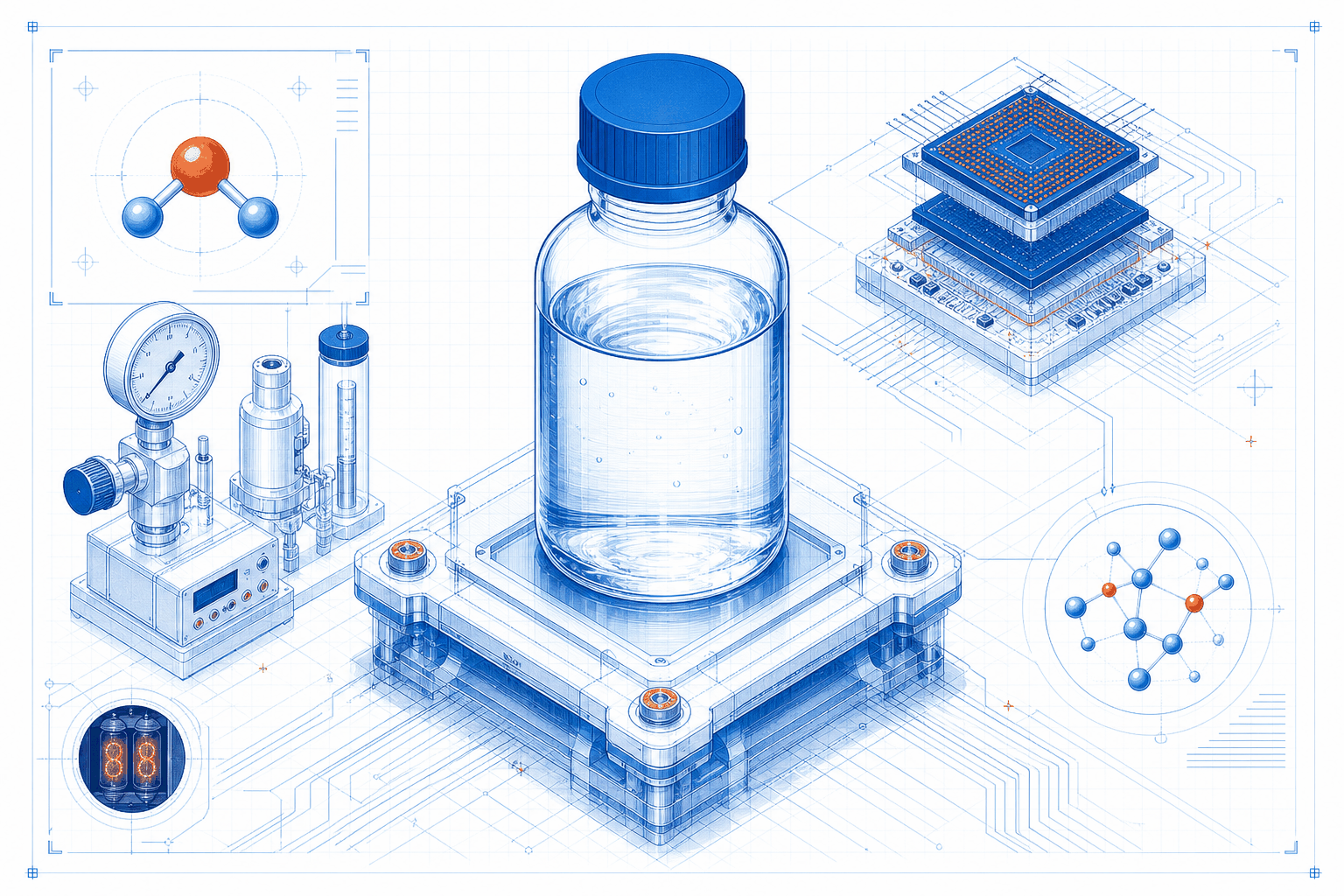
A 5-milliliter ampoule of water carries an official price tag of $159. Scaled up to a gallon (approx. 3.78 liters), that works out to about $120,000—or nearly $1,000 for a single 30 ml mouthful. The seller isn’t a luxury brand: the specifications were established by the International Atomic Energy Agency (IAEA), and the bottles are distributed by a US Geological Survey (USGS) laboratory.
This water is known as VSMOW, short for “Vienna Standard Mean Ocean Water.” Defined in 1966, it remains the single most “official” water on the planet. Its purpose isn’t consumption; it serves as a master benchmark for scientific instruments.
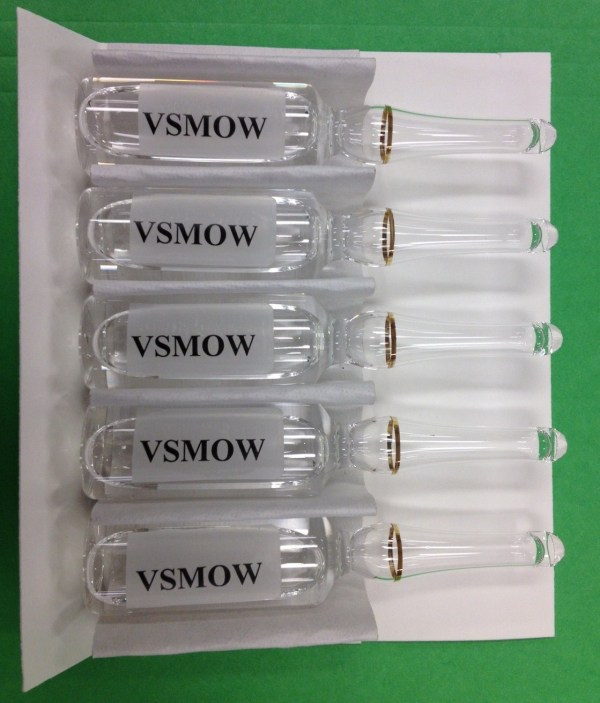 Photo: A sample of VSMOW standard water. Source: signoregalilei.com
At roughly $32 per milliliter, it is hundreds of thousands of times more expensive than everyday bottled water. At such astronomical pricing, one naturally wonders: what makes it so special? The answer begins at the molecular level.
First: What Makes Water Different from Water?
The familiar molecule H₂O is not uniform across nature. Hydrogen comes in three isotopes: common protium, deuterium (with one neutron), and radioactive tritium (with two neutrons and a half-life of ~12 years, produced naturally only in trace amounts by cosmic rays). Oxygen also exists in three isotopes: oxygen-16, oxygen-17, and oxygen-18. Differences in neutron counts mean variations in atomic weight and subtle differences in chemical behavior.
In natural water, roughly one in every 10,000 hydrogen atoms is deuterium, one in 500 oxygen atoms is oxygen-18, and one in 3,000 is oxygen-17. Though these proportions are small, water composed of heavier isotopes is denser and freezes at higher temperatures—pure heavy water freezes at around 4 °C. Even the tiny concentration of heavy isotopes in natural water elevates its freezing point by approximately 0.001 °C.
While humans cannot feel a 0.001 °C difference, precision thermometers can. And when an instrument can detect it, scientists must specify exactly which water they are measuring against. This is precisely why standard reference water exists.
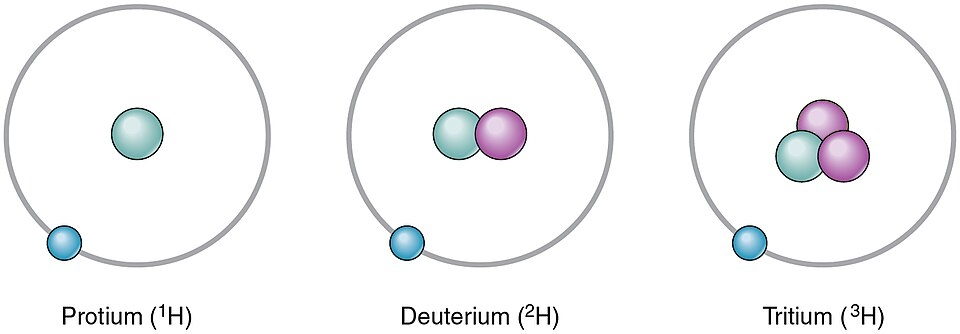 Figure: The three isotopes of hydrogen: protium, deuterium, and tritium. Source: OpenStax / signoregalilei.com
The Problem: No Two Water Sources on Earth Are Identical
Heavier isotopes evaporate more slowly. Consequently, rainwater is “lighter” than seawater, and polar ice is lighter still. Distillation removes salts and impurities, but it cannot alter isotopic ratios. As a result, the phrase “pure water” is insufficiently precise for high-precision measurement.
In 1961, Harmon Craig of the Scripps Institution of Oceanography proposed using the average isotopic composition of global ocean water as a baseline, naming it SMOW (Standard Mean Ocean Water). However, researchers at Caltech subsequently created their own reference sample using New York State sandstone. With two competing standards, isotope measurements across different laboratories could not be reliably compared.
In 1966, the IAEA met in Vienna and officially settled the matter: adopting Craig’s specification, a batch of physical reference water was distilled from Pacific Ocean water to serve as the international standard. Named VSMOW after the host city, the meeting also defined SLAP (Standard Light Antarctic Precipitation), derived from Antarctic snowmelt to represent lighter precipitation. Since then, global isotope data has been reported relative to VSMOW.
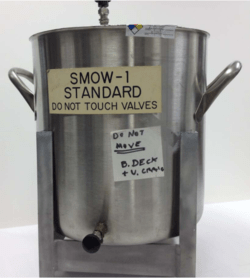 Photo: The original VSMOW container preserved to this day. Source: signoregalilei.com
This system has operated for over half a century. Today, remaining stocks of VSMOW are managed by the IAEA, and subsequent batches (such as VSMOW2) are cross-calibrated by leading laboratories worldwide to maintain strict continuity with the original 1966 standard. The power of a reference standard lies in its immutability: measurements made decades ago remain directly comparable today.
Why Buy It? Calibrating Precision Instruments
Isotopic ratios cannot be calculated purely from first principles; they must be measured empirically against a known benchmark. Instruments drift over time and reagent batches vary, so laboratories must regularly measure a sample with known values to calibrate their equipment.
Why not make it yourself? Absolute isotopic ratios are notoriously difficult to measure accurately from scratch. Rather than having each lab devise its own baseline, it is far more effective for the scientific community to share a single reference standard. A single calibration consumes only a few microliters, meaning a 5 ml vial provides over a thousand measurements—making the per-test cost quite modest. What labs are paying for is the authority of the standard itself.
Data from labs calibrated against the same standard can be directly compared. This underpins numerous real-world applications: tracking plant water uptake, measuring human basal metabolic rates, and reconstructing ancient climates from polar ice cores.
Thermometry relies on it as well. The most precise temperature measurements use triple point cells, where ice, liquid water, and water vapor coexist in equilibrium at exactly 0.01 °C with uncertainties of mere microkelvins. Because the triple point temperature is sensitive to isotopic composition, VSMOW serves as the defining reference. Before 2019, the kelvin was explicitly defined using VSMOW; even after the SI redefinition, it remains the gold standard for practical high-precision temperature calibration.
Why So Expensive? You’re Buying Answers, Not Water
Returning to the price tag: $120,000 a gallon sounds absurd, but the cost isn’t in producing the water—it’s in the certification. Creating VSMOW requires selecting specific water sources, executing multi-stage distillations, and coordinating inter-laboratory testing across elite metrology institutions to quantify isotopic ratios to numerous decimal places with rigorous uncertainty budgets. Amortizing these R&D, certification, and storage costs over a limited supply of 5 ml ampoules yields a high unit price.
This isn’t commercial markup. Managed by international organizations, the $159 price tag covers packaging, certification, distribution, and decades of ongoing maintenance and verification. As noted in HN discussions, maintaining absolute stability over decades is inherently expensive.
An apt analogy from NIST (the US National Institute of Standards and Technology) is their Standard Reference Peanut Butter, sold at $2.44 per gram. The peanut butter itself isn’t rare; what is valuable is the accompanying certificate detailing exact nutritional and elemental breakdowns. As science communicator Veritasium put it: you aren’t paying for peanut butter; you’re paying for the knowledge of what is inside the jar. Similarly, $159 buys the certified truth printed on the vial label.
NIST also sells standard water samples like SRM 1640a—a 250 ml sample certified for 29 trace elements to calibrate water quality testing tools. Drinking water emphasizes purity; standard water emphasizes precision to several decimal places.
Could a lab simply mix its own water based on the certified ratios? In practice, no. Separating oxygen-16 from oxygen-18 is an industrial process of extreme complexity, making commercially enriched heavy isotopes prohibitively expensive. Any slight discrepancy in a synthetic mix would skew the entire measurement chain. The value of a standard is universal consensus.
Why Metrology Needs a “Golden Standard”
Metrology relies on simple fundamentals. Just as rulers and weights require primary standards, so do analytical instruments. Without a common baseline, if Lab A reports 1.0 and Lab B reports 1.1, there is no objective way to resolve the discrepancy. Reference materials align laboratories globally to the exact same ruler.
This framework directly impacts everyday life. Water treatment facilities testing tap water, environmental agencies monitoring river pollutants, and customs inspecting food imports all depend on instruments calibrated with standard reference materials. The cost of a $120,000-a-gallon official water is ultimately fractionalized across millions of routine safety checks.
Consider the analogy of a tuning fork. When an orchestra tunes before a performance, the concertmaster strikes a tuning fork to emit a reference ‘A’ (440 Hz), and every instrument aligns to it. VSMOW is the tuning fork of the physical measurement world—a single vial anchoring thousands of instruments. Its purpose is not profitability, but providing a shared origin point for scientific truth.
This official water will not decrease in price, nor does it need to. Its worth lies not in volume, but in trust. As long as humanity measures the world, science will always need a reference sample to remember what the standard truly looks like.
Next time you open a bottle of mineral water, consider the contrast: drinking water is about taste and origin, while laboratory water is about the ninth decimal place. Both are H₂O, but they belong to entirely different realms.
References:
- Signore Galilei: The Most Official Water
- HN Discussion (item?id=49124042)