450 million EU residents will soon face a new reality when verifying their age online: their smartphones must use secure hardware chips for self-attestation. This is a strict technical requirement of the EU age verification project—project maintainers have publicly confirmed that hardware-bound attestation is an architectural mandate that cannot be removed. Proponents argue this is vastly superior to uploading ID photos to third-party websites; critics counter that issuing an unchangeable identity certificate to every device marks the beginning of hardware fingerprinting and mass surveillance.
 Figure: Concept art for the EU Digital Identity project. Source: linuxiac.com
Why Age Verification Is Coming to the Web
The background is a growing global anxiety over what minors consume online: adult content, algorithm-driven social media feeds, and pay-to-win gaming mechanics are increasingly viewed as harmful to children. While the UK has already legislated age checks for adult sites, the EU is going much further. The eIDAS 2.0 regulation (EU Digital Identity Framework), which took effect in 2024, embedded age verification directly into the European digital identity architecture. In April 2026, the European Commission formally issued recommendations urging all 27 member states to deploy a unified age verification mechanism by the end of 2026. Built upon the European Digital Identity Wallet, this architecture will cover approximately 450 million residents.
What does 450 million mean in practice? Reaching almost the entire population of the European Union means that any architectural flaw will be magnified to national scale. More practically, Apple and Google—the two mobile OS gatekeepers—will for the first time be officially integrated into the most sensitive tier of identity verification.
 Figure: Flag of Europe (photographed in Kyiv, Ukraine). Source: Wikipedia
Current Verification Methods Are a Privacy Nightmare
Today, age verification on most websites requires uploading photos of a passport or national ID, or performing live selfie-based facial recognition. The fallout is immediate: government identity documents end up stored indefinitely on servers owned by obscure third parties, vulnerable to breaches with zero recourse or revocation mechanisms. It is the digital equivalent of leaving your physical passport at a bar’s front counter every time you step inside—hoping the bouncer simply glances at it and hands it back.
The EU’s new framework aims to solve this fundamental problem: proving the fact of being an adult without transmitting identity credentials. Users install an official mobile application, where age verification credentials reside inside the device’s dedicated security chip. When a website requests verification, the hardware chip cryptographically asserts “this device belongs to an adult”—without ever exposing the user’s name, birthdate, or national registration number. In theory, it sounds remarkably clean.
How “Secure Chip Self-Attestation” Works
To understand the architecture, one must examine how mobile security chips operate. Whenever you unlock a phone using Face ID or fingerprint recognition, biometric data remains isolated inside a dedicated hardware enclave (Secure Enclave on iOS, StrongBox/TEE on Android) that even the operating system and manufacturer cannot read. Under the EU proposal, this chip serves as an automated “age verifier”: cryptographic keys tied to adult credentials are burned into the hardware enclave, making them uncopyable and tamper-proof.
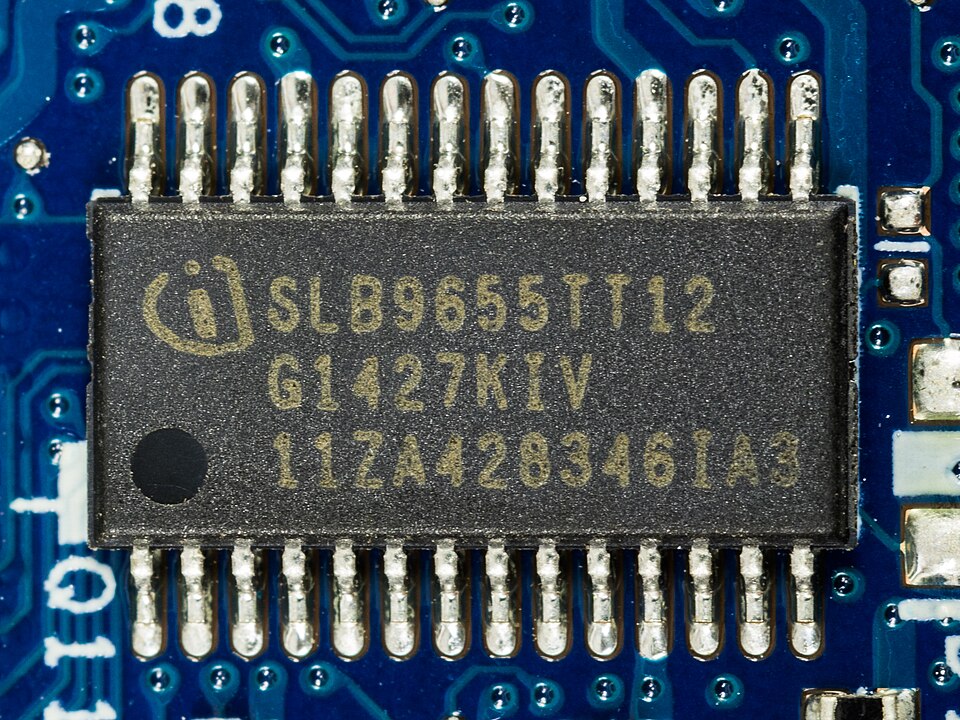 Figure: TPM security chip on a motherboard (Infineon SLB9655TT12). Source: Wikipedia
Technically, this pairs with Zero-Knowledge Proofs (ZKP)—a cryptographic primitive that allows one party to prove “I know the vault combination” without revealing the combination itself. Applied to age verification, it proves to a web service that “I am over 18” without revealing birthdate, full name, or ID details. Designers claim this dual approach deters minors while preserving adult privacy.
High Ideals, Fractured Reality
The core controversy centers on “hardware-bound.” To prevent credential cloning, every smartphone security chip contains an immutable factory-provisioned certificate—essentially a permanent hardware serial number for the device. The central debate is whether this hardware certificate can be tracked and logged across websites, by tech giants Apple and Google, or by issuing government authorities.
Technical discussions in the developer community have highlighted concrete risks. Developers point out that the current implementation draft does not obscure device identity using zero-knowledge cryptography; hardware certificates are exposed directly during attestation. As intermediary verification providers, Apple and Google could theoretically log which hardware certificate verified which site. Combined with web server logs, this enables cross-site tracking across every domain visited by a specific physical device—and potentially links that device back to the original purchaser. Compounding the issue, VPNs offer zero protection against hardware attestation, as changing IP addresses cannot alter the hardware-bound certificate burned into the silicon.
Another issue is platform exclusion. Hardware attestation dictates that only “blessed” devices and operating systems can complete verification. Custom Android ROMs, desktop Linux systems, and older refurbished hardware risk total lockout. While the specification does not explicitly ban Linux, desktop Linux users would be forced to scan a QR code using an approved smartphone—a reality summarized by open-source commentators: “It doesn’t ban Linux; it just mandates that if you use Linux, you must buy an approved smartphone.” Furthermore, with the European Commission managing a list of compliant applications, community-compiled open-source builds may be locked out of authenticating against official servers.
The Counterarguments: Why Proponents Support It
Focusing solely on criticism overlooks the rationale of supporters. First, physical society already operates this way: minors cannot enter casinos or purchase alcohol without showing physical ID, and few view this standard check as mass surveillance. Second, without hardware binding, minors could easily copy an older sibling’s “adult credential” onto their own phone, rendering the entire system useless against tech-savvy teenagers. Third, European eIDAS providers operate under strict legal frameworks governing data retention, logging, and auditability—offering far stronger protections than uploading identity documents to unvetted commercial servers.
Crucially, proponents emphasize that this initial app is a temporary stopgap. The EU’s ultimate vision—the fully realized European Digital Identity Wallet scheduled for 2027–2028—targets complete unlinkability. Under that future specification, every verification exchange will utilize single-use zero-knowledge tokens, preventing websites, governments, or identity providers from correlating separate sessions. However, executing those advanced cryptographic proofs exceeds the compute capabilities of current Secure Enclave, StrongBox, and government issuing infrastructure, necessitating the hardware-bound bridge model in the interim.
Critics respond to this timeline with skepticism: “Nothing is as permanent as a temporary government program.” They argue that requiring an approved device running an approved operating system just to access the internet establishes a dangerous precedent.
No Bystanders in This Debate
Both sides share a common goal: protecting minors online. The disagreement lies in who pays the privacy cost, and for how long. For average users, short-term routines will remain unchanged: phones and websites will function as usual. Yet once hardware-bound device certificates become normalized, restoring online anonymity will become exponentially harder. For the next two years, linking adult status to device identity remains an unavoidable reality—and two years is more than enough time to solidify habits, build registry lists, and reshape industry norms.
Technology itself remains neutral: zero-knowledge techniques can decouple age proof from device tracking. Yet the EU’s deployment timeline prioritizes hardware identification first, promising anonymous attestation later. What this choice means for 450 million people will become clear in the coming years.
Reference Links:
- Linuxiac: EU Age Verification Project Mandates Hardware-Bound Attestation
- Hacker News Discussion (item?id=49148128, 103 points / 59 comments)
- European Commission Recommendation: Recommendation on a common European framework for age verification (2026/1035)
- eIDAS 2.0: EU Digital Identity Framework Regulation (Regulation (EU) 2024/1183)
- Wikipedia: Trusted Platform Module, Flag of Europe (image sources)