Inside the eBay Harassment Scandal: A $56 Million Settlement for a Campaign of Terror
Outraged by a critical news report, the executive leadership team of global e-commerce giant eBay orchestrated a months-long campaign of systematic harassment. Their tactics included mailing live maggots, a bloodied pig mask, and books on coping with spousal loss, as well as sending operatives across state lines for physical surveillance and knocking on the victims’ front door at 4:30 AM. On July 28, 2026, the saga finally reached a legal conclusion with a $56 million civil settlement. A long-form retrospective by the Financial Times brought the infamous executive quote—“Crush this lady”—back into the public spotlight. On Hacker News, the story surged to 150 points and 66 comments overnight, filled with reactions of utter disbelief that such a story could be real.
A Two-Person Newsletter That Rattled a Corporate Giant
The central figures in this ordeal are an American couple, Ina and David Steiner. In 1999, they founded EcommerceBytes—an insider trade publication for online sellers that reported on changing platform rules, fee increases, seller strategies, and unsparing critiques of marketplace policies. Operating out of their home without additional staff for over two decades, the newsletter drew roughly 600,000 visits per month and became essential reading for merchants reliant on eBay. Unbeknownst to the Steiners, top executives at eBay were also avid readers.
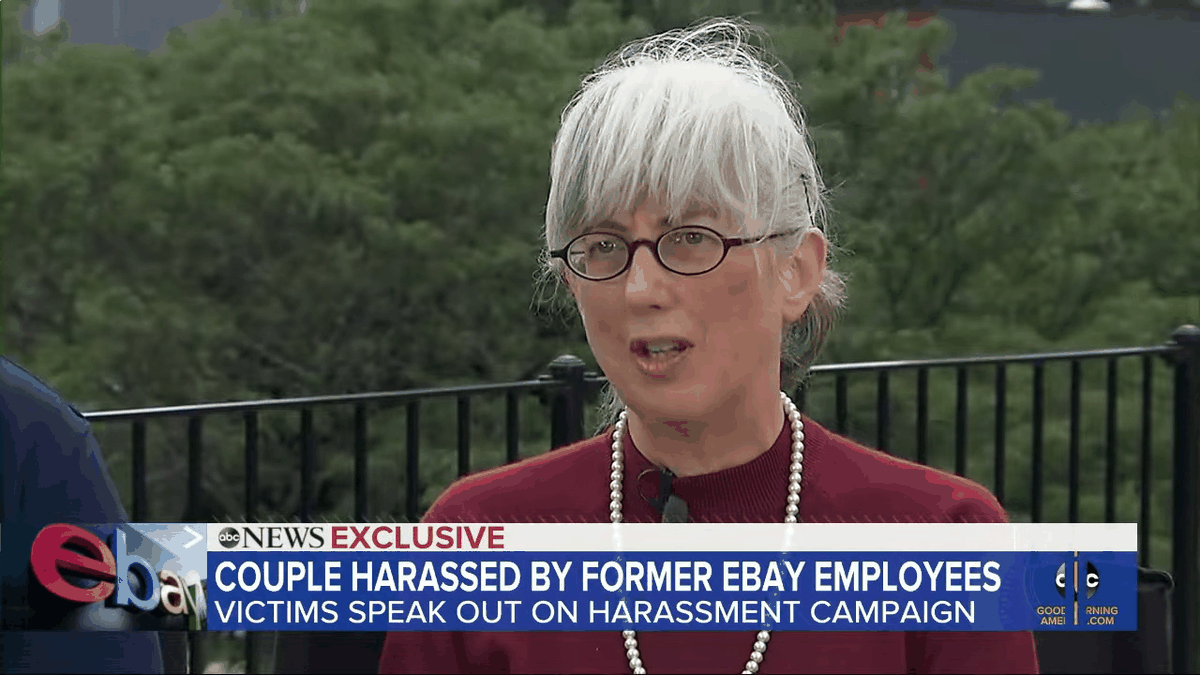 Figure: Ina Steiner speaking on Good Morning America about her ordeal in the summer of 2019. Source: ABC Good Morning America
A Single Text Message: “Take Her Down”
In 2019, eBay was facing intense commercial pressure. Activist hedge fund Elliott Management had acquired a significant stake and publicly demanded board restructuring, leaving executive leadership feeling squeezed. In April of that year, Ina published an article pointing out that then-CEO Devin Wenig’s annual compensation was 152 times that of the average eBay employee. The story infuriated top leadership. Chief Communications Officer Steve Wymer texted Wenig: “We are going to crush this lady.” A month later, following another critical article, Wenig texted back: “Take her down.”
“Take her down” was taken literally. Wymer turned to Jim Baugh, eBay’s Senior Director of Safety and Security. Text messages between the two read: “I want to see ashes. At any cost.” Baugh replied: “I have orders: find and destroy.” What followed was a criminal operation funded and deployed using corporate security assets.
That Summer: Live Maggots, Blood Masks, and Funeral Wreaths
What transpired next reads like a horror film disguised as a series of bizarre pranks:
- One morning in June, David discovered the letters “Fidomaster”—the handle of a notoriously sharp-tongued commenter on their site—spray-painted in black on his freshly painted white fence. The perpetrators intended to frame a online commenter for the vandalism.
- Beginning in August, terrifying deliveries arrived at their doorstep: a box of live maggots and spiders, a preserved pig fetus in formalin, a bloodied pig mask modeled after the horror movie Saw, a funeral wreath, and a book titled Surviving Loss of a Spouse—an unmistakable death threat to a middle-aged married couple.
- Operatives subscribed the couple to over 50 unwanted subscriptions, ranging from irritable bowel syndrome newsletters to the Church of Satan and explicit adult magazines. Adult publications addressed to David were deliberately sent to neighbors’ houses to humiliate them in their community.
- Unrequested takeout pizzas were ordered for 4:30 AM delivery, prompting strangers to knock on their door in the dead of night.
- Classifed ads were placed on Craigslist inviting strangers to their home for explicit sex parties.
- The couple was subjected to physical stalking whenever they left home by operatives driving rental vehicles—a black van with New York plates and a silver SUV—who stayed at a nearby Ritz-Carlton hotel. Operatives even planned to break into their garage to install a GPS tracking device on their vehicle.
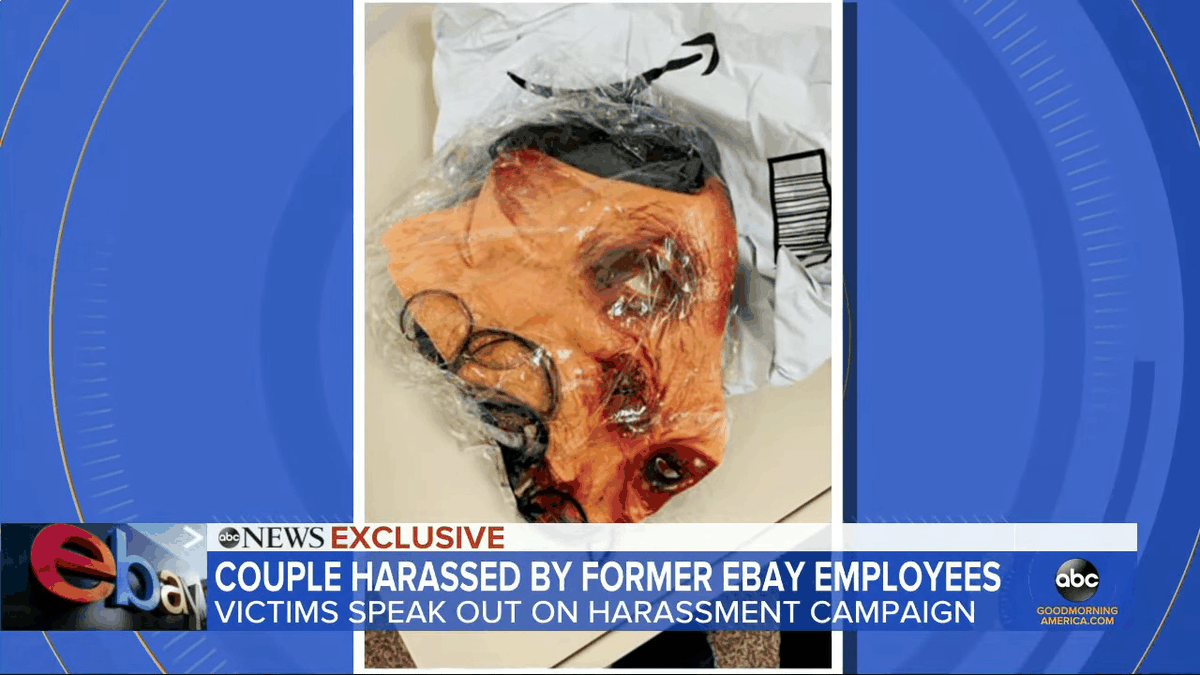 Figure: Key evidence in the case—a bloodied pig mask inspired by the movie Saw, sent to the Steiner home. Source: ABC Good Morning America
Terrified, Ina and David stopped going out for groceries, slept in separate rooms, stacked pots and pans against doors as makeshift noise alarms, and kept baseball bats and golf clubs by their beds. David suffered panic attacks and collapsed twice while attempting to follow suspicious vehicles or contact police. As Ina later reflected in a television interview: “I thought they were going to crush us.”
Caught by the Victims Themselves
Local police initially struggled to make progress. Ultimately, it was the Steiners themselves who broke the case open. A friend jumped out of a vehicle to photograph the license plate of a tailing car, and David lured the silver SUV directly past the local police station to capture its full registration number. Rental records traced back to Veronica Zea, a contractor working as an intelligence analyst for eBay. Pulling that thread enabled the FBI to uncover the entire conspiracy.
The hierarchy extended from the CEO down through communications executives to eBay’s internal security team: Director Jim Baugh (who claimed CIA background), former police officers Philip Cooke and Brian Gilbert, intelligence managers Stephanie Popp and Stephanie Stockwell, and contractor Veronica Zea. Leveraging police backgrounds, team members attempted counter-surveillance tactics while flying from California to Boston. Baugh boasted on WhatsApp: “These two are so paranoid right now, haha.” Even more insidious was their planned “White Knight” phase: after terrifying the couple, Gilbert was to step in under his official eBay capacity to “rescue” them, pretending to help uncover the anonymous harasser to unmask the true identity of “Fidomaster” and appease the CEO.
 Figure: eBay headquarters in San Jose, California. Source: Smith Collection/Gado (Getty Images)
57 Months: The Price of Corporate Malice
In September 2019, the campaign abruptly stopped after federal investigators intervened. eBay launched an internal investigation, leading to the termination of seven security employees and communications chief Wymer. CEO Devin Wenig resigned that same month, leaving with a $57 million severance package.
In June 2020, the U.S. Department of Justice indicted seven former eBay employees on charges of cyberstalking conspiracy and witness tampering. eBay as a corporate entity entered into a deferred prosecution agreement, paying a $3 million criminal penalty. All seven individual defendants pleaded guilty: ringleader Baugh was sentenced to 57 months in federal prison, David Harville received 24 months, Cooke 18 months, Popp 12 months, Gilbert served time served plus a $20,000 fine, while two lower-level analysts received one year of home confinement each. U.S. Attorney Andrew Lelling was widely quoted describing the case: “This was a determined, systematic effort by senior executives of a major corporation to destroy the lives of a couple in Natick all because they published content those executives didn’t like.”
Fifty-seven months is nearly five years. For a former high-earning executive, it represents a career-ending sentence. Yet compared to the lifelong psychological trauma inflicted on the couple—David still hesitates to open packages and both struggle to trust strangers—it hardly seems proportionate. It underscores a grim reality: the legal system’s price tag on corporate-resourced crime remains shockingly low.
The Ultimate Irony: Those Giving Orders Walked Away
The top tier of the command chain escaped criminal liability entirely. Neither Wenig nor Wymer faced criminal charges. An internal eBay investigation concluded that executive leadership “had no knowledge” that criminal acts were being committed and had merely used “inappropriate language.” In a 60 Minutes interview, the victims’ attorney noted that Wymer deleted all his text messages immediately upon receiving a litigation hold notice—remarking, “If I did that, I’d be sitting in prison right now.”
The aftermath makes for stark reading. After departing with his $57 million payout, Wenig retained his seat on General Motors’ board of directors and went on to run an AI startup. Wymer became CEO of a Silicon Valley children’s charity the very next year. Another executive involved, Wendy Jones, subsequently joined the board of Prudential Financial. On Hacker News, users mapped out these career trajectories with widespread indignation. Commenters pointed out the familiar corporate mafia dynamic: leaders speak in plausible deniability—“just take care of it”—leaving subordinates to execute the dirty work while ensuring no written paper trail connects back to the top.
$56 Million: A Victory Won at Tremendous Cost
Following the criminal proceedings, the Steiners pressed forward with a civil lawsuit against eBay and its former executives. The litigation dragged on for five years. After a temporary settlement fell through in early 2026, the case resumed in June before finally concluding on July 28, 2026: eBay and the former executives agreed to pay $56 million. Of that total, Wenig personally contributed $2 million, Jones $500,000, and Wymer $50,000—valuing that infamous “crush this lady” text message at $50,000 after five years of legal battles.
Put in perspective, $56 million is roughly equal to Wenig’s single exit package—meaning five years of terror for two victims was deemed equivalent to one CEO’s golden parachute. For a corporation of eBay’s scale, the sum is trivial. Yet it stands as a permanent public record: an official acknowledgment of the severe harm inflicted and the corporate wrongdoing behind it. Upon reaching the settlement, the Steiners declared they would continue doing what they have done for twenty-seven years: publishing their newsletter, covering e-commerce marketplaces, and reporting the truth, good or bad.
How Executive Teams Collective Slide into Crime
Reflecting on court records and investigative reports, a fundamental question emerges: How do educated, comfortable professionals collectively cross the line into criminal terror?
Several factors converge. First is the arrogance of corporate power. When under pressure from activist investors and falling stock prices, executives view external criticism as sabotage rather than journalism, framing retaliatory action as “protecting the company.” Once leaders convince themselves they are acting righteously, moral constraints evaporate. Second is the diffusion of responsibility through delegation. “Take her down” trickled from the CEO to the CCO, from the CCO to the security director, and down to former police officers, eventually taking the form of mailing live maggots. Each actor rationalized that they were merely executing orders. Third, corporate resources reduce the friction of committing crimes to zero: with former police officers, intelligence analysts, and expense accounts at hand, conducting surveillance or ordering harassment requires nothing more than a booking or a click. Fourth, nobody speaks up. When Baugh bragged about scaring the couple, no one inside the loop objected. In a corporate culture built on absolute loyalty, raising ethical concerns marks one as an outsider.
None of these elements seem catastrophic in isolation, but combined, they created a living nightmare for an ordinary couple. The individuals who executed this campaign were executives at a global tech giant—elite educated, living in luxury, earning millions. Capability and polish have never been a guarantee against malice.
What This Means for Everyday Citizens
Two key takeaways emerge from this case for ordinary people:
First, the power asymmetry between individuals and major corporations is starkly real. Two decades of independent journalism brought the Steiners a directive to “crush” them. Every critical review, consumer complaint, or legal dispute can anger someone with vastly superior corporate resources.
Second, the Steiners proved that the law remains one of the few instruments capable of holding corporations accountable. Through security cameras, recorded license plates, and five years of perseverance, they sent seven former corporate operatives to prison and secured a $56 million settlement. In 2024, their battle was featured in the documentary At Any Cost: Inside the eBay Scandal. In the film, Ina is seen right back at her desk in her home office, continuing to write.
As news of the settlement circulates in August 2026, this story serves as a reminder for anyone hesitating to publish a critical review or hold power accountable: keep writing. Someone endured a nightmare for it—and ultimately proved that accountability can be won.
References:
- FT In-Depth Review: ‘Crush this lady’: How eBay’s campaign of terror ended in a $56m settlement (Late July 2026)
- Hacker News Discussion (item 49147435, 150 points / 66 comments)
- Boston Magazine Investigation: “Take Her Down”: Inside eBay’s Stalking Campaign Against a Natick Couple (2021)
- Associated Press: eBay reaches nearly $50M settlement in corporate stalking case (July 2026)
- CBS 60 Minutes Feature (2023): The Steiners detail campaign of deliveries and stalking
- Wikipedia: eBay stalking scandal (Timeline and sentencing summary)