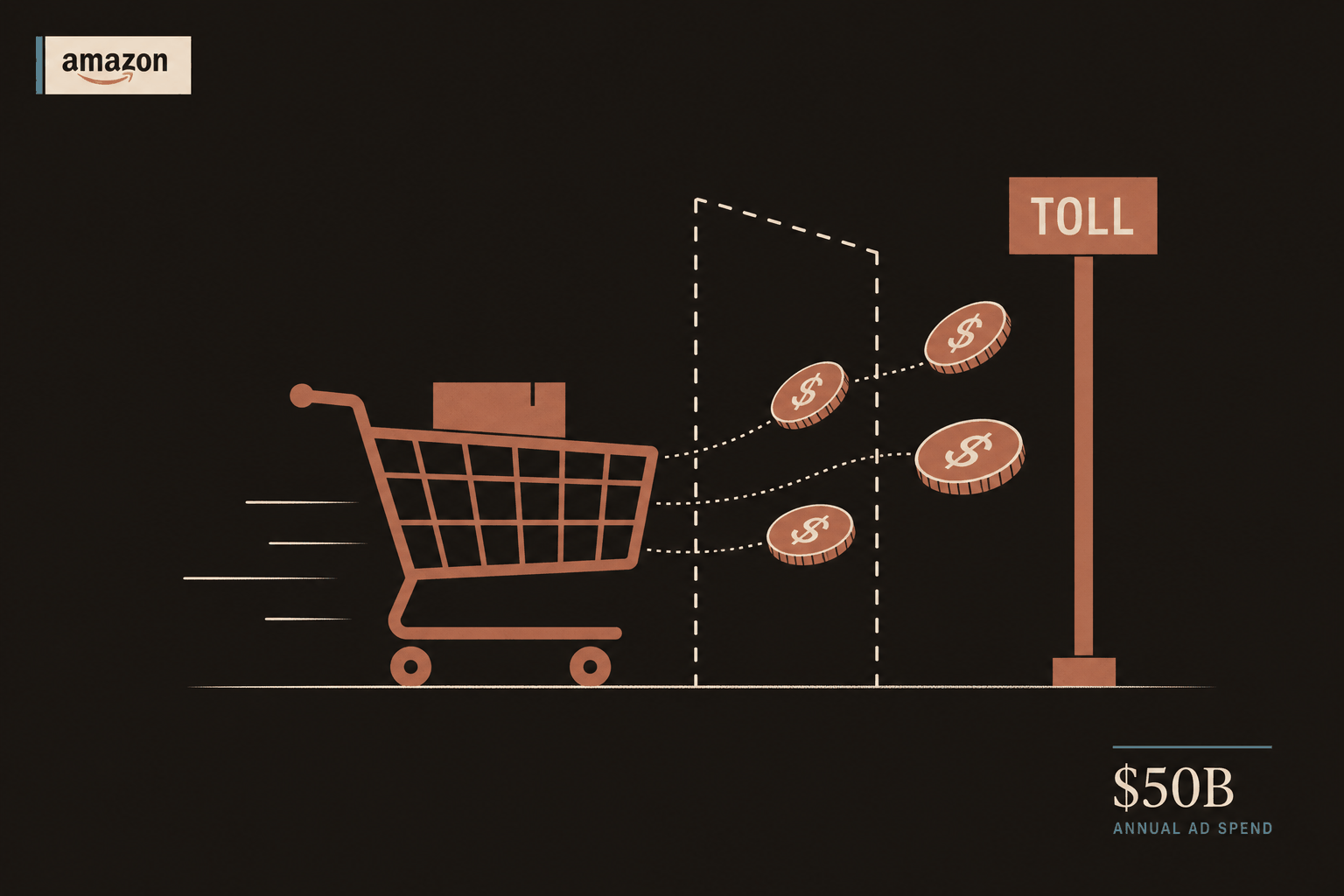
Paying $1 to Search for a Book Title
On August 18, 2026, renowned marketing thinker Seth Godin wrote a pointed critique on his blog: “This is not a tax that pays for public goods, this is legalized theft.” What triggered his outrage was Amazon cutting out nearly $1 billion every week from sponsored search advertisements.
His publisher was forced to pay Amazon $1 per ad click every time a reader searched for The Knot—a book the reader had already decided to buy. If they refused to bid on the ad, competing titles would seize the top sponsored position instead. This ad revenue, now exceeding $50 billion annually, surpasses the yearly revenues of most S&P 500 companies—enough to hand out a $35,000 cash bonus to every single Amazon employee worldwide.
Amazon’s Q2 2026 financial report revealed quarterly advertising revenues of $19.8 billion, a year-over-year surge of 26%, bringing first-half ad revenues to $37.05 billion. This demonstrates that search advertising has surpassed traditional service commissions to become the central profit engine of e-commerce platforms.
The original promise of a search engine was to help users find the best matching products. Today, however, platforms push exact organic search results down, forcing sellers to pay extra just to win back the traffic that was rightfully theirs.
A Zero-Sum Game: Search Ads Create No New Demand
From a business logic perspective, search advertising differs fundamentally from traditional brand advertising. Brand advertising aims to stimulate latent consumer interest, whereas search advertising occurs after a user has already formed a clear intent to buy.
When a customer types “air fryer” into the search bar, Amazon’s recommendation algorithms have already determined the optimal choice based on historical return rates, review scores, and price competitiveness. Inserting sponsored search ads at this moment creates no new demand for air fryers, nor does it add utility to the products themselves.
The ad merely nudges consumers toward a model that might not even offer the best value, or forces the top-rated manufacturer to pay just to preserve existing sales. Studies show that when e-commerce pages become oversaturated with sponsored ads, overall product sales actually decline.
Because search ads do not expand total transaction volume, bid-for-placement degenerates into a pure zero-sum game. Sellers are forced to hike their bids simply to remain visible on the front page, burning away huge margins in an endless bidding war.
Double Degradation: Distorted Quality and User Experience
The proliferation of search ads has far-reaching consequences for the entire e-commerce ecosystem. The most immediate impact is that brand reputation yields to click budgets, leaving high-quality sellers to shoulder elevated R&D and customer service costs.
Margins for premium brands cannot sustain soaring cost-per-click rates. By contrast, low-cost, high-markup generic goods boast ample advertising budgets, allowing them to easily dominate top-of-search placements.
 Photo: Amazon Office Building. Source: Deadline
Driven by immense ad revenues, platforms develop an incentive to continuously degrade organic search results. As organic matching becomes convoluted and obscure, buying sponsored listings becomes a seller’s sole means of survival.
Tech critic Cory Doctorow identified this pattern of platform “enshittification” three years ago, and Amazon’s ad business has since doubled in scale. Algorithms have devolved from collaborative tools that reduce buyer-seller friction into digital tollbooths erected along major transaction highways.
Who Pays for the $50 Billion Toll?
The advertising fees merchants pay to Amazon do not disappear into thin air. In the long run, sellers cannot absorb perpetually rising marketing costs; they must pass the burden on by raising retail prices or reducing product quality.
In a Hacker News thread with nearly 500 comments, the community split into two primary viewpoints. Some argued that ads serve as a market signal, suggesting that savvy consumers seeing a sponsored tag should simply seek out alternative sales channels.
Another perspective highlighted that under platform monopoly conditions, channel costs act as an invisible sales tax. Because Amazon holds a massive share of online retail, average consumers lack viable alternatives, and merchants have nowhere else to turn.
In its Q2 earnings report, Amazon’s total revenue topped $200 billion, with AWS growing 37% and advertising delivering standout high-margin performance. At its core, the debate is about rent extraction fueled by platform dominance—end consumers unknowingly bear the cost through higher retail markups.
 Photo: Amazon HQ and logo. Source: Variety
Retail Reflections Under Channel Squeeze
Transitioning from an efficient marketplace that saved consumers money to a traffic hub levying heavy tolls on sellers reflects path dependency built on massive scale. This business model pushes traffic extraction to its limits, undermining the platform’s original matching efficiency.
When bidding mechanisms shift profits away from manufacturing toward distribution channels, the entire ecosystem’s innovative vitality suffers. Sellers lose capital reserves needed for new product R&D, while buyers pay higher premiums for lower-value goods.
While the platform economy has brought unprecedented logistics and warehousing convenience, the rent-seeking nature of search ads demands objective scrutiny. Balancing channel revenue with product quality will be an unavoidable question for the future of retail.
Reference Links:
- Seth’s Blog
- HN Discussion (item?id=49345263)
- Variety
- Deadline