On August 13, 2026, Science Advances published the results of a 25-day lunar orbital radiation experiment: a 26 kg personal protective vest reduced the effective radiation dose received by astronauts by approximately 60% under simulated solar storm conditions. Led by the German Aerospace Center (DLR), the MARE experiment demonstrated that mounting radiation protection directly on the astronaut’s body is far more mass-efficient than encasing an entire spacecraft in heavy shielding.
The central challenge of deep-space exploration lies in the spacecraft’s unforgiving mass budget. On lunar missions or long-duration flights to Mars, fluxes of high-energy charged particles pose a constant threat of acute radiation syndrome. Traditional shielding relies on tons of lead, aluminum, or water tanks, which crowd out vital space needed for propellant and life-support systems. Developed by Israeli-US startup StemRad in collaboration with Lockheed Martin, the AstroRad vest breaks this deadlock with a novel engineering approach.
A 25-Day Lunar Orbit Experiment with Two Phantom Dummies
In November 2022, the Artemis I mission launched carrying two female radiotherapy dosimetric phantoms constructed from tissue-equivalent materials. Named Zohar and Helga, these human anatomical models were constructed from 38 cross-sectional slices containing 1,400 radiation dose sensors and active detectors. Throughout the 25-day lunar flight, Zohar wore the 26 kg AstroRad vest, while Helga remained unprotected as an experimental control.
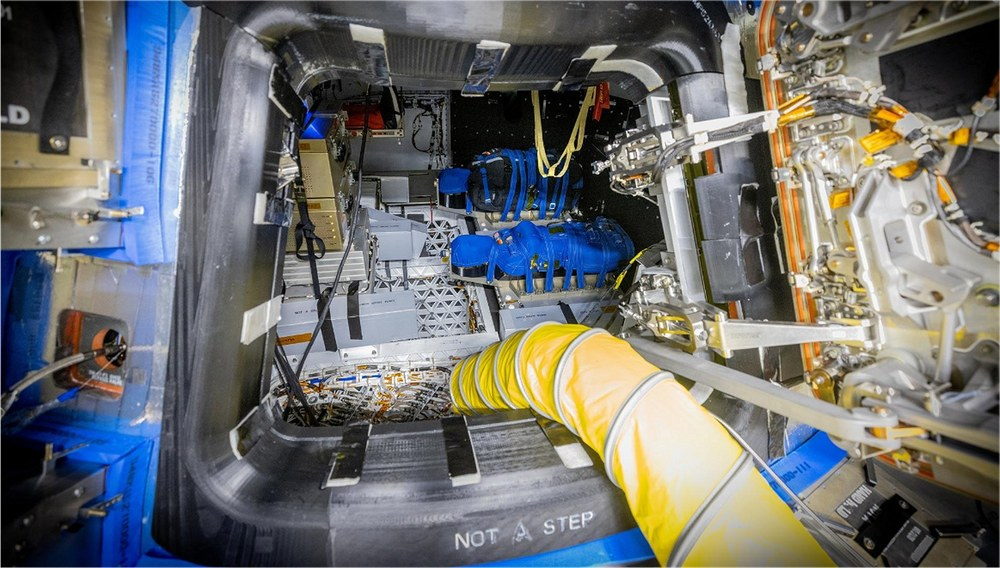 Figure: Helga and Zohar inside the Orion cabin (Zohar wearing the AstroRad vest). Source: DLR, CC BY-NC-ND 3.0
To gather high-precision radiation data, the research team utilized the intense proton fluxes encountered as Artemis I traversed Earth’s inner Van Allen radiation belt as a proxy environment. Because the proton energy spectrum in this region closely overlaps with typical Solar Particle Events (SPE), the sensors captured invaluable absorption data. The deviation between empirical flight data and Monte Carlo particle transport simulations remained below 5%, validating the engineering accuracy of organ-level radiation dose prediction models in deep space.
Protecting 50% of Bone Marrow to Achieve a 60% Dose Reduction
AstroRad’s core breakthrough stems from applying medical logic to traditional mechanical engineering. Co-founders Jordan Houri and Oren Milstein drew on nuclear emergency response experience regarding bone marrow protection: roughly half of the body’s blood-forming hematopoietic stem cells are concentrated in the hip and pelvic regions. By shielding this critical stem cell reservoir, the body can sustain blood cell production and gradually self-repair after radiation exposure.
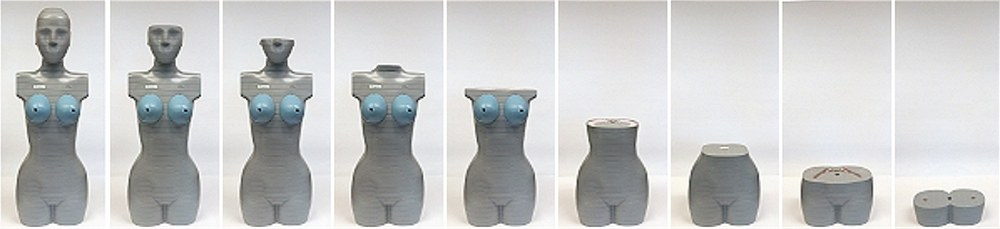 Figure: Human phantom structural diagram (38 cross-sectional slices, tissue-equivalent materials). Source: DLR, CC BY-NC-ND 3.0
Rather than acting as a fully enclosing heavy suit of armor, the vest selectively shields radiation-sensitive organs, including the hips, reproductive organs, stomach, colon, and breasts. The vest’s interior is filled with thousands of hexagonal rods whose lengths were precisely computed using the Bethe-Bloch energy loss formula, made of High-Density Polyethylene (HDPE)—a polymer rich in hydrogen atoms. Compared to liquid water tanks, this solid material carries no risk of leakage, while a honeycomb fabric structure preserves ergonomics, enabling astronauts to bend and maneuver comfortably despite the 26 kg mass.
Simulated Solar Storm Tests: Working While Resisting Radiation
Since solar activity remained relatively calm during Artemis I, researchers fed the recorded proxy radiation spectra into numerical models to reconstruct two historically severe solar storms. In a simulation of the potentially fatal August 1972 solar storm, the vest reduced the effective organ dose inside the phantom from 222 millisieverts (mSv) to 87.5 mSv—a 60% reduction. In the October 1989 storm, which featured higher particle energies and greater penetration, the vest still attenuated the effective dose by 40%. This mitigation successfully suppresses lethal storm radiation levels to within the body’s natural bone marrow recovery limits.
Based on NASA’s 600 mSv career limit for astronauts, wearing the vest during a major solar storm effectively extends an astronaut’s allowable deep-space mission lifetime by 40 to 193 days. Although the Orion spacecraft features a temporary storm shelter stacked with water and supply containers, astronauts huddled inside are unable to perform maintenance tasks. The vest allows crew members to maintain equivalent radiation safety while remaining mobile to monitor instruments and operate cabin hardware.
Not a Universal Solution: The Boundaries of Selective Shielding
This technology has clear engineering boundaries. AstroRad primarily targets short-duration, high-flux Solar Particle Events (SPE), with limited effectiveness against the highly energetic Galactic Cosmic Rays (GCR) that permeate deep space. Because GCR consists of high-energy heavy ions, a 26 kg polymer vest cannot stop their penetration; excessively increasing vest thickness could even exacerbate radiation damage through secondary particle spallation.
Historically, the severe solar storm of August 1972 occurred between the Apollo 16 and Apollo 17 missions—had astronauts been on the lunar surface at that time, the consequences would have been catastrophic. AstroRad is designed as a dynamic, supplementary layer in deep-space defense, operating in tandem with spacecraft storm shelters. This paradigm shift demonstrates that deep-space engineering is moving away from brute-force hull thickness toward intelligent, organ-level mass allocation.
A Wearable Radiation Defense Architecture
The Artemis I lunar data confirms that the center of gravity in deep-space radiation protection is shifting. Given the strict rule where every gram of launch mass translates into cost, building thick metal hulls is fundamentally unsustainable.
Transitioning from building heavier spacecraft hulls to equipping crew members with smarter radiation-shielding apparel, AstroRad illustrates the power of asymmetric protection. By shrinking the security perimeter from geometric spacecraft hulls down to anatomical vital organs, deep-space missions can preserve payload capacity for propulsion and scientific instruments without compromising crew safety. On future long-duration journeys to Mars, this 26 kg vest will serve as a reliable personal defense line through solar storms.
Reference Links:
- Ars Technica Report
- DLR MARE Project Official Overview
- Science Advances Paper
- Hacker News Community Discussion (item?id=49297150)